
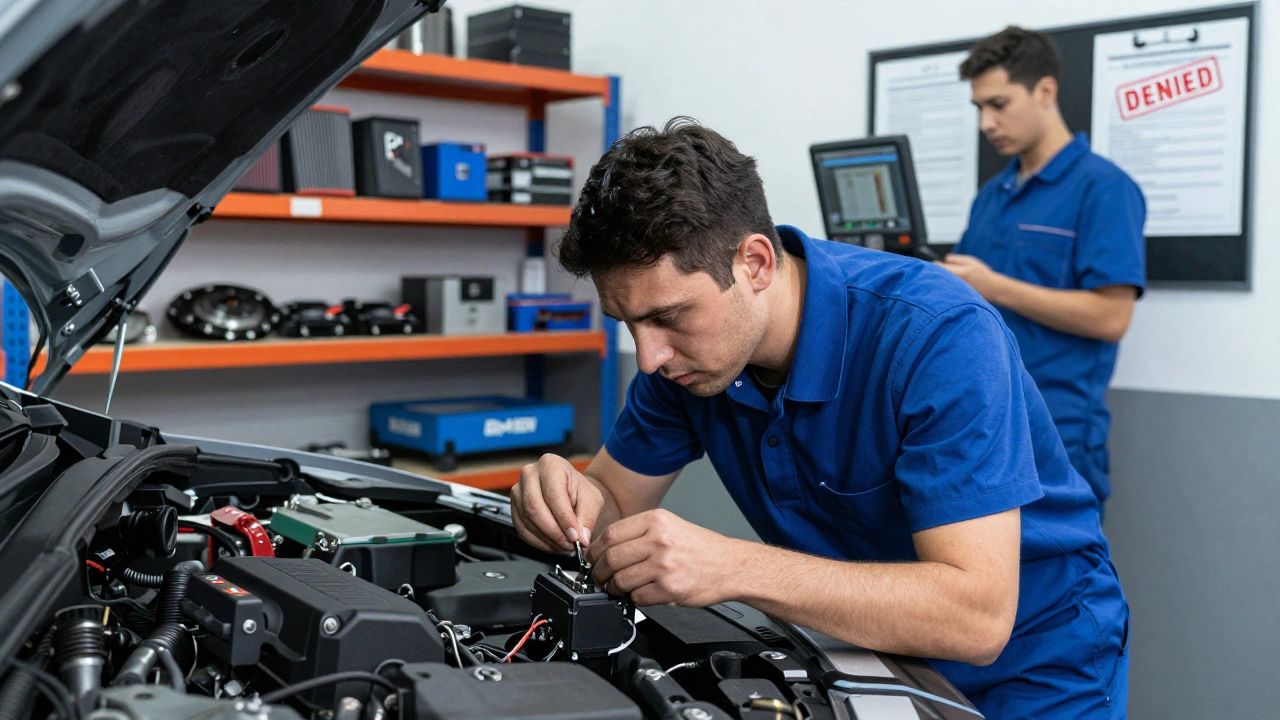
Putting aftermarket parts on your car doesn’t automatically kill your warranty-but it can. Too many drivers assume that installing a cold air intake, upgraded brakes, or a performance chip will void everything. That’s not true. But it’s also not a free pass. The truth is messy, and manufacturers love to scare people into staying with stock parts. Here’s what actually happens when you modify your car, and how to protect yourself.
What Does a Car Warranty Actually Cover?
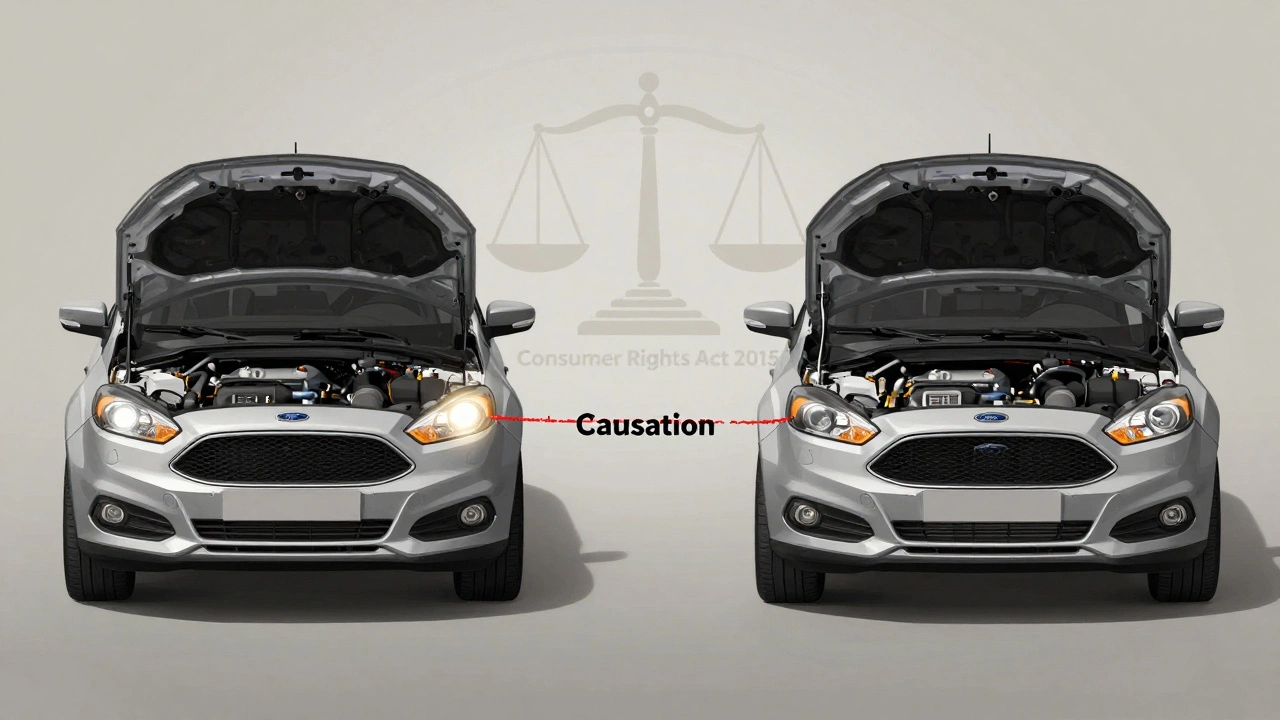
Most new cars in the UK come with a manufacturer’s warranty that lasts between 3 and 5 years. This covers defects in materials or workmanship. If your engine fails because of a faulty piston, they fix it. If your infotainment screen goes black due to a bad circuit board, they replace it. But if you drop your car off after installing a non-OEM turbocharger and the engine blows, they’ll likely say it’s not covered. The key is causation. The warranty doesn’t cover damage caused by modifications, but it still covers unrelated issues. If your airbag sensor fails after you put in aftermarket wheels, and the wheels had nothing to do with the sensor’s wiring, they still have to fix it. That’s the law.The Magnuson-Moss Warranty Act (UK Equivalent)
In the US, the Magnuson-Moss Warranty Act protects consumers by saying manufacturers can’t void your entire warranty just because you used an aftermarket part. The UK doesn’t have an exact copy, but the Consumer Rights Act 2015 gives you similar protection. A dealer or manufacturer must prove that the aftermarket part directly caused the failure before they can deny a claim. That means they can’t just say: “You changed the exhaust, so we’re not fixing your transmission.” They need to show a clear link. If they can’t, you’re still covered. Many people don’t know this, so dealers get away with blanket denials. Don’t accept it without proof.Which Aftermarket Parts Are Most Likely to Cause Problems?
Not all modifications are equal. Some are low risk. Others are red flags.- High-risk parts: Engine tuning modules, forced induction kits (turbo/supercharger), internal engine upgrades (pistons, rods), and transmission modifications. These change how the car operates under load and can stress components the warranty was never designed for.
- Moderate-risk parts: Performance exhausts, upgraded suspension, aftermarket brakes. These rarely cause engine or drivetrain failures, but if they lead to alignment issues or increased vibration, they might be blamed for premature wear.
- Low-risk parts: Air filters, cabin air filters, LED headlights, floor mats, wheel spacers (if within legal limits), and non-performance body kits. These are unlikely to affect mechanical systems.
What About Warranty Extensions and Third-Party Policies?
If you bought an extended warranty from a third party-like Warranty Direct, Protect My Car, or a dealer-backed plan-the rules change. These policies often have stricter terms. Many explicitly ban any non-OEM parts, even if they’re harmless. Read the fine print. Look for phrases like:- “All components must remain in original factory specification.”
- “Use of non-approved parts voids coverage.”
How to Install Aftermarket Parts Without Risking Your Warranty
You don’t have to live with stock parts to protect your warranty. Here’s how to do it smartly.- Keep receipts and installation records. If you ever need to prove a part was installed correctly, documentation helps. Even a photo of the receipt and the installer’s name matters.
- Use reputable brands. Brands like Eibach, Brembo, K&N, and APR are widely recognized. They often test their parts for compatibility and even offer their own limited warranties.
- Don’t tamper with the ECU. Flashing the engine control unit is the fastest way to trigger a denial. If you want power gains, look for plug-and-play tuning boxes that don’t rewrite the factory software.
- Remove modifications before warranty service. If you’re taking your car in for a known issue, take out the aftermarket parts temporarily. Install the originals. This removes any excuse for denial. You can reinstall them after the repair.
- Use certified installers. Many aftermarket brands have certified fitting centres. If a shop is listed by the manufacturer as an approved installer, that’s a strong shield against warranty claims.
Real-World Example: A Driver’s Warranty Battle
In 2023, a Ford Focus owner in Manchester installed a K&N air filter and a cat-back exhaust. After 28 months, the timing chain tensioner failed. The dealer refused to cover it, saying the aftermarket parts caused “unbalanced airflow” and increased engine stress. The owner pushed back. They provided:- Receipts showing the parts were from K&N (a Ford-approved supplier for some models)
- Installation records from a local garage with a 10-year track record
- A report from an independent mechanic stating the tensioner failure was due to normal wear and oil contamination, not airflow changes
What to Do If Your Warranty Is Wrongly Denied
If you’re told your warranty is voided and you believe it’s unfair:- Ask for the specific reason and technical evidence linking your part to the failure.
- Request a written denial letter. Verbal refusals don’t count.
- File a complaint with the Financial Ombudsman Service (FOS) if the dealer is a member of the Motor Ombudsman.
- Check if the part has its own warranty. Some aftermarket brands will cover damage caused by their own products.
When It’s Worth the Risk
Some drivers accept the risk because the benefit outweighs the cost. A modified Golf GTI might lose its warranty, but the owner saves £1,500 on a remap versus a dealer tune. A Land Rover Defender owner installs heavy-duty shocks to handle off-road trails. The warranty might not cover the suspension, but they’re not driving on tarmac anyway. If your car is out of warranty, or you’re planning to sell it soon, aftermarket upgrades make sense. If you’re still under factory coverage and rely on the car for daily commuting, tread carefully.Bottom Line
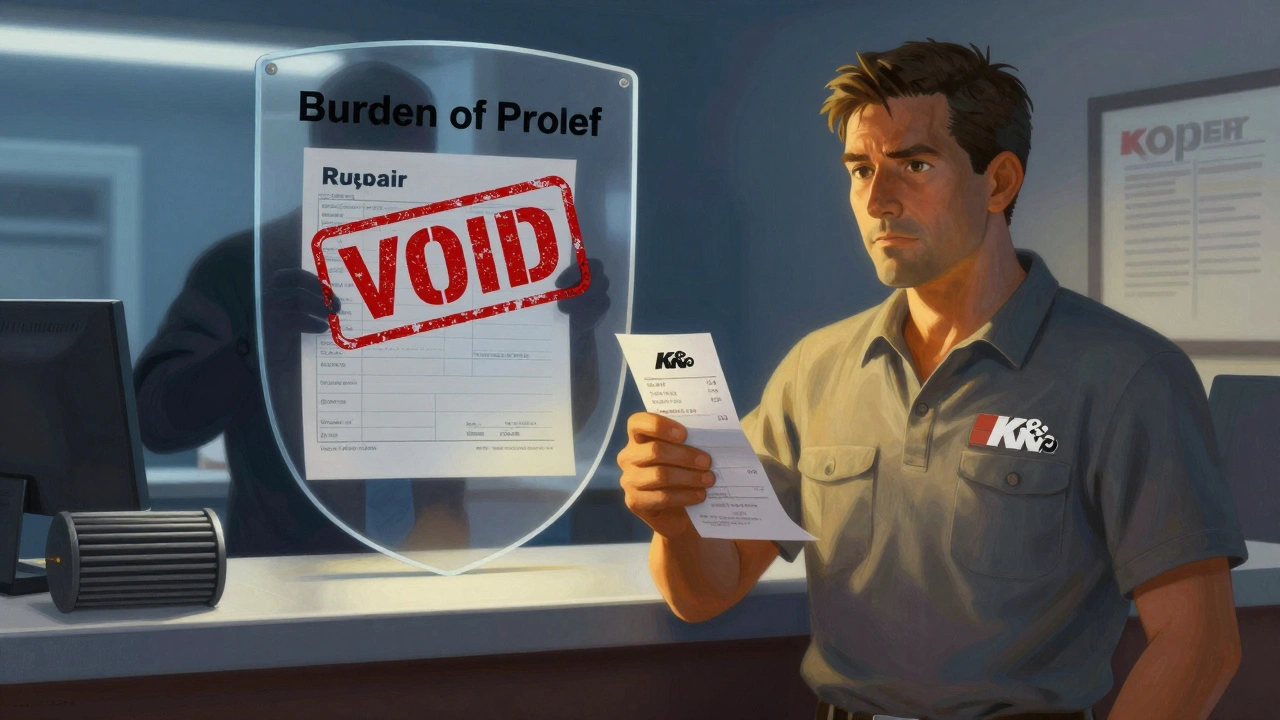
Aftermarket parts don’t automatically void your warranty. But they can trigger a denial if they’re linked to a failure. The burden of proof is on the dealer, not you. Keep records. Use trusted brands. Avoid ECU flashes. And if they say no, ask them to prove it.Your car is your property. You have rights. Don’t let fear or misinformation stop you from making improvements-just make them smart ones.
Does installing an aftermarket air filter void my car warranty?
No, installing a standard aftermarket air filter like a K&N or BMC does not void your car warranty. These parts are designed to be direct replacements and rarely affect engine performance in a way that causes damage. Manufacturers must prove the filter directly caused a failure to deny a claim, which is nearly impossible in most cases.
Can I install aftermarket wheels without losing warranty coverage?
Yes, as long as the wheels are the correct size, offset, and load rating for your vehicle. If you install wheels that are too wide or too light, and they cause damage to suspension components or wheel bearings, the dealer can deny coverage for those specific parts. But unrelated issues-like a faulty radio or brake light-still must be covered.
Will a performance chip void my entire warranty?
It can. Performance chips that reprogram the engine control unit (ECU) change how the engine runs, often increasing pressure and heat. If your engine fails after installing one, the manufacturer will almost certainly deny coverage. Even if the chip didn’t cause the failure, they don’t need to prove it-they just need to say it’s possible. Avoid these if your warranty is still active.
What if I buy a used car with aftermarket parts already installed?
If the car is still under factory warranty, the presence of aftermarket parts doesn’t automatically void it. But if something breaks and the dealer suspects the modification caused it, they may deny the claim. Keep any documentation about the parts and their installation. If the car was sold by a dealer, ask them if they’ve checked compatibility with the warranty.
Can I install an aftermarket exhaust and still pass an MOT?
Yes, as long as the exhaust system meets UK regulations. It must not be louder than the original, must have a functioning catalytic converter (if required), and must not emit excessive smoke. Many aftermarket exhausts are designed to be road-legal and MOT-compliant. Always check the product description for compliance notes.
Comments
TIARA SUKMA UTAMA
Just put on a K&N filter and called it a day. No issues. Warranty still intact.
December 15, 2025 at 01:15
Jasmine Oey
OMG I CANNOT BELIEVE PEOPLE STILL FALL FOR THIS LIE!!
Dealers are SCAMMERS. They want you to think you’re stuck with stock parts so they can charge you $2000 to replace a $20 sensor. I put on a cold air intake and my dealer tried to deny my transmission repair. I sent them the Consumer Rights Act 2015 PDF. They panicked. Paid up. 😎
December 16, 2025 at 10:36
Marissa Martin
I get why people are scared. I used to be one of them. But after reading this, I realize the fear is manufactured. The real issue is people don’t know their rights. Not the mods. Not the parts. The ignorance.
December 16, 2025 at 23:00
James Winter
USA has laws. UK? Nah. They’ll still screw you. Don’t believe the hype. Just keep it stock if you want peace.
December 18, 2025 at 17:47
Aimee Quenneville
So… you’re telling me I can put a $1200 exhaust on my Civic and not get screwed? 🤔
…I’m gonna do it. And if they say no? I’ll send them this post. 😇
December 19, 2025 at 20:05
Cynthia Lamont
Uhh… correction. The Magnuson-Moss Act is US ONLY. The UK equivalent is NOT the same. You can’t just say ‘similar protection’ and expect people to not fact-check you. The Consumer Rights Act doesn’t say ‘burden of proof is on the dealer’ in the same way. You’re oversimplifying. Again. 😒
Also, ‘Ford-approved supplier’? K&N is approved for some trucks, not your Focus. You’re lucky they didn’t check the VIN.
December 21, 2025 at 00:11
Kirk Doherty
Been running a cat-back on my WRX for 3 years. Warranty still good. Just don’t be dumb.
December 21, 2025 at 00:52
Dmitriy Fedoseff
In Canada, we have the same struggle. But here’s the truth: manufacturers fear modification because they know their cars aren’t built for it. They’re designed for average drivers on highways. When you push the limits, things break. It’s not malice. It’s physics. But yes - they should prove causation. Not guess. Respect the system. But don’t fear it.
December 21, 2025 at 07:27
Meghan O'Connor
Why are you even bothering? If you’re gonna mod your car, just buy one without a warranty. Or pay for extended coverage. Stop trying to game the system. It’s pathetic.
December 22, 2025 at 19:53
Morgan ODonnell
My dad’s 2019 Camry got a K&N filter and LED bulbs. 4 years later, the power steering pump failed. Dealer fixed it. No questions asked. Sometimes the system works.
December 23, 2025 at 03:08
Liam Hesmondhalgh
UK law? Pfft. Dealers don’t care about law. They care about profit. If you mod your car, you’re asking for trouble. Simple as that. Don’t cry when they say no.
December 23, 2025 at 15:35
Patrick Tiernan
So if I slap on some rims and my AC stops working they gotta fix it? That’s wild. I’m doing it tomorrow. And if they say no I’m gonna scream at the manager. Just for fun.
December 25, 2025 at 08:34
Patrick Bass
Just a quick note: the example with the Ford Focus - K&N is not officially approved for the Focus in the UK. That detail matters. The owner got lucky. Don’t assume all aftermarket parts are equal. Check the OE number.
December 26, 2025 at 00:05
Tyler Springall
You think this is a battle of rights? No. It’s a battle of power. The dealer has lawyers. You have a Reddit post. You think you’re clever? You’re just another guy who thinks he’s smarter than the system. Spoiler: you’re not. You’ll lose. And then you’ll be stuck with a broken car and no warranty. Congratulations.
December 26, 2025 at 12:32
Jennifer Kaiser
I read this whole thing. And I’m not mad. I’m just… sad. Sad that we live in a world where people have to prove they’re not a criminal just for wanting to improve their car. You don’t need a law to know right from wrong. You need courage. And documentation. And the willingness to say ‘prove it’ - not ‘please don’t take my warranty away.’
My 2021 Hyundai got a performance chip. I didn’t flash it. I used a piggyback unit that doesn’t touch the ECU. It’s plug-and-play. I kept the receipt. I took photos of the install. I told the dealer about it before my next service. They didn’t blink. I didn’t ask for permission. I just told them. And they didn’t deny me when the climate control died last winter.
It’s not about the part. It’s about how you carry yourself. You don’t sneak. You don’t lie. You don’t pretend you’re a mechanic. You just know your rights and you stand by them. Quietly. Confidently.
And if they still say no? File with the Ombudsman. They’ve got a 37% success rate with people like you. You’re not alone. You’re not wrong. You’re just tired of being treated like a kid who broke a vase.
Go mod your car. Just do it with your eyes open. And your receipts ready.
December 27, 2025 at 13:04