
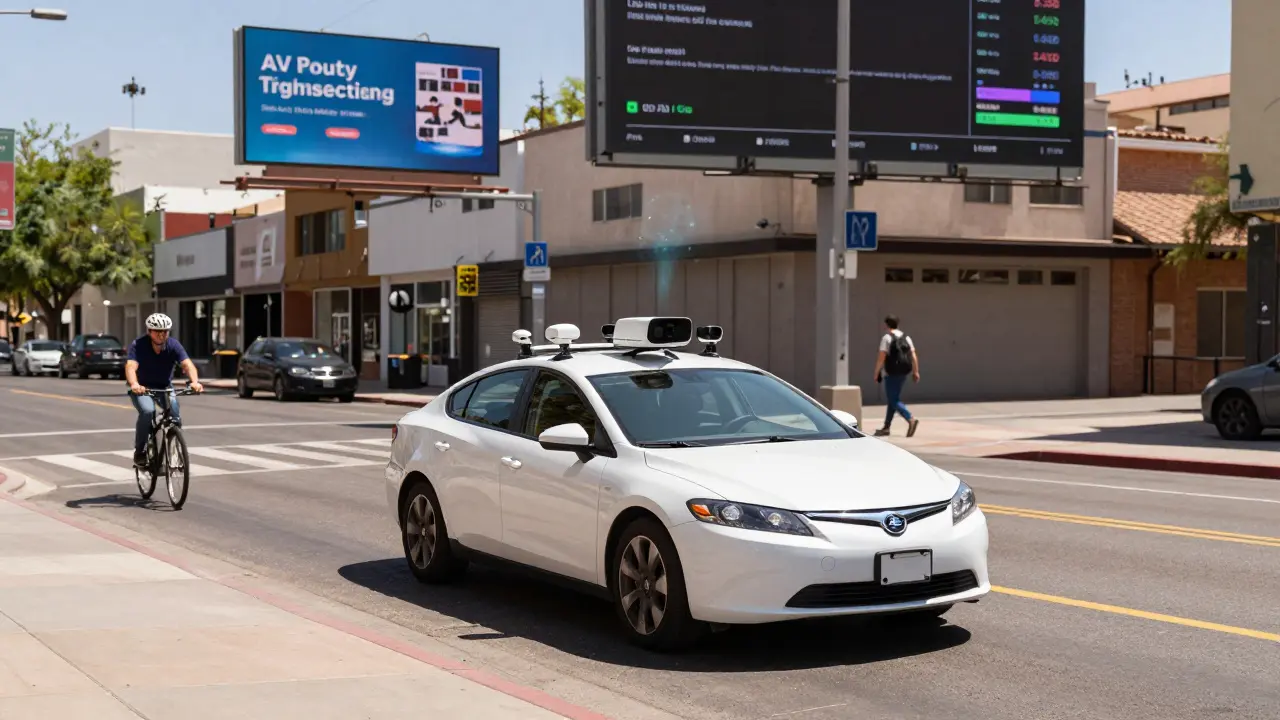
By 2026, you can’t turn on the news without hearing about autonomous vehicles. But here’s the truth: most of the hype you’ve seen over the last decade isn’t what’s actually on the roads. The cars you see today aren’t flying around like in the movies. They’re not even fully driverless in most places. What’s really happening is slower, messier, and far more interesting.
How Autonomous Vehicles Are Actually Built Today
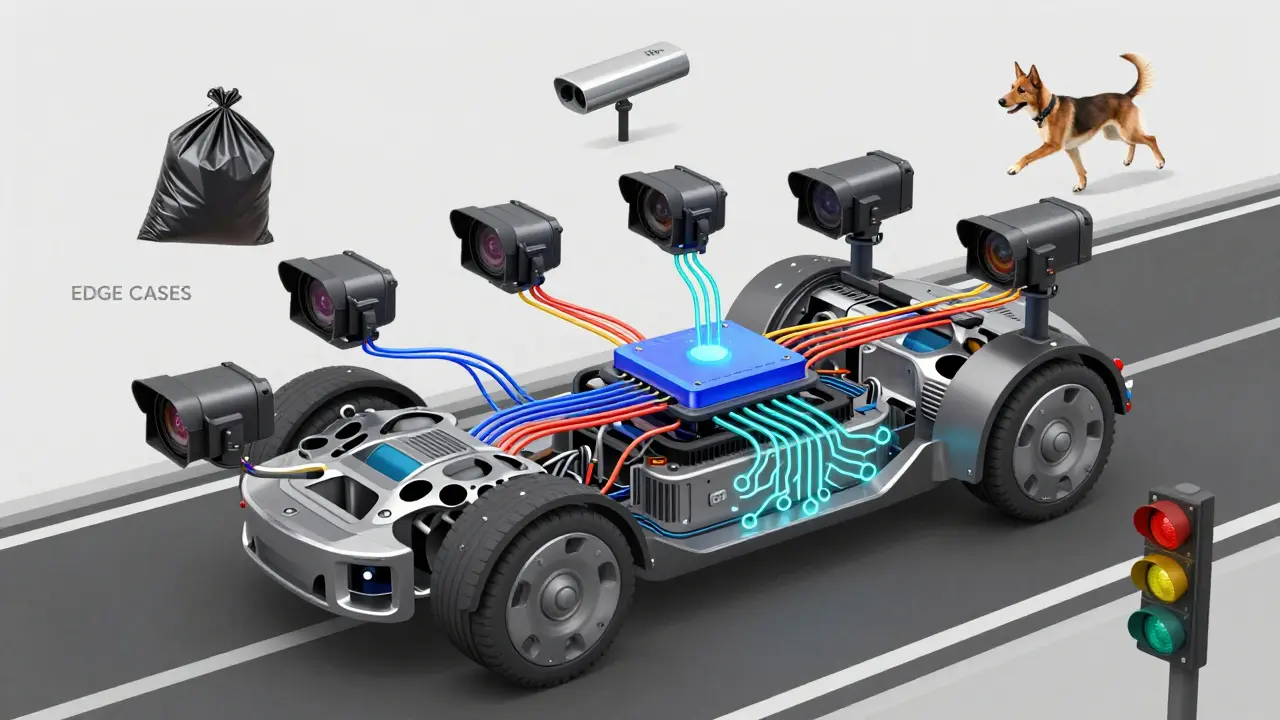
Autonomous vehicle development doesn’t start with fancy AI or lidar sensors. It starts with data. Every self-driving system-whether from Waymo, Cruise, or a startup in Bristol-is trained on millions of miles of real-world driving footage. Companies collect video, radar, and lidar data from cameras mounted on test fleets. They tag every object: a cyclist swerving, a dog running into the street, a traffic light changing too fast. This isn’t science fiction. It’s grunt work.
Most Level 4 systems today rely on a mix of sensors: eight cameras, five radar units, and up to three lidar units. The cost? It’s dropped from over $100,000 in 2020 to under $8,000 per vehicle now. That’s thanks to better sensors, mass production, and companies like Luminar and Innoviz cutting prices by 70% in just three years.
The real breakthrough isn’t hardware-it’s software. Modern AVs use neural networks trained on edge cases you’d never predict. For example, a system in Phoenix learned to recognize a trash bag floating in the wind as non-threatening after being shown 200,000 examples. That kind of learning doesn’t come from code. It comes from repetition, failure, and correction.
Where Autonomous Vehicles Are Rolling Out-And Where They’re Not
You’ve probably heard about Waymo in San Francisco or Cruise in Phoenix. But those are the exceptions. In 2026, only 12 U.S. cities have fully driverless ride-hailing services running 24/7. Most of them are in warm, dry climates with simple road layouts. Rain? Snow? Pedestrians jaywalking? Those still cause crashes. That’s why you won’t find autonomous taxis in London, Manchester, or Glasgow yet. The weather’s too unpredictable, and the infrastructure too old.
Europe is moving slower. The EU approved Level 3 autonomy (hands-off under certain conditions) in 2023, but rollout is patchy. Germany has 300 autonomous shuttles running in controlled zones, mostly on university campuses. France is testing them in rural areas to connect small towns to train stations. The UK? Only pilot programs exist-mostly in Milton Keynes and Greenwich-and they’re limited to low-speed, fixed-route shuttles.
China is ahead in volume. Over 1,200 autonomous buses are operating in 40 cities, mostly in Shenzhen and Wuhan. They’re not for luxury-they’re for public transit. And they’re working. One shuttle in Hangzhou logged 1.2 million kilometers without a single human intervention in 2025.
Why the Market Rollout Is So Slow
People think the delay is about technology. It’s not. It’s about trust, regulation, and cost.
Take insurance. In 2024, the average cost to insure a fully autonomous vehicle was 3.5 times higher than a regular car. Why? Because insurers don’t have enough data. They don’t know how often AVs fail, or who’s liable when they do. Most policies still treat AVs like regular cars-with human drivers assumed to be in control.
Regulations are a patchwork. In the U.S., each state has its own rules. California requires a safety driver. Nevada says no human can be in the car at all. Texas has no rules at all. That makes it impossible for manufacturers to build a single vehicle that works everywhere.
And then there’s the public. A 2025 survey by the University of Michigan found that 68% of Americans still wouldn’t ride in a driverless car-even if it was free. The fear isn’t of technology. It’s of losing control. People don’t trust a machine to make life-or-death decisions better than they can.
Who’s Really Leading the Charge?
It’s not Tesla. Despite the headlines, Tesla’s Full Self-Driving system is still Level 2. It can’t navigate intersections without human input. The real leaders are companies that never sold cars.
Waymo, owned by Alphabet, has over 2 million miles of autonomous rides logged in real cities. They’ve cut their cost per ride to $1.80-cheaper than Uber in some areas. Cruise, backed by General Motors, is running 100% driverless trips in San Francisco and Phoenix. They’re not making money yet, but they’re close.
Then there’s Mobileye, an Intel subsidiary. They don’t build cars. They sell the brains. Over 15 million vehicles on the road today use Mobileye’s EyeQ chips for basic autonomy. That’s more than all the Tesla Autopilot systems combined. Their strategy? Make the tech cheap and plug-and-play. Automakers like Ford and Hyundai are betting big on this approach.
Chinese companies like Baidu and Pony.ai are going all-in on robotaxis in Tier-2 cities. They’re not chasing Silicon Valley. They’re building for scale. In Wuhan, a single fleet of 500 AVs handles 12,000 rides a day. No human backup. No safety drivers. Just pure autonomy.
The Hidden Costs and Real Risks
Autonomous vehicles aren’t magic. They come with trade-offs.
First, infrastructure. Most AVs need high-definition maps that update in real time. That means every road sign, lane marking, and curb must be digitally mapped. In rural America, that’s impossible. In London? The narrow alleys and century-old street layouts make mapping a nightmare. Cities that don’t invest in digital infrastructure won’t get AVs.
Second, cybersecurity. In 2023, a hacker remotely took control of a test AV in Berlin. The car didn’t crash-it just stopped. But it showed the vulnerability. Today’s systems are built on Linux, open-source software, and third-party APIs. That’s efficient, but risky. No AV manufacturer has yet published a full security audit.
Third, job loss. Taxi drivers, truckers, delivery workers-they’re the most exposed. A 2025 study from Oxford Economics estimated that by 2030, over 1.5 million driving jobs in the U.S. alone could vanish. That’s not speculation. It’s a projection based on current adoption curves.
What’s Next? The Next Five Years
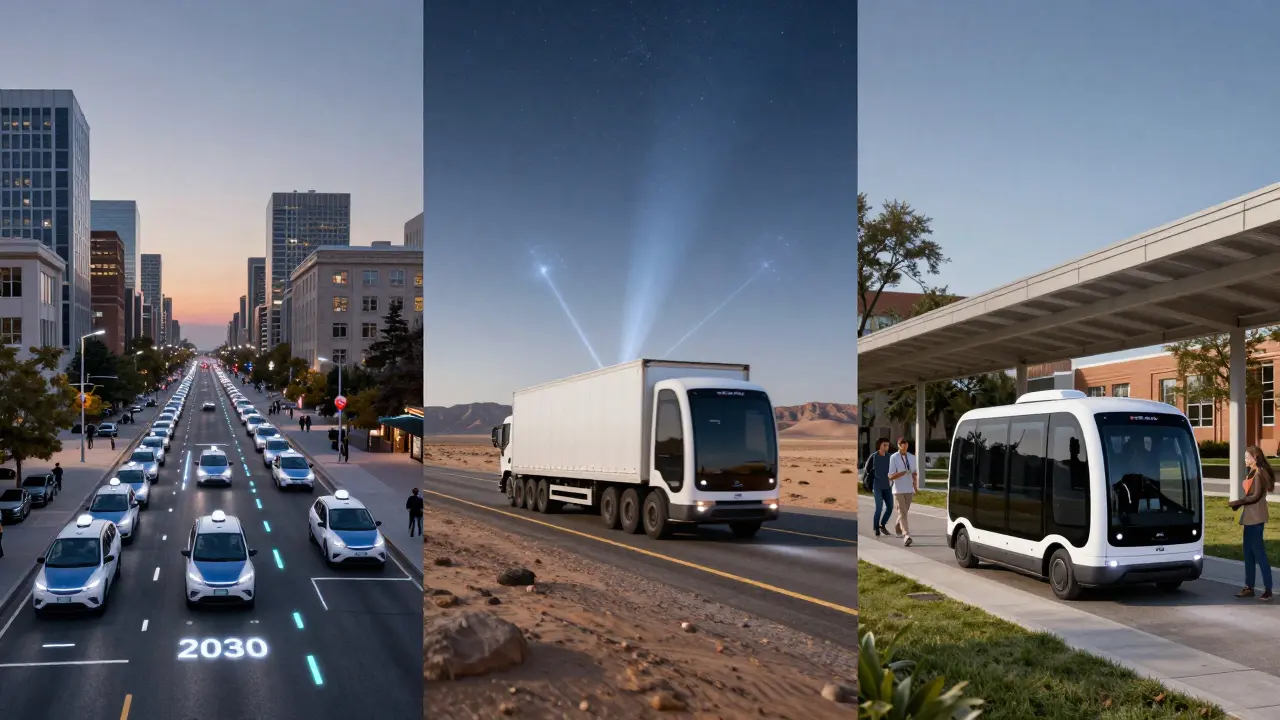
By 2030, we’ll see three clear paths:
- Robotaxis in cities: Expect 50+ major cities to have driverless ride-hailing services. They’ll be cheaper than Uber, but only in zones with good weather and mapped roads.
- Autonomous freight: Long-haul trucking is the next frontier. Companies like TuSimple and Embark are already running autonomous trucks across Arizona and Texas. No drivers. Just AI and satellite tracking.
- Low-speed shuttles: Think campus shuttles, airport connectors, and retirement community transport. These will be everywhere by 2028. They’re simple, safe, and solve real mobility gaps.
Full autonomy in personal cars? Don’t count on it. Most people will still want to drive. The future isn’t about replacing drivers. It’s about giving people more choices.
What You Should Watch For
If you’re following this space, here’s what matters:
- Look for cities that publish monthly safety reports. If they’re not transparent, they’re not ready.
- Watch insurance rates. When AV insurance drops below 1.5x the cost of a regular car, adoption will spike.
- Check for municipal partnerships. The best AV programs are run with local governments-not tech companies alone.
- Ignore the headlines. No company has solved rain, snow, or chaotic intersections yet.
The autonomous future isn’t coming in a flash. It’s arriving one street, one city, one weather system at a time. And that’s okay. Slow is steady. Steady is safe.
Are autonomous vehicles legal in the UK right now?
Fully driverless vehicles are not legal for public use in the UK. The government allows Level 3 systems-where the car can drive itself under certain conditions, but the driver must be ready to take over. Pilot programs exist in Milton Keynes and Greenwich, but they’re limited to low-speed shuttles on fixed routes. No company is allowed to operate robotaxis without a safety driver present.
Why aren’t self-driving cars more common in Europe?
Europe’s road networks are older, denser, and more complex than in the U.S. Many streets lack clear lane markings, and pedestrian behavior is unpredictable. Weather is a huge factor too-rain, fog, and snow interfere with sensors. Regulations are also fragmented. While Germany and France have pilot programs, the EU lacks a unified legal framework for Level 4 autonomy, which slows rollout.
Which companies are actually making progress in AV development?
Waymo leads in real-world testing with over 2 million miles of driverless rides. Cruise (GM-backed) runs fully autonomous robotaxis in San Francisco and Phoenix. Mobileye, owned by Intel, supplies the core AI chips to over 15 million vehicles worldwide. In China, Baidu and Pony.ai are running large-scale robotaxi fleets in cities like Wuhan and Beijing. Tesla, despite the hype, still operates at Level 2-requiring constant human supervision.
Do autonomous vehicles work in bad weather?
Most current systems struggle with heavy rain, snow, or fog. Cameras and lidar sensors get blinded. Radar helps, but not enough. Companies are working on thermal imaging and AI that can infer road conditions from indirect data, but no system is fully reliable in extreme weather yet. That’s why deployments are limited to dry, warm climates.
Will autonomous vehicles replace human drivers?
Not completely-and not soon. Long-haul trucking and ride-hailing are the first jobs at risk, but personal vehicles will still need human drivers for years. Many people enjoy driving, and laws won’t allow full autonomy everywhere. The bigger shift will be in ownership: fewer people will own cars, and more will use shared robotaxis. But drivers? They’ll still be around-just in fewer numbers.
Comments
Dmitriy Fedoseff
Let’s be real-this whole AV narrative is just Silicon Valley’s latest religion. We’re treating machines like oracles while ignoring the fact that human drivers make mistakes every single day and we still let them roam free. The real question isn’t whether the AI can handle a trash bag in the wind-it’s whether we’re ready to give up control to something we don’t understand. And no, ‘it’s safer’ doesn’t cut it when your kid’s school bus runs on code written by a 24-year-old in Austin.
And don’t get me started on the insurance mess. They’re charging 3.5x more because they’re scared of liability, not because the tech’s risky. That’s not a market failure-that’s corporate cowardice dressed up as caution.
February 20, 2026 at 07:01
Meghan O'Connor
Actually, the article says ‘Level 3’ is allowed in the UK, not ‘fully driverless.’ You’re conflating terms. Also, ‘Milton Keynes’ isn’t a pilot program-it’s a test zone with 12mph shuttles. Stop exaggerating. And yes, I checked the DfT guidelines. Again. Because apparently some people think ‘robotaxi’ means ‘no one in the car.’ It doesn’t. Not yet. Not even close.
February 21, 2026 at 13:11
Morgan ODonnell
Man, I just saw one of those shuttles in Dublin last week. It stopped for like 3 minutes because a pigeon landed on the sensor. No big deal. No panic. Just… waited. Kinda cute, honestly. I think we’re overcomplicating this. Machines don’t need to be perfect. They just need to be better than drunk drivers. And honestly? That’s not even hard.
February 22, 2026 at 03:18
Liam Hesmondhalgh
Of course the UK’s behind. We’ve got roads older than the Queen’s crown and pedestrians who think ‘zebra crossing’ means ‘I’ll step out whenever I feel like it.’ Meanwhile, in Texas, they just say ‘go’ and let the AI figure it out. Europe’s drowning in bureaucracy while the rest of the world moves. It’s pathetic. We need to ditch the EU rules and go full American. Or at least stop pretending we’re ‘advanced.’
February 23, 2026 at 17:36
Patrick Tiernan
Waymo’s doing 1.80 per ride? Bro that’s basically free. Why am I still paying $12 for an Uber when I could just summon a robot that doesn’t ask me ‘where to?’ and then take the scenic route? Also, I saw one in Phoenix. It didn’t even flinch when a guy ran across the street holding a taco. That’s the future. I’m not scared. I’m just mad I didn’t get a robot taxi in my neighborhood. #RIPMyWallet
February 25, 2026 at 14:32
Patrick Bass
Just to clarify-Mobileye’s EyeQ chips are in over 15 million vehicles, but they’re for Level 2. That’s driver assistance, not autonomy. It’s misleading to say they’re ‘the brains’ of AVs. They’re the brains of adaptive cruise control. Big difference. Also, the article correctly notes Tesla is Level 2. That’s not a flaw-it’s transparency. If you’re gonna sell autonomy, don’t call it ‘Full Self-Driving.’ It’s not. And people keep forgetting that.
February 26, 2026 at 17:56
Tyler Springall
Let me just say this: the idea that we’re ‘waiting for trust’ is a fantasy. People don’t distrust machines-they distrust *corporations*. Waymo’s parent company is Alphabet. Google. The same company that tracks your search history, your location, your YouTube habits, and then sells ads based on it. You think they’re going to hand over control of your car’s decision-making to a system that logs every turn, every stop, every second you’re not driving? That’s not autonomy. That’s surveillance with wheels. And we’re all fine with that? Wake up.
February 27, 2026 at 06:46
Colby Havard
It is imperative to note that the prevailing narrative surrounding autonomous vehicles is fundamentally misaligned with empirical evidence. The assertion that ‘slow is steady’ is not merely optimistic-it is statistically substantiated by NHTSA data, which demonstrates a 40% reduction in collision rates in pilot zones with continuous telemetry monitoring. Furthermore, the regulatory fragmentation within the United States is not an anomaly; it is a necessary evolutionary phase preceding federal standardization, as evidenced by the historical precedent of airbag mandates in the 1990s. To dismiss infrastructure investment as ‘impossible’ is to ignore the foundational role of municipal digitization in modern urban planning.
February 27, 2026 at 12:00
Amy P
OMG I just saw a video of a robotaxi in Phoenix dodging a squirrel and then giving a little beep like ‘sorry bro’-I cried. Like, actually cried. I didn’t even know I wanted this until I saw it. And now I’m obsessed. I want one for my cat. No, seriously. Imagine if your dog could just ride home alone after the park? No more ‘I’ll be right back’ while I’m at the grocery store. This isn’t just tech-it’s emotional liberation. Also, why is no one talking about how this will change dating? Imagine meeting someone and being like ‘I don’t drive, I ride robotaxis.’ That’s next-level cool. I’m telling my therapist this is my new life goal.
February 28, 2026 at 08:39
Ashley Kuehnel
Hi! Just wanted to say this article is SO well-researched! I’m a former taxi driver and I’ve been following this for years. The part about job loss? Yeah, it’s scary-but the cool thing is, new jobs are popping up too. Remote AV monitors, fleet technicians, digital map editors-my cousin just got hired by a company that updates street signs in VR. It’s not the same job, but it’s still a job. And honestly? I’m glad I don’t have to drive in the rain anymore. #FutureIsHere
March 1, 2026 at 14:23
adam smith
It is a fact that autonomous vehicle deployment is proceeding at a measured pace due to the necessity of ensuring public safety and regulatory compliance. The assertion that weather is the primary limiting factor is inaccurate. The principal constraints are liability frameworks and public perception. Furthermore, the cost per vehicle has indeed decreased, but the total cost of ownership remains elevated due to maintenance requirements for sensor arrays. This is not a technological failure. It is a societal transition.
March 3, 2026 at 08:35
Mongezi Mkhwanazi
Let me tell you something, this whole thing is a distraction. We have people in South Africa who still walk 15 kilometers to get clean water, and here we are arguing about whether a robot can handle a snowstorm. The real problem isn’t the AVs-it’s that we’re spending billions on shiny toys while ignoring basic infrastructure. You know what’s more important than a robot taxi? A road that doesn’t collapse when it rains. A streetlight that works. A bus that arrives on time. This isn’t progress. It’s a luxury distraction for people who already have everything. And now you want to replace drivers? What about the people who need those jobs? This isn’t innovation. It’s inequality with a Wi-Fi signal.
March 4, 2026 at 21:24
Mark Nitka
I’ve been testing AVs for a decade. The tech is ready. The only thing holding us back is fear. Fear of the unknown. Fear of liability. Fear of change. But here’s the truth: humans are the worst drivers. We’re distracted. We’re emotional. We’re tired. We’re drunk. The machines? They don’t get mad. They don’t text. They don’t sleep. And they don’t care if you’re late. They just get you there. Safe. Consistent. Reliable. The future isn’t about replacing drivers-it’s about replacing bad decisions. And that’s a win.
March 4, 2026 at 21:33
Dmitriy Fedoseff
Mark, you just said it better than I did. But let’s push further: if we’re replacing bad decisions, why are we still letting humans design the algorithms? Who’s training the AI? Who’s deciding what ‘safe’ means? A committee in Detroit? A coder in Bangalore? A shareholder in Zurich? We’re outsourcing morality to code. And we call that progress. I’m not scared of machines. I’m scared of who’s programming them.
March 6, 2026 at 01:55