
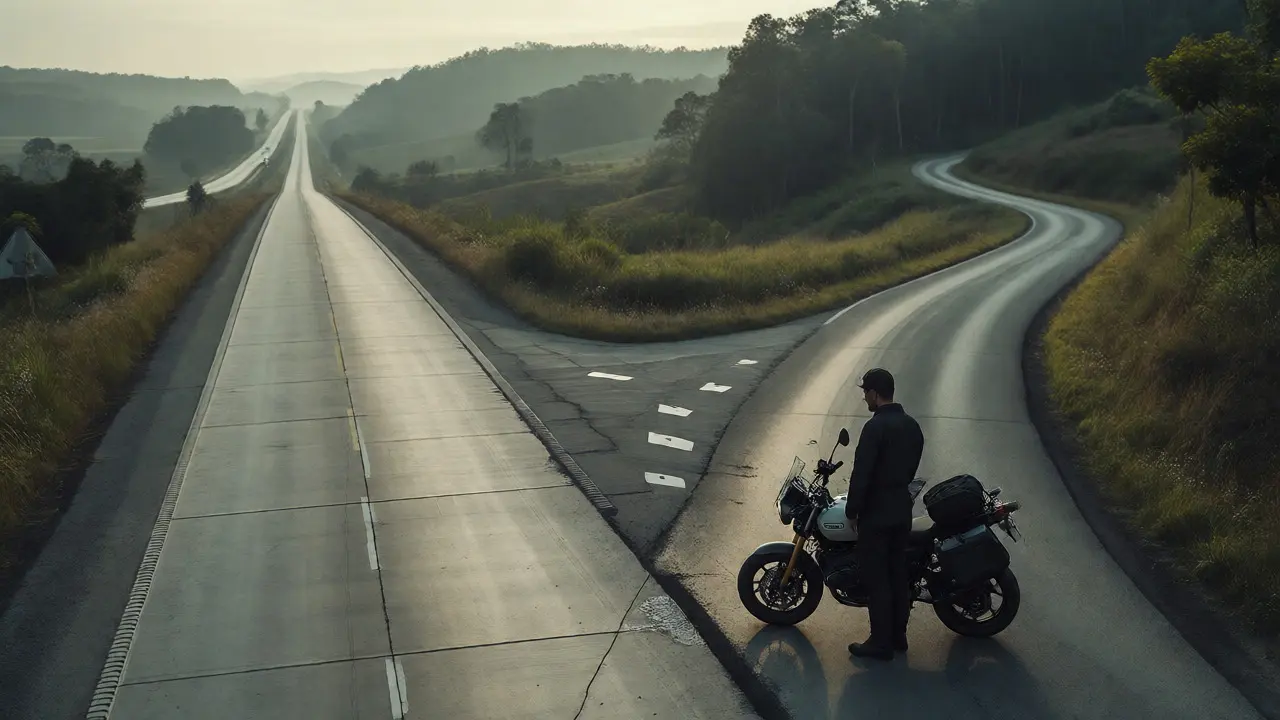
You’ve got your tank bag packed, the route is marked up on your phone, and you’re staring at two lines on the map. One is a thick blue ribbon labeled M1 or Interstate 80-fast, direct, and predictable. The other is a squiggly grey line winding through hills, forests, and small towns. Which one do you take?
This isn’t just about preference; it’s a calculation of time, fatigue, risk, and joy. Most riders assume highways are always faster. But if you’re in a 250cc cruiser or a heavy touring bike with panniers, that assumption might be costing you more than you think. Let’s break down the real trade-offs between taking the scenic backroad versus the efficient highway, so you can plan a trip that actually feels good to ride.
The Speed Illusion: Why Backroads Aren’t Always Slower
We need to talk about average speed versus top speed. On a motorway or interstate, you might cruise comfortably at 70-80 mph (110-130 km/h). It sounds fast. But factor in traffic congestion, construction zones, mandatory stops for fuel, and the sheer mental drain of watching cars merge into your lane without looking, and your actual progress slows down.
On a backroad, you might average 45-55 mph (70-90 km/h) due to curves, lower speed limits, and village crossings. However, there’s rarely a traffic jam. You don’t sit idle behind a truck doing 50 mph in a 70 zone. If you add in the time spent navigating complex highway interchanges-which can easily eat up 15 minutes per major junction-the gap narrows significantly. For distances under 100 miles, a well-chosen backroad often gets you there within an hour of the highway route, but with zero stress.
Fatigue Factor: The Hidden Cost of Highway Hypnosis
Riding a motorcycle is physically demanding. On a straight, flat highway, you’re essentially holding a static position. Your core muscles stay engaged to keep the bike upright, but your hands and arms remain rigid. This leads to "highway hypnosis," a state where your brain goes on autopilot. It’s dangerous because reaction times drop when you’re not actively processing visual information.
Backroads demand engagement. Every curve requires counter-steering. Every elevation change shifts your weight distribution. Your brain stays alert because it’s constantly predicting the next bend. While this sounds tiring, many riders find it less mentally exhausting than the monotony of long highway stints. The key is pacing. A 200-mile highway day leaves you numb. A 150-mile backroad day leaves you tired but satisfied. If you’re prone to drowsiness on long rides, the varied terrain of secondary roads acts as a natural stimulant.
Fuel Efficiency and Mechanical Wear
Here’s where the math gets interesting. Motorcycles generally achieve their best fuel economy at moderate speeds, typically between 45-60 mph. At 75+ mph, wind resistance increases exponentially. According to data from the UK Department for Transport, fuel consumption for motorcycles can increase by up to 20% when moving from 50 mph to 70 mph due to aerodynamic drag.
If you’re riding a smaller displacement bike (under 650cc), sticking to backroads will likely save you money on petrol. You’ll also reduce wear on your clutch and gearbox if you’re using higher gears consistently rather than bouncing off the rev limiter. However, if you’re on a large-displacement tourer like a BMW R1250RT or a Honda Gold Wing, these bikes are designed for high-speed stability. Their engines run cooler and smoother at highway speeds, whereas constant gear changes on twisty roads can overheat smaller oil-cooled engines if you’re pushing hard.
| Metric | Highway / Motorway | Backroad / Secondary Road |
|---|---|---|
| Average Speed | 65-75 mph (105-120 km/h) | 40-55 mph (65-90 km/h) |
| Fuel Efficiency | Lower (High Drag) | Higher (Optimal RPM Range) |
| Mental Fatigue | High (Monotony/Hypnosis) | Moderate (Active Engagement) |
| Safety Risk | High-Speed Collisions | Surface Hazards/Animals |
| Scenic Value | Low (Barriers/Fences) | High (Open Views) |
Safety Risks: Different Dangers, Same Stakes
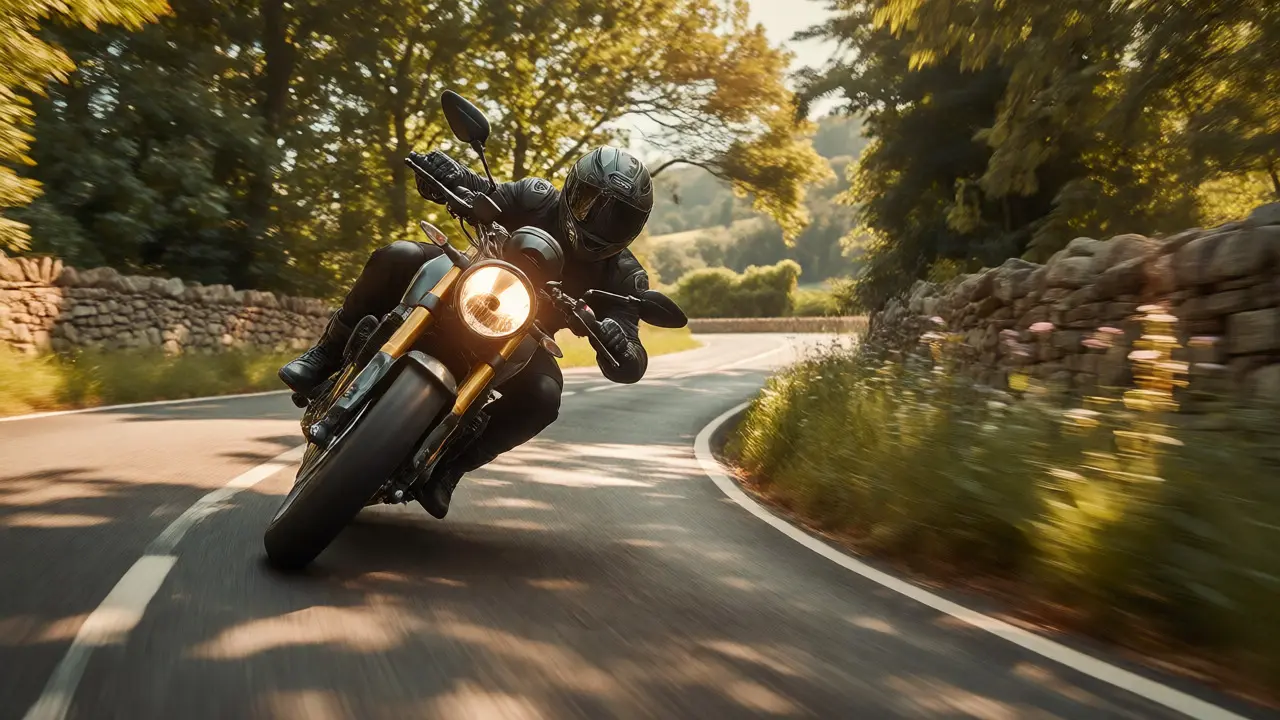
It’s easy to say backroads are safer because speeds are lower. That’s only half true. Lower speeds mean less kinetic energy in a crash, which is good. But backroads come with their own set of hazards that highway riders rarely encounter.
- Surface Quality: Country lanes often have gravel, sand, or oil patches left by farm vehicles. On a highway, the asphalt is usually smooth and swept regularly.
- Visibility: Blind corners and hedgerows hide oncoming traffic. On a motorway, you can see a mile ahead.
- Wildlife: Deer, foxes, and even livestock can step onto rural roads unexpectedly. Hitting a deer at 50 mph is still a serious event.
- Traffic Mix: You’ll share the road with tractors, cyclists, and pedestrians who may not expect a motorcycle to appear around a bend.
Conversely, highways present high-stakes risks. A mistake at 70 mph is fatal much more often than a mistake at 40 mph. Lane-splitting or filtering, while legal in some places, adds complexity. And let’s not forget the "invisible" threat: drivers checking mirrors who simply don’t see you because they’re scanning for cars, not bikes.
The Joyride Argument: What Are You Actually Chasing?
Why do we ride? If you’re commuting, efficiency wins. But if you’re on a weekend trip, you’re chasing something else. It’s the feeling of the bike leaning into a corner, the smell of pine trees, the view of a valley unfolding below you. You can’t get that from behind a concrete noise barrier on the M25.
Backroads allow for spontaneity. See a pub garden? Pull in. Spot a historic castle? Take the detour. On a highway, every exit is planned hours in advance. The flexibility of secondary roads turns a journey into an adventure. Many experienced riders adopt a hybrid approach: use the highway to cover boring, flat stretches quickly, then dive off at a strategic point to tackle the most scenic section of the route. This gives you the best of both worlds-speed when needed, soul when possible.
Planning Your Route: How to Decide
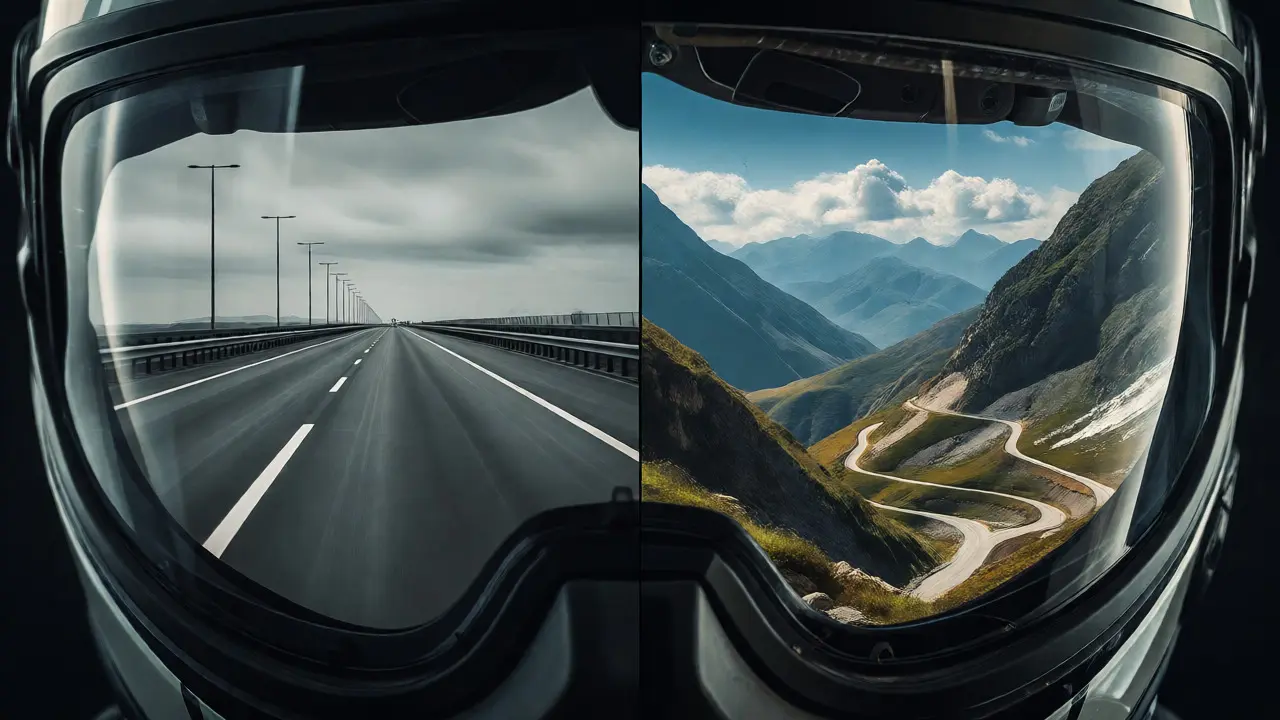
So, how do you choose for your next trip? Use this decision tree:
- Check the Weather: Is rain forecast? Backroads are slippery when wet due to moss and mud. Stick to highways if visibility is poor.
- Evaluate Your Bike: Small engine? Prioritize backroads for better torque usage. Large tourer? Highways are kinder to your suspension and comfort.
- Assess Traffic Patterns: Avoid rural roads during harvest season (tractors) or school runs (slow cars). Check local forums for current roadworks.
- Calculate Rest Stops: Do you need frequent breaks? Backroads offer more frequent villages with cafes. Highways require driving to specific service stations.
For a classic UK example, consider the route from Bristol to the Cotswolds. Taking the M4/M5 is fast but dull. Taking the A38 through Chew Valley Lake and climbing out towards Bath offers rolling hills, stone walls, and minimal traffic. You’ll arrive 20 minutes later, but you’ll arrive happier.
Is it safer to ride on highways or backroads?
Statistically, highway accidents tend to be more severe due to higher speeds, but backroads have a higher frequency of minor incidents due to surface hazards and limited visibility. Safety depends largely on rider skill and attention. Experienced riders often prefer backroads for the control they offer, while beginners may feel safer on the predictable flow of highway traffic.
Do backroads really save fuel?
Yes, for most motorcycles. Aerodynamic drag increases significantly above 60 mph. Riding at 50 mph on a backroad allows the engine to operate in its most efficient RPM range, reducing fuel consumption compared to sustaining 75 mph on a highway.
How do I avoid getting lost on backroads?
Use GPS apps specifically designed for motorcycles, such as Sygic Moto or Calimoto, which prioritize scenic routes over fastest times. Always download offline maps, as rural areas often lack reliable mobile signal. Having a physical backup map is also wise for long trips in remote areas.
Are backroads bad for large touring motorcycles?
Not necessarily, but they can be challenging. Heavy bikes with low ground clearance may scrape on steep inclines or tight corners found on rural roads. Additionally, narrow lanes can be intimidating for wide handlebars. However, modern tourers are increasingly agile, and many riders enjoy the technical challenge of carving a large bike through country bends.
What is the biggest danger on rural roads?
Gravel and sand deposits, particularly at junctions and after rain. These reduce tire grip unexpectedly. Another major hazard is blind corners combined with oncoming vehicles crossing the center line. Always slow down before entering a blind bend and look far ahead through the turn.
Final Thoughts: Balance the Journey
There is no single right answer. The best motorcycle trip mixes both elements. Use highways to bridge the gaps between destinations, preserving your energy for the parts that matter. Save the backroads for the moments when you want to feel the machine beneath you. Plan your stops, respect the weather, and remember that arriving late is better than arriving bored.
Comments
Chris Neal
Actually, the article oversimplifies the fuel efficiency argument by ignoring engine load dynamics. While aerodynamic drag is exponential, small displacement engines often struggle to maintain torque at highway speeds, forcing them into lower gears which can negate the drag benefits compared to a large cruiser in overdrive. Furthermore, the claim that backroads are universally less mentally exhausting ignores the cognitive load of constant hazard assessment versus the sustained vigilance required for high-speed lane discipline.
September 16, 2026 at 16:15
Art HND
Wrong.
Backroads are dangerous because people treat them like race tracks. Highways are safer if you just stay out of the way.
September 17, 2026 at 03:03
Kim Edwards
OH MY GOD YES!!! I literally cried last weekend because I took the interstate and felt my soul leave my body! The monotony is DEATH. You have to feel the wind, the vibration, the DANGER! If you aren't scared a little bit on a backroad, are you even riding? It's about the ALIVE feeling!
September 17, 2026 at 17:17
Elizabeth Brooks
this is so helpful thanks!! i always get lost on back roads though lol. do u use specific apps or just paper maps? i tried using gps once and it sent me down a cow trail and i almost died haha
September 18, 2026 at 16:58
Kyle Ware
Great point about navigation
I recommend Sygic Moto or Calimoto as mentioned but also consider downloading offline maps beforehand since rural signal is spotty
Paper maps are still valid backups for long trips in remote areas
September 19, 2026 at 03:39
Vishnu Vardhan Reddy M S
Haha, love the enthusiasm here! But let's be real, folks. If you're riding a 250cc in heavy traffic, you're not 'alive', you're 'annoyed'.
Also, Chris, while your physics lecture was cute, most of us don't care about marginal MPG differences when we're trying not to fall asleep from highway hypnosis. The mental fatigue is the real killer, not the gas bill. Keep smiling, keep riding, and maybe check your mirrors more than your spreadsheet.
September 20, 2026 at 02:14
Chris Neal
Marginal differences accumulate over thousands of miles. And no, checking mirrors doesn't fix the fact that highway hypnosis is a physiological response to lack of stimulus, not just boredom. The brain disengages when prediction error is low. Backroads increase prediction error, keeping the reticular activating system engaged. It’s neuroscience, not just vibes.
September 20, 2026 at 18:45
Bonnie Watt
Ugh, typical know-it-all energy. Nobody asked for your neuroscience degree. Some of us just want to ride without being lectured about our own brains. Also, saying backroads are safer is naive if you hit gravel. I’ve seen plenty of 'safe' highway riders get clipped by distracted drivers who didn't see them. At least on a backroad, you’re paying attention. Don’t judge people who prefer speed and predictability.
September 20, 2026 at 21:24
Joanna Mucha
The romanticization of the backroad is a construct of modern leisure culture, where the journey becomes a commodity separate from the destination. We seek friction to validate our existence in an increasingly frictionless digital world. The highway represents the sterile efficiency of late-stage capitalism; the backroad, with its unpredictability and inherent risk, offers a semblance of agency. Yet, this agency is illusory, as we remain bound by the machine and the road itself. It is a beautiful, tragic dance between man and metal.
September 21, 2026 at 09:11
Iva Grekova
Love this perspective Joanna. It really captures why we ride. For me, it's just about having a good time and staying safe. Both routes have their place depending on the day and the mood. Just glad everyone is enjoying their rides!
September 22, 2026 at 01:30
Onyinyechi Nwosu
i agree with tiffany and kim. the feeling matters more than the stats. sometimes you just need to escape the noise of the city and find peace in the hills. highways are too loud and fast for my taste. i prefer the slow burn of a country road.
September 23, 2026 at 19:57
Chandan Singh
In India, this distinction is moot because 'backroads' often have worse infrastructure than highways, yet traffic density is higher. The 'speed illusion' doesn't apply when you're stuck behind a truck doing 30km/h on a national highway. Context is key. A blanket statement about backroads being less fatiguing assumes a Western context with well-maintained secondary roads.
September 24, 2026 at 10:45
Brannen Hall
Contrarian take: Highway hypnosis is overstated. Most accidents happen due to rider error or driver negligence, not zoned-out states. Plus, backroads expose you to unpredictable variables like farm equipment and wildlife. Statistically, if you factor in severity per mile, highways might actually be safer for experienced riders who know how to filter and position themselves. Stop romanticizing danger.
September 24, 2026 at 16:56
Brenna Gonedrman
OMG STOP IT ALL OF YOU! THIS IS SO DRAMATIC! Who cares about safety stats?! I just want to look cool and smell the flowers! Why does everyone have to make it so complicated?! Just ride the bike and enjoy the view! UGH!
September 24, 2026 at 17:56
Brandon Olvera
America built the best highways in the world. End of story. Other countries have narrow twisty roads because they couldn't afford to pave properly. Stick to the Interstate. It's efficient. It's American. Anything else is just complaining about progress.
September 25, 2026 at 09:15