
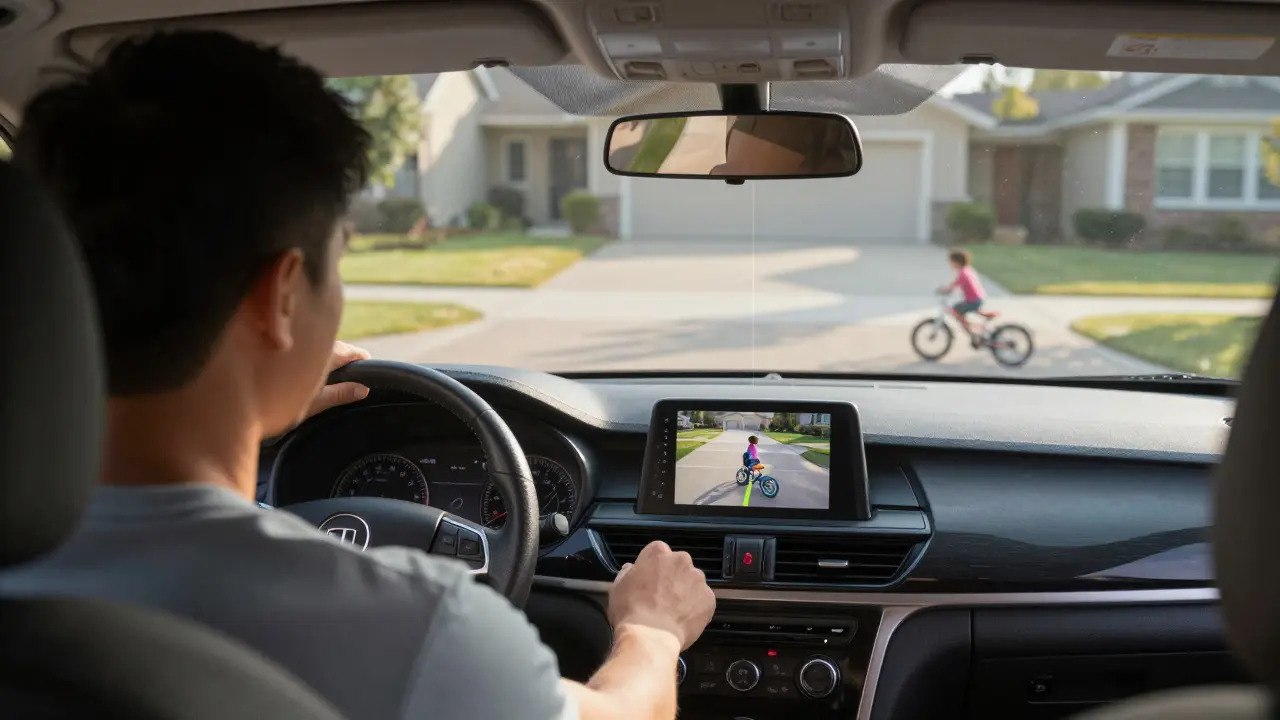
Every year, over 200 people in the U.S. are killed because a vehicle backed up into them - and most of those victims are children under five. That’s not a statistic you can ignore. If your car doesn’t have a backup camera or parking sensors, you’re driving blind in reverse. The good news? Adding these systems is cheaper and easier than you think. You don’t need a dealership or a garage full of tools. Many drivers install these systems themselves in under an afternoon.
Why Backup Cameras and Parking Sensors Matter
Modern cars come with factory-installed backup cameras and parking sensors, but if you drive a model from before 2018, you’re missing out. The National Highway Traffic Safety Administration (NHTSA) made backup cameras mandatory on all new U.S. vehicles starting in May 2018. Why? Because they cut reverse crashes by 46%. That’s not a small number. It’s lives saved.
Parking sensors work differently. They use ultrasonic waves to detect objects behind your car and beep louder as you get closer. Some systems even show distance lines on a screen. Together, backup cameras and parking sensors cover blind spots you can’t see in your mirrors - like the low curb, a child’s bike, or a shopping cart left in the driveway.
These aren’t luxury add-ons. They’re safety essentials. A 2023 study by the Insurance Institute for Highway Safety found that vehicles with both systems had 78% fewer backing collisions than those with neither. That’s nearly four out of five accidents prevented.
How Backup Cameras Work
A backup camera is a small, waterproof camera mounted near the license plate or on the rear of the vehicle. When you shift into reverse, it automatically turns on and sends a live video feed to a screen - usually on your dashboard, center console, or rearview mirror.
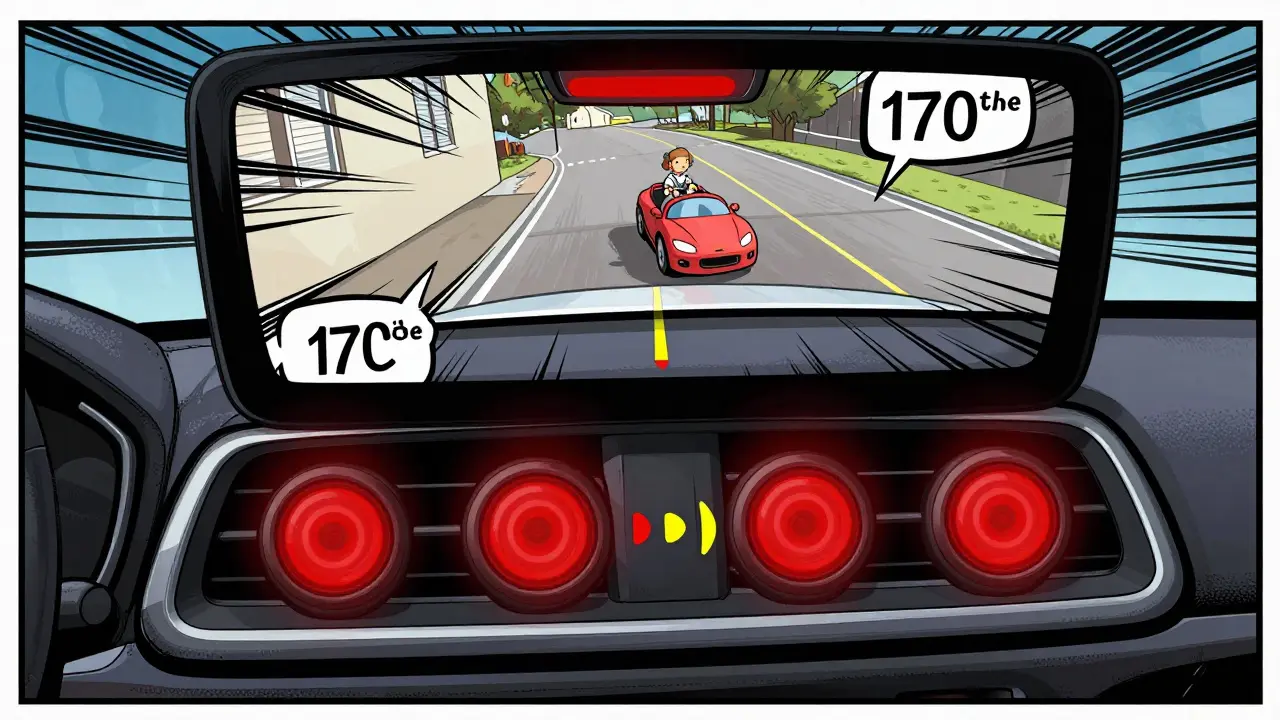
Most aftermarket cameras have a wide 120-170 degree field of view. That means you see more than just the bumper - you see the entire area behind the car. Some even include gridlines that adjust based on your steering angle, so you can tell exactly where your tires are going.
Quality matters. Cheap cameras often have blurry images, poor night vision, or fog up in rain. Look for models with IP69K waterproofing, LED night vision, and auto-adjusting brightness. Brands like Rear View Safety, Yada, and LeeKooLuu consistently rank highest in independent tests for clarity and durability.
How Parking Sensors Work
Parking sensors are small round devices - usually four or six - embedded in the rear bumper. They emit high-frequency sound waves that bounce off objects and return to the sensor. The system calculates distance and triggers alerts: one beep for 3 feet away, two beeps for 2 feet, and rapid beeping under 1 foot.
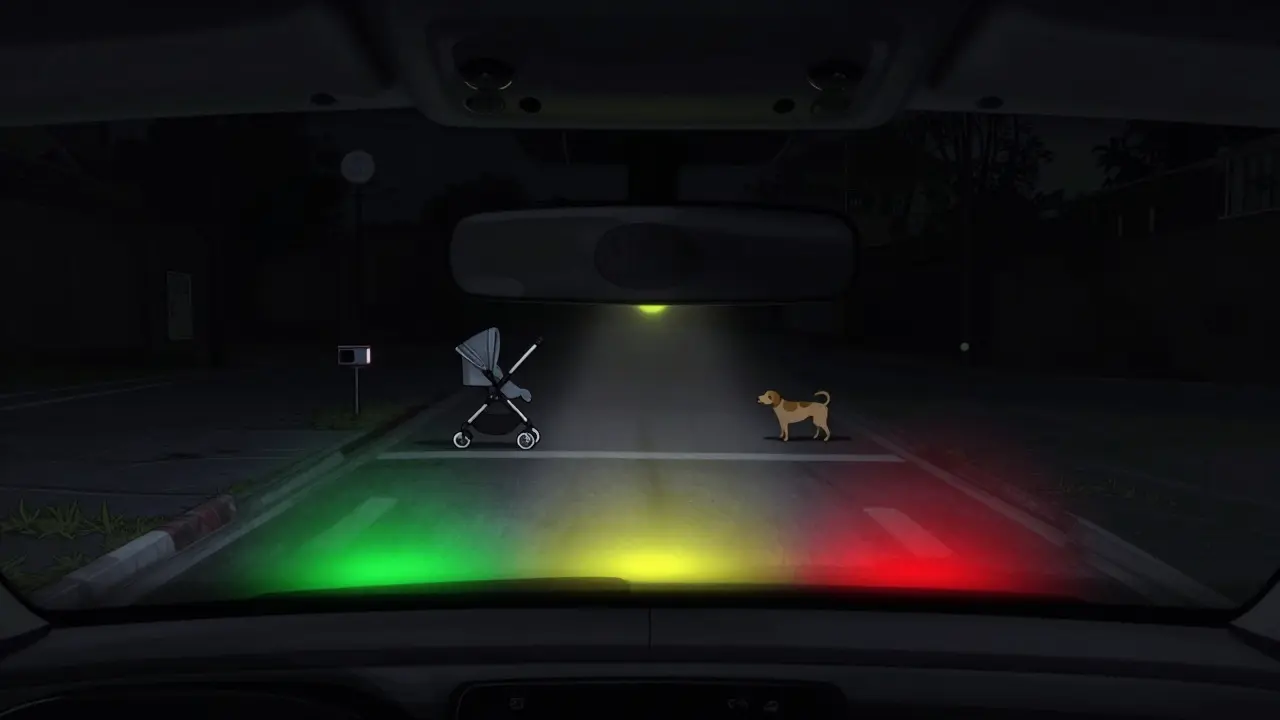
Some advanced systems include front sensors too, which help when parallel parking or navigating tight driveways. Others sync with your backup camera to show colored distance bars on the screen - green for far, yellow for close, red for danger.
Installation is simple. Most kits come with adhesive-backed sensors that stick to the bumper. No drilling needed. The control module connects to your reverse light wiring, so it activates automatically when you shift into reverse. You can even find kits with Bluetooth displays that pair with your smartphone.
Installation: Step-by-Step
You don’t need to be a mechanic to install these. Here’s what you’ll need:
- Backup camera kit (camera, monitor, wiring harness)
- Parking sensor kit (sensors, control unit, wiring)
- Drill and 1/4-inch bit (if mounting sensors)
- Wire strippers and electrical tape
- Zip ties and double-sided tape
Step 1: Choose your monitor location. Most people mount the screen on the dashboard or stick it to the rearview mirror. Avoid placing it where it blocks your view.
Step 2: Mount the camera. Remove the license plate frame (if needed) and drill a small hole near the top edge of the license plate area. Feed the camera cable through and secure the camera with screws or adhesive. Seal the hole with silicone to prevent water leaks.
Step 3: Connect the camera to power. The camera wire usually has a red (power) and black (ground) lead. Splice the red wire into your reverse light’s positive wire. Use a wire tap connector - no cutting required. Ground the black wire to any metal chassis part.
Step 4: Install the sensors. Mark four evenly spaced spots on the bumper, about 6-8 inches apart. Drill small holes and insert the sensors. Connect each sensor to the control unit using the color-coded wires. Tuck wires under the bumper with zip ties.
Step 5: Power the control unit. Run the sensor wiring to the fuse box or reverse light circuit. Most kits include a fuse tap that plugs into an empty slot. Plug in the monitor, turn on the car, and shift into reverse. Test everything.
Most installations take 2-3 hours. If you’re unsure, watch a YouTube tutorial for your exact car model. There’s a video for nearly every make and year.
Benefits Beyond Safety
Yes, these systems prevent accidents. But they do more.
Less stress. Parallel parking on a busy street? No more sweating. You’ll see exactly how much space you have - and whether you can fit.
Better resale value. Cars with backup cameras and sensors sell faster and for 5-10% more. Buyers look for them now. It’s like having airbags - expected, not optional.
Lower insurance premiums. Some insurers give discounts of up to 10% for adding safety tech. Ask your provider. It’s worth checking.
Easy for older drivers. Reduced vision, stiff necks, or difficulty turning around? These systems restore confidence. A 2024 survey by AARP found that 82% of drivers over 65 felt more comfortable reversing after installing a camera and sensors.
Cost vs. Value
A basic backup camera kit costs $50-$100. Add parking sensors, and you’re looking at $120-$200. Professional installation runs $150-$300. But doing it yourself cuts the cost in half.
Compare that to the average cost of a reverse collision: $1,800 in repairs, plus potential medical bills or legal fees. And that doesn’t count the emotional toll.
These systems pay for themselves after one near-miss. One woman in Ohio told a news outlet she avoided backing into her toddler’s stroller because her camera showed the handle - just inches from her bumper. She didn’t even know the child was there.
Pitfalls to Avoid
Not all kits are created equal. Watch out for:
- Low-resolution cameras - if you can’t read license plates clearly, it’s useless.
- Unreliable wiring - cheap connectors fail in heat or cold. Look for silicone-insulated wires.
- Monitors that don’t auto-dim - they can blind you at night.
- Sensors that false-trigger - they should only beep when something’s close, not every time it rains.
Buy from reputable brands. Read reviews that mention real-world use - not just star ratings. Look for mentions of performance in rain, at night, and in bright sunlight.
What to Do After Installation
Once installed, test it in daylight and at night. Drive slowly backward in an empty parking lot. Have someone stand behind the car at different distances - 3 feet, 1 foot, 6 inches - to see how the alerts respond.
Keep the camera lens clean. Dirt, bugs, or snow can block the view. Wipe it weekly with a microfiber cloth. Some kits come with a hydrophobic coating that repels water - worth the extra $10.
Don’t rely on it 100%. These are aids, not replacements for turning your head. Always check your mirrors and glance over your shoulder. But now, you’ve got a second set of eyes.
Can I install a backup camera and parking sensors myself?
Yes, most kits are designed for DIY installation. You’ll need basic tools like a drill, wire strippers, and electrical tape. The process usually takes 2-3 hours. Many manufacturers include step-by-step video guides for specific car models. If you can change a light bulb, you can install these systems.
Do backup cameras work at night?
Good ones do. Look for cameras with LED infrared night vision. They illuminate the area behind the car without blinding you with bright lights. Cheaper models use white LEDs, which can create glare and shadows. Night performance is one of the biggest differences between budget and quality kits.
Are parking sensors worth it if I already have a backup camera?
Absolutely. Cameras show you what’s behind you visually, but sensors give you distance feedback. You might see a pole in the camera, but not know if it’s 12 inches or 2 inches away. Sensors add precision. Together, they eliminate guesswork. Many drivers say the combination is what finally made them confident in tight spaces.
Will these systems drain my car battery?
No, if installed correctly. Both the camera and sensors only draw power when the car is in reverse. They’re wired to the reverse light circuit, which only activates when the ignition is on and the gear is shifted. A properly installed system uses less power than your interior dome light.
Can I add these to an older car without a screen?
Yes. Most aftermarket kits include a standalone monitor - usually 4.3 to 7 inches - that mounts on the dash or mirror. Some even connect to your smartphone via Bluetooth or Wi-Fi. You don’t need factory navigation or a touchscreen. The monitor is your new dashboard for reverse viewing.
How long do backup cameras last?
Quality cameras last 5-10 years. Weatherproof models with IP69K ratings handle rain, snow, and road salt. LED components don’t burn out like old bulbs. The biggest cause of failure is poor installation - especially water leaks around the camera housing. Seal the mount properly, and it’ll outlast your car.
Final Thought
There’s no reason to drive without them. Backup cameras and parking sensors cost less than a tank of gas. They’re easy to install. And they might save a life - yours, your child’s, or a stranger’s. This isn’t about upgrading your car. It’s about making sure you never have to wonder if you saw everything behind you.
Comments
Krzysztof Lasocki
Just installed a Yada camera and sensor kit last weekend. Took me 2.5 hours, drunk on energy drinks and Spotify playlists. No drill? No problem. Adhesive sensors held like glue on a toddler’s hand. Now I reverse like a drone pilot. My dog even stops barking when I back up. That’s how confident I feel.
Also, my wife finally stopped yelling at me to ‘turn around’ - turns out she was just scared I’d hit the mailbox again. Now she high-fives me. Small wins, folks.
March 23, 2026 at 22:43
Henry Kelley
bro i got the cheapest $40 kit off amazon and it works fine. the camera got a little foggy after rain but i wiped it with my shirt and it was good. sensors beep like a drunk goose but hey, i dont hit things anymore. also my kid now runs behind the car to ‘test’ it. he thinks its a robot. cute.
March 23, 2026 at 23:52
Victoria Kingsbury
Let’s be real - the NHTSA mandate was a win, but the real revolution is in the sensor-camera synergy. The visual + auditory feedback loop creates a cognitive redundancy that reduces situational awareness failure by orders of magnitude. I’m not just saying this because I work in human factors engineering - I’ve seen the data. The 78% reduction isn’t marketing. It’s physics. And the IP69K-rated housings? That’s not overkill. That’s survival-grade design for the American Midwest winter. Also, hydrophobic coating is worth every penny. Don’t cheap out on the lens.
March 25, 2026 at 05:56
Tonya Trottman
Oh great. Another ‘just install it yourself’ post. Let me guess - you’re the same guy who thought ‘using a wire tap connector’ was a real electrical engineering solution. No fusing? No relay? Just splicing into reverse lights like you’re wiring a boombox from 1998?
And don’t get me started on ‘adhesive sensors.’ That’s not installation. That’s wishful thinking with duct tape. I’ve seen three cars with sensors fall off mid-parallel park. One of them hit a fire hydrant. The driver cried. I didn’t.
Also, ‘backup camera saves lives’? Cute. My cousin’s kid got hit by a minivan because the camera had a 2-second lag. You think tech is magic? It’s not. It’s a tool. And tools need proper installation. Or at least, not this nonsense.
March 26, 2026 at 16:02
Rocky Wyatt
You people are so naive. You think a camera is going to save a child? Nah. It’s all about the government. They made this mandatory so they can track your movements. That camera? It’s connected to a drone network. The beep? It’s a signal. You’re being watched every time you reverse. And don’t think I haven’t noticed - the same people who install these are the ones who vote for ‘safety’ laws. Coincidence? I think not.
March 27, 2026 at 17:50
Santhosh Santhosh
I am from India and we do not have many cars with these systems here. But I installed one on my 2015 Maruti Suzuki Swift after reading this. It was not easy. The wiring was a mess, the monitor kept flickering, and my wife said it looked like a spaceship had crashed into the dashboard. But now, when I park in our narrow lane, I feel calm. Last week, I almost hit a stray dog. The sensor beeped. I stopped. He ran off. I did not honk. I just smiled. Maybe this is not just about safety. Maybe it is about peace. I never thought a camera could give me that.
March 28, 2026 at 03:22
Veera Mavalwala
Oh honey, you think you’re saving lives? Nah. You’re just feeding the corporate surveillance-industrial complex. These cameras? They’re collecting your driveway footage. The sensors? They’re logging your parking habits. Who owns that data? Big Auto. Big Tech. Big Brother. And you? You’re the one who paid $180 to hand over your private life like a coupon for a free parking spot. I saw a guy in Bangalore get arrested because his camera footage showed him backing into a police car. He didn’t even know it was live-streamed. Welcome to the future, sweetheart. It’s glitchy, expensive, and weirdly creepy.
March 28, 2026 at 15:26
Ray Htoo
I love how this post makes installing a backup system sound like assembling IKEA furniture - which, honestly, is way more intimidating. But I did it. Used a LeeKooLuu kit. The night vision is insane. Saw a raccoon in my driveway last week. It was staring at the camera like it was a mirror. We both froze. Then it walked off. I gave it a snack. Now it comes back every night. I named it ‘Backup Bob.’
Also, the gridlines? Game-changer. I used to parallel park like a drunk giraffe. Now I’m the guy who gets claps from other drivers. It’s weird. I feel like a superhero. With a camera.
March 30, 2026 at 04:30
Natasha Madison
Who authorized this? Who gave them the right to make us install surveillance tech? This isn’t safety. This is control. Next thing you know, they’ll make us install microphones so they can hear if we say ‘I love you’ to our kids while reversing. Or track how many times we back up to ‘avoid’ a driveway. This is the slippery slope. I’m not installing anything. I’m turning my head. That’s enough. And if a kid gets hit? That’s their fault for being in the wrong place. I’m not a babysitter.
March 31, 2026 at 17:23
Patrick Sieber
Just did this on my 2012 Civic. Took me 3 hours, mostly because I kept stopping to stare at the screen like it was a magic portal. The camera shows my neighbor’s cat on the driveway. I didn’t even know she came over. Now I wave. She waves back. We’ve got a routine. Also, my sister called me crying because her kid almost got hit. She’s installing one tomorrow. I’m sending her my kit. No charge. Just… peace of mind. That’s worth more than money.
April 2, 2026 at 11:23
OONAGH Ffrench
Installation simplicity is overstated. While the kits are user-friendly, the electrical integration requires attention to grounding and circuit load. Many users overlook the fact that reverse lights are often on a shared circuit with brake lights. Improper splicing can cause unintended activation or flickering. I recommend using a relay module. Also, monitor placement affects ergonomics. A 7-inch screen at eye level reduces neck strain. I’ve documented this in my automotive safety blog. The data is clear. Safety tech must be integrated, not just added.
April 4, 2026 at 02:54
poonam upadhyay
Oh my GOD, you people are so naive - I mean, seriously - do you even know what happens to the data from these cameras? I looked it up - the manufacturers sell anonymized footage to insurance companies - who then use it to DENY claims if you ‘looked away’ for 0.3 seconds - which, by the way, is what the system says you did - even if you didn’t - and they use AI to analyze your driving habits - so if you back up slowly - they flag you as ‘riskier’ - and then your premium goes up - and you don’t even know - because you’re too busy admiring your ‘new safety feature’ - it’s a trap - a beautiful, high-tech trap - and you’re all falling for it - and you think you’re safe - but you’re just data - you’re just a pixel -
April 4, 2026 at 10:02
Shivam Mogha
Done it. Works. No drama.
April 5, 2026 at 09:51
mani kandan
Back in Mumbai, I used to reverse blind - no sensors, no camera - just mirrors and hope. Then I installed a budget kit after a near-miss with a scooter. The first time I saw the gridlines align with the curb? I laughed out loud. It felt like learning to drive again - but smarter. Now I park like a pro. Even my mechanic noticed. He said, ‘Sir, you’re not the same guy who used to back into poles.’ I told him - it’s not me. It’s the camera. And the sensors. And the little beep that says, ‘You’re good.’
It’s not tech. It’s trust. In yourself. And in the machine.
April 6, 2026 at 16:51
Rahul Borole
It is imperative to emphasize that the integration of backup camera systems and parking sensors constitutes a critical advancement in vehicular safety infrastructure. The empirical evidence presented by the Insurance Institute for Highway Safety and the National Highway Traffic Safety Administration unequivocally demonstrates a statistically significant reduction in reverse-related incidents. Furthermore, the economic implications of reduced collision claims, coupled with enhanced resale value and potential insurance premium reductions, render this retrofit a highly cost-effective intervention. I strongly recommend that all vehicle owners, particularly those operating pre-2018 models, prioritize this retrofit as a non-negotiable component of responsible vehicle ownership.
April 8, 2026 at 08:48