

Imagine this scenario: You order a package. It’s supposed to arrive Tuesday. It’s Thursday. The tracking page says “In Transit” since Monday. No explanation. No apology. Just silence. What do you feel? Frustrated? Ignored? Maybe even angry? Now, imagine the same delay, but you get an automated email at 9 AM on Tuesday saying, “Due to unexpected weather in Chicago, your delivery will be delayed by 24 hours. Here is your new estimated arrival time and a $5 credit for the inconvenience.” How does that change your reaction?
The difference isn’t the delay itself. The delay is the same. The difference is service transparency. It is the act of sharing honest, timely information about what is happening behind the scenes of a business operation. In today’s market, customers don’t just want good products; they want to know how those products are made, delivered, and supported. They want to see the gears turning.
Why Silence Kills Trust Faster Than Bad News
We often think that hiding problems protects our brand. We assume that if we don’t mention a server outage, a supply chain hiccup, or a price increase, customers won’t notice. But human psychology works differently. When information is missing, people fill the gap with their worst fears. If a restaurant doesn’t explain why the kitchen is closed, customers assume health code violations. If a software company goes quiet during a bug fix, users assume data theft.
Service transparency is the strategic disclosure of operational details to build credibility and reduce uncertainty for customers. It turns anxiety into understanding. Studies from Harvard Business Review have shown that companies which proactively communicate failures actually retain more customers than those who hide them. Why? Because honesty signals competence. It shows you are in control enough to admit when things aren’t perfect. That paradoxical strength builds deep loyalty.
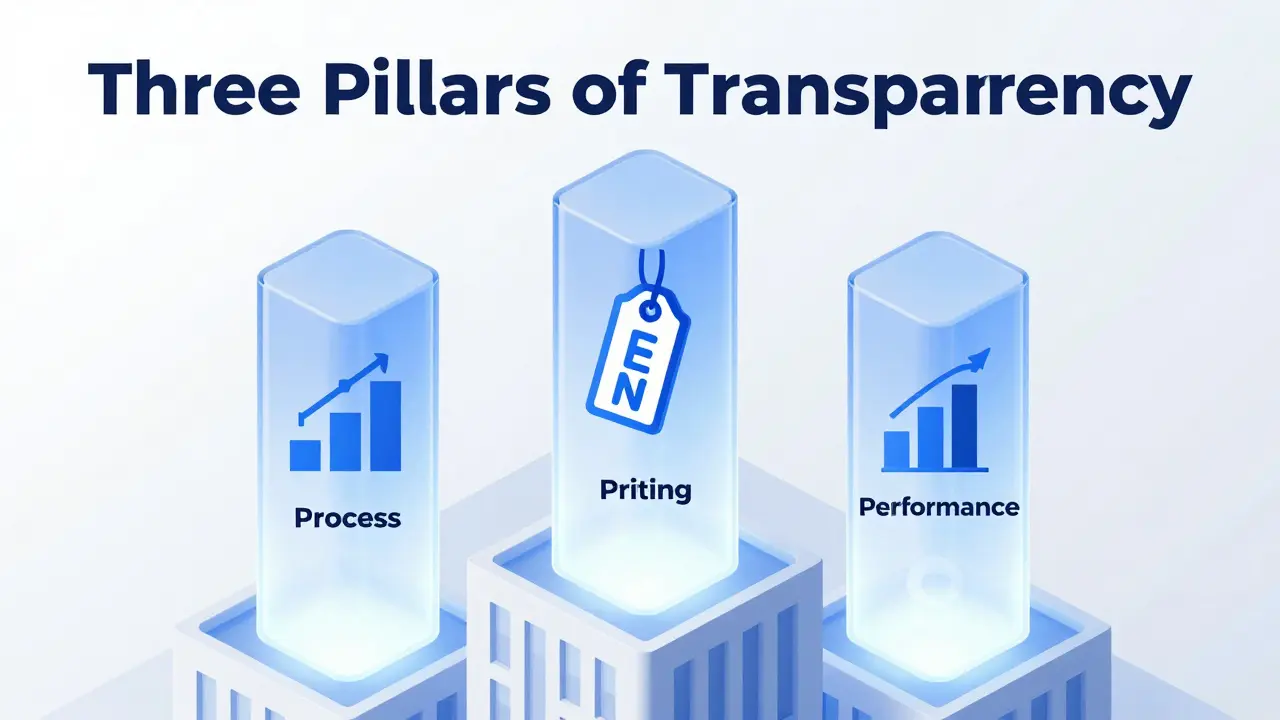
The Three Pillars of Operational Visibility
Transparency isn’t just about apologizing when things go wrong. It’s a holistic approach to how you share information across three key areas: process, pricing, and performance. Each pillar requires a different strategy, but all aim to remove ambiguity.
- Process Transparency: Showing customers how their request is handled. This includes live tracking, status updates, and clear explanations of steps. For example, a legal firm might share a dashboard showing exactly where a contract review stands-drafting, reviewing, finalizing.
- Pricing Transparency: Eliminating hidden fees. This means displaying the total cost upfront, including taxes and shipping, rather than adding surprises at checkout. It also involves explaining why prices change, such as raw material costs or labor rates.
- Performance Transparency: Sharing metrics about service quality. This could be uptime percentages for IT services, average response times for support teams, or satisfaction scores. Admitting that your average wait time is currently 15 minutes due to high volume sets realistic expectations better than promising “instant” help and failing.
How to Implement Transparency Without Over-Sharing
A common fear among business leaders is that too much transparency reveals trade secrets or invites criticism. There is a fine line between being open and being naive. The goal is relevant transparency. You don’t need to show your source code or your employee payroll. You need to show what impacts the customer’s experience.
Start by mapping the customer journey. Identify every touchpoint where confusion usually arises. Is it the billing cycle? The delivery window? The return policy? Focus your transparency efforts there. Use simple language. Avoid jargon. Instead of saying “We are experiencing latency issues in the EU-West region,” say “Our servers in Europe are slow right now. We are working on it and expect it to be fixed in two hours.”
Technology plays a huge role here. Customer Relationship Management (CRM) systems can automate status updates. Project management tools like Trello or Asana can be shared with clients via read-only links. Even a simple weekly newsletter can serve as a transparency tool, highlighting wins, losses, and lessons learned.
The Role of Data Privacy in Modern Transparency
In 2026, data privacy is not optional. Regulations like GDPR in Europe and CCPA in California set strict rules on how personal data is used. Transparency extends to how you handle customer information. Customers want to know who has access to their data, how long it is stored, and whether it is sold to third parties.
Being transparent about data usage builds trust. Include a plain-language summary of your privacy policy on your website. Offer easy-to-use dashboards where users can download their data or delete their accounts. When a data breach occurs-and it likely will for most businesses over time-disclose it immediately. Hiding a breach destroys trust forever. Owning it, fixing it, and explaining how you will prevent it next time can preserve relationships.
Turning Complaints into Opportunities
One of the most powerful forms of transparency is public accountability. When a customer complains on social media or a review site, how you respond matters more than the complaint itself. Defensiveness kills trust. Empathy and action restore it.
Consider the case of a airline losing luggage. If the airline ignores tweets about the lost bag, the passenger feels powerless. If the airline replies publicly, “We’re sorry, John. Our system failed. Please DM us your reference number, and we’ll track it personally. Here’s a voucher for your meal tonight,” the narrative shifts. Other potential customers see that the company takes responsibility. This is known as service recovery, which is the process of resolving a service failure to restore customer confidence and loyalty. Transparent service recovery turns detractors into promoters.
| Aspect | Opaque Approach | Transparent Approach |
|---|---|---|
| Error Handling | Hides mistakes, blames external factors | Admits fault, explains root cause, offers solution |
| Pricing | Hidden fees, complex tiers | All-inclusive quotes, clear breakdowns |
| Communication | Generic auto-replies, no timeline | Personalized updates, specific ETAs |
| Data Usage | Vague privacy policies, dark patterns | Plain-language summaries, user control dashboards |
| Customer Perception | Distrust, suspicion, churn | Confidence, loyalty, advocacy |

Measuring the Impact of Transparency
You can’t improve what you don’t measure. To ensure your transparency efforts are working, track specific metrics. Net Promoter Score (NPS) is a good start, but dig deeper. Look at Customer Effort Score (CES). Does transparency make it easier for customers to solve their problems? Monitor retention rates after service failures. Do customers stay when you are honest about delays? Analyze support ticket volumes. Does proactive communication reduce the number of “Where is my order?” emails?
Also, watch your social sentiment. Are people talking about your honesty? Brands like Patagonia and Buffer have built massive followings by being radically transparent about their supply chains and salaries. While not every business needs to publish salary bands, the principle remains: share what you can, and own what you can’t.
Common Pitfalls to Avoid
Even well-intentioned transparency can backfire if done poorly. Here are three common mistakes:
- Over-promising: Don’t use transparency to set unrealistic expectations. Saying “We’ll be done in 10 minutes” when it will take 30 is worse than saying “It will take 30 minutes.”
- Jargon-heavy explanations: Explaining a technical issue using only technical terms excludes the customer. Translate complexity into simplicity.
- Inconsistency: Be transparent everywhere. If your website is open but your support team is secretive, the contradiction erodes trust. Align all channels.
Conclusion: Trust is a Currency
In a world saturated with AI-generated content and algorithmic manipulation, human connection is rare. Service transparency is one of the few ways to prove you are real, accountable, and caring. It requires courage to admit mistakes and clarity to explain processes. But the reward is invaluable: a customer base that believes in you, not just your product. Start small. Pick one area of opacity in your business and shine a light on it. Watch how your customers respond. You might be surprised by the depth of trust that grows from simple honesty.
What is the difference between transparency and oversharing?
Transparency focuses on information relevant to the customer's experience and decision-making, such as pricing, timelines, and error causes. Oversharing involves disclosing internal proprietary data, sensitive employee information, or unnecessary details that confuse rather than clarify. The key is relevance and value to the customer.
How can small businesses implement service transparency without expensive software?
Small businesses can start with manual processes. Send personalized email updates instead of relying solely on generic notifications. Use free project management tools with client-facing views. Clearly list all fees on invoices and websites. Most importantly, train staff to speak honestly about delays and issues rather than using scripted deflections.
Does transparency hurt sales if customers find out prices are high?
Not necessarily. While some price-sensitive customers may leave, transparency attracts customers who value fairness and quality. By explaining the value behind the price-such as premium materials, expert labor, or ethical sourcing-you justify the cost. Hidden fees lead to cart abandonment and distrust, which is far more damaging to long-term revenue.
What should I do if I make a mistake and didn't communicate it early?
Apologize immediately and sincerely. Acknowledge the failure to communicate earlier. Explain what happened, why it was missed, and what you are doing to fix it now. Offer compensation appropriate to the inconvenience. Then, update your processes to ensure future errors are caught and communicated promptly. Honesty after the fact is better than continued silence.
How does data privacy relate to service transparency?
Data privacy is a critical component of modern service transparency. Customers need to know how their personal information is collected, used, and protected. Being transparent about data practices builds trust and ensures compliance with regulations like GDPR and CCPA. Provide clear, accessible privacy policies and give users control over their data.