

You want that new bike. You’ve saved up for the down payment, you’ve got your helmet ready, but then you check your credit score and it’s sitting somewhere in the 500s or low 600s. The bank says no. The dealership looks at you like you’re asking for a loan to buy a castle. It feels like the door is slammed shut before you even start riding.
But here’s the truth: having bad credit doesn’t mean you can’t get a motorcycle. It just means the path is bumpier, more expensive, and requires a lot more caution than walking into a showroom and signing a paper. If you know where to look and what traps to avoid, you can still get on two wheels without wrecking your financial future further.
Can I buy a motorcycle with bad credit?
Yes, you can. However, you will likely face higher interest rates, larger down payment requirements, and fewer lender options compared to someone with good credit.
The Reality of Subprime Motorcycle Financing
When lenders talk about "bad credit," they are usually referring to FICO scores below 670. In the world of motorcycle lending, this puts you in the subprime category. This isn't a moral judgment; it's a risk assessment. Lenders see past missed payments, collections, or bankruptcies as indicators that you might struggle to make monthly payments again.
To offset that risk, they charge you more. While a person with excellent credit (720+) might secure a rate around 5% to 8%, a borrower with bad credit often faces rates between 12% and 25%. Some predatory lenders go even higher. That difference isn't just a few dollars; over a 60-month loan, it can add thousands to the total cost of the bike.
Motorcycle financing is the process of borrowing money specifically to purchase a motorbike, often involving collateralized loans where the bike itself secures the debt. Unlike unsecured personal loans, these are secured loans. If you stop paying, they take the bike. That leverage gives them some power, but it also means they have an incentive to work with you if you show signs of stability.
Where to Actually Find Loans
Your first instinct might be to go to the big national banks. Don’t bother. They have strict cutoffs. Instead, focus your energy on three specific channels that cater to borrowers with imperfect credit histories.
- Credit Unions: These member-owned nonprofits often use "whole-person underwriting." This means they look at your income, job stability, and debt-to-income ratio, not just your score. If you have a steady job and a reasonable budget, a local credit union might approve you when a bank rejects you.
- Specialty Subprime Lenders: Companies like LightStream (sometimes), OnPoint Financial, or smaller regional lenders specialize in high-risk borrowers. They exist because they know how to price the risk. Yes, the rates are higher, but they are transparent about it.
- Dealer Financing: Dealerships often have relationships with multiple lenders, including those who accept bad credit. Be careful here. The dealer makes money on the markup of the interest rate. Always ask to see the "buy rate" (what the lender charges) versus the "sell rate" (what you pay).
Avoid "Buy Here, Pay Here" lots unless you have absolutely no other option. These lots keep the title to the bike until you pay off the loan. They often report only positive payments to credit bureaus (or none at all), meaning paying on time won't help rebuild your credit, but missing a payment will result in immediate repossession.
The Down Payment: Your Best Negotiating Tool
If you have bad credit, cash is king. A large down payment changes the math for the lender. It reduces the amount they need to lend (lowering their risk) and lowers your monthly payment (making it easier for you to afford).
Aim for at least 20% to 30% of the bike’s purchase price. If you can put 50% down, you’ll walk into the negotiation with significantly more power. Lenders are much more willing to overlook a lower credit score if the Loan-to-Value (LTV) ratio is low. An LTV of 70% or less is considered safe for many lenders, even with subprime credit.
For example, if you’re looking at a $10,000 motorcycle, putting $3,000 down leaves you with a $7,000 loan. At a 15% interest rate over 48 months, your monthly payment is roughly $190. Without that down payment, the same loan at 15% would be $260 per month. That $70 difference might be the gap between keeping the bike and losing it.
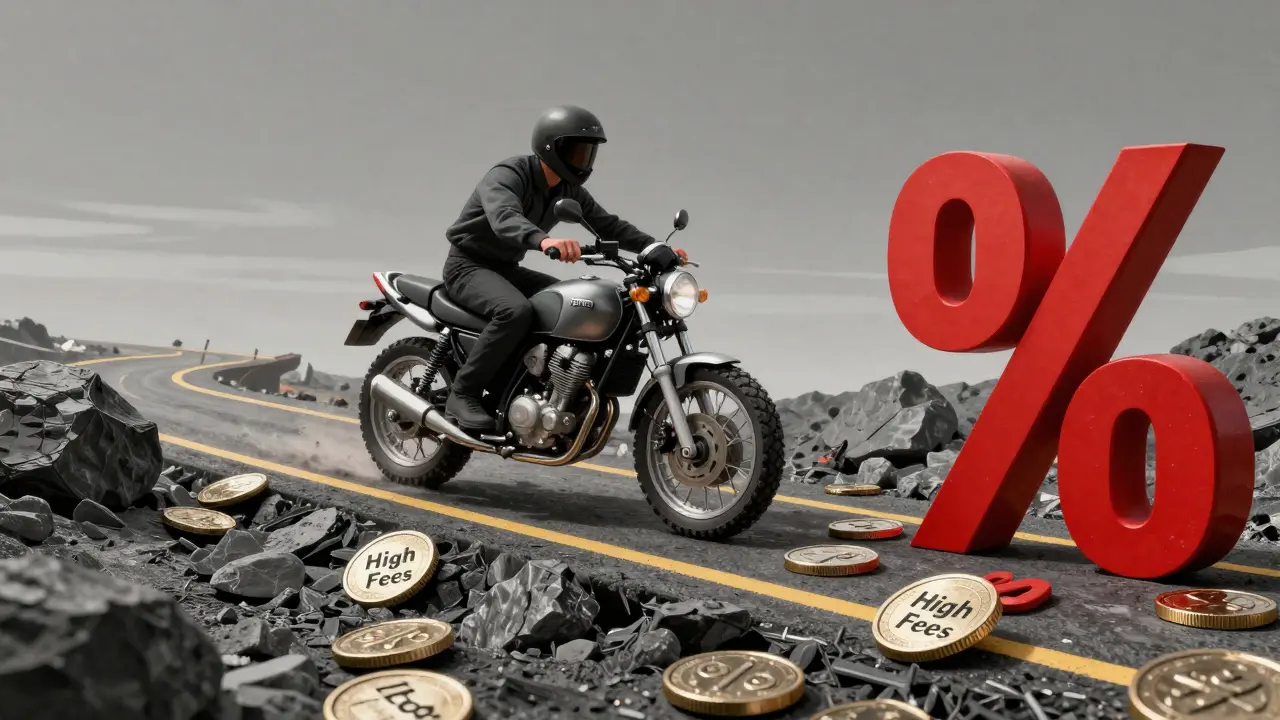
Pitfalls to Avoid: Protecting Yourself from Predatory Practices
Desperation makes you vulnerable. Lenders know this. When you’re trying to get approved with bad credit, you become a target for scams and unfair practices. Watch out for these common traps:
- Jumbo Fees: Watch the bottom line. Some dealers add "documentation fees," "dealer prep fees," or "extended warranty packages" that inflate the loan amount. Since interest is calculated on the total loan amount, adding $1,000 in fees costs you hundreds more in interest over the life of the loan. Refuse any fee that isn’t legally required by your state.
- Negative Equity Traps: Never roll negative equity from a previous car or bike loan into your new motorcycle loan. If you owe $5,000 on a trade-in and the bike is worth $3,000, don’t finance that $2,000 gap. You’ll be underwater immediately, and one accident could leave you owing more than the bike is worth.
- Short-Term High-Interest Loans: Some lenders offer short terms (36 months) with seemingly manageable payments but sky-high interest rates. Others offer long terms (72 months) with tiny payments that stretch out for years. Calculate the total cost of the loan, not just the monthly payment. A longer term means more interest paid overall.
- Gag Clauses: Read the fine print. Ensure you have the right to refinance the loan early without excessive penalties. Once your credit improves slightly, refinancing can save you thousands.
Rebuilding Credit While Riding
Getting the loan is step one. Keeping the bike and improving your financial health is step two. Every on-time payment reported to the three major credit bureaus (Equifax, Experian, and TransUnion) helps build your score. Installment loans like auto and motorcycle loans account for 10% of your FICO score mix and 35% of your payment history.
Set up automatic payments the day you sign the paperwork. Missed payments happen due to forgetfulness, not lack of funds. If you miss one payment, call the lender immediately. Many have grace periods or hardship programs if you communicate proactively.
After 12 to 24 months of perfect payments, shop for a refinance. Even a drop of 20 points in your score can qualify you for a better rate. Refinancing replaces your current loan with a new one at a lower interest rate, reducing your monthly payment or total interest cost.
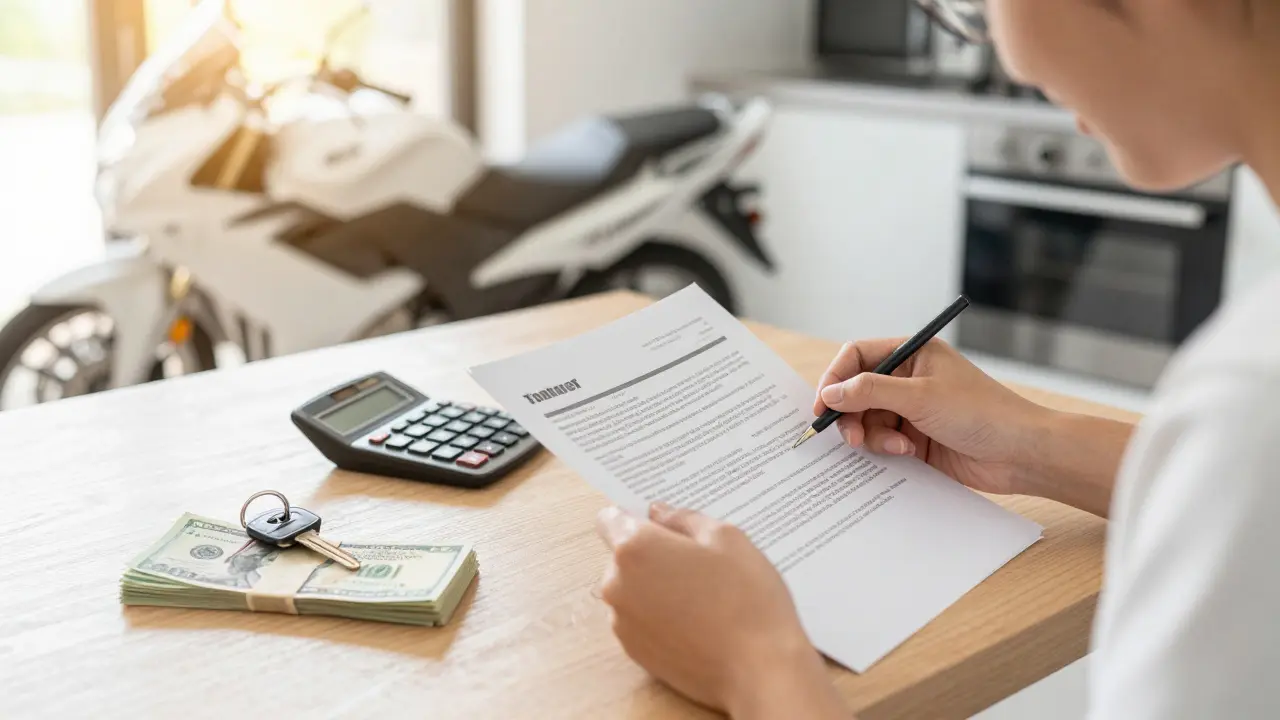
Alternatives to Traditional Financing
If traditional loans are completely off the table, consider these alternatives:
- Save Up and Buy Cash: It takes longer, but it eliminates interest entirely. A used bike bought with cash is often the smartest financial move for someone rebuilding credit.
- Cosigner: If you have a family member or friend with good credit who trusts you, they can cosign the loan. Their creditworthiness helps you get approved and secure a lower rate. Warning: If you miss a payment, their credit suffers too. This is a serious commitment for both parties.
- Leasing: Motorcycle leases require little to no down payment and have shorter terms. However, you never own the bike, and mileage limits can be strict. This is rarely cheaper than financing unless you plan to upgrade frequently.
Making the Decision: A Practical Checklist
Before you sign anything, run through this checklist:
- Have I checked my credit report for errors? Dispute any inaccuracies before applying.
- Do I have at least 20% down?
- Is the monthly payment less than 10% of my gross monthly income?
- Have I shopped around at least three different lenders?
- Do I understand the total cost of the loan (principal + interest + fees)?
- Is there a prepayment penalty?
Buying a motorcycle with bad credit is possible, but it requires discipline. Treat the loan as a tool to rebuild your credit, not just a way to get a bike. Make every payment on time, avoid unnecessary fees, and plan to refinance as soon as your score improves. The road to ownership is steeper, but it’s still drivable.
What credit score do I need to buy a motorcycle?
There is no strict minimum, but most lenders prefer a score above 600. Scores below 580 may require a large down payment or a cosigner. Excellent rates typically start at 680+.
How much should I put down on a motorcycle with bad credit?
Aim for 20% to 30% of the purchase price. A larger down payment reduces the loan amount, lowers monthly payments, and increases approval chances.
Can I refinance a motorcycle loan after improving my credit?
Yes. After 12-24 months of on-time payments, your credit score may improve enough to qualify for a lower interest rate through refinancing.
What are the risks of 'Buy Here, Pay Here' motorcycle dealers?
These dealers often hold the title until the loan is paid off, may not report payments to credit bureaus, and can repossess the bike quickly if a payment is missed.
Does a cosigner help me get a better interest rate?
Yes. A cosigner with good credit can significantly lower your interest rate and increase approval chances, but they are equally responsible for the debt.
Comments
ANAND BHUSHAN
just save up and buy cash. its the only way to not get screwed.
May 6, 2026 at 03:43
Indi s
I totally understand the frustration of being rejected by banks. It feels like they judge you before even knowing your story. I remember when I was in a similar spot, feeling like I had no options left. The pressure to get that bike while dealing with financial stress is really heavy. It is good to know there are other paths like credit unions or dealer financing. You just have to be careful and read every single line of the contract. Don't let them rush you into signing anything you don't fully understand. Take your time and protect yourself from those high interest rates. It is worth the extra effort to find a fair deal. Your financial health matters more than getting the bike quickly. Stay strong and keep looking for better options.
May 6, 2026 at 14:25
Rohit Sen
The article is overly simplistic. Real wealth comes from understanding macroeconomic leverage, not just saving pennies. Most people fail because they lack discipline. Buy cheap. Fix it. Ride it. Simple.
May 6, 2026 at 20:01
Vimal Kumar
Hey everyone, thanks for sharing your thoughts here. It is great to see such a supportive community discussing this important topic. I agree that credit unions can be a lifesaver for many people. They often look at the whole picture rather than just a number. If anyone needs help finding local credit unions, feel free to ask. We can help each other out. Let us make sure we all stay informed and avoid those predatory lenders. Together we can navigate this tricky market safely. Keep the conversation going and share any tips you might have.
May 8, 2026 at 13:57
Amit Umarani
The grammar in this post is acceptable but the advice is generic. You should really focus on the LTV ratio part. It is crucial. Also, stop using so many bullet points. It looks messy. Read the fine print carefully. Do not trust dealers implicitly. They want your money. Not your happiness. Check your credit report first. Always.
May 10, 2026 at 10:21
Noel Dhiraj
you got this man. dont let the banks win. just keep pushing forward and find a way. maybe start small and work your way up. i believe in you. keep grinding and you will get that ride. stay positive and focused on your goals. you can do it.
May 12, 2026 at 00:25
vidhi patel
It is absolutely imperative that one exercises extreme caution when engaging with subprime lenders. The terminology used in these contracts is often deliberately obscure to confuse the uninitiated. One must meticulously scrutinize every clause regarding prepayment penalties and negative equity traps. Failure to do so results in significant financial detriment. The notion that one can simply 'buy' their way out of bad credit is fundamentally flawed. Discipline and rigorous adherence to payment schedules are non-negotiable requirements. Any deviation leads to repossession and further credit damage. Therefore, thorough due diligence is not merely advisable; it is essential for survival in this market.
May 12, 2026 at 15:00
Priti Yadav
They want you to think you have options. They don't. The banks are connected to the dealers who are connected to the lenders. It is all a big scam designed to keep you in debt forever. I tried to get a loan once and they denied me instantly. Then my friend got approved at the same place. Why? Because they decided he was safe. Who decides that? No one knows. It is rigged. Just buy cash or don't ride. That is the only way to stay free.
May 13, 2026 at 17:04
Ajit Kumar
It is morally reprehensible to encourage individuals to engage in high-interest debt without a comprehensive understanding of the long-term consequences. The pursuit of material pleasure, such as motorcycle ownership, should never supersede fiscal responsibility and ethical financial conduct. One must consider the broader implications of their actions on their family and community. Indulging in such frivolous expenditures while carrying a poor credit score demonstrates a profound lack of character and foresight. True virtue lies in restraint and the diligent rebuilding of one's financial standing through honest labor and prudent saving habits. To suggest otherwise is to promote a culture of instant gratification that ultimately leads to personal ruin and societal decay. We must strive for excellence in all aspects of life, including our financial decisions.
May 15, 2026 at 03:13
Diwakar Pandey
I noticed some people mentioned credit unions. I found a few local ones that helped me. It was quiet and easy. They explained everything clearly. No hidden fees. Just simple terms. I recommend checking them out if you are stuck. It helps to talk to someone who understands your situation. Good luck with your search. Hope you find what you need.
May 15, 2026 at 05:46
Geet Ramchandani
This entire discussion is pathetic. People are complaining about bad credit like it is a tragedy. It is not. It is a choice. You spent your money on stupid things and now you are crying about it. The system works exactly as it is supposed to. If you cannot manage your finances, you do not deserve a motorcycle. Stop whining and start saving. Or better yet, walk. It is cheaper and healthier. The fact that you are reading this article instead of fixing your life shows how broken you are. Wake up and take responsibility for your own mess.
May 16, 2026 at 00:00