
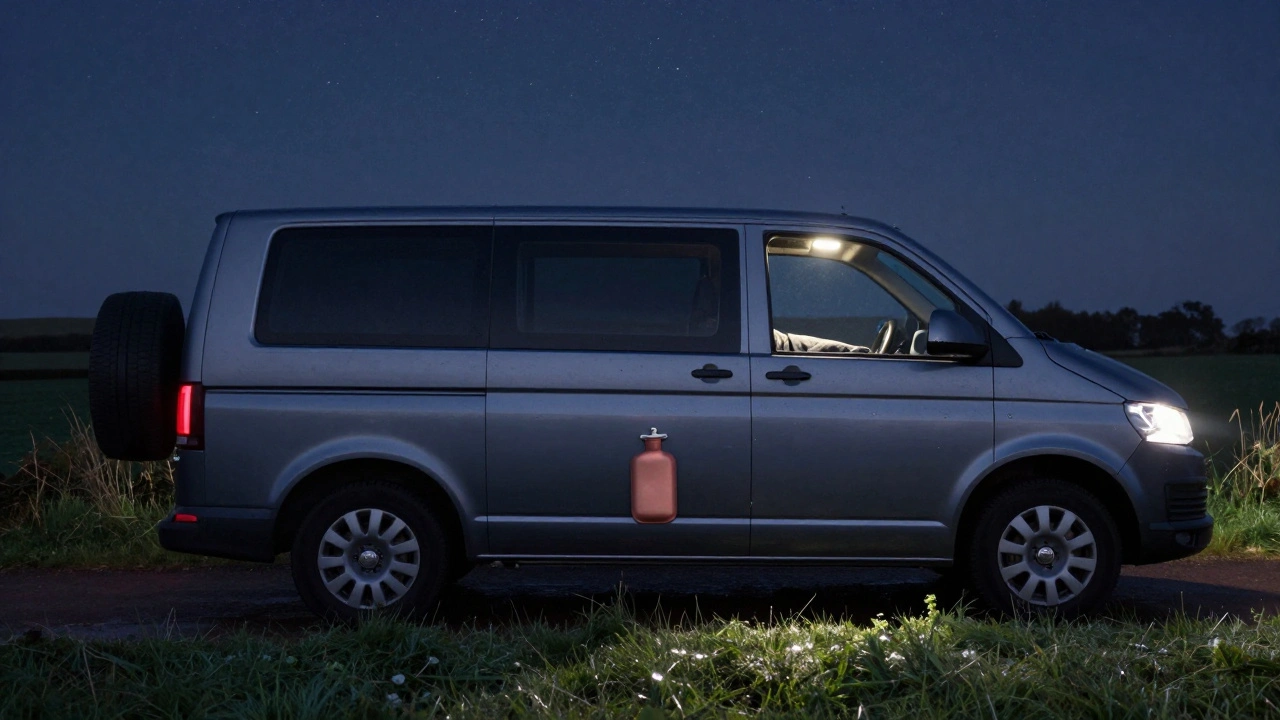
Why Sleeping in Your Car Is Better Than You Think
Most people assume sleeping in a car is a last resort-something you do when you’re lost, broke, or stranded. But thousands of people in the UK and beyond do it on purpose. Car camping isn’t about survival. It’s about freedom. No tent setup. No weather delays. No bugs. Just pull over, lock the doors, and fall asleep under the stars. The trick? Doing it right.
There’s a big difference between crashing in your car after a long drive and actually sleeping comfortably and safely. You need the right gear, the right spot, and the right mindset. This isn’t about roughing it. It’s about smart, simple comfort.
What You Actually Need (No Fluff)
You don’t need a luxury RV or a $2,000 sleeping system. You need five things that work together:
- Insulated sleeping pad-not a foam mat from a discount store. Get one rated for at least R-3.5. The Therm-a-Rest NeoAir XTherm is a top pick because it’s thin, packs small, and keeps you warm even when the car drops to 2°C at night.
- Warm sleeping bag-look for a bag rated to at least -2°C. Down is lighter, but synthetic works better if you’re worried about condensation. The Sea to Summit Spark SP III is a favourite among UK car campers for its weight and warmth.
- Blackout curtains or window shades-your car’s windows aren’t designed for sleep. Sunlight and streetlights will wreck your rest. Use adhesive-backed blackout film or magnetic shades like CarSleep Shades. They block 99% of light and fit snugly without damaging your glass.
- Portable air pump-if you’re using an inflatable mattress, a 12V pump is non-negotiable. Manual pumps take too long, and you’ll be too tired to do it after driving. The Intex Quick-Release Pump runs off your car’s cigarette lighter and fills a twin mattress in under 3 minutes.
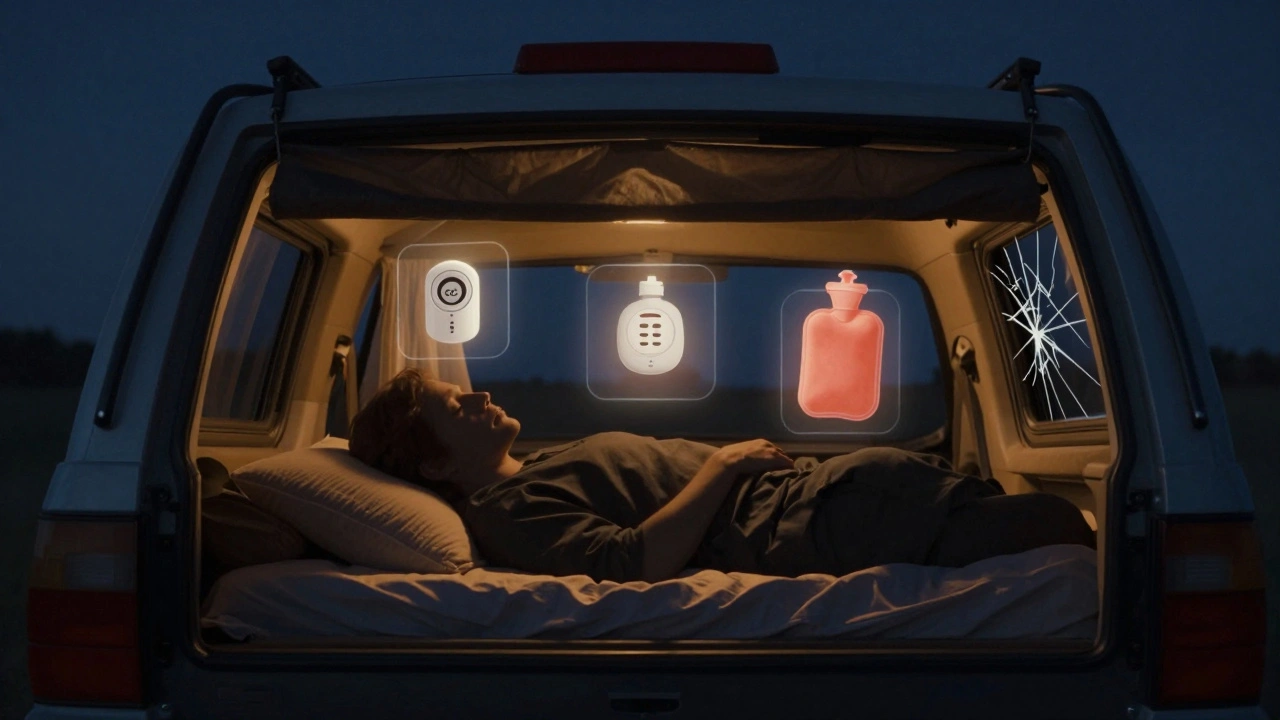
- Carbon monoxide detector-this isn’t optional. Even if you think you’re careful, exhaust fumes can seep in. A small, battery-powered CO alarm like the First Alert CO615 costs under £30 and could save your life.
Where to Sleep Without Getting in Trouble
In the UK, you can legally sleep in your car in many places-but not all. You can’t just park on any roadside and call it a night. Here’s where it works:
- Official campgrounds-even basic ones with no hookups. Many are under £15 a night and give you toilets, water, and security. Sites like Pitchup.com list hundreds of low-key spots across England and Wales.
- Service stations-motorway service areas are designed for rest. Most allow overnight parking if you’re quiet and don’t set up chairs or tents. Avoid ones near big cities-security patrols are common.
- Permitted lay-bys-look for signs that say "Overnight Parking Allowed" or "Rest Area." Rural areas in the Lake District, Dartmoor, and the Scottish Highlands have dozens of these.
- Private land with permission-apps like Park4Night show users’ real-time reports of safe spots, including farms and pubs that let campers stay for free.
Avoid sleeping near schools, hospitals, or busy town centres. Police can ask you to move even if you’re not breaking the law. Stay low-key. No loud music. No open fires. No leaving trash.

How to Stay Warm (Without Turning On the Engine)
One of the biggest mistakes people make is thinking they need to run the engine to stay warm. That’s dangerous and unnecessary.
Here’s what actually works:
- Layer your insulation-put the sleeping pad under you, then your sleeping bag. Add a fleece blanket on top. You’re trapping heat, not generating it.
- Use a hot water bottle-fill a plastic bottle with boiling water before bed. Place it near your feet or core. It’ll last 4-6 hours and costs nothing.
- Block drafts-tape towels or foam strips along door and window edges. Even small gaps let out heat fast.
- Wear dry clothes-never sleep in damp or sweaty clothes. Change into clean, dry thermal layers before getting in bed.
- Keep the air moving-crack a window 1-2 cm. It stops condensation from building up on the glass and making your sleeping bag damp.
People who run their engines overnight often wake up with fogged windows, stale air, and a dead battery. You don’t need it. Your body generates enough heat if you’re properly insulated.
Security: Don’t Be a Target
Most car campers never get bothered. But you need to act like you belong there.
- Park where others are-if you see other cars sleeping nearby, you’re safer. Isolation attracts attention.
- Hide valuables-keep phones, wallets, and cameras out of sight. Even a phone charger on the dash can tempt a thief.
- Lock everything-even if you’re just stepping out for a pee. Use the child lock on rear doors so no one can open them from the outside.
- Don’t advertise you’re sleeping-no tents, no chairs, no lanterns outside. Keep it simple. A car looks like a car. That’s the point.
Some people install a dashcam with motion detection. Others use a simple door alarm like the Yale Real Living-it beeps if someone tries to open the door. Both help, but common sense matters more.
What Not to Do
Here are the top five mistakes car campers make-and how to avoid them:
- Don’t sleep in a sedan with no rear seats-you won’t lie flat. Even if you fold the seats, the angle will hurt your back. SUVs, vans, and hatchbacks work best.
- Don’t use a regular pillow-it slides around and doesn’t support your neck. Use a rolled-up jacket or a compact inflatable pillow.
- Don’t eat messy food in the car-crumbs attract ants, mice, and worse. Eat before you park. Clean up completely.
- Don’t leave the windows wide open-rain, wind, and noise will ruin your sleep. Use the 1-2 cm crack trick instead.
- Don’t assume you’re invisible-some places have quiet enforcement. If you’re parked somewhere odd at 3 a.m., expect a check-in. Be polite. Explain you’re car camping. Most officers will just nod and move on.
Real-Life Example: A Night in the Lake District
Last summer, a couple from Bristol parked at a quiet lay-by near Grasmere at 9 p.m. They used their VW Transporter, a Therm-a-Rest pad, a -2°C sleeping bag, and magnetic blackout shades. They didn’t turn on the engine once. They heated water on a portable stove before bed, filled a bottle, and slept until sunrise. No one bothered them. They woke up dry, warm, and refreshed. No campsite fees. No noise. Just the sound of birds.
That’s the goal.
What to Pack in Your Car (The Minimalist List)
You don’t need a garage full of gear. Here’s what fits in a small duffel:
- Insulated sleeping pad (R-3.5 or higher)
- Warm sleeping bag (rated to -2°C)
- Blackout window shades or film
- 12V air pump
- Carbon monoxide detector
- Hot water bottle
- Microfibre towel (dries fast)
- Small headlamp (red light mode for night use)
- Reusable water bottle and electrolyte tablets
- Trash bag (pack out everything)
- Hand sanitiser and wet wipes
That’s it. Everything else is extra.
Final Tip: Test It Before You Go
Don’t wait until you’re 200 miles from home to find out your sleeping bag is too cold or your windows fog up. Try it out in your driveway or a local park before your trip. Sleep one night. See what works. Adjust. Learn.
Car camping isn’t about gear. It’s about confidence. Once you’ve done it once, you’ll never see your car the same way again.
Is it legal to sleep in your car in the UK?
Yes, it’s generally legal to sleep in your car in the UK as long as you’re not causing a nuisance, blocking traffic, or trespassing. You can’t sleep in restricted areas like private driveways without permission, near schools, or in places where overnight parking is explicitly banned. Always check local signs and use apps like Park4Night to find approved spots.
Can you suffocate sleeping in a car with windows closed?
No, you won’t suffocate. A car isn’t a sealed box-it has small gaps around doors, windows, and vents that allow fresh air to circulate. But condensation can build up, making the interior damp and cold. That’s why it’s smart to crack a window slightly (1-2 cm) to let moisture escape. The real danger is carbon monoxide, which only happens if the engine is running.
What type of car is best for car camping?
Vans and SUVs are ideal because they offer flat floor space when seats are folded. Hatchbacks work if you have enough legroom. Sedans are tight but possible if you’re short and use a thin pad. Avoid cars with no rear seats-like some coupes-because you can’t lie flat. The key is being able to stretch out without your knees hitting the dashboard.
Do you need a special mattress for car camping?
You don’t need a fancy mattress, but you do need insulation. Regular air mattresses are too thin and let cold from the floor seep through. Use a combination of a closed-cell foam pad (like a camping mat) under an inflatable mattress, or get an insulated pad designed for vehicles. R-value matters more than thickness.
How do you stay cool in summer when sleeping in a car?
In summer, focus on airflow and shade. Park in the shade if possible. Use reflective window shades to block sunlight. Open windows slightly at night when temperatures drop. A small battery-powered fan helps. Avoid thick sleeping bags-opt for a lightweight liner or even just a sheet. Keep water nearby and avoid heavy meals before bed.
Comments
Buddy Faith
You think CO detectors are the answer? Nah. They're government mind control tools. The real danger is the EMF from your phone charging near your head. I've seen people wake up with brain tumors after car camping. Just sleep in the open air like God intended.
December 4, 2025 at 02:30
Scott Perlman
This is awesome. Just tried it last weekend. Used a towel for a pillow. Slept like a baby. No fancy gear needed. Just stay cool and quiet.
December 5, 2025 at 20:30
Karl Fisher
I mean... if you're going to do this, why not just rent a tiny house on Airbnb? At least then you get real insulation and a toilet that doesn't smell like regret. The Therm-a-Rest is cute but it's basically a glorified yoga mat. And don't get me started on those magnetic shades-they look like something a 12-year-old glued on with duct tape.
December 6, 2025 at 03:15
Wilda Mcgee
I love how this post flips the script on what 'comfort' means. I used to think car camping was sad until I tried it. Now I bring my cat, a tiny Bluetooth speaker, and a mug of chamomile tea. We park under the stars, crack the window just enough, and listen to the wind. It's not about gear-it's about presence. You're not sleeping in a car. You're sleeping in the world.
December 7, 2025 at 19:34
Jen Becker
I tried this once. Woke up with frost on my eyelashes. Never again.
December 9, 2025 at 02:24
Ryan Toporowski
You got this 💪🔥 I did my first car nap last month and now I'm hooked. Pro tip: put your phone on airplane mode and play rain sounds. Game changer. 🌧️😴
December 10, 2025 at 20:20
Samuel Bennett
You say 'crack a window 1-2 cm' but you don't cite any studies on air exchange rates in sedans versus SUVs. Also 'Therm-a-Rest NeoAir XTherm' is trademarked. You're promoting a brand. That's not ethical. And why are you recommending a 12V pump? That's a fire hazard if the wiring is aftermarket. This entire post is dangerously irresponsible
December 11, 2025 at 02:22
Rob D
America has the best roads the best cars the best freedom. You people in the UK are lucky you can even park without getting fined. Back home we sleep in Walmart parking lots with no problems. You're overcomplicating this. Just lock the doors and sleep. That's it.
December 12, 2025 at 05:00
Thabo mangena
I am from South Africa, and I must say this article resonates deeply. In our country, many people sleep in vehicles due to economic hardship, yet there is also a growing movement of those who choose it for freedom and connection with nature. The principles you outline-safety, preparation, respect-are universal. I have seen families in the Drakensberg do this with dignity, using blankets woven by their grandmothers and warm tea in thermoses. Your list is practical, but the heart of it is the same wherever you are: to rest with peace, and to honor the earth that holds you.
December 12, 2025 at 17:47
Franklin Hooper
The phrase 'you won't suffocate' is misleading. The oxygen depletion in a sealed vehicle is negligible, yes, but the real issue is CO2 buildup over 8+ hours. The EPA recommends 0.5 air changes per hour for enclosed spaces. A 1cm crack provides approximately 0.12 ACH. This is insufficient for prolonged occupancy. Also, your recommendation of 'hot water bottle' is a burn hazard if not properly insulated. Please revise.
December 14, 2025 at 07:09
Glenn Celaya
I read this and cried. I used to do this after my divorce. Parked under a bridge in Ohio. No one knew. No one cared. I didn't need a sleeping bag. I just needed silence. Now I have a house. But sometimes... I still drive out to the woods and sleep in my car. Just to remember what it felt like to be alone and safe at the same time
December 16, 2025 at 04:42
Jess Ciro
The government wants you to think car camping is safe so they can track your location through your phone. That CO detector? It's a beacon. They're watching. Park at a service station? That's a drone hotspot. You think you're free? You're just another data point in the surveillance matrix.
December 17, 2025 at 18:10
Madeline VanHorn
I'm sorry but if you're using a 'hot water bottle' you're not car camping-you're camping in the 1970s. Get a heated blanket. Or better yet, just go to a hotel. This whole post is just a glorified glorification of poverty.
December 18, 2025 at 23:11
Chris Atkins
I live in Florida and do this every weekend. Best part? Waking up to the sound of crickets and the smell of salt air. No tent poles to fight. No rain ruining my sleep. Just me my car and the stars. You don't need much. Just a little courage and a good pair of socks
December 19, 2025 at 06:42
Nicholas Carpenter
I appreciate the practical advice. I'm an older camper and I've seen trends come and go. The key is not the gear-it's awareness. Respect the space you're in. Be quiet. Leave no trace. And if you're unsure whether it's allowed, ask. Most landowners are happy to say yes if you're polite. This isn't about being edgy. It's about being thoughtful.
December 20, 2025 at 14:40