
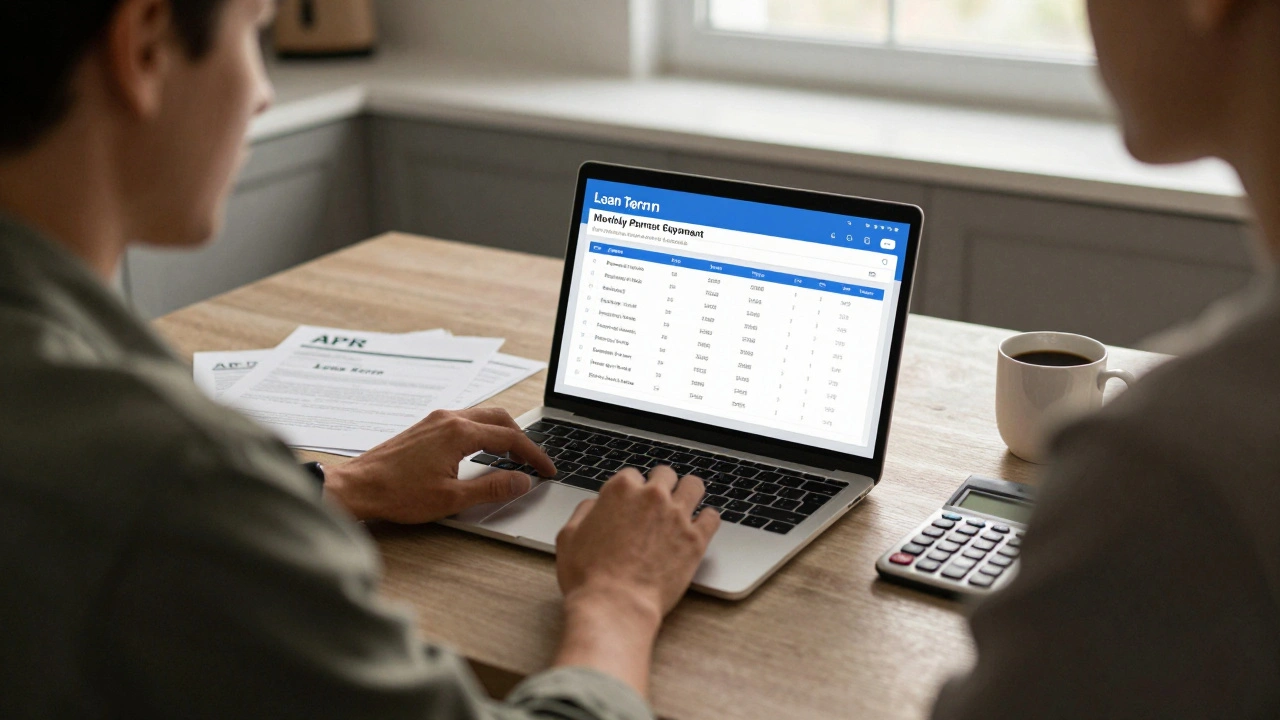
Buying a car is one of the biggest purchases most people make - second only to a home. But unlike a home, a car loses value the moment you drive it off the lot. That’s why understanding your car loan is critical. Too many people focus only on the monthly payment and end up paying thousands more than they planned. This guide breaks down the three things that actually matter: APR, loan terms, and monthly payments.
What Is APR, and Why Does It Matter More Than the Price?
APR stands for Annual Percentage Rate. It’s not the same as the interest rate. The interest rate is just the cost of borrowing money. APR includes that interest rate plus any fees the lender charges - like origination fees, processing fees, or documentation fees. That’s why two loans with the same interest rate can have very different APRs.
For example, say you’re offered two $25,000 car loans. One has a 4.5% interest rate with no fees. The other has a 4.2% interest rate but a $500 origination fee. The second loan might look cheaper at first, but once you add the fee, its APR jumps to about 5.1%. That means you’ll pay more over the life of the loan.
In the UK, lenders are required by law to show you the APR before you sign anything. Always compare APRs, not interest rates. A 0.5% difference in APR on a £20,000 loan over five years can cost you over £250 extra. That’s a weekend getaway gone.
Loan Terms: Shorter Isn’t Always Better
Loan term is how long you have to pay back the loan - usually 36, 48, 60, or even 72 months. Dealers and banks love long terms because they make the monthly payment look smaller. But here’s the catch: longer terms mean you pay more in interest.
Take a £22,000 car loan at 5.8% APR:
- 36-month term: £665 per month, total interest paid: £2,140
- 60-month term: £423 per month, total interest paid: £3,580
- 72-month term: £361 per month, total interest paid: £4,500
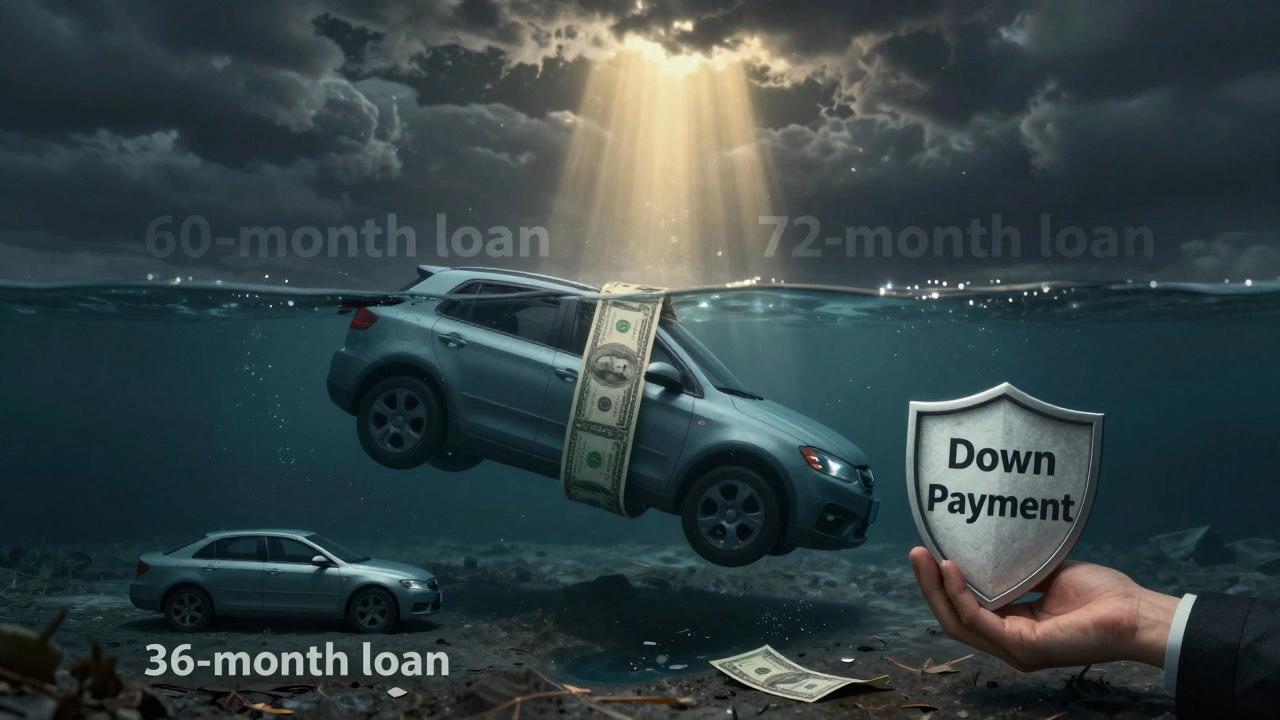
That’s £2,360 more in interest just by stretching the loan to 72 months. And that’s not even counting depreciation. Cars lose about 20% of their value in the first year and up to 60% by year five. If you’re still paying off a 72-month loan after year five, you could owe more than the car is worth. That’s called being upside down on your loan.
Most financial experts recommend a maximum term of 60 months. If you can’t afford a 60-month payment, consider a cheaper car or save more for a down payment. Don’t let a low monthly payment trap you into a longer, costlier loan.
How Monthly Payments Are Calculated (And How to Check If You’re Being Overcharged)
Your monthly payment isn’t just the loan amount divided by the number of months. It’s calculated using a formula that includes the principal, the APR, and the term. Most people don’t know this, but lenders use the same math every time: the amortization formula.
You can check your payment yourself with this simple version:
Monthly Payment = [P × r × (1 + r)^n] / [(1 + r)^n - 1]
Where:
- P = Loan amount (principal)
- r = Monthly interest rate (APR ÷ 12 ÷ 100)
- n = Number of payments (loan term in months)
Let’s say you borrow £18,000 at 6.2% APR for 48 months:
- P = 18,000
- r = 6.2 ÷ 12 ÷ 100 = 0.005167
- n = 48
Plug it in: [18,000 × 0.005167 × (1.005167)^48] / [(1.005167)^48 - 1] = £423.72
If your lender says it’s £450, ask why. Maybe they added insurance, extended warranty, or a credit protection plan - all of which are optional. You have the right to remove them. Never sign anything until you’ve verified the numbers yourself.
Down Payments: The Hidden Power Move
A down payment isn’t just about lowering your monthly payment. It’s about control. The more you put down upfront, the less you borrow - and the less you pay in interest.
Putting down 20% on a £25,000 car means you only borrow £20,000. That’s £5,000 less in principal. At 5.5% APR over 60 months, that saves you £2,900 in interest. It also means you’re less likely to be upside down on your loan.
But you don’t need 20%. Even 10% helps. A £2,500 down payment on the same £25,000 car cuts your monthly payment by £80 and reduces total interest by £1,450. That’s like getting a free month of payments every year.
Some lenders offer 0% down, but those deals often come with higher APRs or mandatory add-ons. If you can scrape together even £1,000, do it. It gives you breathing room.
What to Watch Out For: Common Car Loan Traps
Dealers and lenders have ways to make loans look better than they are. Here are the most common traps:
- Rollover negative equity: If you still owe money on your old car, some dealers will roll that debt into your new loan. That means you’re financing a car you already paid for. Avoid this at all costs.
- Extended warranties and service contracts: These are profitable for the dealer, not you. Most cars don’t break down in the first five years. Skip them unless you’re buying a used car with no warranty.
- Gap insurance: This isn’t always a scam. If you’re financing a new car with low down payment and a long term, gap insurance protects you if the car is totaled and you owe more than it’s worth. But don’t buy it from the dealer - shop online. You can get it for £50 a year instead of £500.
- Prepayment penalties: Some loans charge you if you pay off early. Always read the fine print. If there’s a penalty, walk away.
Where to Get the Best Car Loan Rates
You don’t have to take the dealer’s finance offer. In fact, you shouldn’t. Banks, credit unions, and online lenders often offer better rates.
Check your bank first. If you’ve been a customer for years, they may give you a preferred rate. Credit unions are often the best bet - they’re not-for-profit and usually offer lower APRs than big banks. Websites like MoneySuperMarket, Compare the Market, or ClearScore let you compare car loan deals without hurting your credit score.
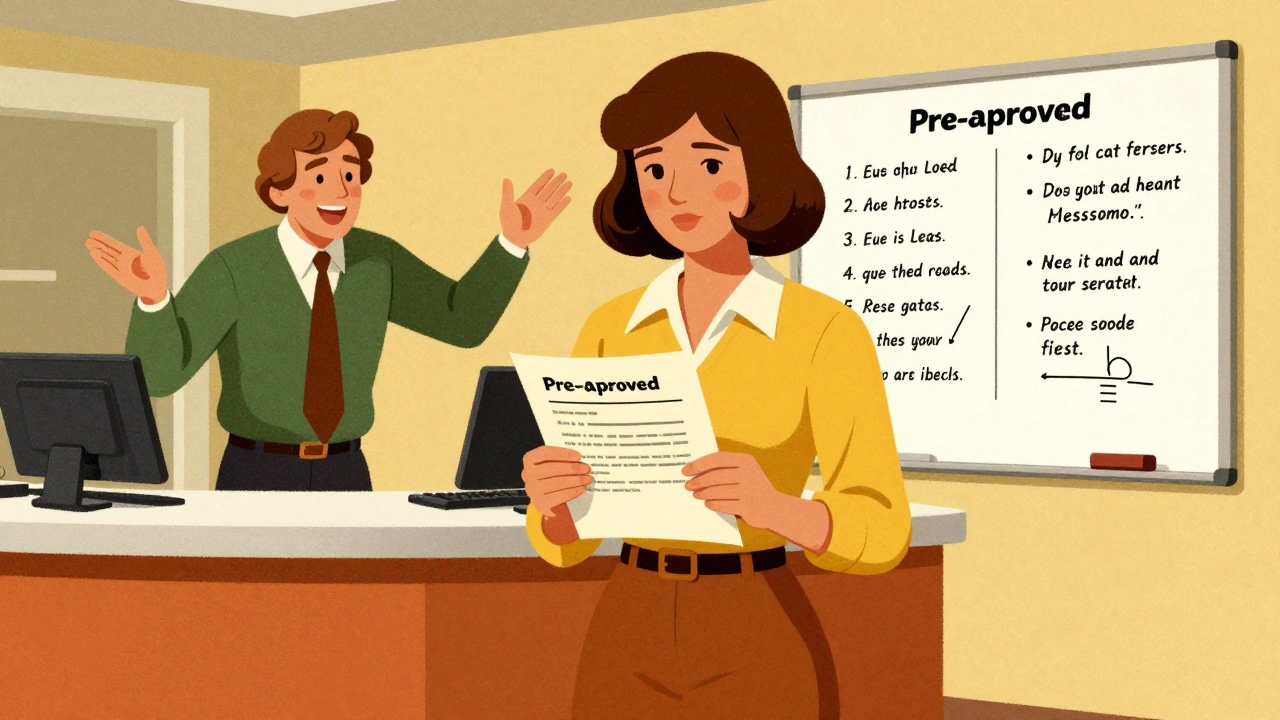
Pre-approval is your secret weapon. Get approved for a loan before you even step into a dealership. That turns you from a buyer into a cash buyer with financing. Dealers have to compete for your business. And you’ll know exactly what you can afford.
Final Tip: Use an Auto Loan Calculator
Before you sign anything, plug your numbers into a free online auto loan calculator. The UK’s Financial Conduct Authority (FCA) recommends using one. You can find them on MoneySavingExpert, Bankrate, or even the BBC’s Money website.
Try this: Enter the car price, down payment, APR, and term. Then change one thing - say, increase the down payment by £1,000. Watch how the interest and monthly payment drop. It’s eye-opening. And it gives you real power in negotiations.
Car loans aren’t complicated. But they’re designed to confuse you. Focus on APR, keep the term short, pay as much upfront as you can, and never trust a salesperson’s math. Do your homework, and you’ll drive off in a car that doesn’t drain your bank account for years to come.
What’s a good APR for a car loan in the UK right now?
As of late 2025, a good APR for a new car loan is between 4% and 6% for buyers with good credit (650+). For used cars, expect 6% to 9%. Rates below 4% are rare and usually reserved for buyers with excellent credit (750+) or special manufacturer promotions. Always compare APRs, not just monthly payments.
Can I pay off my car loan early without penalty?
Yes - but only if your loan agreement doesn’t say otherwise. Most UK lenders don’t charge prepayment penalties anymore, thanks to FCA rules. Still, always check your contract. If there’s a penalty, it’s usually capped at two months’ interest. Paying early saves you money on interest, so it’s almost always worth it if you can afford it.
Is it better to finance through a dealer or a bank?
Usually, a bank or credit union offers a better rate. Dealers sometimes offer 0% APR, but those deals are limited to certain models, require high credit scores, and often come with hidden fees. Getting pre-approved from your bank gives you leverage. You can then tell the dealer: ‘Here’s my rate - can you beat it?’
How much should I put down on a used car?
For a used car, aim for at least 10% down. Used cars depreciate slower than new ones, but they’re riskier - no factory warranty, possible hidden issues. A bigger down payment reduces your loan amount and lowers your monthly payment. It also gives you a buffer if repairs come up.
What happens if I can’t make a car payment?
Contact your lender immediately. Most will work with you if you reach out before missing a payment. Options include skipping a payment, extending the term, or refinancing. Don’t ignore it. Missing payments hurts your credit score and can lead to repossession. In the UK, lenders must give you 14 days’ notice before repossessing your car.
Comments
Mbuyiselwa Cindi
Love this breakdown. I used to think the monthly payment was the only thing that mattered until I got upside down on a 72-month loan. Learned the hard way - now I always check APR and aim for 20% down. Even 10% helps way more than people think.
December 2, 2025 at 13:57
Nathan Pena
The amortization formula is not merely a mathematical construct - it is the bedrock of financial literacy. To ignore APR in favor of monthly payment is to confuse arithmetic with economics. The dealer’s glossy brochure is a Rorschach test for the financially naive. You are not buying a car; you are signing a multi-year contract with a predatory institution that profits from your ignorance.
And yet, the FCA’s recommendations are still insufficient. Why? Because regulation follows behavior, it does not shape it. The real issue is cultural: we have normalized debt as a lifestyle. A 60-month term is not a ‘reasonable’ compromise - it is a surrender.
Pre-approval is not a ‘secret weapon’ - it is the minimum viable defense. If you walk into a dealership without it, you are not a buyer. You are inventory.
Also, ‘gap insurance’ from the dealer? That’s not insurance. That’s a tax on desperation. Pay $50 online or don’t pay at all. Your car is not a sacred object. It is a depreciating asset. Treat it like one.
And for the love of all that is rational - stop conflating ‘good credit’ with moral virtue. Your credit score is a metric, not a merit badge.
December 4, 2025 at 02:39
Tonya Trottman
‘Good APR’? What does that even mean? You say 4–6% is good for new cars - but who defines ‘good’? The banks? The dealers? The same people who invented 72-month loans and ‘negative equity rollovers’? That’s like asking if a snake is ‘good’ at biting.
Also, you wrote ‘APR ÷ 12 ÷ 100’ - that’s wrong. It’s APR ÷ 1200. You’re off by a factor of 10. I’m not even mad. I’m just disappointed. This whole guide is basically a Wikipedia article with extra steps and one critical math error. Thanks for the misinformation, I guess.
Also - ‘BBC’s Money website’? They don’t have one. You mean MoneyHelper? You’re making up sources now. This is embarrassing.
December 4, 2025 at 23:16
Krzysztof Lasocki
So let me get this straight - you’re telling me I should care about APR instead of the monthly payment? And that I shouldn’t let the dealer talk me into a 72-month loan? And that I should put down money? And that I should pre-approve? Holy hell. You just gave me the cheat code to not get screwed. I feel like I just got out of a time loop.
Also, I just paid $500 for gap insurance from the dealer. I’m going to cancel it tomorrow and buy it on Amazon for $45. I’m gonna send them a photo of my receipt with a thumbs up. They’re gonna lose their minds.
December 6, 2025 at 17:10
Victoria Kingsbury
APR is the real MVP here. I used to think ‘low monthly payment = good deal’ until I realized I was paying $3,000 more in interest just because I stretched it to 72 months. My car was worth $12K at year 5 and I still owed $16K. Classic upside down. Now I use Bankrate’s calculator religiously - even for used cars. It’s insane how much difference a 1% change makes.
Also - never trust a salesperson’s ‘special financing’. If they say ‘we can get you approved’, that’s code for ‘we’re gonna bury you in fees’.
December 7, 2025 at 17:39
Shivam Mogha
Down payment matters. Simple.
December 8, 2025 at 15:29
VIRENDER KAUL
The entire framework of consumer credit is a structural illusion designed to extract surplus value from the working class. The automobile industry, in collusion with financial institutions, has engineered a system where liquidity is weaponized against the individual. You are not purchasing mobility; you are entering into a debt covenant that binds your future earnings.
The notion of ‘a good APR’ is a fallacy. There is no good APR. There is only the APR you can negotiate after you have secured pre-approval from a credit union with lower overhead than a corporate bank. The dealer’s finance office is a casino where the house always wins.
Moreover, the FCA’s recommendations are reactive, not proactive. They regulate after the damage is done. True financial sovereignty lies in cash transactions. If you cannot afford to pay for a vehicle outright, you cannot afford it. Period.
And yet - the cultural conditioning is so deep that even those who understand this still capitulate. Why? Because the social pressure to ‘have a car’ overrides rational self-interest. This is not economics. This is psychology.
Pre-approval is not a tactic. It is an act of resistance.
December 10, 2025 at 12:43
OONAGH Ffrench
APR is the only number that matters. Everything else is noise. I’ve been driving the same 2018 Honda for six years now. Paid cash. No payments. No stress. No interest. No regrets. If you can wait, save. If you can’t wait, save more. The car will still be there next year.
And if you’re reading this and thinking ‘but I need a car now’ - ask yourself: do you need it, or do you just want it to look like you’ve made it?
December 10, 2025 at 23:08
poonam upadhyay
OMG YES I HAD THIS HAPPEN TO ME!! I took a 72-month loan for my used Corolla and by year 4 I was upside down by $5K and then the transmission went and I had to sell it for $8K and still owed $13K and I cried in the parking lot like a fool!!
Now I only look at 48-month loans and I always check the APR on MoneySuperMarket - and I NEVER take the dealer’s warranty. I bought a 3-year extended warranty from a third party for $180 and it covered my water pump last year. Dealer wanted $900. I’m a genius now. 😎
December 12, 2025 at 03:34
Henry Kelley
Just want to say this post saved me from a bad deal. I was about to sign for a 72-month loan on a $28K car with 6.9% APR. Thought the $410/month was fine. Then I read this, ran the numbers, and realized I’d pay $5K more in interest than if I went 60 months. I talked to my credit union, got 4.8%, and now I’m paying $470/month but for 12 fewer months. Total interest saved: $2,100. I feel like I just won the lottery.
Also - the part about pre-approval? Game changer. Walked in like I had cash. Dealer scrambled. Ended up with $500 off MSRP. Best day ever.
December 13, 2025 at 07:43
Mike Marciniak
They don’t want you to know this. The entire car loan system is a front for the banking cartel. APR? It’s all smoke and mirrors. The real cost is hidden in the ‘documentation fees’ and ‘dealer prep charges’ that aren’t even disclosed until the last minute. The FCA? They’re owned by the same people who run the banks. They’re not protecting you. They’re making sure you stay in the game.
And why do they push 72-month loans? Because they know you’ll lose your job. Or your car will break down. Or you’ll get divorced. Then they repossess it - and sell it for twice what you paid. That’s the real profit. The interest is just the bait.
Don’t trust any of this. Buy a bike. Or a used truck. Or move to the city. Anything but this.
December 14, 2025 at 12:47