
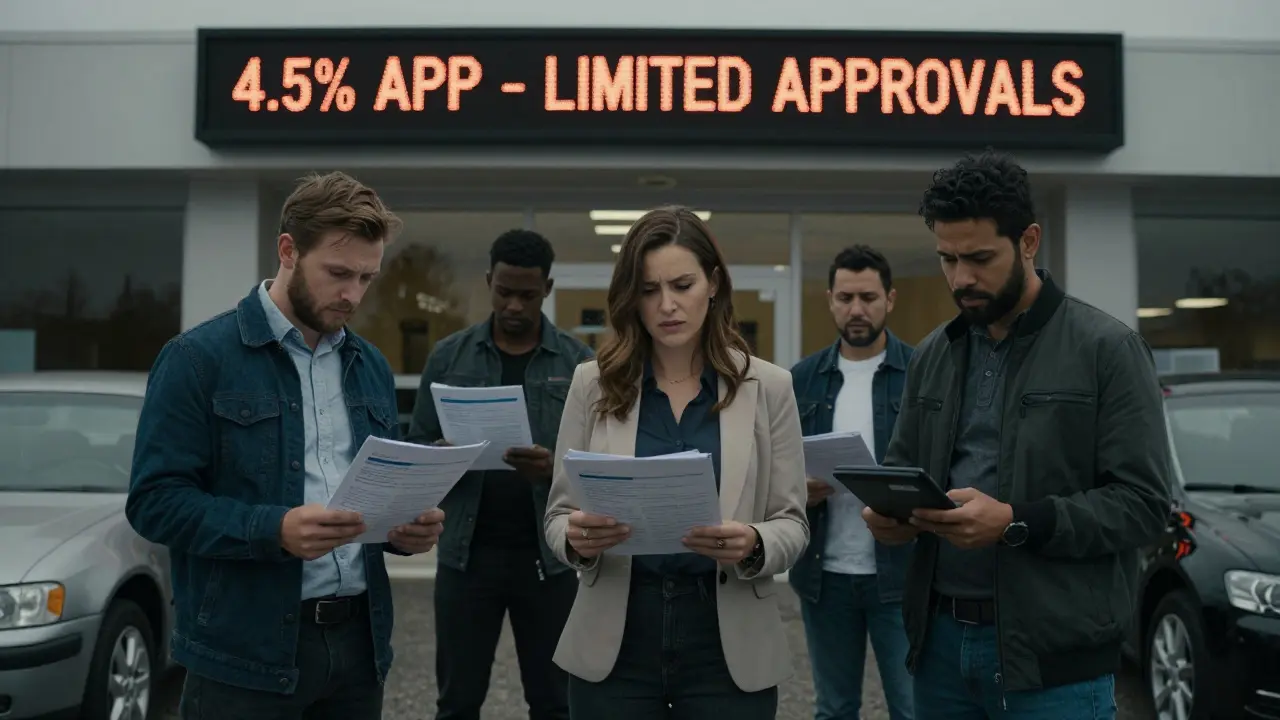
When central banks raise interest rates to fight inflation, it doesn’t just affect mortgages or credit cards-it hits car loans hard. By late 2025, auto credit tightness had become one of the biggest barriers for everyday buyers trying to get into a new or used vehicle. And with the Federal Reserve, the European Central Bank, and the Bank of England all signaling that rates won’t drop anytime soon, 2026 looks like another tough year for car shoppers.
Why Auto Credit Tightness Is Getting Worse
Auto credit tightness isn’t just about higher rates. It’s about lenders pulling back across the board. Banks and finance companies are tightening approval standards, requiring higher credit scores, bigger down payments, and shorter loan terms. In 2023, the average credit score for a new car loan was around 720. By Q3 2025, it had jumped to 745. That’s not a small shift-it means nearly 1 in 4 potential buyers who qualified two years ago now get turned down.
Lenders are also cutting loan-to-value ratios. Where you could once borrow 110% of a car’s value (meaning you rolled over negative equity from an old loan), most lenders now cap it at 90%. That forces buyers to come up with more cash upfront. In the UK, the average down payment on a used car rose from £2,800 in 2023 to £4,100 by the end of 2025.
Why? Because delinquency rates on auto loans have climbed. The Federal Reserve’s data shows that 90-day delinquencies on auto loans hit 4.1% in Q2 2025-the highest since 2011. When people start missing payments, lenders panic. They don’t wait for a recession to tighten up. They act fast.
What Central Banks Are Saying in 2026
The Bank of England kept its base rate at 4.5% in December 2025, its 14th consecutive hold. Governor Andrew Bailey said inflation is “under control but not yet comfortably in target,” and that the central bank won’t cut rates until it sees “sustained evidence” of wage growth slowing. That’s not happening in early 2026.
The U.S. Federal Reserve has a similar stance. Fed Chair Jerome Powell said in a November 2025 speech that “the labor market remains tight, and inflation expectations are still anchored above our target.” That means no rate cuts before mid-2026 at the earliest. The European Central Bank is even more cautious-rates are stuck at 4.25%, with no cuts expected until late 2026.
What does this mean for car buyers? It means the cost of borrowing won’t drop. If you’re waiting for lower rates to buy a car, you might be waiting until 2027. And even then, lenders may not pass on the full cut to consumers. They’ve learned to protect their margins.
How Auto Loan Rates Are Impacting Sales
Car sales are feeling the squeeze. In the UK, new car registrations fell 12% year-over-year in 2025. Used car sales dropped even more-15%-according to the Society of Motor Manufacturers and Traders. That’s not because people don’t want cars. It’s because they can’t afford the payments.
Take a typical £20,000 used car. In 2022, a 60-month loan at 4% interest meant monthly payments of £368. By 2025, the same loan at 7.2% pushed payments to £402. That’s £34 more a month. For someone on a tight budget, that’s a bus pass, a week’s groceries, or a child’s school trip. Many just walk away.
Dealerships are responding by pushing longer-term loans-72 or even 84 months-to make payments look lower. But that’s a trap. You end up paying more in interest, and you’re upside-down on the loan longer. If your car gets totaled or you need to sell it, you’ll owe thousands more than the vehicle is worth.

Who’s Still Getting Approved?
Not everyone is locked out. Lenders are still approving borrowers with strong credit histories, stable incomes, and low debt-to-income ratios. But the pool is shrinking.
Here’s who still qualifies:
- Those with credit scores above 750
- People with a down payment of at least 20%
- Buyers with a debt-to-income ratio under 35%
- Those who can prove steady employment for 2+ years
If you don’t fit that profile, your options are limited. You might turn to subprime lenders, but those come with rates over 12%. Or you might buy a much older car-something 10+ years old-because the loan amount is smaller. But those cars often need more repairs, and you lose the safety and fuel efficiency of newer models.
What You Can Do Right Now
Waiting for rates to drop isn’t a strategy-it’s a gamble. Here’s what actually works in 2026:
- Check your credit report-errors are common. A 30-point boost can save you hundreds a month. Get free reports from Experian, Equifax, or TransUnion.
- Save for a bigger down payment-even an extra £1,000 can drop your monthly payment by £15-20.
- Get pre-approved-don’t wait until you’re at the dealership. Go to your bank or a credit union first. You’ll know your rate and won’t be pressured into a bad deal.
- Consider a used car that’s 2-3 years old-it’s lost most of its depreciation but still has modern safety tech and warranty coverage.
- Avoid 72-month loans-if you must go long, cap it at 60 months. You’ll pay less interest and own the car sooner.
Also, don’t fall for the “no credit check” ads. Those are scams or predatory lenders. They’ll lock you into high fees and hidden charges. Stick with regulated institutions.

What’s Next for Auto Financing?
Some fintech lenders are starting to use alternative data-like rent payment history or utility bills-to assess creditworthiness. It’s still early, but if it catches on, it could open doors for people with thin credit files.
Meanwhile, manufacturers are offering more direct financing. BMW Financial Services and Toyota Financial Services are running promotions with 0% APR on select models, but only for buyers with top-tier credit. It’s not a bailout-it’s a selective discount.
And there’s one quiet trend: more people are buying cars outright. Cash sales rose 18% in 2025. That’s not because everyone’s rich. It’s because people are choosing to drive older cars longer, delay upgrades, or buy cheaper models to avoid debt.
Bottom Line
Central bank policy isn’t abstract. It’s sitting in your monthly car payment. Auto credit tightness isn’t a temporary blip-it’s the new normal. If you’re planning to buy a car in 2026, you need to plan like a buyer in a high-interest economy. That means saving more, borrowing less, and being smarter about what you can afford.
Don’t let the dealerships tell you that now’s the time to buy. Let your budget and your credit score tell you that.
Will auto loan rates go down in 2026?
Most experts expect no significant rate cuts before late 2026. Central banks are prioritizing inflation control over easing credit. Even if rates drop, lenders may not pass the savings to consumers right away. Don’t count on lower payments in the first half of 2026.
Can I still get a car loan with a credit score below 700?
Yes, but it’s harder and more expensive. You’ll likely face higher interest rates-often above 10%-and stricter terms like larger down payments or shorter loan periods. Credit unions sometimes offer better terms than banks for subprime borrowers. Always shop around.
Should I wait to buy a car until rates drop?
Waiting might mean missing out on deals, especially if inventory is low. Used car prices are still falling in many markets, and dealers may offer incentives to move stock. If you need a car now, focus on improving your credit and saving for a down payment instead of waiting for rates to fall.
Are longer car loans a good idea to lower monthly payments?
They make payments look lower, but they cost more in the long run. An 84-month loan on a £20,000 car at 7% interest adds over £3,000 in interest compared to a 60-month loan. You’ll also be upside-down on the loan longer, which is risky if you need to sell or if the car is damaged.
What’s the best type of car to buy right now?
A 2-4 year old used car with low mileage and remaining manufacturer warranty is ideal. These cars offer modern safety features, better fuel efficiency, and lower prices than new models. Avoid cars older than 8 years unless you’re prepared for higher repair costs and no warranty.
Comments
Jamie Roman
I remember when I tried to finance a used Camry back in March and got denied because my score was 738. I thought that was high enough until I checked the lender’s new guidelines-now they want 745 minimum. I had to wait three months, pay off a small medical bill, and get my credit report corrected for an error that was dragging me down. It’s insane how fast lenders have pulled back. I ended up buying a 2021 Corolla with 25k miles for $16k cash after saving for a year. No loan, no stress. I know it’s not glamorous, but I sleep better at night.
December 27, 2025 at 21:17
Salomi Cummingham
Oh my god, I just cried reading this. My sister in Manchester got turned down for a loan on a 2022 Ford Focus last week. She’s a nurse, makes £38k a year, has zero debt, and her credit score is 735. They told her she needed a £5k down payment and a co-signer. She’s 28. She’s not a risk. She’s just not rich enough to meet the new fantasy criteria. This isn’t about credit-it’s about class. And it’s heartbreaking.
December 28, 2025 at 04:27
Johnathan Rhyne
Hold up. You say lenders are ‘tightening’ but let’s be real-they’re just trying to avoid another 2008-style auto loan collapse. You people act like it’s personal. It’s not. It’s math. And if you’re mad about 7.2% interest, you’re mad at the Fed, not the finance manager. Also, ‘no credit check’ ads are scams? Duh. That’s like saying ‘water is wet.’ Why is this even a thing we’re discussing? Also, ‘subprime’ isn’t a bad word-it’s a risk category. Stop acting like it’s a moral failing. You’re not a victim. You’re just bad at budgeting.
December 28, 2025 at 14:09
Nathan Jimerson
My uncle in Delhi bought a 2015 Maruti Suzuki with cash last year. He drives it 40km a day to work. No loan, no interest, no stress. He says, ‘If the car lasts five more years, I’ll be lucky.’ In India, we’ve been doing this for decades. You don’t need a 750 credit score to live. You just need patience and discipline.
December 28, 2025 at 18:21
Sandy Pan
There’s a quiet revolution happening here. We’re not just talking about loans or interest rates-we’re talking about the erosion of the middle-class dream. The car used to symbolize freedom, mobility, independence. Now it’s a financial trap, a liability dressed up as an asset. And the system isn’t broken-it’s working exactly as designed. The goal isn’t to get people cars. It’s to extract value from them until they can’t afford one anymore. That’s capitalism with a smile.
December 30, 2025 at 16:03
Eric Etienne
Wow. So the solution is to save more? Groundbreaking. I didn’t know the answer to ‘I can’t afford this’ was ‘work harder and wait longer.’ Thanks, article. Real helpful. Meanwhile, my cousin’s 2010 Civic just died and he’s stuck taking the bus. But hey, at least he’s ‘financially responsible.’
January 1, 2026 at 01:52
Dylan Rodriquez
I’ve been working with low-income families on financial literacy for years. The truth is, most people don’t know how to read a loan contract, let alone calculate APR. The system doesn’t just exclude them-it confuses them. That’s why I always tell people: go to a credit union. They’re not perfect, but they’re human. And if you can get pre-approved, you walk into a dealership with power. Not desperation. That’s the real win. Not the car. The agency.
January 2, 2026 at 09:34
Amanda Ablan
Just wanted to add: if you’re on the fence about a 72-month loan, ask yourself this-would you take a 72-month mortgage on a house? Probably not. So why do it for a car? Cars depreciate. Houses appreciate (usually). That’s the difference. And if you’re tempted by a ‘low monthly payment,’ remember: you’re not saving money-you’re just stretching the pain out. I’ve seen too many people trade in a 5-year-old car still owing $8k on it. Don’t be that person.
January 4, 2026 at 03:31
Meredith Howard
It's interesting how the central banks are prioritizing inflation control over consumer access to credit. The data shows delinquencies rising but lenders are still tightening. This suggests a structural shift in risk appetite rather than a cyclical adjustment. The long-term implications for consumer mobility and labor market participation are significant. I wonder if there are any academic studies on this trend in post-industrial economies
January 4, 2026 at 18:16
Yashwanth Gouravajjula
Buy older car. Save money. Drive longer. Simple.
January 6, 2026 at 01:17
Kevin Hagerty
Wow someone actually wrote a 2000 word essay on how to not buy a car. Congrats. You won. You’re now the person who drives a 2005 Prius with 200k miles and no warranty. Meanwhile, the rest of us are paying 7% interest because we have jobs and don’t want to ride a bike in the snow. You’re not wise. You’re just poor.
January 6, 2026 at 13:13