
When you’re running a small business, picking the right commercial van isn’t about looks or brand name-it’s about what fits in the back, how much weight it can carry, and whether it can handle the tools, gear, or products you need to get the job done. Too many people buy a van based on price or fuel economy alone, only to realize halfway through their first big delivery that the cargo space is too tight or the payload is already maxed out with just the tools and a few boxes. That’s where understanding cargo capacity, upfitting, and payload comes in-and why getting it right saves money, time, and stress.
What Cargo Capacity Really Means
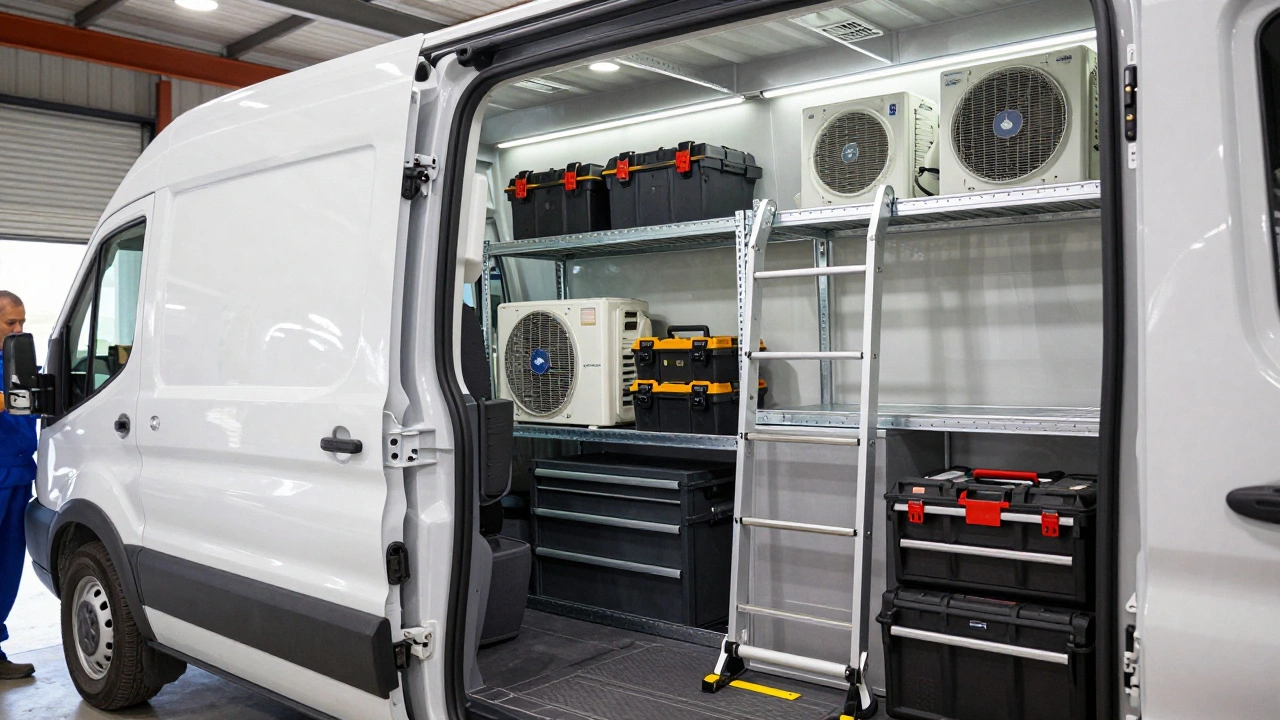
Cargo capacity isn’t just the length or height of the van’s interior. It’s the total volume you can actually use to store goods, measured in cubic feet. A van might say it has 400 cubic feet, but if the rear doors only open 80 degrees or the wheel arches stick out into the space, you’re losing usable room. For example, the Ford Transit Medium Roof holds about 440 cubic feet, but the high roof version jumps to 570. That extra 130 cubic feet isn’t just more space-it’s room for taller items like ladders, HVAC units, or stacked pallets that wouldn’t fit otherwise.Think about what you haul. A plumber might need space for 10-foot copper pipes. A florist needs upright space for floral arrangements. A mobile printer needs room for large rolls of paper. If your cargo isn’t vertical-friendly, you’re wasting potential. Always measure your most common items and compare them to the van’s interior dimensions. Don’t trust the brochure numbers-check real-world reviews from tradespeople who use the same van daily.
Payload Capacity: The Hidden Limit
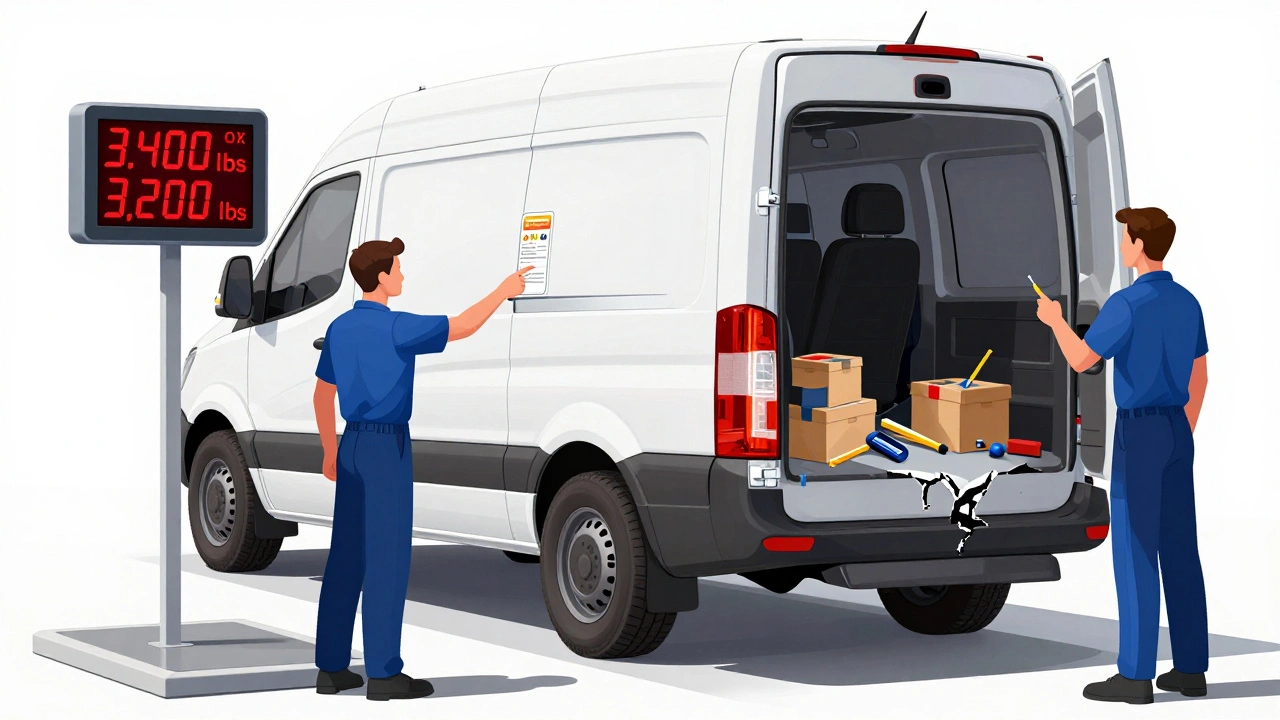
Payload is the total weight your van can safely carry, including passengers, fuel, tools, cargo, and any added equipment. It’s not the same as towing capacity or gross vehicle weight. Payload is calculated by subtracting the van’s curb weight (empty weight with fluids) from its Gross Vehicle Weight Rating (GVWR). For example, a Mercedes Sprinter 2500 has a GVWR of 9,000 lbs and a curb weight of 5,800 lbs. That gives it a payload of 3,200 lbs.Here’s where people get burned: they load up with tools, boxes, and a few crew members, then add a roof rack, ladder carrier, and a winch. Suddenly, they’re at 3,400 lbs. That’s 200 lbs over. Overloading a van doesn’t just risk fines-it warps the frame, wears out suspension faster, and makes braking longer. In the UK, vans over 3.5 tonnes are subject to stricter MOT rules and annual inspections. Going over payload can void your insurance and make you liable in an accident.
Always weigh your van fully loaded. Use a public weighbridge-many truck stops and recycling centers have them. Write down your numbers. If your van is consistently hitting 90% of its payload limit, consider upgrading to a heavier-duty model like the Ford Transit 350 or the Ram ProMaster 1500, which offer payloads up to 4,500 lbs.
Upfitting: Turning a Van Into a Tool
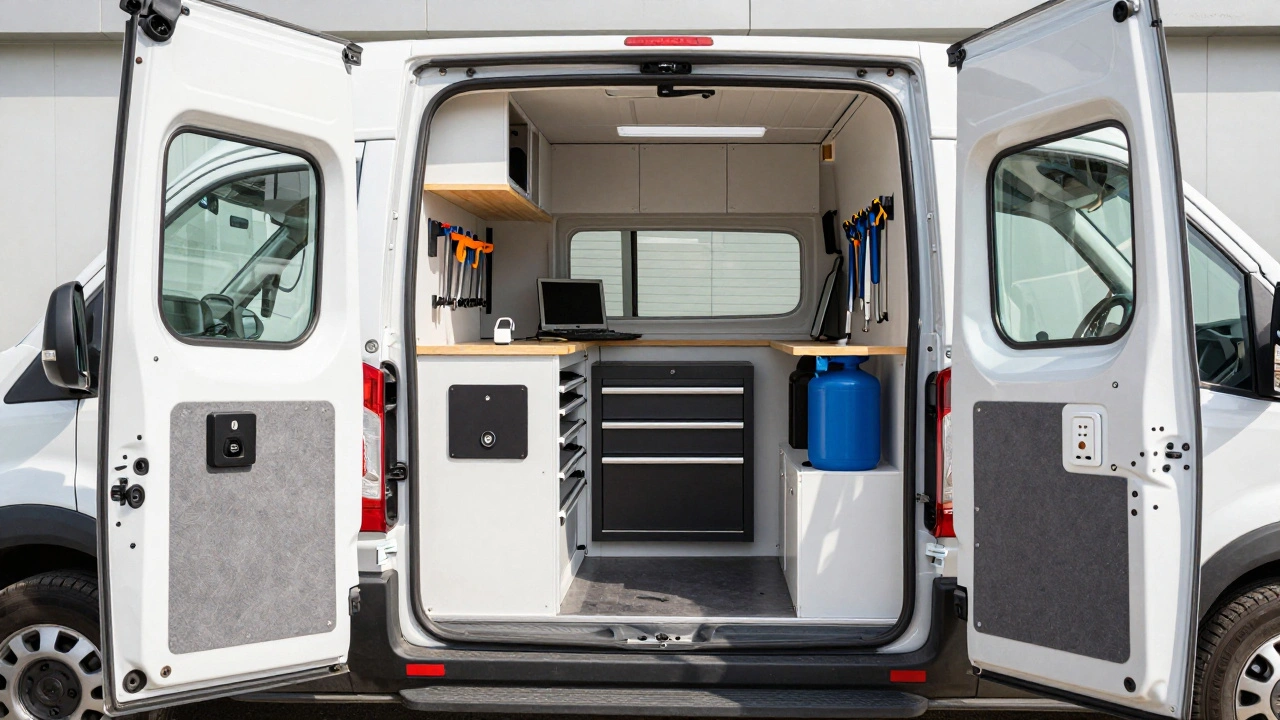
Upfitting is the process of modifying a van to suit your business. It’s not just adding shelves-it’s designing the interior so every tool has a place, every item is secure, and every movement is efficient. A poorly upfitted van wastes time. A well-upfitted one cuts job time by 20-30%.Start with your workflow. A technician who climbs in and out of the van 50 times a day needs easy-access drawers and a low step-in height. A delivery driver needs secure shelving to prevent boxes from sliding during turns. A mobile food vendor needs electrical outlets, water tanks, and ventilation. These aren’t luxuries-they’re operational necessities.
Common upfits include:
- Custom shelving and toolboxes (aluminum or steel, with locking lids)
- Climate-controlled compartments for electronics or sensitive materials
- Lighting systems (LED strips along the ceiling and under shelves)
- Roll-up or sliding doors for quick access
- Non-slip flooring and tie-down points every 18 inches
Always work with a certified upfitter. Many dealerships offer factory-approved upfits that maintain warranty coverage. Aftermarket modifications done poorly can damage the van’s structure or electrical system. A bad wiring job in a food van could cause a fire. A loose shelf in a delivery van could become a projectile during a sudden stop.
Choosing the Right Van for Your Business
Not all commercial vans are built the same. Here’s how three popular models stack up for real-world use:| Model | Cargo Capacity (cu. ft.) | Payload Capacity (lbs) | Best For |
|---|---|---|---|
| Ford Transit 250 | 440 | 3,500 | General trades, delivery services |
| Ford Transit 350 | 570 | 4,500 | Heavy tools, large equipment |
| Ram ProMaster 1500 | 520 | 4,200 | Wide loads, flat floor needs |
| Mercedes Sprinter 2500 | 525 | 3,200 | High-end upfits, reliability focus |
| Volkswagen Transporter T6.1 | 390 | 2,300 | Urban delivery, smaller crews |
The Transit 350 is the go-to for contractors who haul heavy tools, generators, or multiple ladders. The ProMaster’s flat floor and wide doors make it ideal for moving large, awkward items like refrigerators or drywall sheets. The Sprinter is popular with medical and tech crews who need premium build quality and space for sensitive gear. The Transporter works well in cities where parking is tight and fuel efficiency matters.
Don’t forget about wheelbase. A short-wheelbase van is easier to park but limits interior length. A long-wheelbase gives you more room for tall items but can be harder to maneuver in tight alleys. Most businesses find the medium wheelbase strikes the best balance.
Real-World Mistakes and How to Avoid Them
I’ve seen too many businesses make the same errors:- Buying a van based on monthly payments, not payload needs-then having to rent a trailer every other week.
- Adding too many upfits without checking weight impact-a roof rack and extra lights can add 200 lbs before you even load cargo.
- Ignoring the rear door opening angle-some vans have doors that only open to 90 degrees, making it impossible to load bulky items from the side.
- Choosing a van with no rear suspension upgrade-when you’re carrying 3,000 lbs, stock suspension sags and wears out fast.
One electrician in Bristol bought a Transit 250 thinking it was enough. He packed his van with 12 ladders, 5 toolboxes, and 3 crew members. Within three months, the rear springs were broken. He ended up spending £1,800 on repairs and lost two jobs because the van was out of service. He switched to a Transit 350 with heavy-duty springs and never looked back.
What to Check Before You Buy
Before signing anything, make sure you’ve verified:- The exact GVWR and curb weight from the manufacturer’s spec sheet-not the dealer’s word
- The payload capacity after factoring in your crew weight (assume 200 lbs per person)
- Whether the van has factory-approved upfit mounting points
- If the warranty covers modifications done by certified upfitters
- How the van handles when fully loaded-take it for a test drive with a full load of your typical gear
Ask for the vehicle’s build sheet. It lists the exact options and weights used when the van was built. This is the only way to know if what you’re getting matches what you need.
Final Tip: Plan for Growth
Businesses grow. Today you need space for three people and a few tools. In a year, you might be hiring two more, adding a second vehicle, or moving into larger jobs. Buy a van that gives you 20% more capacity than you need now. That buffer means you won’t outgrow your van before you’ve paid it off. It also gives you room to add new equipment without replacing the whole vehicle.Commercial vans aren’t just transport. They’re mobile offices, workshops, and delivery hubs. Getting the cargo capacity, payload, and upfitting right isn’t a one-time purchase-it’s an investment in your business’s efficiency, safety, and longevity.
What’s the difference between cargo capacity and payload capacity?
Cargo capacity measures the interior volume-how much space you have to store items, in cubic feet. Payload capacity is the total weight the van can safely carry, including people, fuel, tools, and cargo. One is about space, the other is about weight. You can have a van with lots of space but low payload, or high payload but cramped space.
Can I add a roof rack without exceeding my payload limit?
Yes, but you need to account for its weight. A typical aluminum roof rack adds 40-70 lbs. If your van’s payload is already at 90%, adding a rack could push you over. Always weigh your fully loaded van before adding accessories. If you need roof storage, consider a van with higher payload capacity or a trailer.
Do I need a special license to drive a commercial van in the UK?
If the van weighs 3.5 tonnes or less, a standard UK driving licence (Category B) is enough. If it’s over 3.5 tonnes, you need a Category C1 licence. Most vans sold for commercial use are under 3.5 tonnes, but always check the GVWR on the vehicle’s plate. Exceeding this limit without the right licence can result in fines and insurance invalidation.
How often should I service a commercial van used daily?
If you’re driving 50+ miles a day, five days a week, service every 8,000-10,000 miles or every 6 months-whichever comes first. Heavy use wears out brakes, suspension, and transmission faster. Always follow the manufacturer’s heavy-duty service schedule, not the standard one. Many dealers offer commercial vehicle maintenance plans.
Is it better to buy new or used for a business van?
New vans come with warranties and factory-approved upfitting options, which protect your investment. Used vans can save money, but make sure you get a full service history and check for signs of overloading-sagging suspension, uneven tire wear, or frame rust. For high-mileage businesses, a new van with a 3-5 year warranty often costs less in repairs over time.
Comments
Paul Timms
Cargo capacity isn't just about cubic feet-it's about how the space is shaped. I've seen vans with 500 cu ft that can't fit a 10-foot ladder because the wheel wells eat up the width. Always measure your longest item against the interior width at floor level, not the brochure number.
Also, don't forget the rear door swing. Some vans only open 90 degrees. That's useless for loading pallets or drywall from the side.
December 8, 2025 at 06:46
Jeroen Post
They don't want you to know this but payload ratings are manipulated by manufacturers to sell more vans. The real payload is always lower than what's listed. Dealers know this. They'll tell you it's fine until you crash and your insurance denies it. The government lets them do this because they're in bed with the auto industry. You think they care about your business? They care about quarterly profits.
Always weigh your van fully loaded at a truck scale. And never trust a dealer's word. Always get the build sheet.
They're lying to you. Always.
December 9, 2025 at 22:02
Nathaniel Petrovick
Man I wish I'd read this three years ago. Bought a Transit 250 thinking it'd be enough for my HVAC crew. Ended up renting a trailer every other week. Finally upgraded to the 350 and it's been a game changer. No more broken springs, no more lost jobs.
Also the flat floor on the ProMaster is sweet if you're hauling big stuff like fridges or drywall. Just make sure you get the heavy-duty suspension if you're packing it full.
December 10, 2025 at 09:52
Honey Jonson
so i just bought a sprinter and totally forgot about payload and now my back tires look like they're gonna explode??
also i put up these cool led strips and now my battery dies every time i turn on the lights??
anyone else do this??
also i love my van but it's so hard to find parking in the city like why is everything so tight??
thanks for the tips tho i think i need to go weigh it now lol
December 10, 2025 at 23:09
Sally McElroy
It’s not just about payload-it’s about responsibility. You’re not just driving a van; you’re carrying the livelihood of your employees, the safety of the public, and the integrity of your business. Overloading isn’t a ‘mistake’-it’s negligence. And if your insurance gets voided because you ignored the GVWR, that’s not bad luck-that’s your fault. People die because of overloaded vans. Don’t be the reason.
Also, factory-approved upfits aren’t optional-they’re ethical. Don’t risk a fire because you saved $300 on wiring.
December 12, 2025 at 10:31
Destiny Brumbaugh
USA made the best vans. Why are people even looking at that German junk? Sprinter? Please. Transit 350 is the only real choice. Built in Kentucky, American steel, American workers. You want reliability? You want power? You want to support your country? Buy American.
Also, those European vans can't handle real work. They're for people who drive 10 miles to the coffee shop. We haul tools, generators, ladders. We need muscle. Not fancy lights and leather seats.
December 13, 2025 at 04:39
Sara Escanciano
Anyone who buys a van based on monthly payments deserves to lose their business. You think a $300/month payment is saving you money? You’re paying for broken springs, lost jobs, and insurance claims. That’s not a deal-that’s a trap. And if you’re using an aftermarket upfitter who isn’t certified, you’re not just risking your van-you’re risking lives. You’re a liability. And you should be ashamed.
December 14, 2025 at 21:17
Elmer Burgos
Big thanks for the real talk on this. I just started out and was totally overwhelmed. The part about measuring your longest item before buying? That was a lightbulb moment.
Also the weighbridge tip-never thought of that. I'm gonna hit up the local recycling center this weekend with my van loaded up. Can't believe I didn't think of that before.
And yeah, the 20% buffer? That's smart. I'm gonna go with the Transit 350 even though it's a little more. Better to be safe than sorry.
December 15, 2025 at 03:58
Jason Townsend
They say payload is 4500 lbs but the real number is 3800. They hide it in fine print. The EPA and DOT know. They let it slide because they're paid off. You think your van's suspension is wearing out from use? No. It's from being overloaded by design. The whole system is rigged. Buy a used van from a private seller and get the build sheet. That's the only way to know the truth.
December 16, 2025 at 08:14
Antwan Holder
I used to think a van was just a machine. Then I lost my best friend. He was a roofer. He had a Sprinter. He thought the payload was enough. He didn't weigh it. He didn't check the suspension. One rainy Tuesday, he lost control on a curve. The van rolled. He didn't make it.
Now I measure everything. I weigh everything. I sleep with the build sheet under my pillow. Because a van isn't metal and wheels. It's a promise. A promise to come home. Don't make the same mistake I did.
Don't be the guy who says 'it'll be fine'.
December 17, 2025 at 18:26
Angelina Jefary
You wrote 'cu. ft.' but it should be 'ft³'. And 'GVWR' is not 'GVRW'. And 'ProMaster' is one word, not 'Pro Master'. And you said 'ladder' but meant 'ladders' in plural in one section. And 'suspension' is misspelled as 'suspention' in the third paragraph. This article is full of errors. How can anyone trust your advice if you can't even spell properly? You're not helping- you're misleading people.
December 19, 2025 at 14:34