
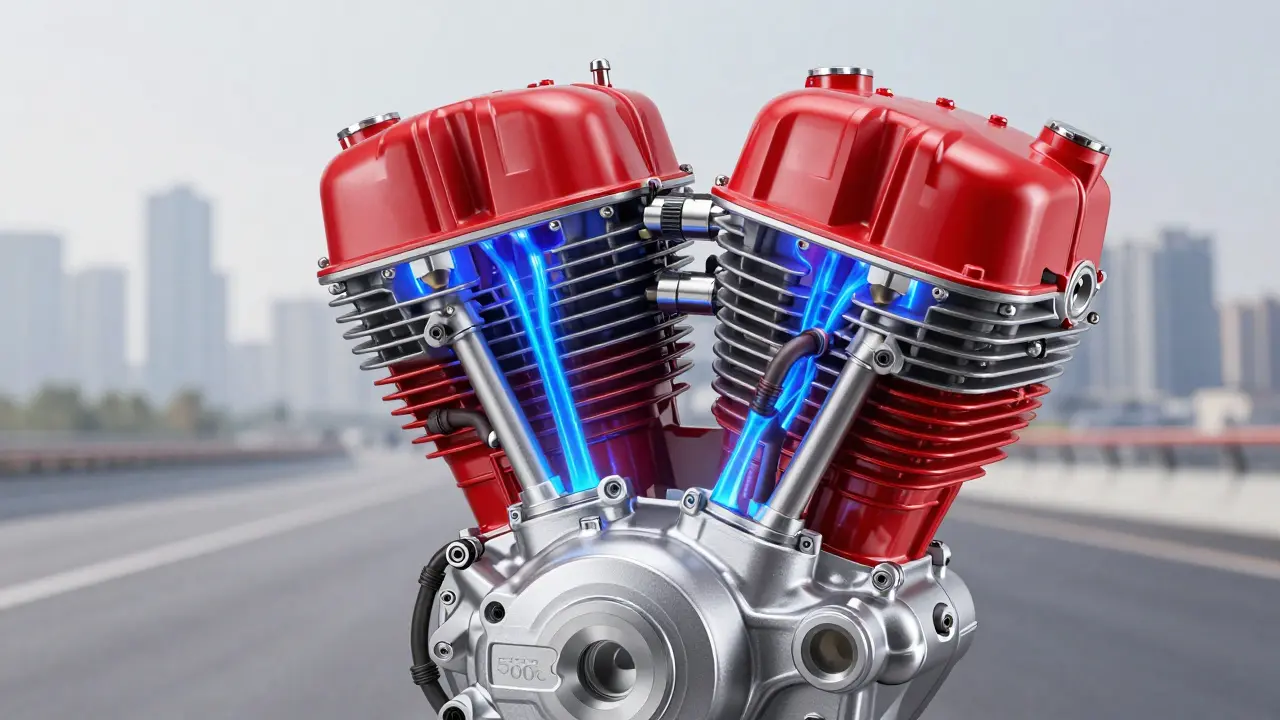
When you look at a motorcycle spec sheet, you’ll see numbers like 250cc, 650cc, or 1200cc. These aren’t just random digits-they tell you exactly how much power the engine can make, how heavy the bike feels, and whether it’s right for your riding style. Engine displacement, measured in cubic centimeters (cc), is the total volume of air and fuel an engine can push through its cylinders in one full cycle. It’s the single biggest indicator of how a motorcycle will behave on the road.
What Engine Displacement Actually Means
Think of an engine like a pump. Each time the piston moves up and down inside the cylinder, it draws in a fixed amount of air and fuel. The size of that space-the cylinder’s inner volume-is what’s measured in cc. A 500cc engine has cylinders that can hold 500 cubic centimeters of mixture per stroke. More cc means more fuel and air can be burned, which usually means more power.
It’s not just about raw size, though. A 1000cc engine doesn’t always outperform a 600cc one. Engine design matters. A 600cc four-cylinder sportbike can feel wilder than a 1000cc single-cylinder cruiser because of how the power is delivered. But if you’re looking for low-end torque to pull away from stoplights or haul a passenger and luggage, bigger displacement usually wins.
How CC Affects Real-World Riding
Let’s say you’re commuting through Bristol’s city center. A 250cc bike is perfect here. It’s light, easy to maneuver in traffic, and gets great fuel economy-around 70-80 mpg on average. You won’t be racing past cars, but you won’t be straining to keep up either. The engine is smooth, predictable, and forgiving if you’re new to riding.
Now imagine taking that same 250cc bike on the M5 at 70 mph. It’ll work, but the engine will be screaming near its redline, vibrating, and using more fuel than it should. You’ll feel every bump, and the wind will push harder against you. That’s because the engine is being asked to do more than it was designed for.
On the other hand, a 1000cc sportbike can cruise at 70 mph with barely a whisper from the engine. It’s got room to spare. You can accelerate hard without downshifting, and the bike feels planted and stable. But in traffic? It’s heavy. It’s expensive to fuel. And if you’re not confident, it can feel overwhelming.
Typical Engine Sizes and What They’re For
Motorcycle engine sizes fall into clear categories, each suited to different riders and uses:
- 50cc-125cc: Ideal for learners, city commuting, or mopeds. Low power, super light, cheap to run. Often restricted to 30 mph in the UK.
- 125cc-400cc: The sweet spot for beginners and urban riders. Enough power to handle highways safely, still easy to control. Most common for A1 license holders.
- 400cc-750cc: For experienced riders who want more speed and touring ability. Popular for intermediate riders on sportbikes, naked bikes, and adventure models.
- 750cc-1200cc: High-performance machines. Used for sport riding, long-distance touring, and dual-sport adventures. Requires more skill and confidence.
- 1200cc+: Heavyweight cruisers, touring bikes, and muscle bikes. Built for comfort, power, and presence. Often over 500 pounds wet. Not for beginners.
These aren’t hard rules. A 650cc dual-sport bike can handle dirt trails and highway miles, while a 500cc naked bike might be your daily driver in the city. But the general pattern holds: bigger cc = more power, more weight, more cost.
Why Bigger Isn’t Always Better
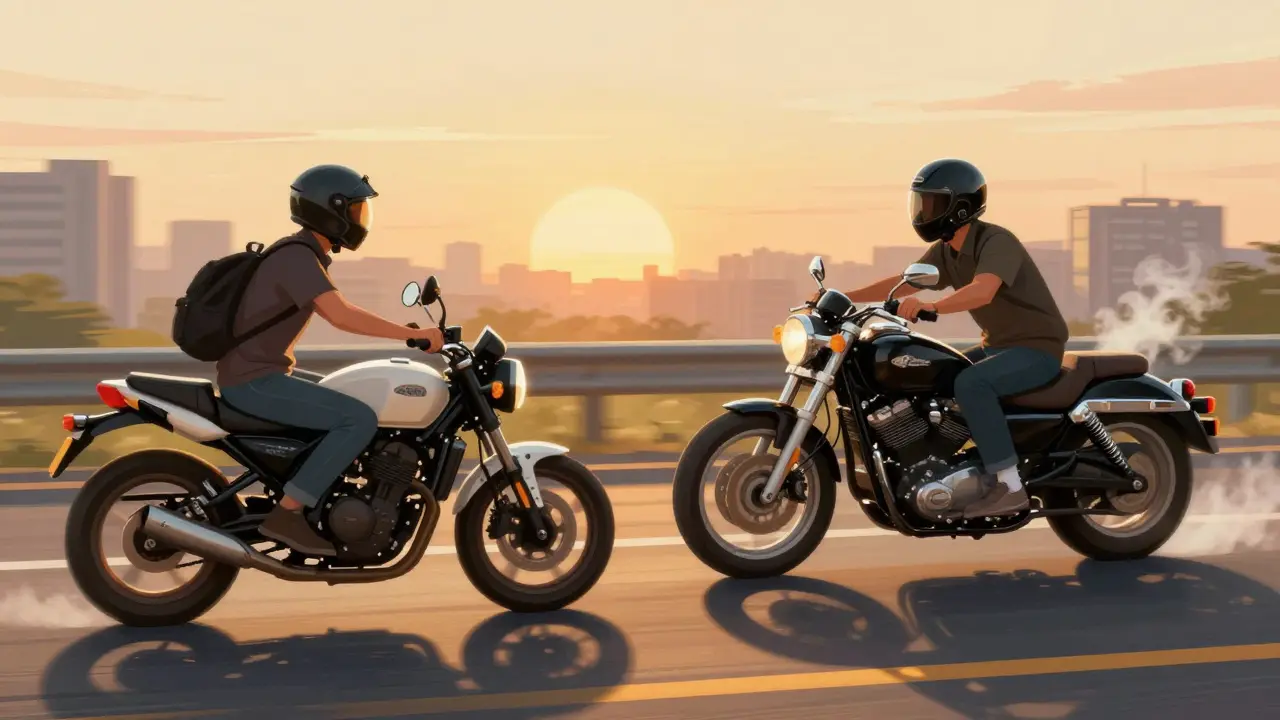
Many riders think bigger cc means better. That’s not true. A 1200cc Harley-Davidson Iron 883 weighs 265 kg. A 750cc Honda CB750 is around 220 kg. The lighter bike feels more agile, easier to park, and less tiring on long rides. If you’re 5’5” and ride mostly on twisty back roads, that extra 45 kg can make a huge difference.
Also, modern small engines are smarter. A 250cc fuel-injected bike today has better throttle response and smoother power delivery than a 400cc carbureted bike from 20 years ago. Technology compensates for size. A 300cc bike can now out-accelerate a 400cc bike from the 90s.
Then there’s cost. Insurance for a 1200cc bike can be three times higher than for a 400cc one. Fuel consumption jumps from 60 mpg to 40 mpg or lower. Maintenance? Bigger engines need more oil, more parts, and cost more to fix.
Engine Displacement vs. Horsepower
Don’t confuse cc with horsepower. Two bikes with the same engine size can have wildly different power outputs. A 600cc inline-four sportbike might make 120 horsepower. A 600cc single-cylinder enduro bike might make 50. Why? Because of how the engine is tuned.
High-revving engines (like those in sportbikes) squeeze more power out of smaller displacement by spinning faster. They’re built for speed, not torque. Cruisers, on the other hand, use big pistons and low revs to push out torque at low speeds. That’s why a 1100cc Harley can pull away from a stoplight faster than a 1000cc sportbike-even though the sportbike has more horsepower on paper.
What you really want to look at is torque curve. Torque is the twisting force that gets you moving. If you ride in the city or carry loads, torque matters more than top-end horsepower. Look for numbers like “65 Nm at 4500 rpm” rather than just “100 hp.”
How to Choose the Right CC for You
Here’s a simple way to pick:
- Ask yourself: Where will I ride most? City? Highway? Country roads? Off-road?
- Ask yourself: What’s my experience level? First bike? 5 years riding?
- Ask yourself: How much do I want to spend? On fuel, insurance, and maintenance?
If you’re a beginner, start with 300cc-500cc. You’ll learn control without being overwhelmed. If you’re a commuter, 250cc-400cc gives you enough speed and efficiency. If you’re planning long tours or want to carry a passenger regularly, 750cc+ gives you the comfort and power to do it safely.
Test ride multiple sizes. Sit on a 250cc, then a 600cc, then a 1000cc. Feel the weight. See how the throttle responds. Notice how your arms feel after 10 minutes. That’s more important than any spec sheet.
What’s Changing in 2026
Electric motorcycles are changing the game. A 15kW electric bike (like the Zero SR/F) can match the acceleration of a 600cc gas bike-but with zero cc. No engine noise, no gear shifts, instant torque. But they’re still expensive, and charging infrastructure isn’t everywhere.
For now, gas engines dominate. But the trend is clear: manufacturers are making smaller, smarter, more efficient engines. A 300cc bike today is more capable than a 500cc bike from 2010. So don’t assume bigger is better-just because it’s older.
Engine displacement isn’t magic. It’s a starting point. It tells you the engine’s potential. But how that potential is shaped-by fuel injection, valve timing, exhaust design, weight, and rider skill-is what makes the difference between a thrilling ride and a frustrating one.
Choose based on your life, not the numbers on a brochure. A 250cc bike can be just as satisfying as a 1000cc one-if it fits your needs.
Is engine displacement the same as engine size?
Yes, engine displacement and engine size mean the same thing in motorcycles. Both refer to the total volume of all cylinders combined, measured in cubic centimeters (cc). A 650cc engine has a displacement of 650 cubic centimeters.
Does higher cc always mean faster motorcycles?
Not always. Higher cc usually means more potential power, but speed depends on engine design. A 600cc sportbike with four cylinders and high-revving tuning can be much faster than a 1000cc cruiser with low-revving torque. Weight, aerodynamics, and gearing also play big roles.
What cc is best for a beginner rider?
For beginners, 250cc to 500cc is ideal. These bikes are light, manageable, and forgiving. They give you enough power for highways but won’t overwhelm you in traffic or at low speeds. Many new riders start with models like the Honda CB300R or Yamaha MT-03.
How does engine displacement affect fuel economy?
Generally, the larger the displacement, the more fuel the engine uses. A 250cc bike can get 70+ mpg, while a 1200cc cruiser might only manage 40 mpg. But modern fuel injection and efficient designs help smaller engines stay economical even under load.
Can a small cc bike handle highway speeds?
Yes, but it depends. A 300cc bike can cruise at 70 mph, but the engine will be working hard, which can cause fatigue and higher fuel use. A 500cc+ bike handles highway speeds more comfortably. Always check the bike’s top speed rating and rev range before riding long distances.
Are electric motorcycles replacing gas bikes with high cc?
Not yet, but they’re closing the gap. Electric bikes like the Zero SR/F or Harley-Davidson LiveWire deliver instant torque and performance equal to 600cc-1000cc gas bikes. However, they’re still expensive, have limited range on long trips, and charging isn’t as widespread. For now, gas engines still dominate, especially for touring and heavy-duty use.
Comments
Adrienne Temple
Just got my first bike-a 300cc Honda! So nervous at first, but it’s like riding a bicycle with wings 😊
January 7, 2026 at 04:59
Sandy Dog
Okay but HAVE YOU EVER TRIED TO PARK A 1200CC HARLEY IN A TINY SPOT?? I swear my back still hurts from last weekend. I thought I was a ninja until I tried to turn around in a parking garage. My knees are now a permanent part of the asphalt. 🤕💔
January 7, 2026 at 16:16
Nick Rios
I used to think bigger was better until I crashed my 600cc sportbike trying to keep up with a 250cc on a twisty road. Turned out the smaller bike was way more agile. Sometimes it’s not about power-it’s about balance. And patience. 🙏
January 7, 2026 at 20:15
Taylor Hayes
Really appreciate how this breaks down real-world use cases. I’m a 5’3” rider who commutes 40 miles daily, and I went from a 500cc to a 300cc last year. The difference in confidence is night and day. Also, the fuel savings let me buy more gear. Win-win.
Don’t let the numbers scare you-find what fits your body, your life, your rhythm. Not the brochure.
January 9, 2026 at 01:02
Sanjay Mittal
As someone who rides daily in Mumbai traffic, I can confirm: 125cc is king. Light, easy to weave through, and if you get rear-ended, you’re not launching into the next district. Also, maintenance costs? A fraction of a big bike. You don’t need 100hp to get to work.
Modern 250ccs are surprisingly capable-my friend’s Royal Enfield Hunter 350 does 100km/h without breaking a sweat. Engine size isn’t destiny.
January 9, 2026 at 17:02
Mike Zhong
Everyone’s so scared of big bikes like they’re dragons. You want to ride? Learn to ride. Stop hiding behind ‘beginner’ cc numbers like they’re safety blankets. A 250cc won’t teach you anything but fear. If you’re gonna ride, ride something that challenges you. Otherwise, just stay on the sidewalk.
January 10, 2026 at 10:07
Andrew Nashaat
Ugh. This post says ‘cc’ is the ‘single biggest indicator’-but then spends 80% of the text explaining that it’s NOT the single biggest indicator. So… which is it?? You can’t have it both ways. Also, ‘torque curve’? Please. Just say ‘low-end grunt.’ And why is ‘dual-sport’ capitalized like it’s a religion? Grammar police are weeping.
Also, ‘1200cc+’ is ‘heavyweight’? My 2004 Yamaha R6 weighs less than 400 lbs. You’re clearly not a rider-you’re a spreadsheet jockey with a hobby.
January 10, 2026 at 15:56
Gina Grub
Big cc = big ego. That’s the real story. I’ve seen grown men cry because their 1000cc bike got outpaced by a 300cc Vespa on a hill. The real power isn’t in the engine-it’s in the rider’s ego. And that’s the one thing no amount of cc can fix.
Also, electric bikes? They’re the future. But let’s be honest-no one’s buying them because they’re better. They’re buying them because they’re quiet. And quiet is the new flex.
January 12, 2026 at 00:33
Nathan Jimerson
My first bike was a 250cc and it changed my life. I used to think I needed something loud and flashy to feel like a real rider. Turns out, the joy is in the ride-not the numbers. I’ve since upgraded to a 500cc, but I still miss the simplicity of that little bike. You don’t need a lot to feel free.
Keep riding. Keep learning. You’ve got this.
January 12, 2026 at 21:18
Sandy Pan
There’s something poetic about displacement. It’s not just physics-it’s philosophy. A 250cc bike doesn’t scream for attention. It whispers. It asks you to listen-to the road, to your breath, to the rhythm of the engine. A 1200cc bike? It roars. It demands. It says ‘I am here.’
Which one are you? The quiet observer or the thunderous force? The engine doesn’t care. But you do.
January 13, 2026 at 17:52
Dylan Rodriquez
For anyone starting out: don’t just pick a bike based on what’s ‘safe.’ Pick one that makes you feel alive. I started on a 300cc, loved it, then moved to a 650cc and felt like I’d been handed a superpower. But I still ride my 300cc on rainy days because it’s fun. Not because it’s easy.
Size isn’t the point. Connection is. Find the bike that talks to you-not the one that fits the checklist.
January 15, 2026 at 14:06
Amanda Ablan
Just wanted to say thank you for mentioning test rides. So many people skip this and end up with a bike they hate. I sat on a 1000cc and thought I was ready-until I tried to lift it off the kickstand. My arms shook. I went home and bought a 500cc. Best decision ever.
It’s not about what you can handle. It’s about what lets you enjoy the ride. And that’s different for everyone.
January 16, 2026 at 00:56