
You want more power from your car. Maybe you’re tired of being passed on the highway, or maybe you just love the sound of a high-revving engine. But before you drop thousands of pounds on parts, you need to understand what actually works. Engine modifications are not one-size-fits-all. A turbocharger is not the same as a supercharger, and slapping a new chip on your computer without supporting mods can blow up your motor.
This guide cuts through the noise. We will look at the three big pillars of internal combustion upgrades: Turbos, Superchargers, and ECU Tuning. You will learn how they work, what they cost, and which one fits your driving style. By the end, you’ll know exactly where to put your money for the best bang per buck.
Understanding Forced Induction: The Power Boosters
At its core, getting more power means burning more fuel. To burn more fuel, you need more air. Your stock engine pulls in air naturally based on vacuum. Forced induction forces extra air into the cylinders under pressure. This allows you to inject more fuel safely, creating bigger explosions and more horsepower.
There are two main ways to force that air in: turbos and superchargers. They achieve the same goal but use very different methods. Choosing between them depends on whether you want instant throttle response or peak horsepower numbers.
Turbochargers: Exhaust-Driven Efficiency
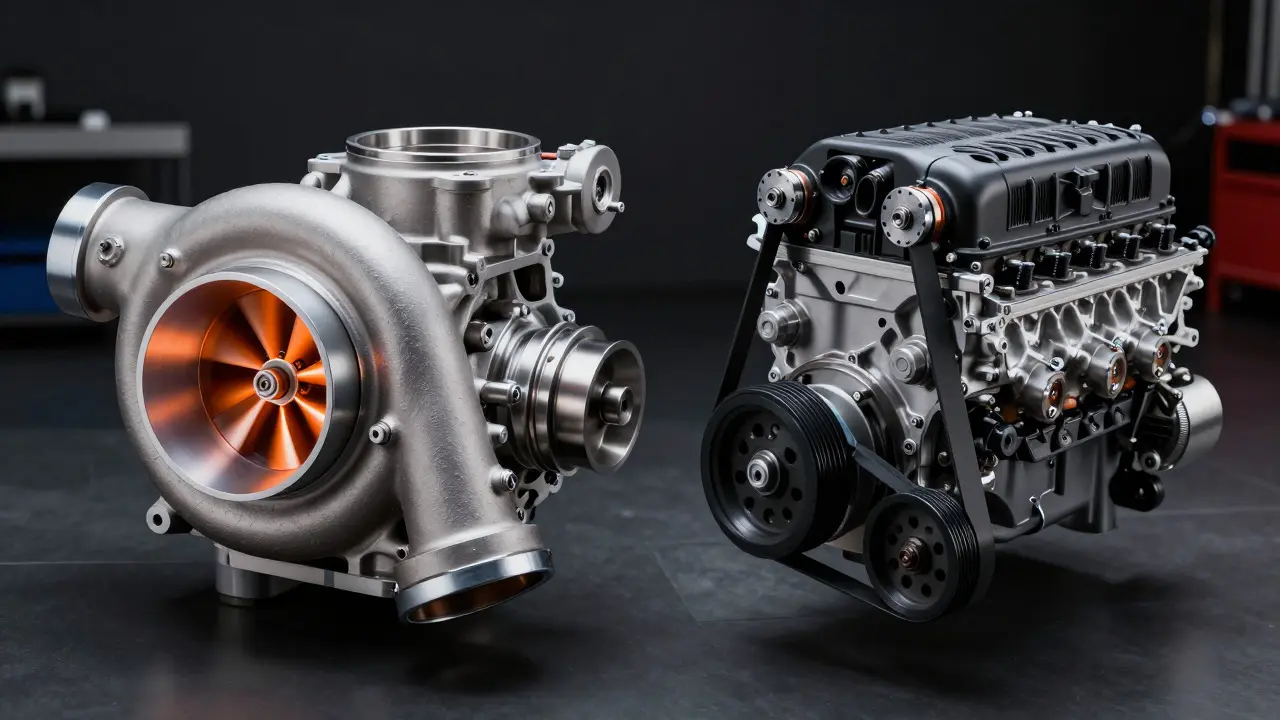
A Turbocharger is a device that uses exhaust gas energy to spin a turbine, which compresses intake air. It sits in your exhaust stream. As hot gases leave the engine, they spin a wheel connected to another wheel in the intake tract. This compresses the air before it enters the engine.
The biggest advantage of a turbo is efficiency. It uses waste energy (exhaust) rather than stealing power from the crankshaft. A well-tuned turbo setup can add 50% to 100% more horsepower depending on the engine block’s strength. However, there is a catch: lag. Because the turbo needs exhaust flow to spool up, there is often a delay when you first hit the gas. Modern twin-scroll turbos and smaller electric-assist turbos have reduced this, but it still exists.
- Pros: Higher peak power potential, better fuel economy at cruising speeds (if tuned correctly), no direct parasitic loss from the engine.
- Cons: Turbo lag, complex installation, higher heat management requirements, expensive components.
- Best For: Track days, top-speed runs, and drivers who prefer linear power delivery after the initial spool.
Superchargers: Instant Throttle Response
A Supercharger is an air compressor driven directly by the engine's crankshaft via a belt or gear. Unlike a turbo, it doesn’t wait for exhaust gases. It spins whenever the engine spins.
This gives you immediate power. You press the pedal, and the boost hits instantly. There is zero lag. For street driving, especially in city traffic or twisty backroads, this feel is superior. The downside is parasitic loss. Because the engine has to drive the supercharger, it loses some horsepower just turning it over. You also generate significant heat, requiring large intercoolers to keep charge temperatures down.
- Pros: Linear power delivery, no lag, easier installation on many platforms, predictable torque curve.
- Cons: Steals engine power (parasitic loss), lower peak power ceiling compared to turbos, increased engine strain.
- Best For: Daily drivers, drag racing (short bursts), and enthusiasts who value drivability over dyno sheet numbers.
ECU Tuning: Unlocking Hidden Potential
You can have the biggest turbo in the world, but if your engine control unit isn’t talking to it properly, you’re wasting money. ECU Tuning is the process of modifying the software parameters of an Engine Control Unit to optimize performance, fuel delivery, and ignition timing.
Your factory ECU is programmed for reliability, emissions compliance, and compatibility with low-grade fuel across every market. It plays it safe. Tuning changes that. A custom tune adjusts:
- Ignition Timing: Advancing the spark plug firing time for more efficient combustion.
- Fuel Maps: Adding more fuel to support the extra air from forced induction.
- Boost Pressure: Allowing the wastegate to open later, increasing psi.
- Rev Limiters & Speed Limiters: Removing artificial caps on RPM and speed.
For naturally aspirated engines, a basic ECU flash might yield 10-15% more power. For turbocharged cars, it’s essential. Without a tune, adding boost can cause detonation (knock), which destroys pistons. Always get a professional dyno tune after major hardware changes. Don’t rely on off-the-shelf "chip" solutions unless they are reputable brand-specific maps.
Turbo vs. Supercharger: Which Should You Choose?
Let’s compare them side-by-side so you can make a decision based on your specific goals.
| Feature | Turbocharger | Supercharger |
|---|---|---|
| Power Source | Exhaust Gas | Crankshaft Belt/Gear |
| Lag | Yes (varies by size) | No (Instant) |
| Peak Power Potential | High (50-100%+ gain) | Moderate (20-40% gain) |
| Installation Complexity | High (Piping, Manifolds) | Moderate (Belt Drive, Mounts) |
| Fuel Economy Impact | Neutral or Slight Improvement | Slight Decrease |
| Cost Range (UK Approx.) | £1,500 - £4,000+ | £800 - £2,500 |
If you drive a BMW M3 or a Ford Focus ST, a turbo upgrade makes sense because the platform is already optimized for it. If you own a classic Mustang or a V8 truck, a supercharger is often the cleaner, more reliable path. Think about how you drive. Do you spend most of your time in stop-and-go traffic? Go supercharger. Do you track your car on weekends? Go turbo.
Supporting Mods: Don't Neglect the Basics
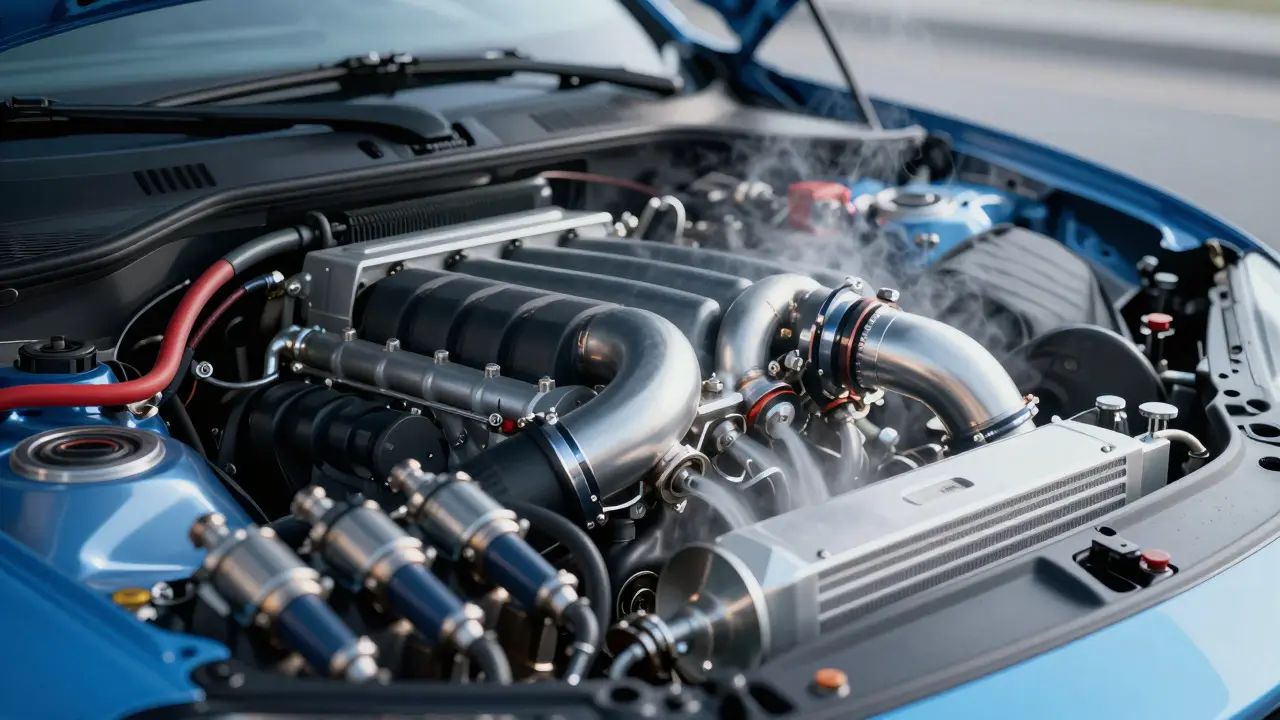
Adding forced induction puts massive stress on your engine. Before you bolt on a turbo, ensure your foundation is solid. Ignoring these basics leads to broken engines.
- Intercooler: Compressing air heats it up. Hot air is less dense and causes knock. An upgraded front-mount intercooler is non-negotiable for any serious boost level.
- Fuel System: More air needs more fuel. Stock fuel injectors may run lean under boost, melting pistons. Upgrade to high-flow injectors and a larger fuel pump if exceeding 10-12 psi.
- Exhaust: Turbos hate restrictions. A 3-inch cat-back exhaust helps the turbo spool faster and reduces backpressure.
- Cooling: Add an oil cooler and transmission cooler. Heat is the enemy of reliability.
Reliability and Longevity Concerns
Will modding kill your car? Not necessarily, but it changes the wear profile. A naturally aspirated engine might last 200,000 miles with minimal care. A boosted engine running 15 psi regularly needs stricter maintenance schedules.
Change your oil every 3,000 to 5,000 miles instead of 10,000. Use high-quality synthetic oil with proper shear stability. Check coolant levels weekly. Listen for knock sensors triggering-if your ECU is pulling timing constantly, you have a problem. Many modern engines, like the Subaru EJ25 or the VW EA888, are built with forged internals specifically to handle boost. Know your engine’s limits. Research community experiences with your specific model before buying parts.

Budgeting for Engine Modifications
People often underestimate costs. Here is a realistic breakdown for a mid-range project car in the UK market as of 2026:
- Basic ECU Tune (N/A): £300 - £600
- Entry-Level Turbo Kit: £1,500 - £2,500 (parts only)
- Professional Dyno Tune: £400 - £800
- Supporting Mods (Intercooler, Exhaust): £500 - £1,000
- Installation Labor: £500 - £1,500 (depending on shop rates)
Total for a decent turbo setup: £3,900 - £6,800. Keep a contingency fund of 15% for unexpected issues like cracked manifolds or wiring harness repairs. Cheap parts save money upfront but cost triple in labor when they fail.
Legal Considerations in the UK
In the United Kingdom, engine modifications can affect your MOT test and insurance. While increasing horsepower itself isn’t illegal, altering emission systems is. Removing catalytic converters requires fitting a compliant replacement to pass MOT. Noise regulations are strictly enforced; excessive exhaust noise can lead to failure.
Always inform your insurer. Failure to declare modifications can void your policy entirely. Some insurers specialize in modified cars and offer competitive rates. Check the DVLA guidelines for any structural changes that might require VCA (Vehicle Certification Agency) approval if you change the vehicle’s classification.
Is it better to get a turbo or a supercharger for daily driving?
For daily driving, a supercharger is often preferred due to its instant throttle response and lack of lag. It feels more natural in traffic. However, if you want better fuel economy at highway speeds and plan to track the car occasionally, a turbo is the better long-term investment despite the slight delay in power delivery.
How much horsepower can I expect from an ECU tune alone?
On a naturally aspirated engine, expect a 10-15% increase. On a turbocharged engine, a Stage 1 tune (software only) can add 20-30% more power by optimizing boost pressure and fuel maps. These gains assume the engine is in good health and using high-quality fuel.
Do I need to replace my engine internals for a turbo kit?
Not always. Many modern engines come with forged pistons and rods designed to handle moderate boost (up to 10-12 psi). If you plan to run higher boost levels (15+ psi), upgrading to forged internals is highly recommended to prevent catastrophic failure under high cylinder pressures.
What is turbo lag and how can I reduce it?
Turbo lag is the delay between pressing the accelerator and feeling the boost. It happens because the turbo needs exhaust flow to spin up. You can reduce it by using smaller turbochargers, twin-scroll turbos, anti-lag systems, or electric-assist turbos. Upgrading the exhaust system to reduce backpressure also helps.
Will engine modifications void my warranty?
In most cases, yes. Manufacturers can void the powertrain warranty if they detect aftermarket tuning or hardware that contributed to a failure. Even if the modification didn’t cause the issue, proving otherwise can be difficult. Check your specific warranty terms before making changes.
Comments
Chris Neal
First off, this guide is decent but it completely glosses over the reality of modern direct injection engines. You can't just slap a turbo on a GDI engine without dealing with carbon buildup on the intake valves like it's no big deal. The article mentions fuel maps but ignores the fact that many modern ECUs have anti-lag software locked down so tight you need a bench tune or a full ECU swap to get real gains. Also, saying superchargers are 'easier' is relative; installing a Whipple on an LS is easy, but trying to fit a Roots blower on a transverse V6 is a nightmare of clearance issues. People forget about the heat soak in the engine bay too.
And let's talk about the cost breakdown. £1,500 for an entry-level turbo kit? In the current market, that’s barely enough to buy a used Garrett GTX and a set of pipes if you're lucky. Labor costs in the UK have skyrocketed. A proper dyno tune isn't just '£400-800', it's often more if you need multiple pulls to nail the knock limits. This post makes modding sound like a weekend DIY project for beginners, which is dangerous advice.
August 16, 2026 at 03:02
Vishnu Vardhan Reddy M S
Haha, Chris is right as always! 🙄 But seriously, good read. I love how you broke down the parasitic loss vs efficiency argument. It’s the classic 'have your cake and eat it too' dilemma. For my daily driver, I’d take the instant response of a supercharger any day because I’m stuck in traffic half the time anyway. Turbo lag in stop-and-go is just annoying.
But hey, if you’re tracking, go turbo. Just don’t forget the intercooler piping. Nothing kills a vibe faster than melted silicone hoses because you forgot to check the clamps after a hard pull. Stay safe out there!
August 16, 2026 at 08:49
Brannen Hall
Everyone here is missing the point. Forced induction is a band-aid for poor engineering. If you want power, build a bigger naturally aspirated engine. It’s simpler, more reliable, and sounds better. Turbos are just a way for manufacturers to sell small engines that pretend to be big ones while failing within 50k miles. Superchargers are just inefficient belt-driven fans. Save your money and buy a car with adequate stock power instead of breaking things.
August 18, 2026 at 01:02
Iva Grekova
I think Brannen is being a bit harsh! 😅 There’s definitely something special about building your own ride. I’ve been reading up on this for my Civic. The part about oil changes every 3,000-5,000 miles really opened my eyes. I didn’t realize boost puts that much extra stress on the lubrication system. It makes sense though, higher temps mean thinner oil faster. Thanks for the detailed breakdown, it helped clarify why I should probably stick to a Stage 1 tune for now before going all-in on hardware.
August 18, 2026 at 08:11
Chris Neal
@Brannen Hall Typical contrarian take. 'Build a bigger NA engine.' Sure, put a 7.0L Hemi in a Mazda Miata and see how well that fits. Displacement isn't free either. Modern turbos are incredibly efficient when tuned correctly. The reliability argument is also outdated; forged internals are standard on many performance variants now. If you blow up your motor, it’s usually user error (running lean, bad tune), not the tech itself. Stop fear-mongering.
August 19, 2026 at 23:06
michelle veluz
WAIT!!! Are you telling me the car companies are LYING to us??? They say these cars are reliable but they KNOW we will mod them and then the warranty voids?! It’s a trap!!! A giant corporate conspiracy to drain our wallets!!! And what about the emissions??? They remove the catalytic converter and then the government fines us??? It’s all connected!!! Wake up people!!! The turbo lag is psychological warfare designed to keep us docile in traffic!!! #TruthSeeker #CarConspiracy
August 21, 2026 at 01:22
Brenna Gonedrman
Michelle is losing her mind lol. But honestly, the insurance part is scary. I called my agent and he sounded like he was having a heart attack when I mentioned 'turbo'. Like, bro, it’s just air. Why is everyone so dramatic? Anyway, does anyone know if a cold air intake actually helps with turbo spool times or is that just marketing hype? I feel like I’m spending money on stuff that doesn’t do anything.
August 22, 2026 at 10:29
Chandan Singh
Cold air intakes have negligible effect on turbo spool times. The mass airflow sensor sees the same amount of air regardless of temperature until you hit significant charge cooling differences, which the intercooler handles. What matters is reducing backpressure in the exhaust side for spool speed. A high-flow downpipe is far more effective than a shiny cone filter on the intake. Also, Brenna, stop buying random parts from eBay. Read the dyno sheets first.
August 23, 2026 at 14:22
Courtney Wagstaff
Chandan is speaking truth! 🎯 I learned the hard way that shiny parts don’t equal horsepower. I spent a fortune on a loud exhaust and a fancy intake, and the only thing that changed was my neighbors’ opinion of me. When I finally did the proper fuel system upgrade and got a custom tune, THAT’S when the car woke up. It’s like the difference between wearing cool shoes and actually learning to run. Support mods are boring but necessary. Don’t skip the intercooler!
August 24, 2026 at 20:24
Onyinyechi Nwosu
just curious... if i get a supercharger do i still need to change my oil more often? or is that only for turbos? i dont want to break my car but i also hate paying for oil changes every month lol
August 25, 2026 at 00:16