
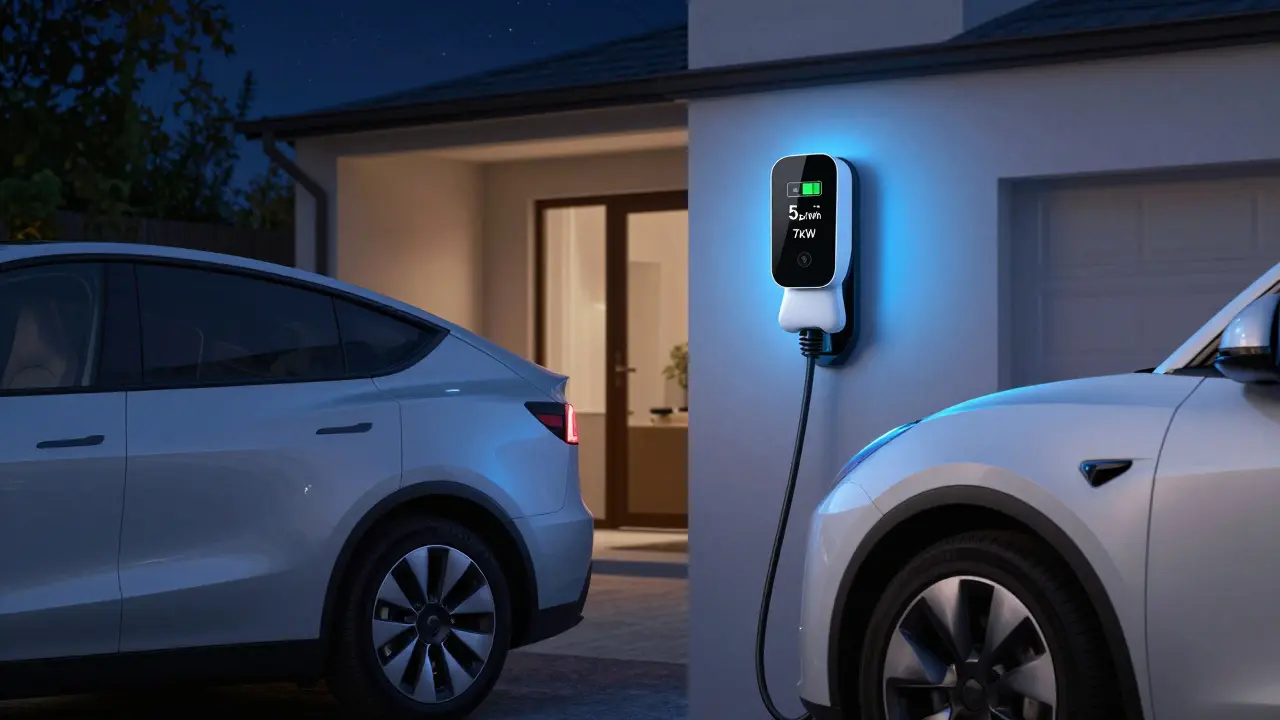
How much does it really cost to charge your electric car? If you're thinking about going electric, one of the biggest questions is whether to charge at home or rely on public stations. The answer isn't simple-it depends on your driving habits, where you live, and how much you're willing to pay for convenience. Let’s break down the real numbers behind home charging versus public charging in 2026, especially in the UK.
Home Charging: The Quiet Winner
Most EV owners in the UK charge at home, and for good reason. If you’ve got a driveway or garage, installing a dedicated 7kW home charger is the most cost-effective way to fuel your car. The upfront cost? Around £800 to £1,200 after the UK government’s OZEV grant (which still applies in 2026 for eligible homes). That’s a one-time hit.
Once installed, the cost per mile is dirt cheap. Electricity rates vary, but if you’re on a standard tariff, you’re looking at roughly 28p per kWh. A typical EV like the Nissan Leaf or Volkswagen ID.3 uses about 4.5 miles per kWh. That means every mile costs you just over 6p. For a 100-mile trip, you’re paying around £6.
But here’s the real trick: smart charging. Most home chargers let you schedule charging during off-peak hours. If you’re on an EV-specific tariff-like Octopus Go (12p/kWh) or Agile (as low as 5p/kWh at night)-you can slash your cost to under 3p per mile. That’s cheaper than refuelling a petrol car by more than 70%.
And let’s not forget convenience. You plug in at night. Wake up with a full tank. No detours. No waiting. No fumbling with payment apps. In Bristol, where nearly 40% of households have off-street parking, home charging isn’t just smart-it’s the norm.
Public Charging: Convenience Comes at a Price
Public chargers are essential for road trips, apartment dwellers, or those without home access. But they’re not cheap. There are three main types: rapid (50kW+), ultra-rapid (150kW+), and slow (3-7kW). Most public charging you’ll use is rapid or ultra-rapid.
Here’s what you’re paying in 2026:
- Rapid chargers (50-100kW): 45p to 65p per kWh
- Ultra-rapid chargers (150kW+): 55p to 85p per kWh
- Slow chargers (3-7kW): 35p to 50p per kWh (rarely used for quick top-ups)
That’s 2 to 3 times more expensive than home charging on a standard tariff-and up to 15 times more than off-peak home charging.
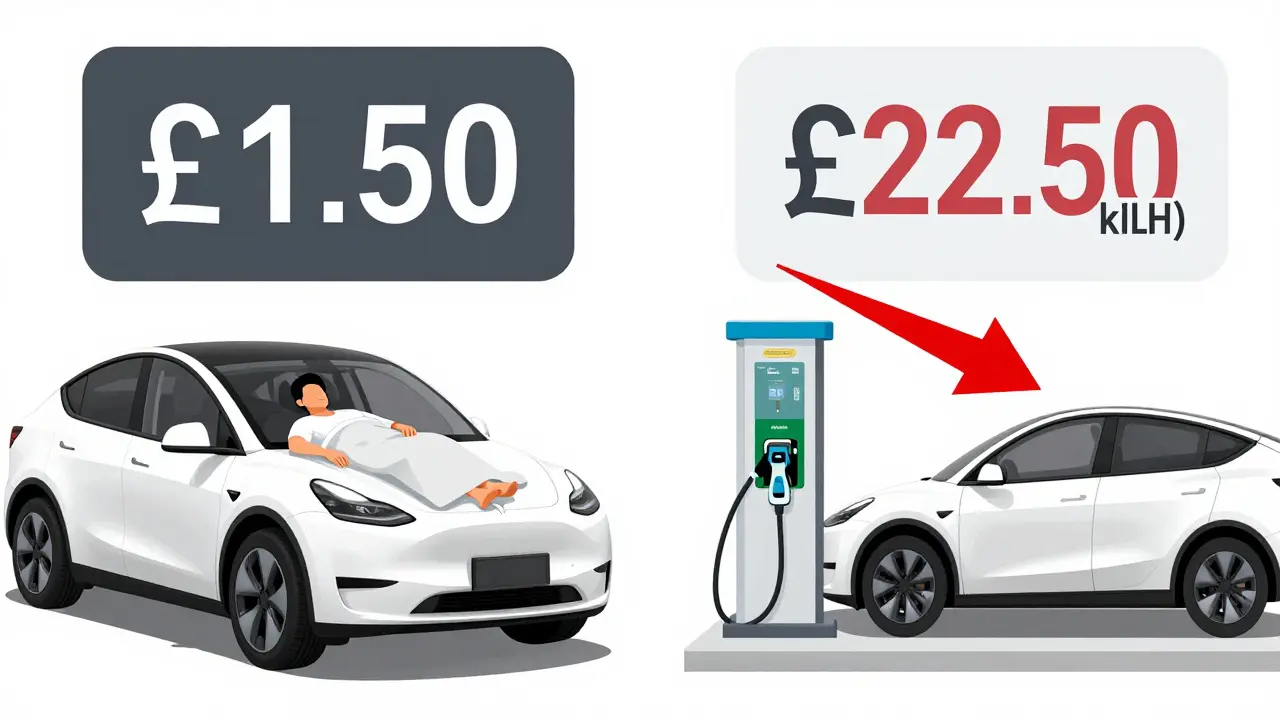
Take a 30-minute top-up on an ultra-rapid charger. You get about 100 miles of range. At 75p/kWh, and assuming your car uses 3.5kWh per 10 miles, that’s 30kWh for 100 miles. That’s £22.50. At home? On a night tariff, that same 100 miles would cost you £1.50.
And it gets worse. Many networks add connection fees. ChargePoint, InstaVolt, and Shell Recharge all charge £0.50 to £1.50 just to start the session. Some even charge idle fees if you don’t move your car within 5 minutes after charging finishes. That’s not just expensive-it’s frustrating.
Who Pays What? Real-Life Scenarios
Let’s look at three real drivers in the UK:
- The Commuter (Bristol to Bath): Drives 20 miles each way, 5 days a week. That’s 500 miles a month. At home, on Agile tariff: £15/month. At public chargers: £110/month.
- The Road Tripper (London to Cornwall): Makes one 400-mile trip every 6 weeks. Home charger handles 90% of miles. One public top-up per trip: £25. Total annual public cost: £200. Home cost: £180/year.
- The Apartment Dweller (No driveway): Uses public chargers 80% of the time. Drives 800 miles/month. At 60p/kWh: £192/month. That’s £2,300/year. Even with a 50p/kWh tariff, it’s still £1,600/year.
The pattern is clear: home charging saves hundreds-or even thousands-per year. For those without home access, the cost penalty is massive. That’s why councils in Bristol, Manchester, and Glasgow are now installing on-street chargers for residents without driveways. But even then, public rates are still 2-3x higher than home.
Hidden Costs of Public Charging
It’s not just about the kWh price. Public charging has a lot of friction:
- App overload: You need 3-5 different apps (ChargePoint, Pod Point, InstaVolt, Shell Recharge, Osprey). Some don’t even accept contactless.
- Wait times: In cities, chargers are often occupied. A 2025 survey by Which? found 38% of users waited over 20 minutes for a free spot.
- Reliability: One in five public chargers in the UK are broken or out of service. That’s according to the UK’s National Charge Point Registry.
- Payment delays: Some networks take 3-5 days to charge your card. Others lock your account if you miss a payment.
Home charging? Plug in. Sleep. Wake up. Go. No apps. No waiting. No surprises.
What About Fast Charging for Long Trips?
Yes, you’ll need public chargers for holidays or emergencies. But you don’t need to rely on them daily. Most EVs can do 200-300 miles on a full charge. If you’re driving 1,000 miles a month, you might only need to use a public charger twice. That’s £40-£60 extra a month-not a lifestyle cost, just a travel cost.
Plan ahead. Use apps like Zap-Map to find chargers along your route. Look for ones with 150kW+ speed and no idle fees. And always have a backup plan. Some motorway service stations now offer 350kW chargers that can add 200 miles in 15 minutes. But they cost more-up to 85p/kWh.
The Bottom Line: Home Charging Wins
By 2026, the math is undeniable. Charging at home is faster, cheaper, and more reliable than using public stations. Even with rising electricity prices, home charging remains the most affordable option by far.
If you can install a home charger, do it. The payback period? Less than 18 months if you drive more than 8,000 miles a year. After that, every mile is pure savings.
If you can’t install one, talk to your landlord or local council. Many UK cities now offer grants for on-street chargers. The government still funds the On-Street Residential Chargepoint Scheme (ORCS)-it’s not gone.
Public charging is a lifeline-not a primary fuel source. Treat it like that. Use it for trips, not daily runs. And never assume it’s the cheaper option. It’s not.
Electric vehicles are already cheaper to run than petrol cars. But only if you charge at home.
Is it cheaper to charge an EV at home or at a public station in the UK?
It’s almost always cheaper to charge at home. On a standard tariff, home charging costs about 6p per mile. On off-peak tariffs like Octopus Agile, it can drop below 3p per mile. Public rapid chargers cost between 45p and 85p per kWh, which translates to 15-25p per mile. That means home charging can be 5 to 10 times cheaper.
How much does it cost to install a home EV charger in the UK in 2026?
After the government OZEV grant, most home chargers cost between £800 and £1,200 to install. This includes the charger unit, wiring, and a certified electrician. Some energy suppliers offer free or heavily discounted installations if you sign up for their EV tariff. The grant still applies in 2026 for homeowners with off-street parking.
Are public EV chargers reliable in the UK?
No, not always. According to the UK’s National Charge Point Registry, about 20% of public chargers are out of service at any given time. In cities like London and Manchester, wait times can exceed 20 minutes. Some networks have poor app support or charge idle fees. Reliability is improving, but home charging remains far more dependable.
Can I charge my EV for free at public stations?
Rarely. A few supermarkets, car parks, or workplaces offer free charging as a perk, but these are exceptions-not the norm. Most public chargers now charge per kWh or per session. Free charging was common in 2020-2022, but operators now need to cover maintenance and grid costs. Don’t count on it.
What’s the best EV tariff for home charging in 2026?
Octopus Energy’s Agile tariff is still the cheapest for home charging in 2026, with rates as low as 5p/kWh overnight. Other good options include OVO’s So Energy tariff (10p/kWh) and EDF’s EV tariff (12p/kWh). These tariffs use smart technology to charge during the cheapest hours-usually between 12am and 5am. Always pair them with a smart home charger that can auto-schedule.
Comments
chioma okwara
I dont know why everyone keeps sayin home charging is cheaper like its obvious. You forget the install cost. Like £1200? Thats like 200 gallons of gas right there. And dont even get me started on how half the chargers in the UK are broken. I seen one in Manchester that was just a metal box with a plug. No screen. No app. Just... a plug. And they charge you £1.50 to use it. Wtf.
Also why is everyone using Octopus Agile? I got a friend in Birmingham who got charged £80 last month just for 300 miles because the grid went haywire and their tariff spiked. So much for 'smart' charging.
February 9, 2026 at 22:25
John Fox
Home charging is cheaper period. Public is for road trips. That's it. No need to overthink it
February 10, 2026 at 03:17
Tasha Hernandez
Oh wow. So the 'solution' is just 'buy a house with a driveway' like that's some kind of moral victory. What about the 60% of Brits who live in flats? The ones who work 60 hour weeks and can't even afford to park their car legally, let alone install a £1200 charger? This whole post reads like a rich person's fantasy. You know what's cheaper than home charging? Not owning a car. But no one wants to talk about that because then the whole EV narrative collapses like a soggy biscuit.
And don't even get me started on how the government 'grant' is only for 'eligible homes' - which means if you're poor, you're ineligible. Brilliant. Let's make electric cars a luxury for the 1%.
February 11, 2026 at 20:50
Anuj Kumar
You all think this is about money. Its not. Its about control. The government wants you to charge at home so they can track your usage. Every time you plug in, they know where you are. They know when you sleep. They know when you leave. The smart chargers? They're spy devices. And the tariffs? They're just a trap. Wait till they start charging you extra for charging during 'peak emotional hours' - like when you're stressed and need to drive to calm down.
February 12, 2026 at 12:56
Kathy Yip
I really appreciate how thorough this breakdown is. I'm still trying to wrap my head around the idea that public charging could cost 15x more. I guess I always assumed public stations were just... faster, not necessarily more expensive. But now I'm wondering - if someone lives in a city with no off-street parking, and their only option is public, is there any hope? Or is the system just designed to punish people who can't afford a driveway? It feels less like infrastructure and more like a class filter.
February 13, 2026 at 17:03
Jack Gifford
Honestly the biggest win isn't even the cost - it's the peace of mind. I used to drive 20 minutes to a charger, wait 40 minutes, pay £5, and then realize my car only got 60% charged because the thing was glitching. Now I plug in at 11pm. Wake up. Go. No apps. No stress. No 'did I remember to tap my card?'
And yeah, the upfront cost sucks. But if you drive 10k miles a year, you break even in like 14 months. After that? Free fuel. I'd rather pay £1000 once than £2000 a year.
February 15, 2026 at 11:52
Sarah Meadows
Let’s be real - this whole EV push is just Europe’s way of handing over energy sovereignty to China and Russia. The batteries? Lithium from Congo. The chargers? Made in Shenzhen. The grid upgrades? Funded by Chinese state loans. Meanwhile, we’re over here debating whether to charge at home or at a station like it’s a lifestyle choice. Wake up. This isn’t green. It’s dependency. And if you think your ‘smart charger’ is safe from hacking? You’re the reason our infrastructure is crumbling.
February 17, 2026 at 11:11
Nathan Pena
The author makes a compelling case, but fails to contextualize the data within macroeconomic trends. In 2026, the UK's wholesale electricity price is projected to rise by 18% YoY due to decommissioned nuclear capacity and reduced North Sea gas output. Even with Agile tariffs, the marginal cost per kWh will increase, eroding the 5:1 advantage. Furthermore, the OZEV grant is contingent on property ownership - a structural bias that disproportionately impacts renters. The real policy failure isn't public charging cost - it's the lack of universal access to residential infrastructure. This post reads like a marketing pamphlet for Octopus Energy.
February 19, 2026 at 10:21
Mike Marciniak
You think they're just charging for electricity? Think again. The grid operators are using your charging patterns to build behavioral profiles. They're selling that data to insurance companies. Then they raise your premiums because you 'charged at 3am' - which they interpret as 'you're a night owl, therefore you're high-risk'. I've got a friend who got a 40% hike after using a home charger for six months. They called it 'predictive risk modeling'. I call it surveillance. And they're gonna start charging you for idle time even if you're just sitting in your car waiting for your coffee to brew.
February 20, 2026 at 04:29
Sheila Alston
I just want to say - if you're one of those people who thinks home charging is 'the answer' and you've got a driveway, please don't act like you're some kind of environmental hero. You're not. You're just lucky. You didn't earn this. You were born into a house with a garage. Meanwhile, my sister works two jobs and still can't get a charger installed because her landlord says 'no modifications'. So she drives 17 miles to a public station every other day. And pays £25 a week. And you're sitting there patting yourselves on the back for saving £15 a month? You're not saving the planet. You're just making yourself feel better. And that's not enough.
February 21, 2026 at 01:53