
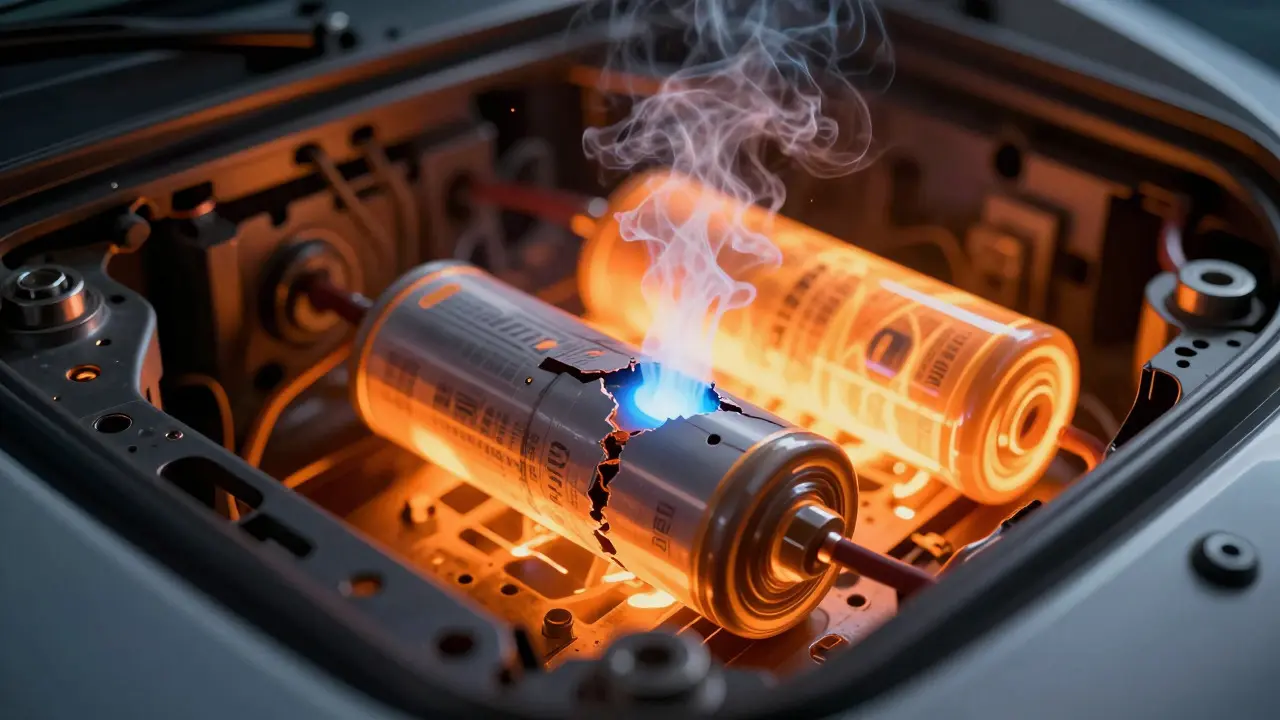
Most people assume that because electric vehicles don't have gas tanks, they are immune to the worst automotive emergencies. But ask any firefighter who has responded to a modern EV crash, and they'll tell you the danger isn't gone-it's just different. The core issue is thermal runaway, a chain reaction inside the battery pack that can turn a contained electrical fault into an intense, high-temperature fire that standard extinguishers often struggle to put out permanently.
Understanding this mechanism isn't just for engineers; it’s essential knowledge for drivers, fleet managers, and first responders. Unlike gasoline fires that burn fuel as long as there is air and liquid, EV fires burn energy stored in chemical cells. If you know how it starts, how it spreads, and exactly what to do when it happens, you can keep yourself and others safe.
What Is Thermal Runaway?
Thermal Runaway is a self-accelerating process where heat generated by a failing battery cell raises its temperature, causing neighboring cells to fail and release even more heat. It is not a single explosion, but a cascading failure. In a typical Lithium-Ion Battery Pack, hundreds of individual cells are packed tightly together. When one cell experiences internal damage-say, from a puncture or a manufacturing defect-it begins to overheat. This heat transfers to adjacent cells, triggering their own decomposition. Within seconds, the entire section of the pack can reach temperatures exceeding 800°C (1,472°F).
The key difference between this and a petrol engine fire is the source of energy. A car engine needs external fuel injection to keep burning. A battery pack contains its own fuel and oxidizer within the chemistry of the electrolyte and cathode materials. Once triggered, the reaction sustains itself until the energy is depleted or the cells are physically destroyed.
Common Triggers for EV Battery Fires
While EVs are statistically safer than ICE vehicles regarding spontaneous combustion, specific triggers can initiate thermal runaway. Knowing these helps in prevention and diagnosis.
- Mechanical Damage: The most common cause in accidents. A sharp object piercing the battery housing (often located under the floor) can rupture cell casings, mixing positive and negative electrodes directly.
- Overcharging: Charging beyond the manufacturer's voltage limits, often due to a faulty charge controller or using incompatible chargers, stresses the cell structure.
- Manufacturing Defects: Microscopic metal shavings or impurities left inside cells during production can create short circuits over time.
- Extreme Temperatures: While modern Battery Management Systems (BMS) regulate heat, prolonged exposure to extreme cold followed by rapid charging can cause lithium plating, which creates dendrites that pierce the separator.
It’s worth noting that the Battery Management System is an electronic system that monitors and controls the state of charge, temperature, and health of the battery pack. When functioning correctly, it prevents most of these scenarios by cutting power before conditions become critical. However, if the BMS fails or the damage bypasses its sensors, thermal runaway becomes likely.
How EV Fires Differ from Gasoline Fires
If you’ve seen videos of EV fires, you might notice they look different from traditional car fires. Here is why:
- Duration: An EV fire can reignite hours after it appears to be out. The residual heat in the pack can trigger dormant cells.
- Heat Intensity: The core of the fire reaches much higher temperatures than gasoline, melting aluminum chassis parts quickly.
- Fume Toxicity: Burning lithium-ion batteries release hydrogen fluoride (HF), a toxic gas. While dangerous in high concentrations, it dissipates quickly outdoors. Indoors, however, it poses a significant respiratory hazard.
- Water Requirement: Water is the primary agent used to cool the pack. Foam suppresses flames but doesn’t stop the chemical reaction deep inside the cells.
| Feature | ICE Vehicle (Gasoline) | EV Vehicle (Lithium-Ion) |
|---|---|---|
| Primary Fuel Source | External liquid fuel (petrol/diesel) | Internal chemical energy in cells |
| Reignition Risk | Low once fuel line is cut | High (can last up to 24+ hours) |
| Best Extinguisher Type | Class B / ABC Dry Chemical | Cooling Water (Hose down) |
| Smoke Visibility | Black/Grey thick smoke | White/Blue-grey vapor (less visible initially) |
| Toxic Byproducts | Carbon Monoxide, Particulates | Hydrogen Fluoride (HF), CO, Particulates |
Emergency Procedures: What To Do Immediately
When an EV catches fire, panic is your enemy. Follow these steps in order:
- Evacuate Immediately: If you smell burnt plastic, see smoke, or hear popping noises from under the floor, get everyone out. Don’t wait to check the dashboard.
- Move Upwind: Move at least 30 meters (100 feet) away from the vehicle, positioning yourself upwind to avoid inhaling fumes.
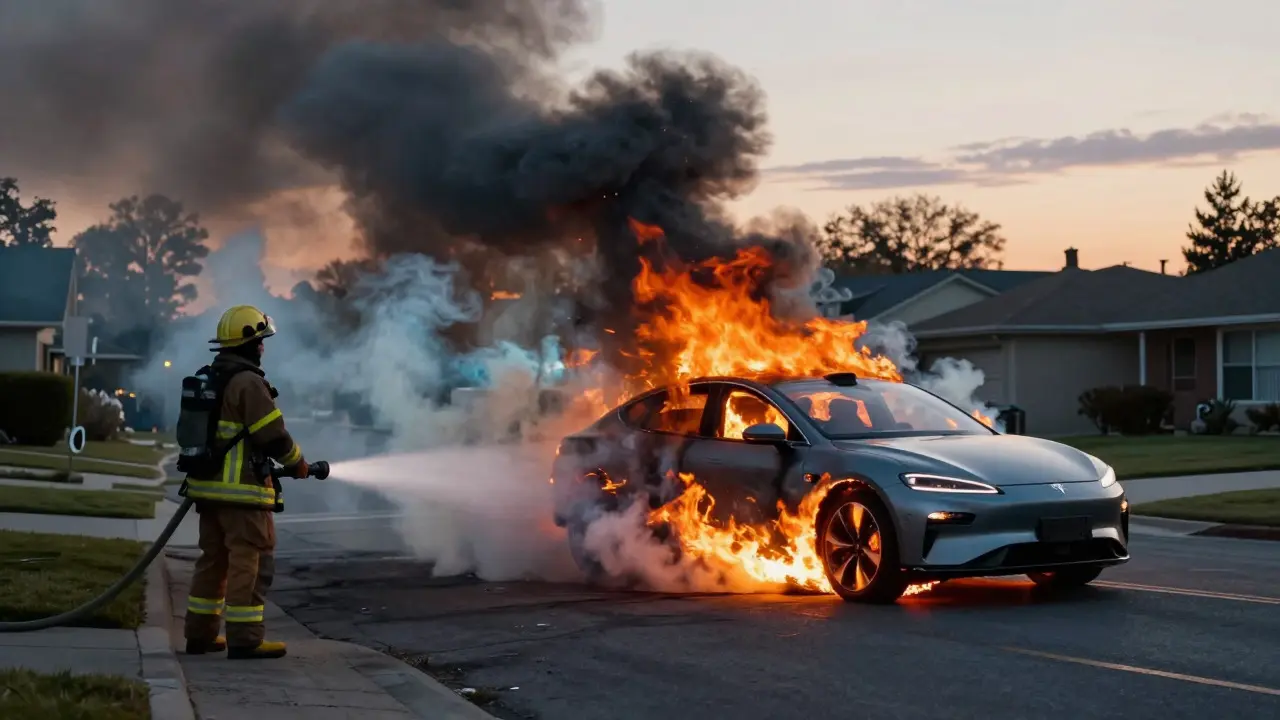
- Call Emergency Services: Tell the dispatcher specifically that it is an electric vehicle. This changes the resources sent. They need to know to bring water supply capabilities, not just foam trucks.
- Do Not Touch the Vehicle: Unless there is a visible spark or open circuit, the risk of electrocution is low, but the risk of sudden ignition is high. Keep clear until professionals arrive.
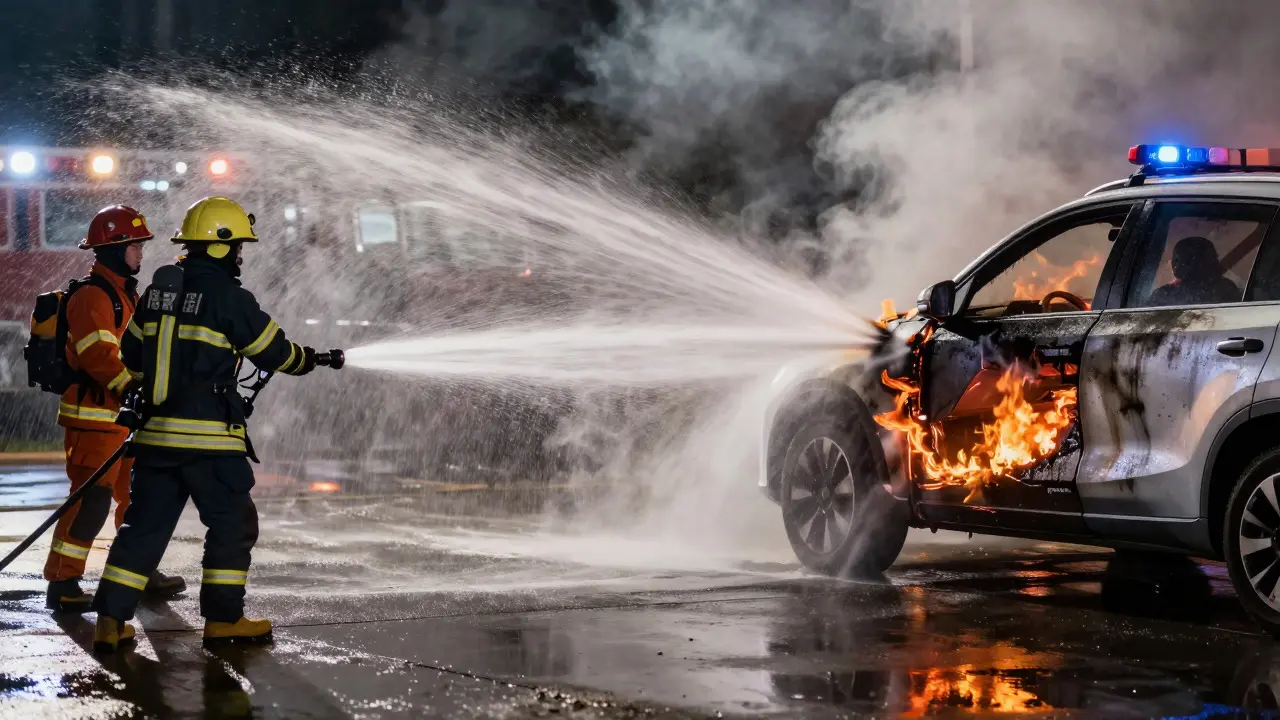
A common myth is that you should use a Class D extinguisher for metals. In reality, for an EV fire, Cooling Water is the most effective medium for dissipating heat from the battery pack and preventing propagation to adjacent cells. Firefighters will typically hose down the vehicle continuously for several minutes to ensure the core temperature drops below the threshold for re-ignition.
Prevention and Maintenance Tips
Most EV fires are preventable with good habits. Here is how to minimize your risk:
- Use Certified Chargers: Stick to OEM (Original Equipment Manufacturer) chargers or those certified by recognized bodies like UL or CE. Cheap, uncertified third-party cables are a leading cause of overvoltage events.
- Park on Hard Surfaces: Avoid parking on grass or uneven ground that could trap debris under the chassis. A sharp rock or piece of metal can puncture the bottom plate over time.
- Monitor Health Warnings: Pay attention to BMS alerts. If your car warns about reduced range or battery health issues, get it checked immediately. Ignoring minor faults can lead to major failures.
- Post-Accident Inspection: Even if the car looks fine after a minor collision, get the battery pack scanned. Internal cracks may not be visible externally but can compromise cell integrity later.
For fleet operators, implementing a regular diagnostic schedule is crucial. Data from recent industry reports suggests that vehicles with consistent BMS monitoring have a 90% lower incidence of unexplained battery failures compared to those serviced only upon symptom occurrence.
Myths vs. Facts About EV Fire Safety
Misinformation spreads quickly online. Let’s clear up a few persistent myths:
- Myth: "EVs explode like grenades."
Fact: While cells can vent violently, the pack housing is designed to contain pressure. Explosions are rare; sustained high-heat fires are the norm. - Myth: "You can't put out an EV fire."
Fact: You can, but it takes more water and time. It requires cooling, not just smothering. - Myth: "Charging overnight is always dangerous."
Fact: Modern cars limit charge to 80-90% for daily use and manage heat actively. The risk is minimal unless the charger or cable is defective.
Understanding the physics behind these events demystifies the fear. The technology is robust, but like any complex system, it requires respect and proper handling when things go wrong.
Frequently Asked Questions
How long does an EV fire last?
An active flame phase usually lasts 5 to 15 minutes. However, the underlying thermal event can persist for hours. Firefighters consider the fire 'out' only after the battery pack has been cooled to ambient temperature, which may take several hours of continuous hosing.
Are EVs more likely to catch fire than gas cars?
Statistically, no. According to National Highway Traffic Safety Administration (NHTSA) data, the probability of a fire per million miles driven is roughly similar for both. However, EV fires tend to be more intense and harder to extinguish completely, which makes them seem more frequent in news coverage.
What is the best fire extinguisher for an EV?
There is no single portable extinguisher that fully solves an EV battery fire. For small initial flare-ups, a Class ABC dry chemical extinguisher may help buy time. However, the definitive solution is large volumes of water to cool the pack. Always prioritize evacuation over fighting the fire yourself.
Can I drive my EV if the battery warning light is on?
Generally, yes, but cautiously. A warning light indicates a deviation from normal parameters. Drive slowly to a service center and avoid fast charging. If accompanied by smell, smoke, or unusual noise, pull over and evacuate immediately.
Does insurance cover EV battery replacement after a fire?
Comprehensive insurance typically covers battery damage from fire, theft, or vandalism. Collision insurance covers damage from accidents. Check your policy specifics, as some older policies may have excluded batteries, though this is becoming less common as EVs become mainstream.