
If you’ve ever leased or financed a new car, you’ve probably been asked about gap insurance. It sounds simple - cover the gap between what you owe and what the car is worth. But here’s the truth: gap insurance isn’t just another add-on. It’s a financial safety net most people don’t realize they need until it’s too late.
What Exactly Is Gap Insurance?
Gap insurance stands for Guaranteed Asset Protection. It kicks in when your car is totaled or stolen and your regular auto insurance doesn’t cover the full amount you still owe on your loan or lease.
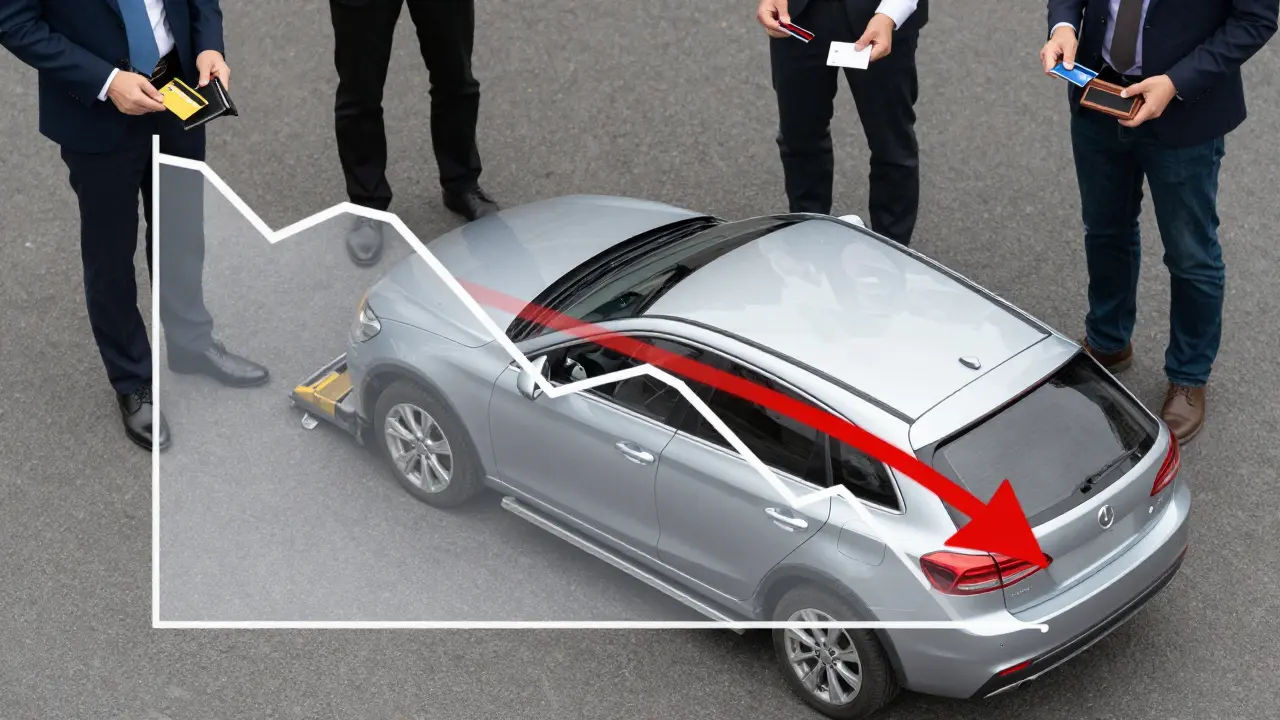
Here’s how it works: When you drive a new car off the lot, it loses 10% to 20% of its value immediately. In the first year, it can drop another 15% to 20%. That means if you get into an accident six months after buying a $35,000 car, your vehicle might be worth only $26,000 - but you still owe $32,000 on the loan. Without gap insurance, you’re stuck paying the $6,000 difference out of pocket.
Most standard auto insurance policies only pay the actual cash value (ACV) of the car at the time of loss. That’s the market value, not what you paid or what you owe. Gap insurance covers the difference between that ACV and your remaining loan balance.
Who Actually Needs Gap Insurance?
Not everyone needs it. But if you fall into any of these categories, you’re at risk:
- You made a down payment of less than 20%
- Your loan term is longer than 60 months (5 years)
- You rolled over negative equity from an old car loan
- You’re leasing a vehicle
- You drive a car that depreciates faster than average (like luxury or electric models)
For example, the 2024 Tesla Model Y lost 34% of its value in the first year - one of the steepest drops in the market. If you financed it with 10% down and a 72-month loan, you’d owe nearly $10,000 more than it’s worth after just 12 months. That’s a gap waiting to happen.
Leased cars almost always require gap insurance. Why? Because lease agreements are structured so you pay for the entire depreciation over the term. If the car is totaled, you still owe the full remaining lease balance. Without gap insurance, you could be on the hook for thousands.
How Much Does Gap Insurance Cost?
It’s cheap - really cheap. Most dealerships will try to sell you gap insurance for $500 to $700 as a one-time fee. But if you buy it through your auto insurance company, it typically costs between $20 and $40 per year. Some insurers even include it for free with comprehensive coverage.
Here’s the catch: Dealerships often bundle it into your loan. That means you’re paying interest on the gap insurance over five or six years. If you pay $600 upfront at the dealership, you might end up paying $750 total with interest. But if you add it to your existing policy, you pay $30 a year - no interest, no fees.
Pro tip: Ask your insurer before you buy. Many companies like Geico, Progressive, and State Farm offer gap coverage as an add-on. It’s easier to manage, cheaper, and doesn’t get buried in your monthly payment.
When Gap Insurance Doesn’t Help
Gap insurance isn’t magic. It won’t cover everything.
- It doesn’t cover your deductible
- It won’t pay for missed payments or late fees
- It doesn’t cover mechanical breakdowns or engine failure
- If you owe more than 125% of the car’s value, some policies won’t pay
Also, if you paid cash or made a huge down payment (30% or more), you probably don’t need it. The car’s value won’t drop below what you owe - at least not in the first few years.
And here’s something people forget: Gap insurance only applies if the car is totaled or stolen. If you wreck it and it’s repairable, you’re on your own. No gap coverage kicks in unless the car is declared a total loss.
What Happens If You Don’t Have It?
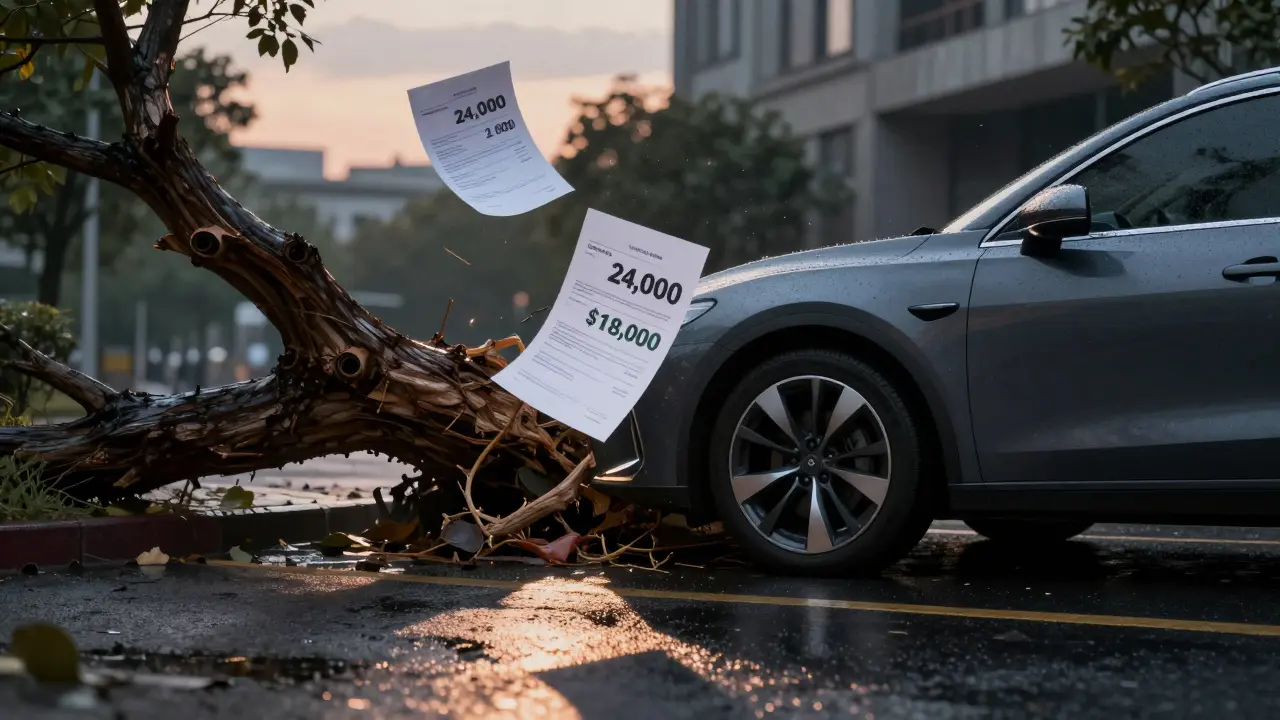
Imagine this: You’re driving home from work. A tree falls on your car. It’s totaled. Your insurance pays $18,000 - the current market value. But you still owe $24,000 on the loan. You’re out $6,000. You don’t have a car. And you still owe the bank.
That’s not hypothetical. In 2024, over 1.2 million vehicles were declared total losses in the U.S. The average payout from standard insurance was $17,800. The average remaining loan balance? $22,100. That’s a $4,300 gap - on average - per claim.
People who don’t have gap insurance often end up taking out personal loans, dipping into savings, or even defaulting on their car loans. That hurts your credit. It makes buying another car harder. It’s a domino effect.
Gap Insurance vs. New Car Replacement Coverage
You might have heard of new car replacement coverage. It’s different. This pays to replace your totaled car with a brand-new one of the same model - if it’s less than a year old and you have full coverage.
But here’s the trade-off: New car replacement coverage only works for the first year or two. Gap insurance lasts as long as you have a loan. So if you’re financing a car for 72 months, gap insurance covers you longer.
Some people stack both. If you’re buying a $50,000 luxury SUV with 10% down and a 72-month loan, having both gives you peace of mind: new car replacement for the first year, gap for the rest.
How to Get Gap Insurance
You have three options:
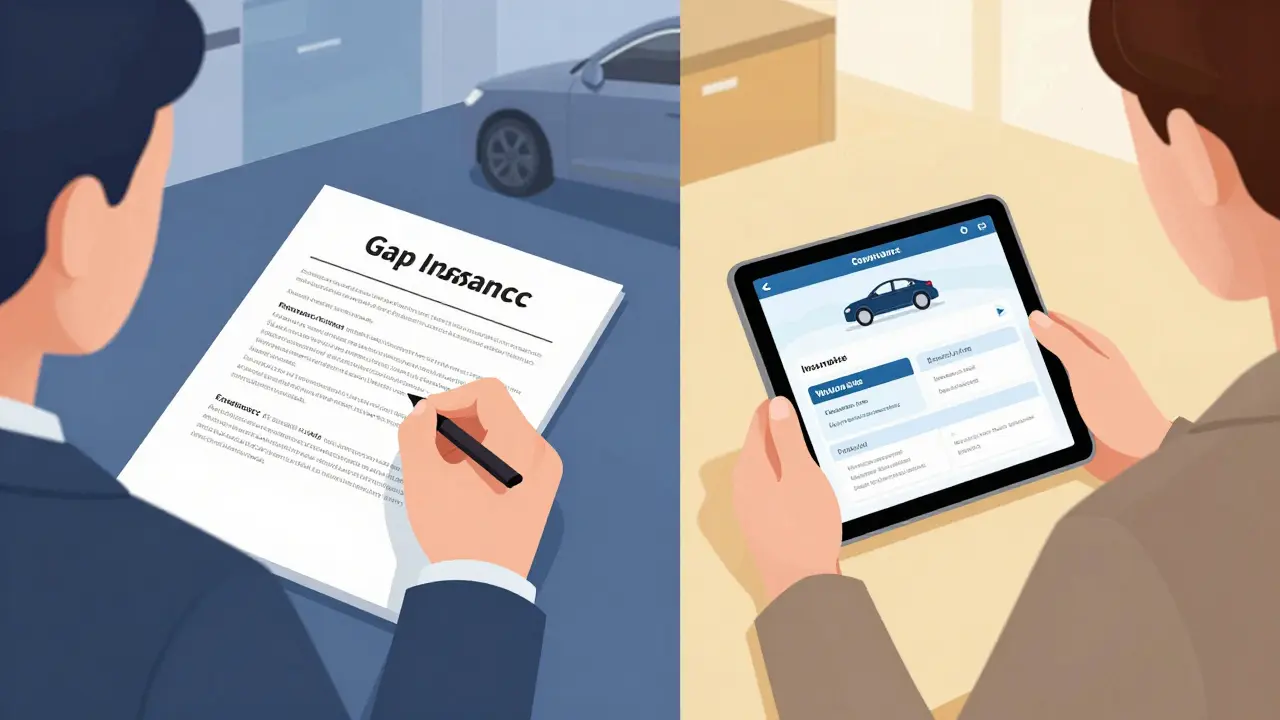
- Your auto insurer - Best value. Add it to your existing policy. Usually under $40/year. Easy to cancel if you pay off the loan early.
- The dealership - Convenient but expensive. Often bundled into your loan. Pays out if you total the car, but you’re paying interest on it.
- The lender - Some banks and credit unions offer it. Check terms. Some have restrictions.
Don’t just say yes at the dealership. Ask: Can I cancel this if I pay off the loan early? Will I get a refund? Most dealerships won’t refund the unused portion. Insurance companies usually will.
When to Drop Gap Insurance
You don’t need it forever. Once your loan balance drops below the car’s market value, you’re safe. That usually happens between 18 and 36 months, depending on your down payment and interest rate.
Check your loan statement monthly. Use Kelley Blue Book or Edmunds to track your car’s value. When your loan balance is less than the car’s current value, call your insurer and cancel gap coverage. You’ll save money.
Pro tip: Set a reminder six months after you buy the car. That’s when most people start to break even on depreciation. Recheck every six months after that.
The Bottom Line
If you’re financing a car with less than 20% down, or you’ve got a long-term loan, gap insurance is a smart move. It’s cheap, it’s simple, and it protects you from a financial shock most people never see coming.
But if you made a big down payment, paid cash, or bought a used car with a short loan term - skip it. You’re not at risk.
Don’t let dealerships pressure you. Don’t assume it’s required. Do the math. Check your numbers. If the gap is real, get the coverage. If not, save your money.
Is gap insurance required by law?
No, gap insurance is not required by any state law. However, if you’re leasing a car, the leasing company will almost always require it. If you’re financing, your lender may require it too - especially if you have a low down payment or long loan term. Always check your contract.
Can I get gap insurance after I buy the car?
Yes, you can usually get gap insurance after purchase - as long as the car is still under a loan and hasn’t been totaled or stolen. Most insurers allow you to add it within 12 to 24 months of the purchase date. Dealerships may have stricter time limits. The sooner you get it, the better.
Does gap insurance cover my deductible?
No. Gap insurance only covers the difference between your car’s actual cash value and your loan balance. It does not pay your deductible. You’ll still need to pay that out of pocket before gap insurance kicks in.
What if I pay off my car early?
If you pay off your car early, you can cancel gap insurance and usually get a prorated refund. This is one reason why buying gap insurance through your auto insurer is better than through a dealership - you can cancel it anytime and get money back. Dealership policies often have no refunds.
Do used cars need gap insurance?
Used cars rarely need gap insurance unless you’re financing with a very low down payment or a long loan term. Most used cars have already gone through their steepest depreciation. If you put 20% or more down on a used car, you’re likely not at risk for a gap. But if you’re buying a high-end used model with a 72-month loan, it’s worth checking the numbers.
Comments
Geet Ramchandani
Let me tell you something about gap insurance-nobody ever talks about how dealerships rig the whole system. You think you’re getting protection? No. You’re getting a predatory add-on that’s buried in your loan at 7.5% interest because they know you’re too tired to read the fine print. I bought a car last year, signed everything without reading, and six months later realized I was paying $580 for something that should’ve cost $32 a year. And when I tried to cancel? They said ‘no refunds.’ That’s not insurance-that’s a tax on naivety. And don’t even get me started on how they push it on people who just leased a $30k Honda Civic. You’re not driving a Lamborghini. You don’t need this. But they’ll make you feel like you’re irresponsible if you say no. It’s psychological manipulation dressed up as financial advice. And the worst part? The system works because people are too exhausted to fight back. You show up, you sign, you drive off, and then you’re trapped. That’s not a safety net. That’s a trapdoor.
February 19, 2026 at 07:22
Pooja Kalra
There is a quiet tragedy in how we’ve turned car ownership into a financial gamble. We don’t just buy vehicles anymore-we buy liabilities wrapped in chrome. The moment you drive off the lot, you are already underwater. And yet, society tells you to celebrate. To post pictures. To pretend this is progress. But the truth is, you are not owning a car-you are servicing a debt. Gap insurance is not a shield. It is a Band-Aid on a hemorrhage. We have normalized a system where the only way to survive is to pay extra for protection against the very system that created the risk. Who benefits? Not you. Not me. The banks. The dealerships. The insurers. And we, the consumers, are the ones who are supposed to feel grateful for being allowed to pay for the privilege of being screwed.
February 20, 2026 at 07:47
Sumit SM
Wait-hold on-let me clarify something here: Gap insurance does NOT cover your deductible-that’s critical-and yet, so many people assume it does. I’ve seen this mistake cost people thousands. You total your car, insurance pays $18,000 ACV, you owe $24,000, gap covers $6,000… but you still owe $1,500 for your deductible. So now you’re out $7,500. That’s not a gap-that’s a canyon. And dealerships? They never mention that. They say ‘we cover the gap’ like it’s magic. It’s not. It’s a contract. Read it. Highlight it. Ask for the policy wording. If they hesitate? Walk away. Also-don’t buy it from the dealer unless you’re getting a refund clause. Most don’t offer one. I got mine through Progressive for $35/year. Cancelled it at 22 months. Got a $21 refund. Simple. Clean. No drama. Dealerships? They want you to pay interest on a $600 fee for 60 months. That’s $780. That’s not insurance. That’s usury.
February 20, 2026 at 09:01
Dave Sumner Smith
Did you know that gap insurance is part of a larger scheme to keep Americans in debt? The banks, the dealerships, the manufacturers-they all work together. You think the depreciation curve is natural? It’s engineered. They flood the market with new models every year, make sure the resale value plummets, then push you into longer loans so you’re underwater for years. Gap insurance? It’s not protection-it’s a trapdoor that keeps you paying. And if you think your credit union is safe? They’re in on it too. They make more money from your loan interest than your insurance premium. The whole system is designed to make you feel secure while they quietly drain your bank account. They don’t want you to know you can cancel it. They don’t want you to know you can get it cheaper. They want you to believe you need it. And you do-but not from them. From the truth. And the truth is, they’re lying.
February 21, 2026 at 12:53
Paul Timms
Gap insurance is worth it if you financed under 20% down or have a long loan. Otherwise, skip it. Simple.
February 21, 2026 at 18:13
Sally McElroy
It’s insane how we’ve normalized this. We’re told to ‘be responsible’-save for a down payment, get good insurance, drive safely-and then the system turns around and says, ‘Oh, but you still owe more than the car’s worth? Here’s a $600 fee for that.’ It’s not just unethical-it’s cruel. And the fact that dealerships profit from people’s ignorance? That’s not capitalism. That’s exploitation. I’ve seen friends cry because they totaled a $25k car and owed $32k. They didn’t have gap. They didn’t know it existed. They thought their insurance would ‘cover everything.’ It’s not their fault. It’s the system’s. And yet, nobody talks about it. We just keep buying cars like this is normal. It’s not. It’s a Ponzi scheme with wheels.
February 22, 2026 at 23:41
Jason Townsend
Gap insurance is a scam. Dealers push it because they make bank. Insurance companies don’t care. You’re better off saving $50 a month and self-insuring. If you total your car, you pay the difference. Big deal. You’ll survive. Most people who panic about this are the same ones who buy extended warranties and tire protection. You’re not poor. You’re gullible.
February 24, 2026 at 04:40
Jen Deschambeault
I’m not here to convince you. But if you’re reading this, you’re probably wondering whether you’re safe. You’re not. Not yet. But you can be. Start by checking your loan balance against KBB today. If you’re underwater? Get gap. If not? Breathe. You’re fine. Don’t overthink it. Just check. That’s all.
February 24, 2026 at 16:26