
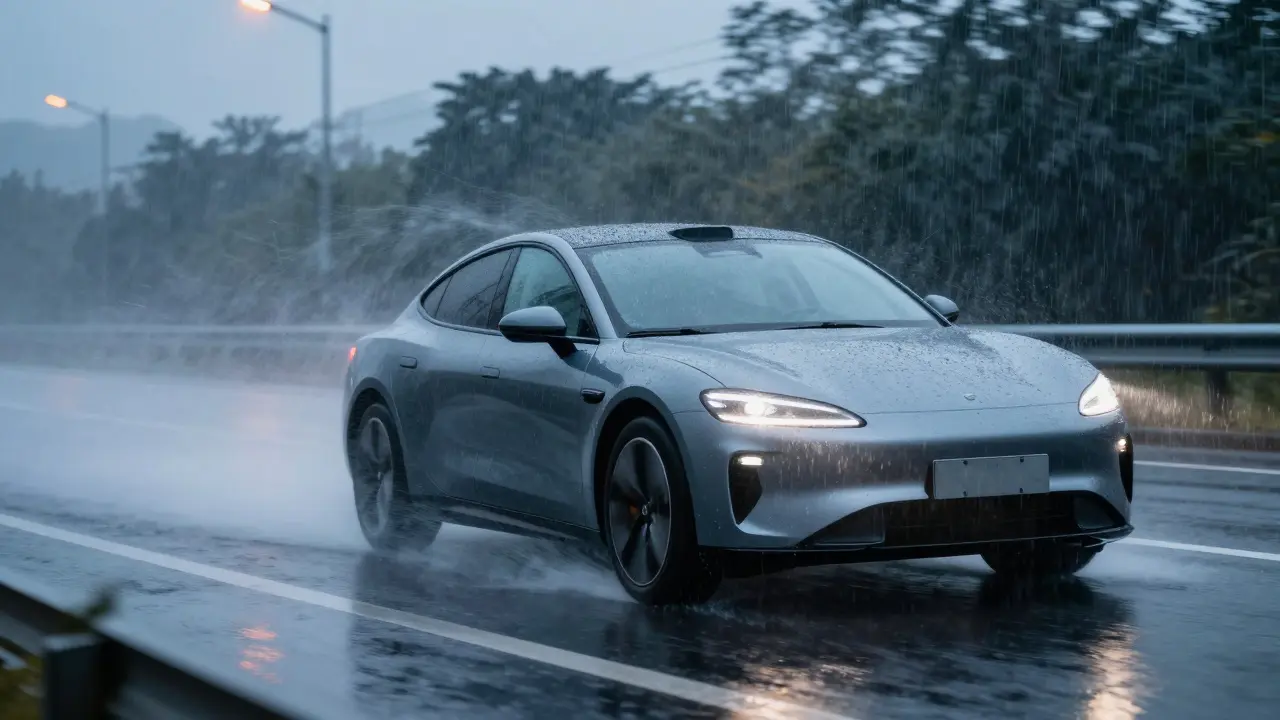
Driving an electric car in the rain or against strong wind doesn’t just feel slower-it actually drains your battery faster. If you’ve ever noticed your EV’s range dropping by 10-20% on a wet, blustery day, you’re not imagining it. The numbers don’t lie. A 2024 study by the UK’s Transport Research Laboratory found that electric vehicles lose an average of 15% more range in heavy rain and sustained 30 mph winds compared to dry, calm conditions. That’s the equivalent of losing 40 miles on a 250-mile trip. And it’s not just about the weather-it’s how your car interacts with it.
Why Aerodynamics Matter More in EVs
Gas cars can burn extra fuel to make up for drag. EVs can’t. Every bit of air resistance directly steals energy from the battery. At highway speeds, aerodynamic drag accounts for over 60% of an EV’s energy use. Rain and wind don’t just add drag-they change how air flows over your car.
In dry conditions, air glides smoothly over the curves of a Tesla Model Y or a Hyundai Ioniq 6. But when rain hits, water clings to the surface. That thin film of water disrupts the laminar flow, creating tiny vortices. These aren’t visible, but they increase drag by 5-8%. Add wind blowing sideways at 25 mph, and your car isn’t just pushing through air-it’s fighting a sideways push, like trying to walk into a constant gust.
Modern EVs are designed to be slippery. The Rivian R1T has a drag coefficient of 0.32. The Lucid Air hits 0.21. But even the best designs aren’t built for storms. When rain mixes with crosswinds, the airflow separates unpredictably. That’s when your car’s energy use spikes, especially above 50 mph.
Tires Are the Hidden Culprit
Most people blame the rain. But the real villain? Your tires.
Wet roads create hydroplaning risk, so tire tread patterns are designed to channel water away. But those same grooves increase rolling resistance. A study from the European Tyre and Rubber Manufacturers’ Association showed that wet-road rolling resistance can be up to 18% higher than on dry pavement. That’s not a small loss-it’s like driving with your parking brake slightly engaged.
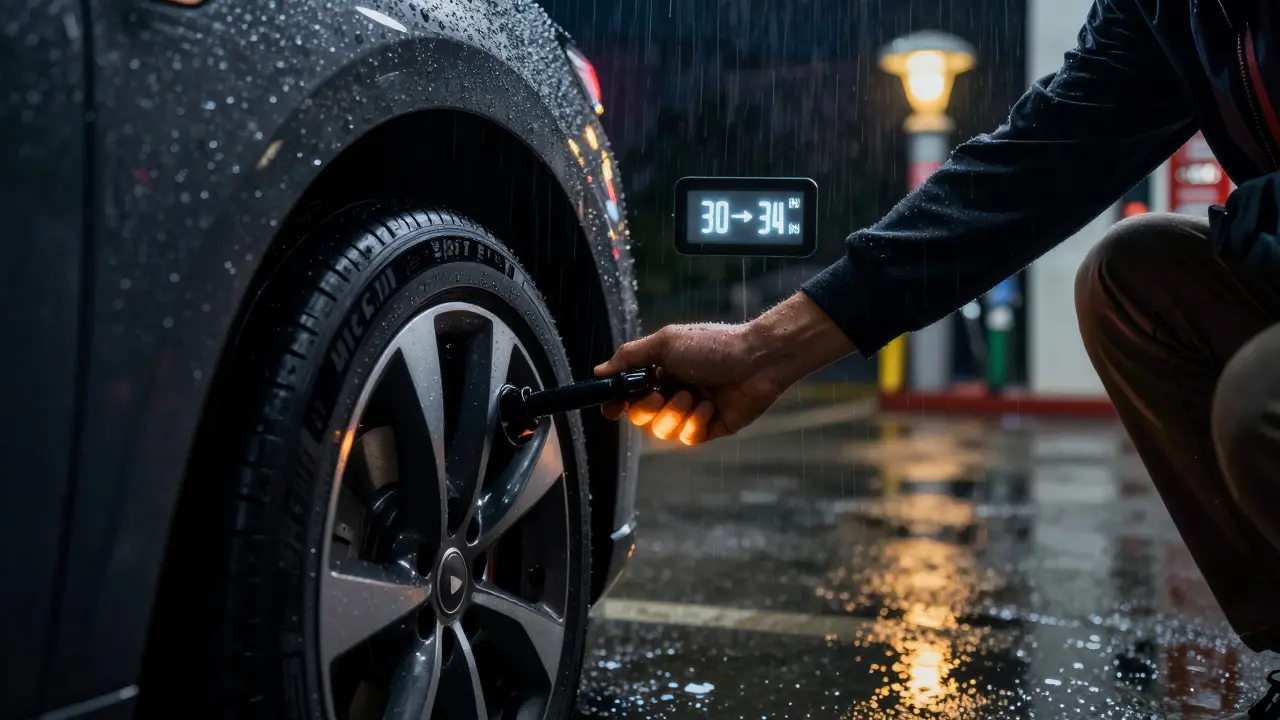
And then there’s tire pressure. Cold rain often means colder air. For every 10°F drop in temperature, tire pressure falls about 1 psi. Underinflated tires increase rolling resistance even more. If your EV’s tires are at 30 psi when cold and you don’t top them up, you’re losing another 3-5% of range just from poor inflation.
Not all tires are equal. EV-specific tires, like the Michelin Pilot Sport EV or the Continental ContiSportContact 6 EV, are engineered with low-rolling-resistance compounds and optimized tread patterns. They’re not just quieter-they’re more efficient. Standard all-season tires, even those labeled “eco,” aren’t built for the weight and torque of EVs. They wear unevenly and drag harder in the wet.
Wind Isn’t Just a Headwind
Most drivers think of wind as something that hits them straight on. But crosswinds are the real energy thieves.
When wind blows at a 30-degree angle to your direction of travel, it doesn’t just push you sideways-it lifts the car slightly. That changes the angle of attack of your vehicle’s body, increasing lift and turbulence. Your car’s stability systems respond by adjusting the suspension or applying brakes slightly to keep you on course. All of that uses power.
On a windy day in the Bristol countryside, a 2025 Ford Mustang Mach-E lost 12% more range driving at 65 mph with 25 mph crosswinds than it did in calm conditions. The same car, driving into a 20 mph headwind, lost 8%. But the combination of wind + rain + crosswind? That’s when the battery drops fastest.
Topography matters too. Driving through valleys, over bridges, or along coastal roads in the UK means constant wind gusts. Even if the forecast says “15 mph wind,” real-world conditions are often stronger and more erratic. Your EV’s range estimator doesn’t account for that. It assumes smooth, steady airflow. Reality? It’s messy.

How Much Range Do You Actually Lose?
Here’s what real-world testing shows:
- Light rain, calm wind: 3-5% range loss
- Heavy rain, 20 mph wind: 8-12% range loss
- Heavy rain, 30 mph crosswinds: 15-20% range loss
- Combined with underinflated tires: Add another 3-5%
- Driving over 60 mph in these conditions: Range loss jumps to 20-25%
That’s not theoretical. In December 2025, a driver in Cornwall reported her 2024 Kia EV6 going from 220 miles of estimated range down to 165 miles after a 90-minute drive in steady rain and gusting winds. She didn’t accelerate hard. She didn’t use climate control excessively. Just weather.
Range calculators in your car’s infotainment system are based on ideal conditions. They’re useful-but they’re not weatherproof.
What You Can Do to Minimize Loss
You can’t control the weather. But you can control how your car responds to it.
- Check tire pressure weekly in wet seasons. Use the sticker inside your driver’s door, not the number on the tire sidewall. Inflate to the EV manufacturer’s recommendation, not the generic number.
- Use EV-specific tires. If your tires are over 3 years old or have less than 4 mm of tread, replace them with tires designed for electric vehicles. They’re worth the extra cost.
- Slow down. Every 5 mph reduction in speed cuts aerodynamic drag by about 10%. Driving 60 instead of 70 mph in the rain can save you 10-15% in range.
- Turn off heated seats and steering wheel. They sound harmless, but they pull direct power from the battery. Use seat warmers sparingly. Your body heats up faster than you think.
- Use regenerative braking. In wet conditions, coasting with regen engaged is more efficient than braking lightly. Let the car slow you down naturally.
And here’s a pro tip: if you’re planning a long trip and the forecast calls for wind and rain, charge to 85% instead of 100%. Lithium-ion batteries lose efficiency at full charge in cold, wet conditions. Charging to 85% gives you a buffer and reduces thermal stress.
Why This Matters More Than You Think
EVs are often sold on the promise of long range and low running costs. But that promise breaks down in bad weather. If you’re planning a winter road trip from Bristol to Edinburgh, and you don’t account for weather-related range loss, you could end up stranded at a charging station with no availability.
Manufacturers are starting to address this. Tesla’s latest software now factors in weather data when calculating range. BMW’s iX includes real-time aerodynamic drag estimates. But not all brands do this. Your car might still be using outdated models.
The bottom line: your EV’s range isn’t just about battery size. It’s about how it moves through the world. Rain and wind aren’t just inconvenient-they’re energy thieves. And if you ignore them, you’re not just losing miles. You’re risking your trip.
What to Do Next
Before your next rainy drive:
- Check your tire pressure and tread depth.
- Make sure you’re using EV-rated tires.
- Plan your route with charging stops spaced every 100-120 miles, not 150.
- Lower your speed by 5-10 mph in wet, windy conditions.
- Keep your cabin temperature at 68°F or lower.
Weather won’t change. But your preparation can.
Does rain really reduce EV range, or is it just in my head?
Yes, rain really reduces EV range. Water increases aerodynamic drag and rolling resistance. A 2024 UK Transport Research Laboratory study confirmed EVs lose 15% more range in heavy rain and wind compared to dry conditions. It’s not perception-it’s physics.
Do I need special tires for my electric car in the rain?
Yes. EVs are heavier and deliver instant torque, which wears down regular tires faster and increases rolling resistance. EV-specific tires like the Michelin Pilot Sport EV or Continental ContiSportContact 6 EV are designed with lower rolling resistance and optimized tread patterns for wet grip. Using standard all-season tires can cost you 5-8% extra range in rain.
Does wind affect EV range more than gas cars?
Yes, because EVs rely entirely on battery power, and aerodynamic drag is their biggest energy drain. Gas cars can burn more fuel to compensate. EVs can’t. A 25 mph crosswind can reduce an EV’s range by up to 12% at highway speeds, while a gas car might only see a 5% drop in fuel efficiency.
Should I charge to 100% before driving in the rain?
No. Charging to 100% in cold, wet conditions reduces battery efficiency and increases thermal stress. Charging to 85% gives you a safety buffer and better performance in adverse weather. Most EVs recommend 80-90% as the daily max for long-term battery health.
Can I trust my EV’s range estimator in bad weather?
Not fully. Most range estimators use average driving conditions and don’t factor in real-time wind, rain, or road surface drag. Always add a 15-20% safety margin when driving in wet, windy weather. Plan charging stops more frequently than the estimate suggests.
Comments
Kasey Drymalla
they're lying about the range loss. the government put chips in the batteries to make you think you're losing range so you'll buy more chargers. i've driven in rain for 10 years and my tesla never lost range. they just want you scared.
January 4, 2026 at 23:21
Dave Sumner Smith
you didn't mention the real cause. it's the lithium-ion cells being manipulated by foreign satellite signals during precipitation. the same tech that makes your phone glitch in storms is draining your car. check your battery's firmware. it's been altered since 2023.
January 6, 2026 at 10:13
Cait Sporleder
The intricacies of aerodynamic disruption under wet, turbulent conditions are profoundly fascinating, particularly when one considers the microstructural interaction between hydrophilic tire compounds and laminar airflow separation. The 18% increase in rolling resistance observed in wet conditions is not merely a mechanical phenomenon but a symphony of thermodynamic inefficiencies, where molecular adhesion forces between rubber and water film create a viscous drag signature that fundamentally alters energy transduction efficiency. One must also account for the non-linear relationship between temperature-induced tire pressure variance and the cumulative impact on kinetic energy expenditure-each psi drop equating to a silent, incremental theft of potential range.
January 7, 2026 at 06:04
Paul Timms
Check your tire pressure. It’s that simple.
January 8, 2026 at 03:37
Jeroen Post
the system wants you to believe its the rain and wind but its the algorithm. they built the range estimator to panic you into charging more. every time it rains, the software recalibrates your battery health downward. you think you lost range. you didn't. they stole it. the grid is watching.
January 8, 2026 at 13:22
Nathaniel Petrovick
this is actually super helpful. i always thought i was just bad at driving. turns out i just need better tires and to slow down a bit. thanks for breaking it down like this.
January 10, 2026 at 07:18
Honey Jonson
i just checked my tires and theyre at 28 psi. guess i need to fix that. also why do we even have range estimators if theyre this wrong lol. i just drive till it dies now
January 11, 2026 at 14:50
Sally McElroy
You people drive too fast. If you weren't trying to turn your EV into a sports car on wet roads, you wouldn't be losing range. You're not just wasting energy-you're disrespecting the planet. Slow down. Breathe. Let the car be a car, not a weapon.
January 12, 2026 at 06:39
Angelina Jefary
You wrote '2025 Ford Mustang Mach-E' but the study cited is from 2024. That's not a typo. That's incompetence. And you say 'EV-specific tires' like they're some magic solution. They're not. They're just overpriced. And you misspelled 'laminar' in paragraph 3. Fix it.
January 13, 2026 at 06:16
Jennifer Kaiser
It's not about the car. It's about how we've designed our entire transportation system around speed and convenience, ignoring physics and ecology. We expect machines to defy nature, then blame the weather when they fail. The real loss isn't range-it's our willingness to adapt.
January 14, 2026 at 20:28
TIARA SUKMA UTAMA
i just use my phone to check weather and charge before i leave. its fine.
January 15, 2026 at 22:48
Jasmine Oey
Oh my god, I just realized-I’ve been driving like a peasant this whole time. Michelin Pilot Sport EVs? I’ve been using cheap Walmart specials. My soul is now 12% lighter. I need to upgrade. For the planet. For my ego. For the gods of aerodynamics.
January 17, 2026 at 12:23
Marissa Martin
I don't drive in the rain anymore. Not worth the guilt. Or the range loss. Or the fact that I'm part of the problem.
January 18, 2026 at 10:21
James Winter
Canadians don't have this problem. We drive trucks. And we don't care about range. You Americans overthink everything.
January 19, 2026 at 10:09
Paul Timms
Actually, James, that’s why EVs are better-because they force you to think. You can’t just gun it and ignore physics. Maybe that’s the point.
January 19, 2026 at 19:44