
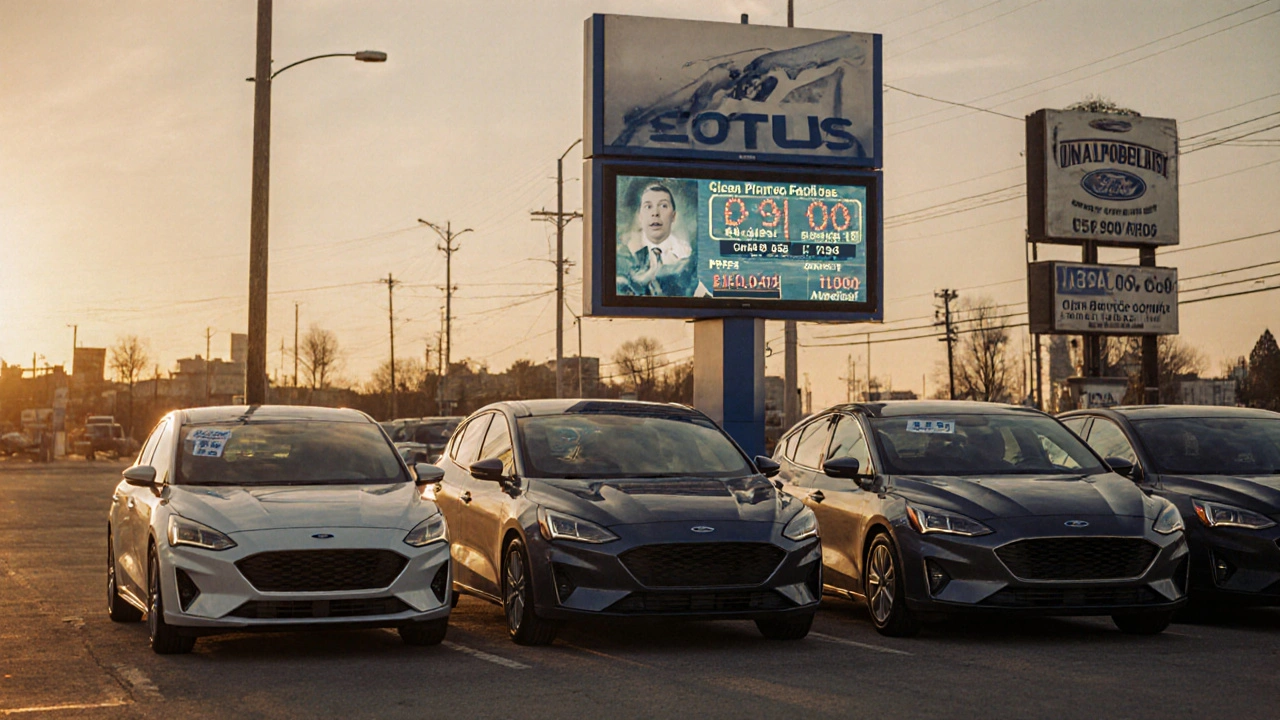
Getting vehicle pricing right isn’t about guessing what your neighbor charges or copying what the big chains do. It’s about knowing what your customers are willing to pay right now in your specific town or neighborhood. A car that sells in 3 days in Bristol might sit for 45 days in a town 20 miles away. The difference isn’t the car-it’s the pricing strategy.
Start with what’s actually selling nearby
Don’t rely on national websites like Autotrader or CarGurus to set your prices. Those sites show averages, not local reality. Go to Facebook Marketplace, local classifieds, and even rival dealerships within a 10-mile radius. Look at the same make, model, year, and mileage as your inventory. Note the asking price, the condition notes, and how long the listing has been up. If three similar 2021 Ford Focuses with 55,000 miles are listed at £9,500 and all sold in under a week, that’s your benchmark-not the £11,000 you saw on a national site.Check the photos too. Are those cars clean? Do they have service records shown? Are they being sold by private sellers who don’t offer warranties? If your car has a full service history and a 3-month warranty, you can price higher. But if your car has scratches, no history, and no guarantee, you need to be lower. Matching the competition isn’t enough-you need to out-value them.
Use real-time data, not old reports
Many dealers still use monthly market reports from third-party services. Those are outdated by the time they land on your desk. In late 2025, the used car market is still adjusting after pandemic-era spikes. In Bristol, for example, demand for compact petrol hatchbacks dropped 18% in the last 90 days, while demand for compact SUVs with AWD rose 22%. That’s not something a 30-day-old report will tell you.Use tools like Black Book or CAP HPI to get weekly updates, but don’t stop there. Log into your dealership management system and pull a report of your own inventory. Which cars have been sitting over 30 days? Which ones moved in under 7? Look at the price points. If your 2020 Hyundai Kona with 40,000 miles sat for 42 days at £10,200 but sold in 5 days at £9,400, that’s your new price floor for that model. Adjust your other Kona listings to match.
Factor in local demand drivers
What’s happening in your town affects pricing more than you think. In Bristol, the rise in remote work means more people are buying cars to escape the city on weekends. Compact SUVs and hybrids are flying off the lot. Meanwhile, older diesel saloons are sitting because of the city’s low-emission zone rules. If you’ve got a 2017 Volkswagen Passat diesel with 80,000 miles, you can’t price it like you did in 2022. You need to drop it 15-20% and highlight the low tax rate and good fuel economy-because that’s what buyers care about now.Check local events too. Is there a big university nearby? Students need cheap, reliable cars. Are there new housing developments? Young families need space and safety. A 2019 Toyota Corolla with a full service history and rear parking sensors will move fast in a suburb with new schools. Price it right, and you’ll sell before it even hits your lot.
Don’t overprice to cover costs
It’s tempting to add on every cost you’ve incurred-reconditioning, transport, advertising, finance fees-and then tack on a 20% profit. That’s how you end up with a £12,000 car that nobody wants. Instead, start with the market price. Then subtract your costs. If the market says your car is worth £9,800, and your total cost to get it ready is £2,100, your profit is £7,700. That’s fine. You don’t need to force it to £11,000 just because you spent more on detailing than you expected.Think of pricing like a restaurant menu. You don’t charge £35 for a burger because your kitchen staff costs £20/hour. You charge what the customer will pay. If your burger competes with others at £14, you price at £14-and make up the margin on drinks and sides. Same with cars. Price to sell. Then make your profit on finance, warranties, and add-ons after the sale.

Use dynamic pricing, not static tags
Static pricing is dead. If a car sits for 14 days, drop the price by 5%. If it sits for 28 days, drop it another 7%. That’s not a discount-it’s a correction. Buyers notice when prices are stuck. They assume the car has a problem. But if they see a car dropped from £10,500 to £9,800 to £9,100, they think it’s a hot deal. They move faster.Set up a simple rule: every 14 days on the lot, reduce price by 5%. Use your DMS to auto-flag cars hitting that mark. Don’t wait for your manager to notice. Don’t hope the market will change. Act. In Bristol, one dealer reduced a 2018 Honda Civic from £9,900 to £8,400 over 42 days. It sold in 3 days. Another dealer kept the same price and had to sell it at auction for £6,800. The difference? One adjusted. The other waited.
Bundle services to justify price
You can’t always undercut the competition on price. But you can out-value them. If your competitor is selling a 2020 Mazda3 for £9,200, and yours is £9,600, you need to give buyers a reason to choose you. Offer a free 12-month service plan. Throw in a full tank of fuel. Add a 6-month warranty on the engine. Include a free valet before delivery.These cost you little but feel huge to the buyer. One Bristol dealer started including a free MOT with every used car. Sales went up 27% in two months. Buyers didn’t care about the £80 cost-they cared that they wouldn’t need to worry about the next test. That’s the emotional win. Price the car at market value, then stack on services that reduce buyer anxiety.
Track your own metrics, not industry averages
Stop comparing yourself to national averages. Track your own numbers. How many days does it take your average car to sell? What’s your gross profit per vehicle? What percentage of your inventory turns over in 30 days? If your turnover rate is below 60% in 30 days, your pricing is off. If it’s above 80%, you’re leaving money on the table.Set a goal: 70% of your inventory sells in under 45 days. If you’re not hitting it, your pricing isn’t working. Don’t blame the market. Look at your price tags. Adjust. Test. Repeat. One Bristol dealer tracked this for 6 months and found that cars priced under £8,500 sold 3x faster than those above £9,000-even though the higher-priced ones had better specs. They adjusted their entire pricing model and increased monthly profit by 19%.
Test small changes, not big leaps
Don’t slash prices by 20% overnight. That signals desperation. Instead, test small shifts. Take 5 similar cars. Keep one at the current price. Drop another by 3%. Drop a third by 6%. Leave one unchanged. See which one gets the most inquiries and test drives. Use that data to adjust the rest. It’s not guesswork-it’s science.One dealer in Clifton tested five 2019 Toyota Corollas: £9,200, £8,900, £8,600, £8,300, and £8,000. The £8,600 model got the most attention and sold first. The £8,000 one got lots of calls but no serious buyers-they thought it had hidden damage. The £9,200 one sat for 41 days. The sweet spot? £8,600. That’s your data point. Use it.
Know when to cut your losses
Sometimes, no matter how well you price, a car just won’t sell. Maybe it’s the color. Maybe it’s the engine type. Maybe it’s bad luck. If a car sits for 75 days, it’s time to act. Lower the price again. Offer it to your finance partner as a trade-in. Send it to auction. Don’t hold onto it for emotional reasons. That £7,000 car sitting for 90 days is costing you £150 a month in storage, insurance, and missed sales. Let it go. Free up space. Free up cash. Move on.How often should I adjust my vehicle prices?
Adjust prices every 14 days if the car hasn’t sold. A 5% drop at that point keeps the listing fresh and signals to buyers that you’re serious about selling. Don’t wait longer than 28 days without a price change-cars that sit too long lose perceived value and attract lowball offers.
Should I price my cars lower than my competitors?
Not necessarily. Price based on what’s selling, not what’s listed. If your car has better condition, warranty, or service history, you can price the same or slightly higher. If it’s older, has more miles, or lacks features, then yes-price lower. Value matters more than being the cheapest.
What tools are best for checking local car prices?
Use Black Book or CAP HPI for weekly market trends, but also check Facebook Marketplace, Auto Trader’s local listings, and nearby dealership websites. Look at real sold prices, not just asking prices. Your own DMS sales data is the most accurate tool-you know what actually moved and for how much.
How do I handle cars that don’t sell even after price drops?
If a car sits over 75 days, consider offering it as a trade-in to your finance partner, listing it on auction platforms like Manheim or Copart, or bundling it with a service package to make it more attractive. Don’t let it tie up capital. Every day it sits costs you money in storage, insurance, and lost opportunity.
Does the time of year affect pricing?
Yes. In late autumn and winter, SUVs and AWD vehicles sell better. In spring, convertibles and smaller cars pick up. Around school holidays, family cars in good condition move faster. Adjust your pricing focus based on seasonality. Don’t price a 2018 convertible the same in November as you would in May.
Final tip: Price to move, not to impress
Your goal isn’t to make the biggest profit on one car. It’s to move inventory quickly, keep your lot fresh, and keep cash flowing. A car that sells fast at £8,500 with a £1,200 profit is better than one that sits for two months and sells at £9,800 with a £1,600 profit. The first one frees up space, reduces risk, and lets you buy more stock. The second one drains your time and money.Use data. Watch the market. Adjust fast. And remember-in a local market, the best price isn’t the highest. It’s the one that gets the car out of your lot and into a buyer’s driveway.
Comments
Reshma Jose
Love this breakdown. I run a small lot in Pune and started using Facebook Marketplace to check local comps last month - sales jumped 40% in 3 weeks. No more guessing.
December 2, 2025 at 09:17
rahul shrimali
14 day drop rule works. Done it. Sold 8 cars in 2 months. Simple.
December 3, 2025 at 09:42
Anand Pandit
This is exactly what I’ve been telling my team for months. We were stuck on national averages and wondered why our inventory sat. Real local data changes everything. Thank you for putting this so clearly.
December 4, 2025 at 12:40
Nikhil Gavhane
I appreciate how practical this is. Too many dealers treat pricing like magic. It’s not. It’s math, observation, and discipline. The 5% drop every 14 days is genius - simple, measurable, and effective.
December 6, 2025 at 02:19
Rajat Patil
Thank you for sharing this. As someone who manages a small dealership in Jaipur, I’ve struggled with pricing for years. Your point about bundling services instead of lowering price is something I will try immediately. Free MOT sounds like a small cost but a big win for customers.
December 7, 2025 at 03:09
Rahul Borole
While the methodology presented is commendable for its empirical grounding, it must be acknowledged that the underlying assumption of market rationality is increasingly tenuous in the post-pandemic economic landscape. Consumer behavior is no longer linear, and algorithmic pricing models, while efficient, may inadvertently erode perceived brand equity. One must not conflate velocity with value; the psychological premium attached to a vehicle with demonstrable provenance and service integrity cannot be reduced to a mere function of days-on-lot metrics. The true art lies in calibrating the perception of scarcity, not merely the price point.
December 9, 2025 at 02:41
Sheetal Srivastava
Oh please. You’re all still thinking in terms of ‘price points’ and ‘DMS flags’? How quaint. The real insight is that modern consumers are not buying cars - they’re buying *narratives*. A 2020 Hyundai Kona isn’t a vehicle - it’s a symbol of urban resilience. If your listing doesn’t evoke emotional resonance through curated storytelling - ‘This car carried a single mom through lockdowns’ - you’re already dead. And don’t get me started on ‘free MOT’ - that’s basic hygiene, not value-add. You need premium touchpoints: ambient lighting upgrades, scent diffusion in the cabin, handwritten thank-you notes. Otherwise, you’re just another soulless dealership in the algorithmic void.
December 9, 2025 at 18:02
Bhavishya Kumar
There are several grammatical inconsistencies throughout the post. For example, the phrase 'your car has scratches no history and no guarantee' lacks necessary commas. Also, 'price the car at market value then stack on services' is a run-on. Proper punctuation is not optional in professional communication. Furthermore, 'DMS' should be spelled out on first use. These errors undermine the credibility of an otherwise sound argument.
December 11, 2025 at 02:56
ujjwal fouzdar
Let me tell you something - pricing isn’t about numbers. It’s about the soul of the car. That 2018 Honda Civic that sold in three days after the price drop? It didn’t just drop in price - it dropped its ego. It said, ‘I’m ready to be loved again.’ And the buyer? They didn’t just buy a car - they bought redemption. We’re not selling metal and rubber. We’re selling second chances. Every car on that lot has a story. The ones that sit? They’re waiting for someone who gets it. The ones that move? They found their person. That’s not strategy. That’s poetry. And you can’t measure poetry in percentages.
December 12, 2025 at 05:12
Vishal Gaur
bro this is lit but i think u missed something - what about the weather? like in delhi, if its 45c and you got a convertible, even if its priced right, no one’s gonna come look at it. also, i think u should add like a section on how to handle customers who come in with 5000 pages of research and still try to haggle you down 20%. like… dude i already dropped it 15% last week. also typo in ‘dms’ - should be ‘DMS’? i think? idk. but yeah this helped a lot thanks.
December 12, 2025 at 21:48
deepak srinivasa
Interesting approach. But I’m curious - how do you account for regional differences within the same city? For example, in Bangalore, prices in Whitefield might differ significantly from those in Indiranagar, even though they’re only 10 km apart. Do you segment data by neighborhood, or do you use a city-wide average?
December 14, 2025 at 02:36
NIKHIL TRIPATHI
I tried the 5% drop every 14 days last month on three cars. One sold in 11 days. One in 21. One is still sitting. But the one that sold? Got two offers before the 14 days were up. So maybe the drop doesn’t need to be rigid. Maybe it’s about timing the drop right before a weekend. I’m testing that now. Also, I added a ‘Price Reduced’ sticker on the window - small thing, but it gets attention. Just saying.
December 15, 2025 at 13:53
Rahul Borole
Thank you for the thoughtful feedback. Indeed, neighborhood-level granularity is critical. We now segment our DMS data by postal code and have found that in Mumbai, Bandra and Andheri require entirely different pricing curves for the same model. We’re developing a micro-market algorithm based on foot traffic patterns from Google Maps and local event calendars. It’s early, but the results are promising.
December 15, 2025 at 22:48