

You walk onto a dealership lot on a Tuesday morning. The sales consultant greets you with a smile, but ten minutes later, the Finance and Insurance (F&I) manager seems like they’re reading from a completely different script. Then you drop your car off for service, and the advisor acts like they’ve never heard of the vehicle’s history. Sound familiar? This disjointed experience isn’t just annoying for customers; it’s bleeding money from the dealership’s bottom line.
Standard Operating Procedures (SOPs) are the backbone of any high-performing automotive retail business. They aren’t about turning staff into robots. They’re about creating a predictable, repeatable framework that ensures every customer gets the same high-quality experience, whether they’re buying a truck, financing a loan, or getting an oil change. When your Sales, F&I, and Service departments operate in silos with inconsistent rules, you lose efficiency, confuse employees, and frustrate buyers. Let’s fix that.
Why Siloed Operations Kill Profit Margins
Most dealerships start as a collection of independent kingdoms. The Sales team wants speed. The F&I department wants compliance and margin. The Service department wants accuracy and throughput. Without a unified operational language, these goals clash. You end up with a "handoff hell" where information gets lost between departments. A salesperson promises a feature that doesn’t exist, or an F&I manager rejects a deal structure the salesperson didn’t know was possible.
This fragmentation costs you in three specific ways:
- Employee Turnover: New hires spend months guessing how things work instead of learning clear expectations.
- Customer Churn: Inconsistent experiences erode trust. If the service team doesn’t follow the same communication standards as sales, the customer feels abandoned post-purchase.
- Compliance Risks: Vague procedures lead to missed disclosures in F&I or incorrect warranty claims in Service, inviting regulatory headaches.
The Blueprint for Cross-Departmental Consistency
To standardize effectively, you need a central document architecture. Don’t just write manuals; create living digital playbooks. Start by mapping the customer journey end-to-end, identifying every touchpoint where one department hands off to another. These handoffs are where errors multiply.
Your SOPs should be structured around Customer Journey Stages rather than department names. For example, the "Delivery" stage involves Sales handing off keys, F&I finalizing paperwork, and Service scheduling the first maintenance. By defining this as a single process owned by a cross-functional team, you eliminate finger-pointing.
Here is how to break down the core components for each major department:
| Department | Primary Objective | Critical SOP Focus Areas |
|---|---|---|
| Sales | Efficient Conversion | Lead response time, test drive protocols, trade-in appraisal consistency, CRM data entry standards. |
| F&I | Risk & Margin Optimization | Menu presentation scripts, disclosure compliance, product attachment rates, payment structuring guidelines. |
| Service | Retention & Throughput | Tech lane efficiency, multi-point inspection (MPI) standardization, appointment scheduling logic, parts ordering workflows. |
Standardizing the Sales Process: Speed Without Sloppiness
In Sales, the biggest variable is human interaction. You can’t script every conversation, but you can standardize the infrastructure supporting it. Start with Lead Management. Define exactly what constitutes a valid lead and how quickly it must be touched. Is it 5 minutes? 15? Write it down. Make it non-negotiable.
Next, look at the Trade-In Appraisal. This is often where deals die because appraisals vary wildly between managers. Implement a standardized checklist for physical inspections and use a centralized pricing tool. If two different managers look at the same used car, their offer shouldn’t differ by more than 5%. This builds trust with the customer and prevents internal friction.
Finally, enforce strict CRM Hygiene. Every call, text, and email must be logged. Why? Because when the customer walks into F&I, the F&I manager needs to see exactly what was promised. If the salesperson noted "customer loves heated seats," the F&I manager knows to highlight the package upgrade. If the CRM is empty, the F&I manager starts from zero, wasting valuable face time.
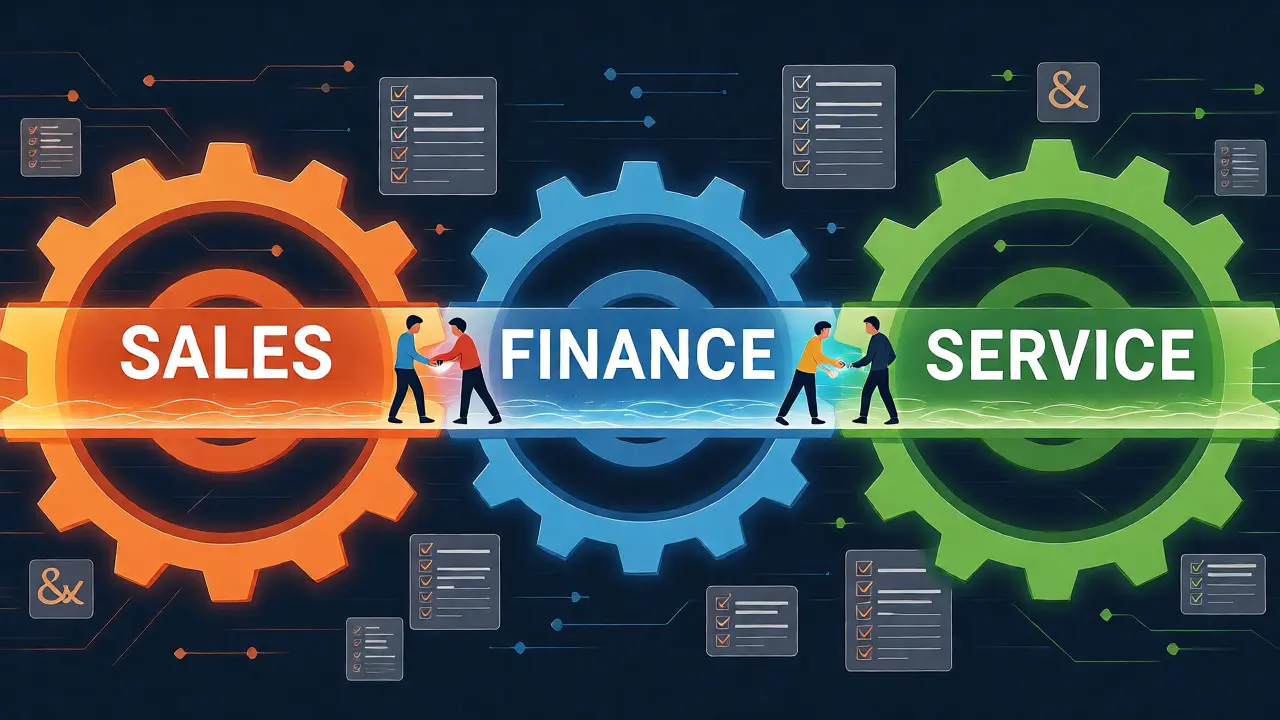
F&I: Turning Compliance into a Customer Experience
F&I has historically been the most opaque part of the dealership. Customers often feel pressured or confused. Standardizing here means shifting from a "closing" mindset to a "consulting" mindset. Your SOPs must mandate a consistent Menu Presentation Method. Whether you use a four-column menu or a digital interface, every F&I manager must present options in the same order, using the same language.
Consider the phrase "extended warranty." It’s vague. Instead, standardize on "Vehicle Protection Plan" and define exactly what it covers in plain English. Create a glossary of approved terms for all customer-facing communications. This reduces confusion and helps with legal compliance.
Also, standardize the Deal Structuring workflow. Define who approves which types of deviations. Can a junior F&I manager waive a doc fee? Can they adjust the APR by 0.5%? Clear authority matrices prevent bottlenecks and ensure that no single person becomes a bottleneck for approvals.
Service: The Engine of Long-Term Revenue
Service is where loyalty is built or broken. The key to standardizing Service SOPs is removing ambiguity from the technician’s job and the advisor’s job. Start with the Multi-Point Inspection (MPI). Most dealerships do MPIs, but few do them consistently. Some techs take photos; others don’t. Some advisors explain findings verbally; others send texts.
Implement a rigid MPI protocol. Require photos for every flagged issue. Mandate that the advisor calls the customer within 30 minutes of the MPI completion. Use a standardized script for explaining repairs: "We found X, it costs Y to fix, and if we don’t fix it, Z might happen." This clarity increases repair order approval rates significantly.
Another critical area is Appointment Scheduling. Don’t let advisors guess how long a job takes. Build a library of standard labor times for common services (oil change, brake pad replacement, tire rotation). If a job takes 45 minutes, block 45 minutes plus a 15-minute buffer. Overbooking leads to delays, angry customers, and rushed technicians. Underbooking wastes capacity. Data-driven scheduling fixes both.

Bridging the Gap: The Handoff Protocols
The magic happens in the transitions. How does Sales talk to F&I? How does Sales talk to Service? You need formalized "Handoff Checklists."
For Sales to F&I, the checklist should include: verified income, confirmed credit score range, desired monthly payment, and list of requested accessories. No deal goes to F&I without these basics. This saves the F&I manager 20 minutes of digging per deal.
For Sales to Service, the handoff is even more critical. The salesperson should schedule the first service appointment before the customer drives off the lot. The SOP should require the salesperson to enter the VIN and mileage into the service system immediately. This ensures the service department has the correct warranty status and recall information ready for the customer’s first visit.
Implementation: From Paper to Practice
Writing SOPs is easy. Getting people to follow them is hard. Here’s a realistic rollout plan:
- Audit Current State: Spend two weeks observing actual behavior, not just what managers think is happening. Note discrepancies.
- Draft with Stakeholders: Don’t write SOPs in a vacuum. Include top performers from each department. Ask them, "What do you do that works?" Codify their best practices.
- Digital First: Put SOPs in a searchable, mobile-friendly platform. Nobody reads PDF binders. Use video snippets for complex tasks like installing a dashcam or running a diagnostic scan.
- Train and Certify: Hold workshops to introduce new SOPs. Require staff to pass a quick quiz or practical demonstration to prove understanding.
- Audit and Iterate: Review SOPs quarterly. If a step isn’t being followed, ask why. Is it too complicated? Does it conflict with reality? Update the document, don’t just blame the employee.
Remember, standardization isn’t about rigidity. It’s about providing a solid foundation so your team can focus on building relationships rather than figuring out the process. When everyone knows the rules, they can play the game better.
How often should dealership SOPs be updated?
You should review SOPs at least annually, but ideally quarterly. Automotive technology changes rapidly, especially with electric vehicles and connected car features. Additionally, manufacturer requirements and local regulations can shift. A quarterly review ensures your procedures remain relevant and compliant.
Who is responsible for enforcing SOPs?
While General Managers set the tone, daily enforcement falls to department heads (Sales Manager, F&I Director, Service Manager). However, true consistency requires cross-departmental accountability. Regular mystery shopping and audit reports should be shared across leadership teams to ensure no department is operating outside the agreed-upon standards.
Can SOPs stifle creativity in sales?
No, good SOPs free up mental bandwidth. By automating routine decisions and processes (like paperwork checks or pricing limits), salespeople have more cognitive energy to devote to creative problem-solving and building rapport with customers. Standardization handles the boring stuff so humans can handle the human stuff.
What tools help manage dealership SOPs?
Many dealerships use specialized DMS (Dealer Management System) modules or dedicated workflow software like CDK Global, Reynolds & Reynolds, or third-party apps like DealerSocket or VinSolutions. These platforms allow you to embed checklists directly into the transaction flow, ensuring steps aren't skipped.
How do I get buy-in from resistant staff?
Involve them early. Show them how SOPs reduce their stress by eliminating ambiguity. Highlight success stories where following the process led to faster closings or fewer comebacks. Offer incentives for adherence, such as recognition programs or bonuses tied to process compliance metrics, not just volume.