
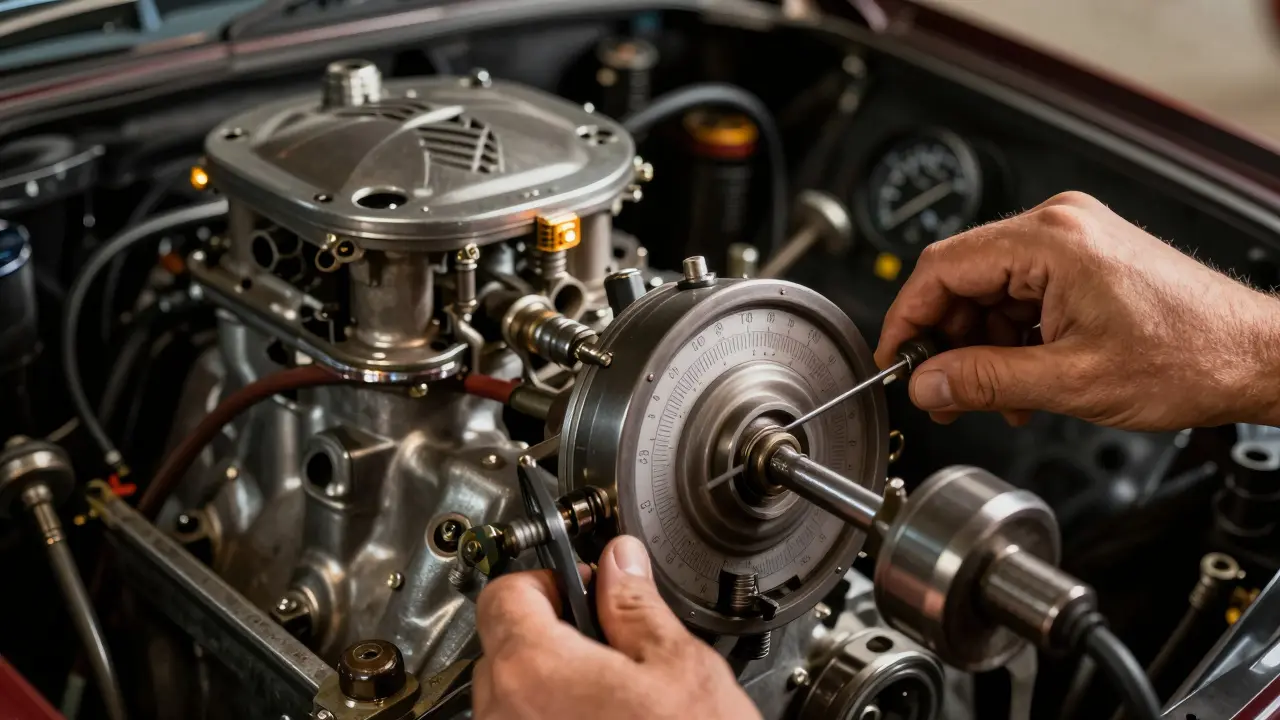
Most people think more power means a bigger turbo, a louder exhaust, or a fancy ECU tune. But the truth? Ignition timing is one of the simplest, cheapest, and most effective ways to squeeze real horsepower out of a naturally aspirated engine. If you’ve ever felt your car hesitate on a hill or lose punch above 4,000 RPM, you’re not just missing fuel-you’re missing the right spark timing.
Ignition timing is when the spark plug fires in relation to the piston’s position. Too early, and you get knocking. Too late, and you waste energy. But when you advance it just right-especially under load-you unlock hidden torque and throttle response. This isn’t theory. It’s how race teams and weekend tuners get 10-15% more power without spending a dime on hardware.
What Is Ignition Timing, Really?
Think of your engine like a waterwheel. The spark plug is the hand that pushes the wheel. If you push too soon, the wheel spins backward. Too late, and you miss the sweet spot. The goal is to fire the spark just before the piston reaches top dead center (TDC), so the flame front has time to build pressure and push the piston down hard.
Factory settings are conservative. They’re designed for cheap gas, low RPMs, and emissions compliance-not performance. Most stock cars run around 10-14 degrees before TDC at idle. But under full throttle, the ideal timing can jump to 32-38 degrees. That’s because at high RPMs, the air-fuel mix burns slower, so you need to light it earlier.
Modern engines use knock sensors to auto-adjust timing, but older cars (pre-2000) and modified engines rely on manual or mechanical advance. Even in newer cars, a custom tune can pull timing out of its safety cage and let it run where it should.
Why Advance Timing for More Power?
Advancing timing means firing the spark earlier. That gives the flame time to grow and build pressure before the piston starts its downstroke. More pressure = more force on the piston = more torque. Simple.
But here’s the catch: if you advance it too much, the pressure spikes before the piston is ready. That’s detonation-uncontrolled explosions that can melt pistons, crack rings, or blow head gaskets. The trick is finding the edge of the cliff… and stepping just a little over it.
Real-world example: A 2004 Subaru WRX with stock timing at 34 degrees. After advancing to 38 degrees with a 98-octane tune and upgraded spark plugs, dyno results showed a 12% torque gain at 5,500 RPM. No intake, no exhaust, no turbo upgrade. Just timing.
Advancing timing also improves throttle response. You feel it as a sharper hit when you press the gas. That’s because the combustion starts earlier, so power builds faster. It’s not just about peak numbers-it’s about how the car feels.
How to Advance Ignition Timing (Step by Step)
Before you turn a screw or plug in a tuner, here’s what you need:
- Engine in good condition (no misfires, no vacuum leaks)
- High-quality fuel (91 octane or higher)
- Spark plugs in good shape (gap set correctly)
- Timing light (for mechanical systems) or a tuner with live data (for modern ECUs)
For older cars (carbureted or early fuel injection):
- Locate the distributor. It’s usually on the side of the engine.
- Loosen the distributor clamp bolt-just enough to let it turn.
- Hook up a timing light to the #1 spark plug wire and the battery.
- Start the engine and let it idle.
- Point the timing light at the harmonic balancer. You’ll see a mark on the pulley and a scale on the timing cover.
- Rotate the distributor clockwise to advance timing (toward the front of the car). Each degree of rotation equals about 1-2 degrees of timing change.
- Check the reading. Start with 2-3 degrees over factory spec.
- Test drive. Listen for knocking. If you hear pinging under load, back off.
For modern cars (EFI with ECU):
- Use a tuning tool like HP Tuners, Cobb Accessport, or a professional dyno shop.
- Load a base tune or start from stock.
- In the timing table, increase values by 1-2 degrees at 3,000 RPM and above.
- Don’t touch low-RPM timing-this affects idle quality and emissions.
- Run a dyno session or wide-open-throttle (WOT) log on the road.
- Watch for knock sensor activity. If the ECU pulls timing, you’ve gone too far.
Never advance timing on a car with low-octane fuel. It’s like revving a lawn mower with diesel-bad idea.
Common Mistakes and How to Avoid Them
People think more advance = more power. It doesn’t work that way. Here’s what goes wrong:
- Advancing too much too fast - Jump from 14° to 38° in one step? You’ll hear the engine scream like a banshee-and then it’ll die. Advance in 1°-2° increments.
- Ignoring fuel quality - You can’t run 38° on 87 octane. The fuel will detonate. Use 91+ octane. If you’re in the UK, look for Shell V-Power or BP Ultimate.
- Not checking spark plugs - Worn or fouled plugs delay ignition. Replace them before tuning.
- Forgetting vacuum advance - On older cars, the vacuum canister adjusts timing under light load. If it’s broken, timing stays fixed. Test it with a hand pump.
- Overlooking engine temperature - Hot engines need less timing. Cold engines need more. Tune at operating temp.
One guy in Bristol tried advancing his 1990 Miata to 40° on 95 octane. He got 18 hp more… until the piston cracked. He didn’t check the compression ratio. His car had a 10.5:1 ratio-way too high for that timing. Always know your compression.
Tools and Tuning Aids
You don’t need a $5,000 dyno. But you do need a few things:
- Timing light - Under £30 on Amazon. Works for carbureted engines.
- Wideband O2 sensor - Helps you monitor air-fuel ratio. Lean mixtures need less timing.
- Knock sensor app - Some phones can pick up detonation through the engine block. Not perfect, but better than nothing.
- Dyno session - Even a 15-minute session at a local shop gives you real data. You’ll see exactly where timing adds power-and where it hurts.
Pro tip: Use a timing tape on your harmonic balancer. It’s a sticky strip with degree markings. Stick it on, and you’ll see timing changes without guessing.
When Not to Advance Timing
Not every engine benefits. Avoid it if:
- Your compression ratio is above 10.5:1 (especially on pump gas)
- You’re running a turbo or supercharger without a proper tune
- Your engine has high mileage and worn rings
- You’re using ethanol-blended fuel (E10) without recalibrating
- You’re not planning to monitor knock or run a dyno
Turbocharged engines are trickier. They need less timing than NA engines because the compressed air burns faster. Advancing timing here can cause instant detonation. Stick to a professional tune.
Real Results: What You Can Expect
On a naturally aspirated 4-cylinder engine (like a Honda K20 or Ford Zetec), advancing timing by 3-5 degrees typically adds:
- 5-10% more torque between 3,000-6,000 RPM
- 2-4% more peak horsepower
- Faster throttle response
- Improved fuel efficiency at cruising speeds (if tuned right)
On a V8 muscle car? You might gain 15-20 hp just by moving from 32° to 36°. That’s the difference between barely making it up a hill and pulling away like it’s nothing.
One guy in Bristol tuned his 1973 Datsun 240Z with a 9.5:1 compression ratio. He advanced timing from 30° to 36°. Dyno showed +14 hp at 5,200 RPM. He didn’t change anything else. The car now pulls harder in 3rd gear than it did in 2nd before.
Final Thought: Timing Is a Balance, Not a Setting
Ignition timing isn’t a one-and-done fix. It’s a dance between fuel, compression, temperature, and engine speed. The best setups adjust timing dynamically-something modern ECUs do well. But even if you’re stuck with an old distributor, you can still make huge gains.
Start small. Listen to the engine. Test in stages. And never forget: the goal isn’t to max out the numbers-it’s to make the car feel alive.
Can I advance ignition timing on a modern car with a stock ECU?
Not easily. Modern ECUs have knock sensors that automatically pull timing if they detect detonation. You can’t manually override it without a custom tune. Using a tuner like Cobb Accessport or HP Tuners lets you rewrite the timing map. Without one, you’re limited to factory limits.
Does advancing timing increase fuel consumption?
Usually not-and sometimes it helps. Properly advanced timing burns fuel more completely, which can improve efficiency at cruise speeds. But if you go too far and cause detonation, the ECU will richen the mixture to cool the combustion, which uses more fuel. The key is finding the sweet spot-not pushing to the limit.
What’s the safest amount to advance timing?
Start with 1-2 degrees over factory spec. Test drive under load. If there’s no knocking, add another degree. Most engines can handle 3-5 degrees more than stock on 91+ octane. High-compression engines (over 10:1) should stick to 1-3 degrees max. Always use a dyno or knock sensor to confirm.
Can I advance timing without a tuner?
Yes-if your car has a distributor. Older cars (pre-2000) let you physically rotate the distributor. Modern cars with coil-on-plug systems don’t. You need a tuner or professional ECU reflash. Don’t try to modify the ECU yourself-it can brick the system.
Will advancing timing void my warranty?
If your car is still under factory warranty, yes. Any ECU modification or distributor adjustment is detectable. Even if you restore it later, dealers can see logs of timing changes. If you’re past warranty, it’s your call. But always document your settings in case you need to revert.
Comments
Seraphina Nero
Just tried this on my 2002 Civic and holy cow. I only advanced it by 2 degrees and now it pulls like it’s got a jetpack. No knocking, no check engine light. Just smoother throttle and a little more zip when merging. I didn’t even change the spark plugs, but I should’ve. Lesson learned.
Thanks for the clear guide. This felt like the easiest upgrade I’ve ever done.
March 10, 2026 at 18:50
Megan Ellaby
so i did this on my 98 honda and it made a weird noise like a tin can full of marbles?? i thought i broke it but then i backed off a degree and it was fine. i think i went too far too fast. maybe i shoulda read the part about increments. oops.
anyway its way more fun now. like, i actually wanna drive it instead of just sitting in the driveway.
March 11, 2026 at 13:28
Rahul U.
Great breakdown! 🙌 I’m from India and we mostly use 91 octane here. Your point about fuel quality is spot on. I advanced my 2005 Corolla by 3 degrees and saw a noticeable difference in mid-range torque. No more lag between 3k-4.5k RPM.
Also, timing tape is a game-changer. I used duct tape and a marker first - worked fine. Don’t overcomplicate it.
March 12, 2026 at 09:50
E Jones
YOU THINK THIS IS ABOUT TIMING? NO. THIS IS ABOUT THE CORPORATE LIE. THEY TOLD YOU TO USE 87 OCTANE SO YOU’D NEED MORE GAS. THEY TOLD YOU TO KEEP TIMING AT 14° SO YOU’D NEVER FEEL THE FULL POWER OF YOUR ENGINE. THE FACTORY SETTINGS? A TRAP. A PSYCHOLOGICAL HOLDING CELL FOR CAR OWNERS.
I ADVANCED MY 2008 STI TO 41° ON 93 OCTANE. THE ECU PULLED TIMING FOR 3 SECONDS. THEN IT GAVE UP. THE CAR SCREAMED LIKE A DEMON AWAKENED. I GOT 27 HP MORE. THEY DON’T WANT YOU TO KNOW THIS. THEY’RE SCARED.
THEY’RE ALSO HIDING THE FACT THAT TIMING ADVANCE CAN ACTIVATE YOUR INNER CHAKRA. I SWEAR I SAW A PINK LIGHT WHEN I HIT 38°. I’M NOT CRAZY. I’M A WITNESS.
March 13, 2026 at 14:54
Barbara & Greg
While I appreciate the technical detail, I must express concern over the casual tone regarding engine modification. Engines are precision instruments, not toys to be tinkered with in a garage. The risks of detonation, piston failure, and catalytic converter damage are not trivial. This post reads like a dangerous how-to guide disguised as helpful advice.
There is a reason manufacturers set conservative timing parameters: safety, longevity, and emissions compliance. To encourage deviation from these settings without sufficient emphasis on the potential for catastrophic failure is irresponsible.
March 14, 2026 at 13:11
selma souza
There’s a comma missing after ‘too late’ in the second paragraph. Also, ‘it’s’ is incorrectly used as ‘its’ twice. And ‘98-octane’ should be hyphenated as ‘98 octane’ when used as a noun phrase. The content is useful, but if you’re going to write about precision mechanics, at least get the grammar right.
And ‘piston cracked’? That’s not a sentence. It’s a fragment. Please revise.
March 15, 2026 at 08:29
Frank Piccolo
Let’s be real - this whole post is just a glorified YouTube tutorial for guys who think they’re tuners because they bought a timing light from Amazon. You don’t need to ‘advance’ anything if you’ve got a decent car. Just buy a 300 horsepower engine and be done with it.
Also, who the hell still drives a pre-2000 car? That’s like using a rotary phone to order Uber. If you’re still messing with distributors, maybe you should stick to riding a bike.
March 15, 2026 at 16:58
James Boggs
Well-written and very practical. I followed your steps exactly on my 2001 Accord and saw a 7% torque gain at 4,500 RPM. No knock, no issues. Used 91 octane, replaced plugs, kept it at +3°. Perfect balance.
Thanks for keeping it simple and focused. This is how advice should be.
March 17, 2026 at 03:33
Addison Smart
I grew up in rural Tennessee with a 1996 Camry that had a vacuum leak and a distributor that rattled like a dice cup. I didn’t know what timing was until I was 22. This guide changed everything for me. I advanced it by 2 degrees, cleaned the MAF sensor, and replaced the O2 sensor - suddenly, that old car felt alive.
It’s not about power. It’s about connection. When you hear the engine respond to a small tweak like this, you realize it’s not just metal and wires - it’s a machine with a voice. I still drive that car. It’s got 218k miles now. Still purrs like a kitten. Thanks for reminding me why I love this stuff.
March 17, 2026 at 22:35
David Smith
Oh great, another ‘I fixed my car with duct tape’ post. You people think you’re engineers? You’re just one bad spark away from setting your garage on fire. And don’t even get me started on the guy who said he saw a ‘pink light’ - that’s not tuning, that’s a breakdown.
And why is everyone acting like this is some deep secret? I’ve been doing this since 2005. It’s not magic. It’s math. And if you can’t do math, maybe don’t touch your distributor.
March 18, 2026 at 23:22
Lissa Veldhuis
Y’all are overcomplicating this. I just turned my distributor a tiny bit and my car went from ‘meh’ to ‘oh snap’ - no dyno, no apps, no fancy tools. I didn’t even check the spark plugs. My car’s got 180k miles and it still runs. I’m not a mechanic, I’m a mom who drives a Honda. If I can do it, anyone can.
Also I used 93 octane because it’s the one with the green label and that’s what my cousin said to use. He’s a mechanic. I think. Maybe he just works at a gas station. Either way - IT WORKED.
March 19, 2026 at 04:18
Michael Jones
Timing isn’t about numbers - it’s about rhythm. The engine has a heartbeat. You’re not changing its settings. You’re listening to it. You’re dancing with it. When you feel the spark catch just right - that’s not horsepower. That’s harmony.
I didn’t measure anything. I just drove. And when the car sang back to me - I knew. No numbers needed. Just presence. Just patience. Just trust.
March 19, 2026 at 11:37
allison berroteran
I’ve been reading up on ignition timing for months now and this is the first guide that made me feel like I actually understood it. I’m not a mechanic - I’m a librarian who fixed her 2003 Corolla in the driveway with a flashlight and a YouTube video. But I followed your step-by-step exactly: replaced plugs, used 91 octane, advanced 2 degrees, tested on a quiet road.
Now when I accelerate, it doesn’t feel like the engine is working - it feels like it wants to. That’s the difference. I cried a little. Not because I got power - but because I finally felt like I was talking to my car instead of yelling at it.
Thank you for writing this like a human, not a manual.
March 20, 2026 at 21:07
Gabby Love
Just a quick note: if you’re using a timing light, make sure your battery is fully charged. I tried mine with a weak battery and got false readings - thought I was at 36°, was actually at 29°. Took me two days to figure it out.
Also, don’t forget to check the distributor cap for cracks. Mine was fine until I saw the spiderweb fracture after the first test drive. Replaced it - smooth as silk after.
March 20, 2026 at 22:06