
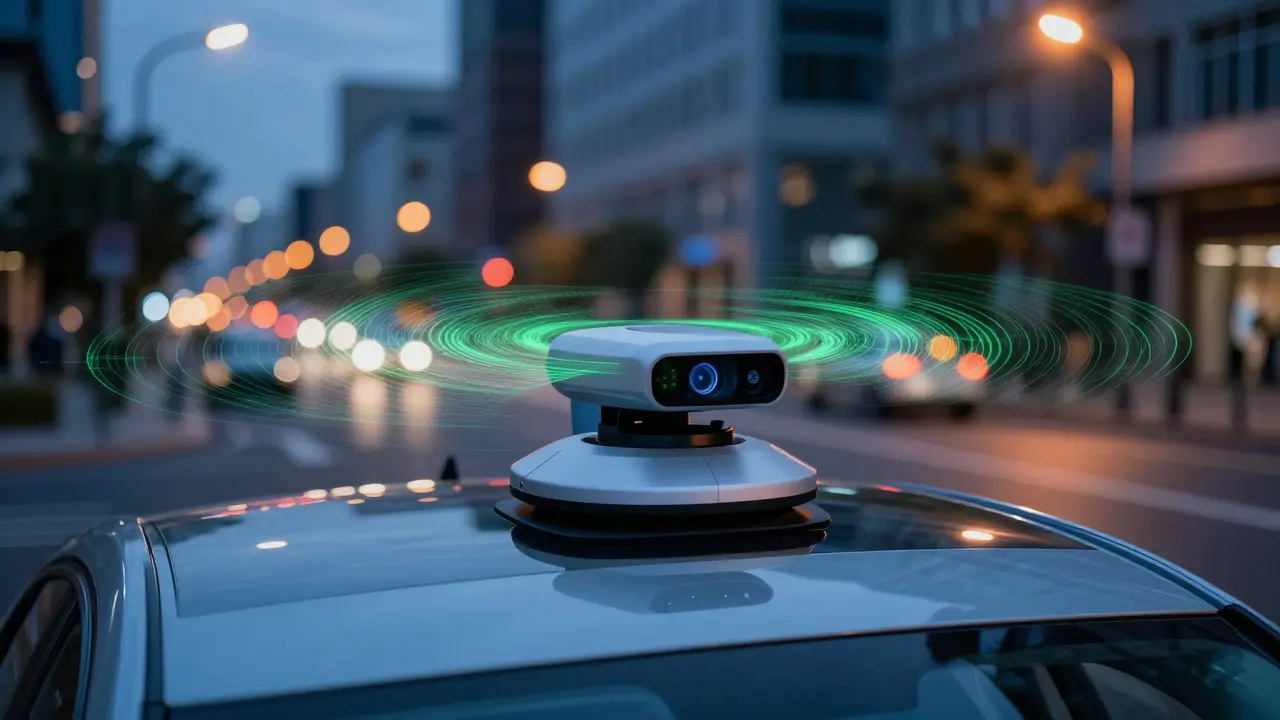
You’ve seen the spinning top on a Waymo or the sleek bumpers on a Tesla. But have you ever wondered how a car actually "sees" the world? It’s not magic, and it’s not just cameras. It’s a complex dance of light, radio waves, and raw data processing. When we talk about self-driving cars, we are really talking about a vehicle that has replaced human senses with electronic ones. Your eyes see; the car scans. Your ears hear; the car listens for ultrasonic pings. Your brain processes; the car’s computers calculate.
The core question isn’t whether these cars will drive themselves-they already do in limited areas. The real question is how they perceive reality accurately enough to keep you safe when a child chases a ball into the street or when fog rolls in thick as soup. To answer that, we need to look under the hood at the three main pillars of perception: LIDAR, Radar, and Cameras, and the crucial process that ties them together called sensor fusion.
The Eye That Measures Distance: LIDAR Technology
LIDAR (Light Detection and Ranging) is often the most visible part of an autonomous vehicle’s setup. If you’ve seen a car with a rotating dome on its roof, that’s LIDAR. It works by firing millions of laser pulses per second. These pulses bounce off objects-cars, pedestrians, trees-and return to the sensor. By measuring the time it takes for the light to return, the system calculates the exact distance to every point it hits.
This creates a high-resolution 3D map of the environment in real-time. Unlike a camera, which sees flat images, LIDAR understands depth instantly. It knows exactly how far away that stop sign is, down to the millimeter. This precision is critical for navigation. A self-driving car needs to know not just that there is a curb, but exactly where the curb ends and the road begins.
| Sensor Type | How It Works | Strengths | Weaknesses |
|---|---|---|---|
| LIDAR | Laser pulses measure distance | High-precision 3D mapping, excellent depth perception | Expensive, performance drops in heavy rain/snow/fog |
| Radar | Radio waves detect motion and speed | Works in all weather, detects speed accurately | Low resolution, struggles to identify object shape |
| Cameras | Optical lenses capture visual data | Reads text (signs), recognizes colors (lights), low cost | No inherent depth perception, affected by lighting/glare |
Historically, LIDAR was prohibitively expensive, costing upwards of $75,000 per unit. Today, thanks to advancements in solid-state LIDAR, prices have dropped significantly, making it viable for mass-market vehicles. However, it still faces physical limitations. Heavy rain, snow, or dense fog can scatter the laser beams, creating noise in the data. This is why no serious engineer relies on LIDAR alone.
The Reliable Workhorse: Radar Systems
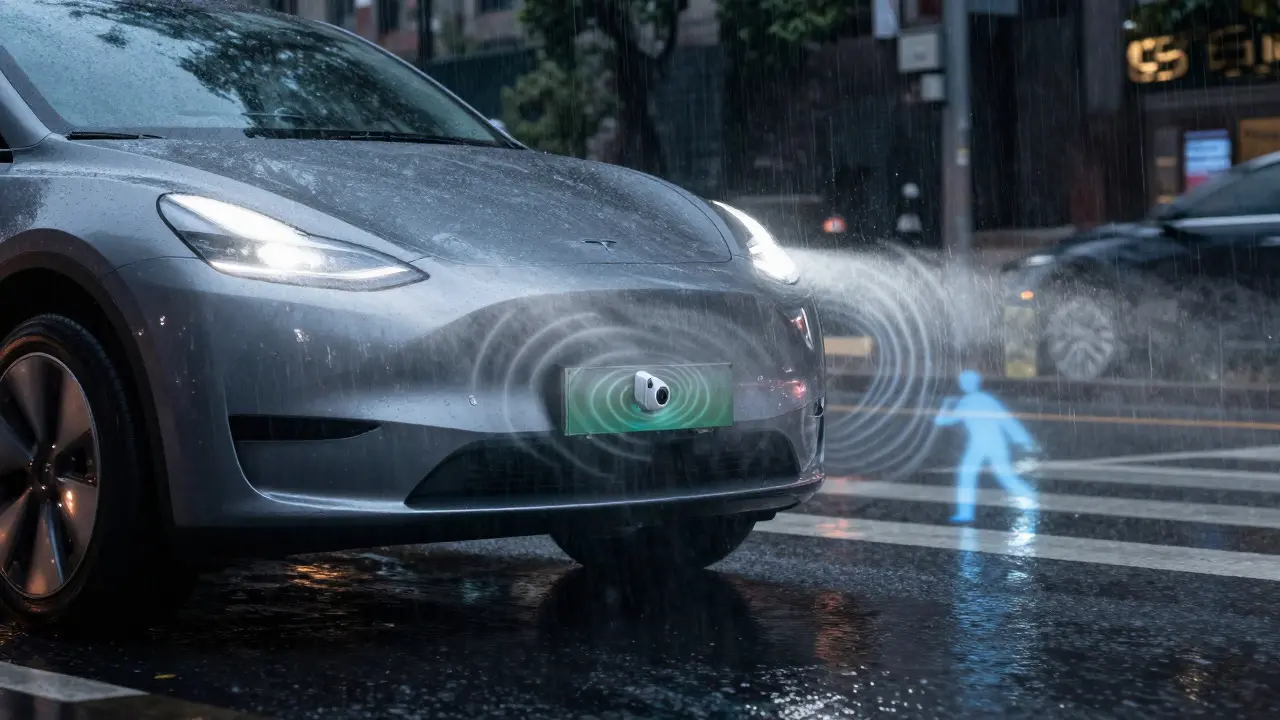
If LIDAR is the detailed eye, Radar (Radio Detection and Ranging) is the reliable workhorse. You likely have radar in your current car if it features adaptive cruise control or automatic emergency braking. Radar emits radio waves that penetrate through weather conditions that blind LIDAR and cameras. Rain, snow, dust, and even darkness don’t stop radar from working effectively.
The primary advantage of radar is its ability to measure velocity directly. Using the Doppler effect, radar can tell exactly how fast another object is moving relative to your car. Is that truck ahead slowing down? Radar knows immediately. While early radar systems had low resolution and struggled to distinguish between a plastic bag and a pedestrian, modern 4D imaging radar has improved dramatically. It now provides height information and better angular resolution, allowing it to create a more detailed picture of the surroundings.
Radar is also incredibly cheap compared to LIDAR. This makes it a staple in almost every autonomous driving stack. It acts as a safety net. If the LIDAR fails due to fog, or if the camera is blinded by sun glare, radar continues to provide essential data about obstacles and their speeds. It ensures the car doesn’t crash just because the "eyes" are temporarily impaired.
The Context Provider: Computer Vision and Cameras
Cameras are the only sensor that truly mimics human vision. They capture color, texture, and fine details. More importantly, they read the language of the road. A LIDAR scanner might see a red octagon, but it doesn’t inherently know it means "Stop." A camera, paired with Computer Vision algorithms, recognizes the shape, color, and text. It identifies traffic lights, lane markings, pedestrian signals, and even hand gestures from traffic controllers.
Tesla famously bet the house on cameras alone, arguing that since humans drive with two eyes and a brain, cars should be able to do the same. This approach, known as pure vision, relies heavily on advanced neural networks to infer depth from 2D images. While impressive, it has faced challenges. Glare from the sun, sudden shadows, or unusual lighting conditions can confuse even the best AI models. A white truck against a bright sky might disappear from a camera’s view-a phenomenon known as "blooming"-whereas LIDAR and radar would still detect the physical object.
For most autonomous systems, cameras provide the semantic context. They tell the car *what* things are, while LIDAR and radar tell the car *where* they are and *how far* away they are. Without cameras, a self-driving car might avoid hitting a fire hydrant but fail to notice a green traffic light, leading to inefficient or illegal driving behavior.
The Brain Behind the Sensors: Sensor Fusion
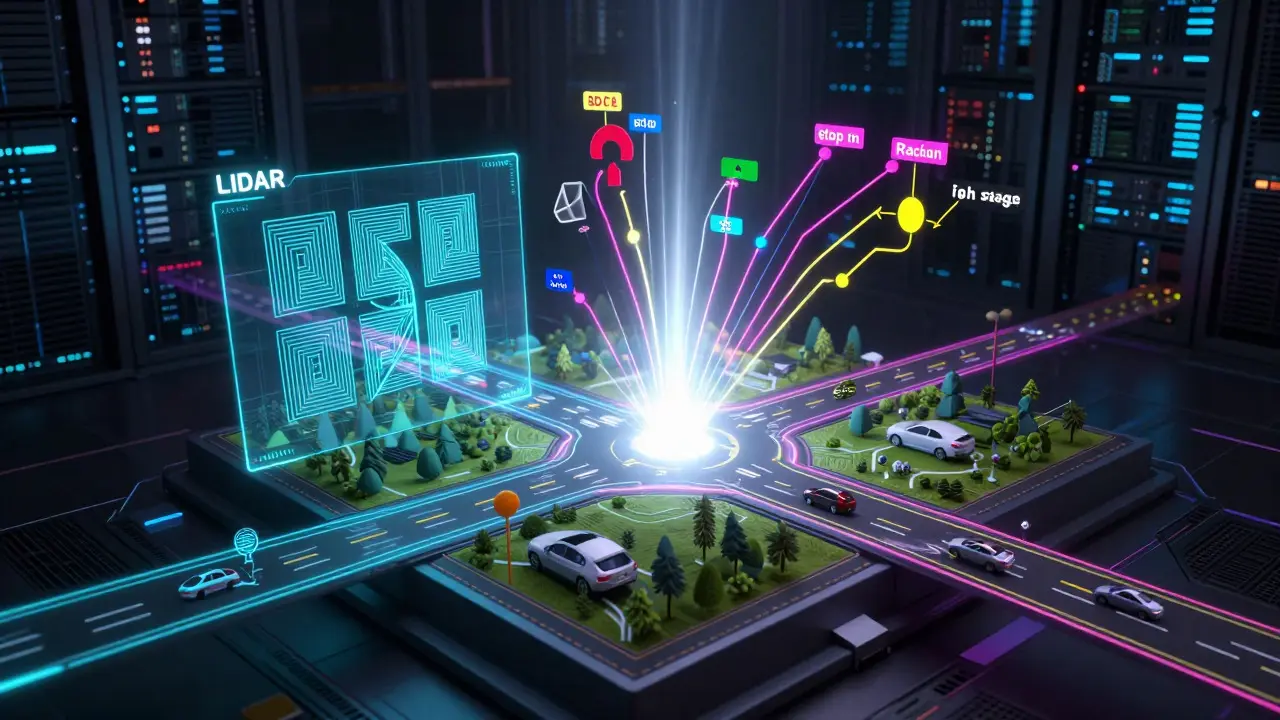
Having multiple sensors is useless if the car doesn’t know how to combine their data. This is where Sensor Fusion comes in. Sensor fusion is the process of integrating data from LIDAR, radar, and cameras to create a single, coherent model of the environment. It’s like your brain combining sight, sound, and touch to understand the world around you.
There are different levels of fusion. Early fusion combines raw data before processing, while late fusion combines the results after each sensor has been analyzed independently. Most modern systems use a hybrid approach. For example, if the camera sees a red light and the LIDAR detects a stationary object ahead, the system confirms with high confidence that it should stop. If the camera says "clear" but radar detects a slow-moving object, the system flags a discrepancy and prioritizes caution.
This redundancy is key to safety. No single sensor is perfect. By fusing data, the system compensates for individual weaknesses. If fog blinds the LIDAR, radar and cameras take over. If glare blinds the cameras, LIDAR and radar maintain awareness. The goal is to achieve a level of reliability that exceeds human capability, reducing accidents caused by distraction, fatigue, or impairment.
Processing Power: The Edge Computing Challenge
All this data requires massive computational power. A single frame of video from eight cameras, combined with millions of points from LIDAR and continuous streams from radar, generates terabytes of data daily. Processing this in real-time requires specialized hardware. Traditional CPUs aren’t fast enough. Instead, self-driving cars use GPUs (Graphics Processing Units) and TPUs (Tensor Processing Units) designed for parallel processing.
Companies like NVIDIA produce dedicated chips, such as the Orin platform, capable of handling hundreds of trillions of operations per second. These chips run the neural networks that interpret sensor data. They must make decisions in milliseconds. If a pedestrian steps out, the car needs to react before the next frame is processed. Latency-the delay between sensing and acting-is the enemy of autonomy. Even a fraction of a second can mean the difference between a near-miss and a collision.
As technology advances, we’re seeing a shift toward edge computing, where more processing happens locally in the car rather than relying on cloud connectivity. This reduces dependency on network quality and ensures the car can operate safely even in areas with poor cell service. The future involves even more powerful, energy-efficient chips that can handle higher-resolution sensors without draining the battery too quickly.
Challenges and Future Directions
Despite rapid progress, significant hurdles remain. Weather remains a major challenge. While radar handles rain well, extreme conditions can still degrade performance across all sensors. Snow covering lane markers confuses cameras, while ice on LIDAR domes blocks lasers. Engineers are developing self-cleaning sensors and heated housings to mitigate these issues.
Another challenge is ethical decision-making. In unavoidable accident scenarios, how should the car choose between protecting passengers or pedestrians? While programming ethics is complex, the immediate focus is on preventing accidents altogether through superior perception. As sensor accuracy improves, the frequency of edge cases-rare situations that confuse the AI-decreases.
Looking ahead, we expect to see smaller, cheaper, and more integrated sensors. Solid-state LIDAR will replace mechanical spinning units, becoming flush with the car’s body. Cameras will have higher dynamic range to handle extreme lighting. And AI models will become more efficient, requiring less power to deliver greater intelligence. The dream of fully autonomous Level 5 driving-where you can sleep in the back seat anywhere in the world-is closer than ever, but it depends on solving these remaining technical puzzles.
What is the difference between LIDAR and Radar?
LIDAR uses laser light to create precise 3D maps of the environment, offering high resolution but struggling in bad weather. Radar uses radio waves to detect distance and speed, working reliably in rain, snow, and fog but with lower image detail. They complement each other in self-driving systems.
Do self-driving cars need all three types of sensors?
Most experts believe yes. While some companies like Tesla rely primarily on cameras, the majority of autonomous vehicle developers use a combination of LIDAR, Radar, and Cameras. This redundancy ensures safety if one sensor type fails or is impaired by environmental conditions.
How does sensor fusion improve safety?
Sensor fusion combines data from multiple sources to create a more accurate and reliable understanding of the surroundings. If one sensor gives conflicting or unclear data, others can verify or correct it, reducing false positives and negatives, which is critical for avoiding accidents.
Why is LIDAR so expensive?
Traditional mechanical LIDAR units contain moving parts and high-precision optics, making them costly to manufacture. However, new solid-state LIDAR technologies are eliminating moving parts, significantly lowering costs and enabling wider adoption in consumer vehicles.
Can self-driving cars drive in heavy snow?
Heavy snow poses challenges for all sensors. It can obscure lane markings for cameras and scatter LIDAR beams. Radar performs better in snow, but overall performance may be reduced. Current autonomous systems often limit operation in severe weather until sensor technology further improves.