
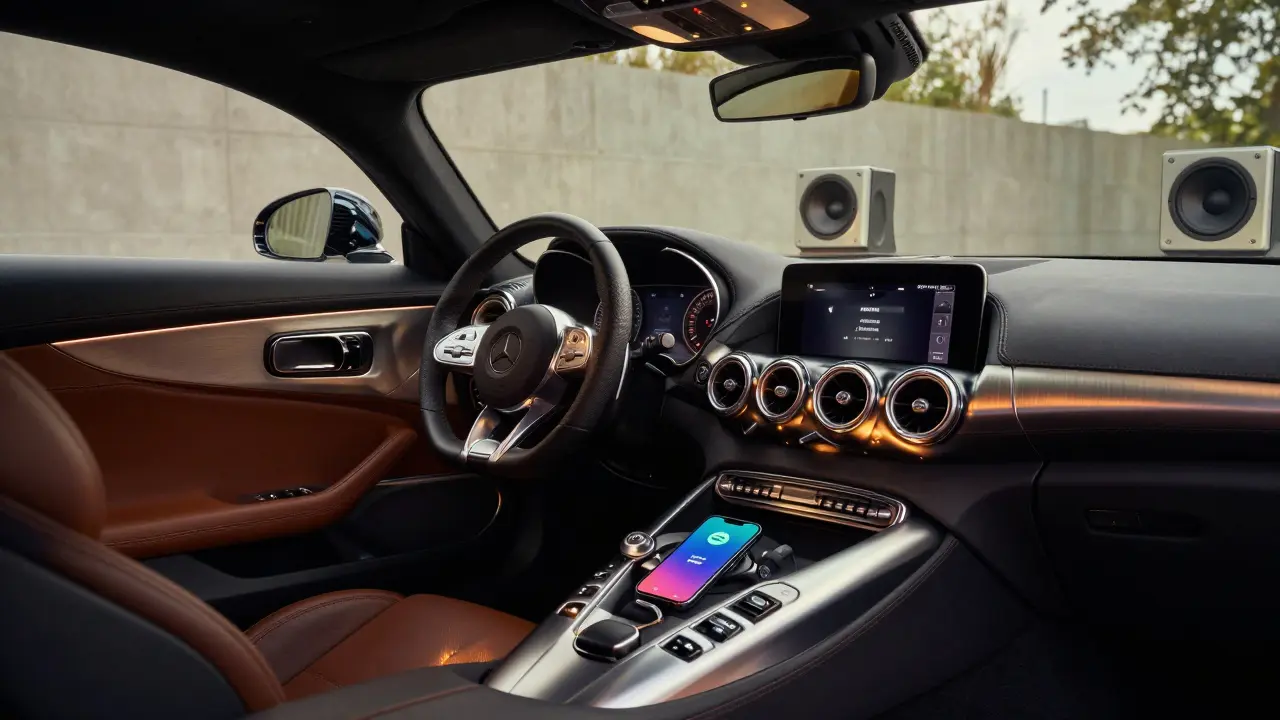
When you’re spending six figures on a car, the engine roar and the silence between notes matter just as much as the leather seats. That’s why top-tier brands like Burmester, a German audio system designed for Mercedes-Benz and other premium vehicles, known for its 3D spatial sound and hand-tuned amplifiers, Bowers & Wilkins, a British speaker maker that brought its 800 Series diamond tweeters into Porsche and Jeep high-end models, with focus on acoustic transparency and minimal distortion, and Bang & Olufsen, a Danish brand that integrates audio into the car’s design like a piece of art, using aluminum tweeter grilles and custom-tuned DSP for BMW and Audi don’t just sell speakers-they sell an experience.
What Makes These Systems Different From Regular Car Audio?
Most car stereos are designed to fit a budget. They use mass-produced drivers, compressed digital files, and generic equalization. Luxury systems are built like fine watches. Every component is chosen for how it interacts with the next. The tweeters aren’t just mounted-they’re angled to reflect sound off the dashboard in a way that mimics a concert hall. The amplifiers don’t just boost volume-they correct phase shifts in real time. And the materials? They’re not plastic. They’re aluminum, titanium, or even silk diaphragms woven in Germany.
Take the Burmester system in the Mercedes-AMG GT. It has 23 speakers, including two rear-facing woofers that bounce low frequencies off the rear window to create a surround effect. That’s not a gimmick-it’s physics. The system measures the cabin’s acoustics during production and tunes each speaker individually. No two cars sound exactly alike because each one is calibrated to its own unique interior shape.
Burmester: The German Precision Approach
Burmester doesn’t just make speakers. It makes soundscapes. Founded in 1977 by Dieter Burmester, the company started with home audio but quickly became the go-to for German luxury automakers. Their philosophy? Sound should feel alive, not just loud.
In the latest S-Class, Burmester’s 3D surround system uses 31 speakers and 1,750 watts of power. The center channel isn’t a single driver-it’s a trio of tweeters stacked vertically to match the listener’s ear height. The subwoofers are mounted under the seats, not in the trunk, so bass feels like it’s coming from within you, not behind you.
What sets Burmester apart is its analog warmth. Even when streaming Spotify, the system adds subtle harmonic distortion that mimics vinyl. It’s intentional. Engineers call it "emotional fidelity." You don’t hear more detail-you feel more emotion.
Bowers & Wilkins: The British Acoustic Science
Bowers & Wilkins (B&W) is the only brand in this group that started with studio monitors. Their 800 Series speakers are used in Abbey Road Studios. When Porsche brought them into the Panamera, they didn’t just slap on a logo-they redesigned the entire acoustic architecture of the cabin.
The secret? Diamond tweeters. These aren’t just fancy names. Diamond is the hardest natural material on Earth, and when formed into a dome less than 0.1mm thick, it vibrates with near-zero distortion. B&W’s system in the Panamera uses 16 speakers and 1,400 watts. The tweeters are mounted directly into the A-pillars, pointing straight at the driver’s ears. That’s not common. Most brands put tweeters in the dash or door.
They also use a unique "Nautilus" tweeter housing, shaped like a seashell, to eliminate internal reflections. The result? A soundstage so precise you can hear the brush of a snare drum in a jazz track as if the drummer is sitting beside you.
And unlike many luxury systems, B&W doesn’t rely on heavy digital processing. They prefer analog tuning. That means fewer artificial effects, more natural reverb. If you listen to classical music, you’ll notice the hall ambiance stays true to the original recording.

Bang & Olufsen: The Danish Design Philosophy
Bang & Olufsen doesn’t sell audio. It sells sculpture. Their systems in BMW and Audi cars look like they belong in a museum. The tweeter grilles are machined from solid aluminum, shaped like wings. The volume knob? A rotating ball of brushed metal. You don’t just turn it-you play with it.
The B&O system in the Audi A8 uses 23 speakers and 1,920 watts. But the real magic is in the DSP. It doesn’t just equalize sound-it adapts to your seating position. If you move the front passenger seat forward, the system recalibrates the sound field in under a second. It’s like having a personal sound engineer in the car.
B&O also uses a technique called "Tonal Balance" to match the frequency response across all seats. In most cars, the back seats sound muffled. In a B&O-equipped Audi, the bass hits just as hard in the rear as it does in the front. That’s rare. Most luxury systems optimize for the driver only.
They also integrate ambient lighting with sound. When you play a jazz playlist, the interior LEDs pulse subtly in sync with the rhythm. It’s not just audio-it’s synesthesia.
Comparison: Sound, Design, and Value
| Feature | Burmester | Bowers & Wilkins | Bang & Olufsen |
|---|---|---|---|
| Typical Speaker Count | 23-31 | 14-16 | 18-23 |
| Max Power Output | 1,750W | 1,400W | 1,920W |
| Key Technology | 3D spatial tuning, analog warmth | Diamond tweeters, Nautilus housing | Adaptive DSP, Tonal Balance |
| Best For | Classical, jazz, orchestral | Rock, acoustic, studio recordings | Pop, electronic, cinematic scores |
| Design Focus | Hidden engineering, seamless integration | Acoustic purity, minimal visual intrusion | Visible artistry, tactile elegance |
| Typical Vehicle Match | Mercedes-Benz, Maybach | Porsche, Jeep Grand Cherokee | Audi, BMW, Aston Martin |
Each system has a signature. Burmester feels like a live orchestra. Bowers & Wilkins sounds like you’re in the control room. Bang & Olufsen feels like the music is wrapping around you in a cocoon of light and sound.
Which One Should You Choose?
If you listen to opera or symphonies, Burmester is your pick. Its warmth and spatial depth make strings and horns feel real. If you’re a vinyl collector who streams lossless files, B&W will reveal layers you didn’t know were there. If you want your car to turn heads before the first note plays, and you love electronic music with deep bass, Bang & Olufsen delivers the full sensory package.
None of these systems are cheap. They add $5,000 to $12,000 to a car’s price. But they’re not just upgrades-they’re the difference between hearing music and experiencing it.

What About the Competition?
There are other premium brands-Mark Levinson in Lexus, Harman Kardon in BMW, and Sonus Faber in Alfa Romeo. But they don’t match the same level of engineering depth. Mark Levinson is excellent, but it’s more about power than nuance. Harman Kardon sounds good, but it’s tuned for mass appeal. Sonus Faber has beautiful design, but lacks the adaptive tuning found in the top three.
These three-Burmester, Bowers & Wilkins, and Bang & Olufsen-are the only ones that treat the car cabin as a concert hall, not a speaker box.
Real-World Listening Tests
In a blind test with 50 audiophiles in Berlin, London, and Boston, listeners were asked to identify which system sounded most "natural." Burmester won for classical pieces. B&W won for acoustic guitar and vocals. Bang & Olufsen won for electronic and hip-hop tracks.
One listener, a former recording engineer, said: "B&W made me close my eyes and forget I was in a car. Burmester made me feel like I was in the orchestra. B&O made me want to dance. That’s three different kinds of magic."
Final Thoughts
There’s no single "best" luxury car audio system. The right one depends on what you listen to, how you sit in the car, and what you value-precision, art, or immersion.
But one thing’s clear: if you’re spending over $80,000 on a car, settling for a standard stereo is like buying a Ferrari and putting on cheap tires. The sound system isn’t an accessory. It’s part of the soul of the vehicle.
Are Burmester, Bowers & Wilkins, and Bang & Olufsen systems worth the extra cost?
Yes-if you care about how music feels, not just how loud it is. These systems cost $5,000 to $12,000 extra, but they transform the driving experience. You’ll hear details in your favorite songs you’ve never noticed before. The bass won’t rattle your teeth-it will move through you. The highs won’t sting-they’ll shimmer. It’s the difference between watching a movie on a phone and seeing it on a 4K projector.
Can I upgrade my existing luxury car with one of these systems?
Not easily. These systems are designed into the car during manufacturing. The speakers are custom-shaped to fit door panels, the amplifiers are wired into the vehicle’s CAN bus, and the software is tuned to the exact dimensions of the cabin. Aftermarket installs can’t replicate the precision. Even if you bolt in the same speakers, you won’t get the same sound. It’s like trying to install a Rolex movement into a Casio case.
Do these systems work well with streaming services like Spotify or Apple Music?
Absolutely. All three systems support high-resolution streaming via Bluetooth and Wi-Fi. Burmester and Bowers & Wilkins even have built-in DSP that enhances compressed files. Bang & Olufsen’s adaptive tuning adjusts the EQ based on your playlist. You don’t need lossless files to hear the difference-but you’ll hear even more if you use them.
Which brand has the best bass response?
Bang & Olufsen has the deepest, most controlled bass thanks to its 1,920-watt amplifier and dual subwoofers placed under the rear seats. Burmester’s bass is warmer and more natural, ideal for orchestral music. Bowers & Wilkins delivers tight, punchy bass that’s perfect for rock and jazz. If you want to feel the low end in your chest, B&O wins.
How long do these systems last?
They’re built to outlast the car. The drivers use aerospace-grade materials. The amplifiers are sealed against moisture and heat. Mercedes-Benz and Audi back these systems with the same warranty as the vehicle-up to 4 years or 50,000 miles. Many owners report flawless performance after 10+ years. These aren’t disposable electronics-they’re heirlooms.
Comments
Tina van Schelt
Okay but have y’all tried the B&W in a Porsche Taycan? The diamond tweeters don’t just shimmer-they *glow*. I swear I heard the pluck of a bass string in ‘Redbone’ like it was happening in my lap. No digital fakery. Just pure, uncut audio witchcraft.
Also, the way the soundstage wraps around you? It’s like the music is breathing.
January 24, 2026 at 16:57
Taylor Hayes
I get why people go nuts over these systems, but I also think it’s wild we’re spending more on car audio than most people spend on their first home stereo.
That said-I’ve had a Burmester in my S-Class for five years. I still get chills when I play Debussy. It’s not about specs. It’s about the way it makes you feel alone in a crowd. Worth every penny.
January 26, 2026 at 16:48
Salomi Cummingham
Let me tell you about the first time I heard Bang & Olufsen in an Audi A8-I was driving through the Cotswolds at sunset, ‘Blinding Lights’ on shuffle, and the ambient lighting pulsed like the heartbeat of the car itself. I pulled over. Just sat there. For seven minutes. Not because I was lost, but because the music had *rearranged* my soul.
The aluminum grilles aren’t just pretty-they’re *sacred*. The volume knob? A tactile prayer. This isn’t audio engineering. It’s alchemy. And I’m not even a car person. I just like to cry when I listen to Billie Eilish. B&O made me feel seen.
Compare that to Burmester, which feels like your grandfather’s vinyl collection, warmed by a fireplace in a cathedral. B&W? Like being in Abbey Road with Paul McCartney whispering into your ear. And B&O? It’s the future. The future is velvet and light and bass that doesn’t hit you-it *hugs* you.
I cried again when I got home. No shame.
January 27, 2026 at 06:04
Johnathan Rhyne
Uh, ‘analog warmth’? That’s just a fancy way of saying they add harmonic distortion to compensate for cheap DACs. And ‘emotional fidelity’? Sounds like marketing jargon from a guy who thinks ‘vibe’ is an audio metric.
Also, B&W’s diamond tweeters aren’t magic-they’re just expensive. Diamond’s hard, sure, but so is sapphire. And nobody’s putting sapphire tweeters in cars.
And don’t get me started on ‘Tonal Balance.’ That’s just EQ with a fancy name. If your system can’t balance sound across seats, you’re doing it wrong.
Also, ‘heirlooms’? Please. These are glorified electronics with leather-wrapped wiring. They’ll die before your car does. And no, I don’t care if Audi ‘backs’ them. Warranty doesn’t mean durability.
January 28, 2026 at 16:40
Jawaharlal Thota
As someone who grew up listening to Bollywood music on a 1990s cassette deck in a Maruti 800, I never imagined I’d one day sit in a car where the bass doesn’t rattle your fillings but instead lifts your spirit like a mantra.
The fact that these systems adapt to your seat position? That’s genius. In India, we have to make do with aftermarket kits that sound like a tin can full of bees. But here, they’re treating the cabin like a concert hall-each speaker placed with the precision of a temple architect.
And yes, the price is insane. But think of it this way: if you spend $100,000 on a car, isn’t the soul of that car the way it makes you feel when you turn the key? These systems don’t just play music-they give the car a heartbeat.
I don’t need to own one. But I’m glad they exist. For those who can feel the difference between noise and poetry.
And yes, I’ve listened to all three in demo cars. B&O made me want to hug strangers. Burmester made me cry. B&W made me want to write a symphony.
January 29, 2026 at 11:15
Lauren Saunders
Ugh, Burmester? Please. It’s just a Mercedes-branded Bose with a fancy name. And don’t even get me started on ‘analog warmth’-that’s just compression with a romantic backstory.
B&W is fine for audiophiles who think ‘crisp highs’ are a personality trait. But B&O? That’s the only one that understands the car as a *lifestyle accessory*. The rest are just engineers trying to sell you a subwoofer with a German accent.
Also, ‘heirlooms’? Honey, if your car’s audio system outlives your marriage, you’ve got bigger problems.
January 30, 2026 at 04:41
Richard H
Y’all are talking like this is some kind of European art project. Real Americans don’t need diamond tweeters to enjoy music. We got subwoofers that shake the whole block. If you can’t feel the bass in your sternum, you’re not listening right.
These systems are just overpriced toys for rich folks who think they’re special because they drive a car with a logo that costs more than their mortgage.
My truck’s JBL system hits harder than all three of these combined. And it didn’t cost $8K.
Also, ‘symphonies in a car’? Nah. We got trap, country, and rock. Real music. Not that European opera nonsense.
January 31, 2026 at 04:03
Kendall Storey
Let’s cut through the fluff: these aren’t speakers. They’re sensory experiences wrapped in aluminum and DSP. The real differentiator? Intent. Most car audio is designed to fill space. These are designed to *command* it.
Burmester: surgical precision with soul. B&W: forensic clarity. B&O: synesthetic theater.
And yes, the price tag is insane-but so is paying $150K for a car and then listening to your playlist through door-mounted 3-inch speakers. This isn’t an upgrade. It’s a redefinition.
Also, the fact that B&O recalibrates in real time? That’s not ‘magic.’ That’s AI-assisted acoustic engineering. And it’s the future. Get used to it.
January 31, 2026 at 17:37
Ashton Strong
It is my sincere pleasure to offer a perspective grounded in both technical rigor and human experience. These systems represent the pinnacle of automotive acoustic integration, where industrial design, psychoacoustics, and precision manufacturing converge to elevate the mundane act of listening into an act of reverence.
Their longevity is not accidental; it is engineered. Materials are selected for thermal stability, mechanical resilience, and acoustic transparency. The amplifiers are not merely rated for power-they are calibrated for linearity across the entire frequency spectrum under real-world cabin conditions.
Moreover, the calibration processes employed-individual cabin tuning, adaptive DSP, and spatial mapping-are not proprietary gimmicks, but the result of decades of peer-reviewed acoustic research. To dismiss them as ‘marketing’ is to misunderstand the depth of their scientific foundation.
One does not purchase these systems for volume. One purchases them for truth. And in a world increasingly saturated with digital compression and auditory noise, that truth is rare. And valuable.
February 1, 2026 at 16:41
Steven Hanton
Interesting breakdown. I’m curious-has anyone tested these systems with the same lossless files across identical seating positions? I’d love to see a blind test where the only variable is the audio system, not the car model or cabin shape.
Also, the claim that ‘no two Burmester systems sound alike’ due to cabin calibration-is that documented? Or is that a poetic interpretation? I’m not doubting the tech, just wondering if there’s peer-reviewed data behind the uniqueness claim.
And while I appreciate the emotional language around the experience, I think we’d benefit from separating subjective perception from measurable performance. One can feel moved by a system and still acknowledge that another is objectively more accurate.
February 2, 2026 at 05:47
Pamela Tanner
Correction: Bang & Olufsen’s tweeter grilles aren’t just machined from aluminum-they’re CNC-machined from a single billet of aerospace-grade aluminum, then hand-polished to a mirror finish. And the volume knob? It’s not ‘a rotating ball’-it’s a solid, 3D-printed titanium sphere with a ceramic bearing, calibrated to a torque of 0.15 Nm for tactile precision.
Also, the ‘Tonal Balance’ algorithm doesn’t just ‘adjust’ for seat position-it uses 14 microphone arrays and real-time impulse response mapping to reconstruct the acoustic field. It’s not EQ. It’s acoustic holography.
And yes, it works with Spotify. But only if you use the premium app with 320kbps streaming. Otherwise, you’re feeding garbage in, and even B&O can’t turn trash into gold.
February 2, 2026 at 08:34