
If your check engine light is on and your car is running rough, sputtering, or getting terrible gas mileage, it’s easy to assume one sensor is to blame. But here’s the thing: a failing mass airflow sensor and a bad O2 sensor can look almost identical. Both trigger the same trouble codes. Both cause poor performance. Both make you wonder if you need a new engine-or just a cheap fix. The difference? One costs $150 to replace. The other can cost $600 if you misdiagnose it.
What the Mass Airflow Sensor Actually Does
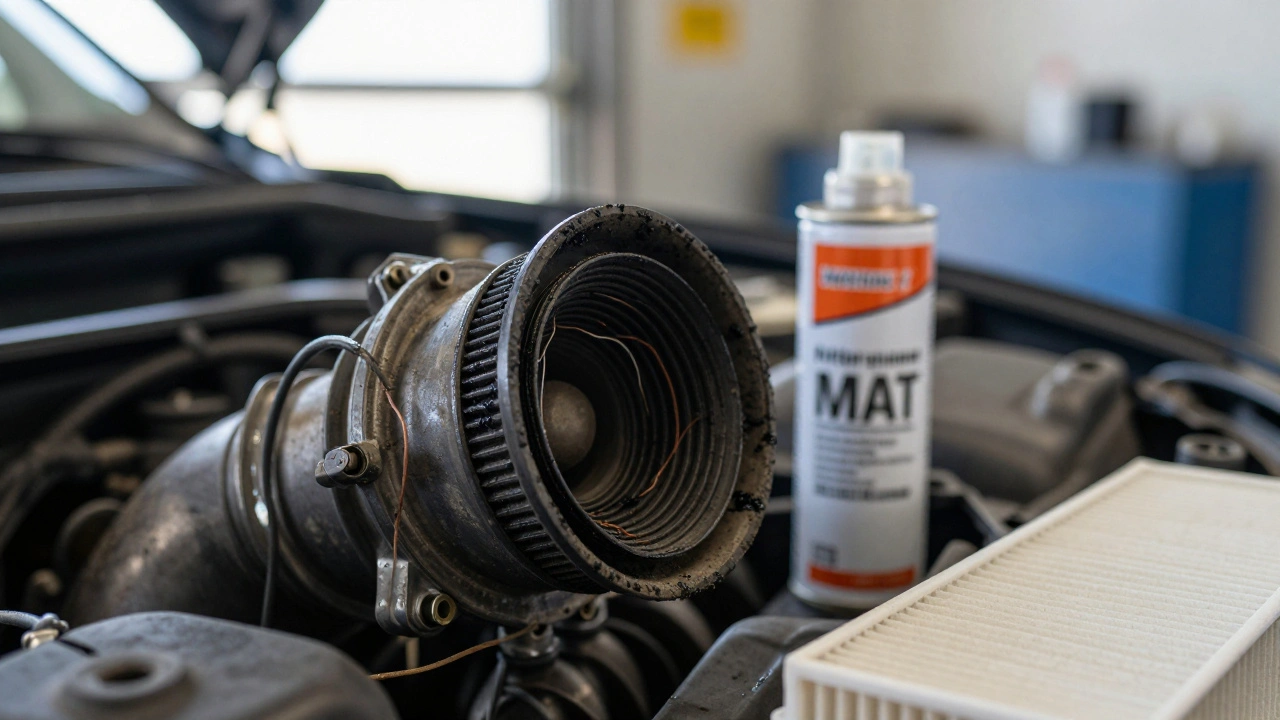
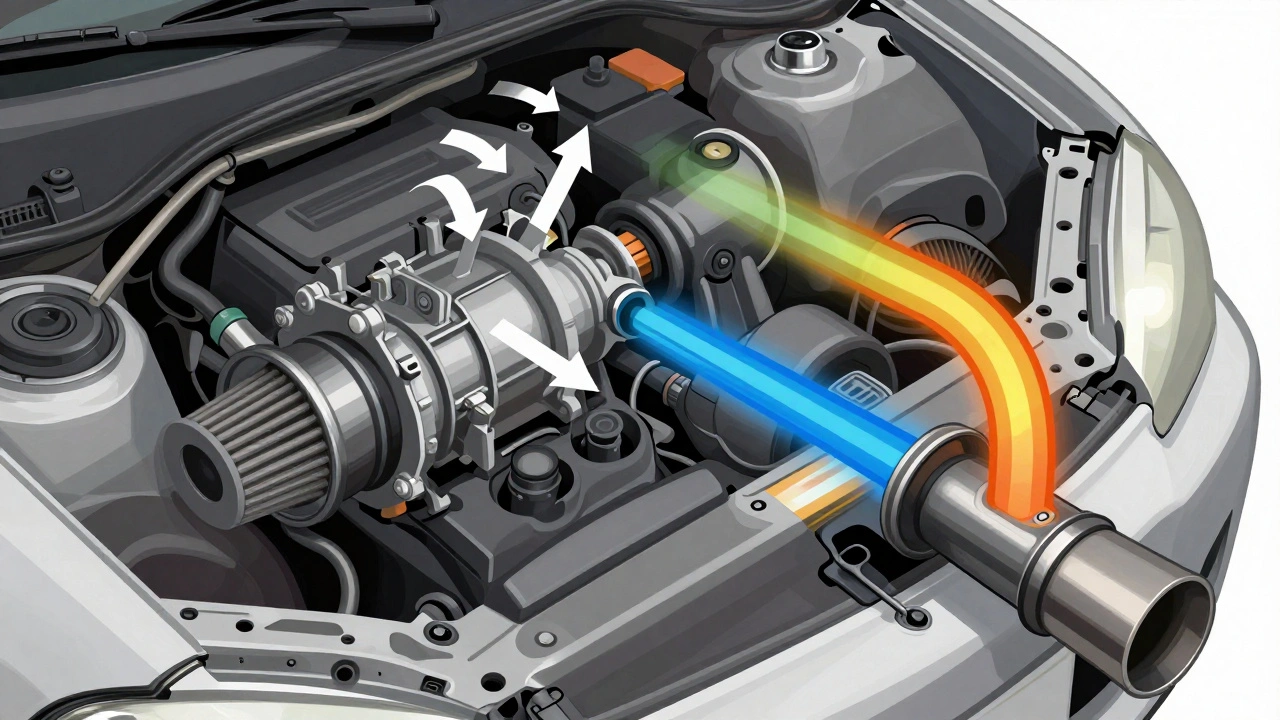
The mass airflow sensor, or MAF, sits between your air filter and the throttle body. It measures exactly how much air is rushing into the engine. That number is critical. Your car’s computer uses it to calculate how much fuel to inject. Too much air? Too little fuel. Too little air? Too much fuel. Either way, the mixture goes wrong.
MAF sensors are delicate. Dust, oil vapors, or even a dirty air filter can coat the tiny hot wire inside. That’s why they fail. When it does, your car might:
- Stall at idle or when accelerating
- Surge or hesitate when you press the gas
- Run rich (too much fuel), making the exhaust smell like gasoline
- Get 20-30% worse fuel economy
Common trouble codes: P0101, P0102, P0103. These mean the MAF signal is out of range or inconsistent.
What the O2 Sensor Actually Does
The O2 sensor, or oxygen sensor, sits in the exhaust pipe. It doesn’t care about air coming in-it watches what’s coming out. It measures how much unburned oxygen is left after combustion. That tells the computer whether the fuel mixture is too lean (too much air) or too rich (too much fuel).
There are usually two O2 sensors: one before the catalytic converter (upstream) and one after (downstream). The upstream one is the one that directly affects fuel trim. When it fails, your engine runs inefficiently because the computer is flying blind.
Signs of a bad O2 sensor:
- Check engine light on, often with a P0171 or P0174 code (system too lean or rich)
- Foul-smelling exhaust, sometimes like rotten eggs
- Reduced power, especially at highway speeds
- Failed emissions test
Unlike the MAF, the O2 sensor doesn’t measure airflow. It measures exhaust gas. That’s the first clue to tell them apart.
Why People Mix Them Up
Both sensors cause similar symptoms. Both trigger fuel trim codes. Both make the engine run poorly. And both are relatively cheap to replace-so mechanics and DIYers often guess.
But here’s the trap: replacing the MAF when the O2 sensor is bad is a waste of money. The MAF might be perfectly fine. And replacing the O2 sensor when the MAF is dirty? The problem comes right back.
I’ve seen people spend $400 on a new O2 sensor, only to have the same symptoms return two weeks later. The real culprit? A MAF covered in gunk from a cheap aftermarket air filter. Or worse-a clogged air filter that’s been ignored for years.
How to Diagnose: Step-by-Step
Don’t guess. Test.
- Read the trouble codes. Use a basic OBD2 scanner. Write down the exact code. P0171/P0174? That’s fuel trim-could be either sensor. P0101-P0103? That’s MAF-specific.
- Check the MAF visually. Turn off the engine. Open the airbox. Remove the MAF (usually held by two screws). Look at the wire inside. If it’s coated in black dust, grease, or debris, clean it. Use MAF cleaner spray-never brake cleaner or alcohol. Let it dry completely. Reinstall. Clear codes. Drive for 10 minutes. If the light stays off, you fixed it.
- Check live data. If you have a scan tool that shows live readings, watch the MAF value at idle. A healthy MAF on a 2.0L engine reads 4-7 grams per second at idle. If it’s below 2 or above 10, it’s likely faulty. Now watch the short-term fuel trim (STFT). If it’s over +15% or below -10%, the system is struggling to correct the mixture. That’s a sign of a bad sensor.
- Compare upstream and downstream O2 readings. A healthy upstream O2 sensor should fluctuate between 0.1V and 0.9V every 1-2 seconds. If it’s stuck at 0.45V or moves slower than once every 5 seconds, it’s dead. Downstream should be steady-around 0.45V. If it’s fluctuating like the upstream, your catalytic converter is failing too.
- Do the vacuum leak test. Sometimes, what looks like a sensor problem is just a vacuum leak. Spray carb cleaner around intake hoses and the throttle body while the engine idles. If the RPM changes, you’ve found a leak. Fix that first. A vacuum leak can make the MAF look bad.
Real-World Example: A 2015 Ford Focus
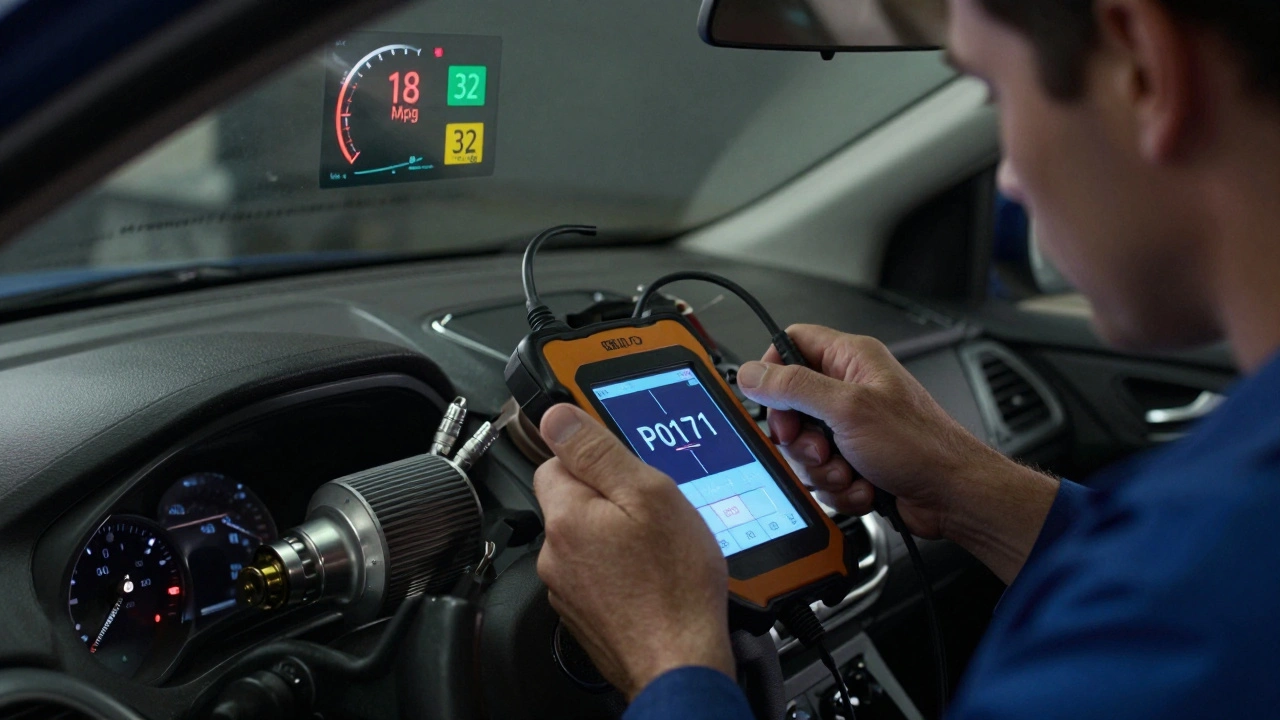
A customer brought in a 2015 Ford Focus with a P0171 code. The car ran rough at idle and had 18 mpg. The last mechanic replaced the O2 sensor-$220. Problem came back.
I checked the MAF. It was covered in black grime. Cleaned it with MAF cleaner. Replaced the air filter (it was 80,000 miles old and clogged). Cleared codes. Drove it. Fuel trim went from +22% to +3%. MPG jumped to 32. Cost: $18 for a filter, $12 for cleaner. No new sensors needed.
When to Replace vs. Clean
MAF sensors can often be cleaned and reused. But if the wire is broken, cracked, or the housing is melted, replace it. Aftermarket MAFs are cheap-$60-$120. OEM ones cost $250+.
O2 sensors? Don’t clean them. They’re not designed to be cleaned. Once they’re contaminated with oil, coolant, or carbon, they’re done. Replace them. A good aftermarket upstream O2 sensor costs $80-$150. OEM? $300+.
Prevention: How to Keep Both Sensors Working
- Use OEM or high-quality air filters. Cheap foam or cotton filters shed oil that coats the MAF.
- Change your air filter every 15,000-20,000 miles. If you drive on dusty roads, do it every 10,000.
- Don’t ignore oil leaks. Blown valve cover gaskets or PCV issues let oil into the intake, ruining the MAF.
- Use fuel injector cleaner every 20,000 miles. Carbon buildup can foul O2 sensors.
- Replace spark plugs on schedule. Misfires dump raw fuel into the exhaust, killing O2 sensors faster.
Common Mistakes to Avoid
- Replacing the O2 sensor first because it’s cheaper. That’s backwards. Always check the MAF and air filter first.
- Using the wrong cleaner on the MAF. Brake cleaner or WD-40 will destroy the sensor.
- Ignoring vacuum leaks. They’re the #1 cause of false MAF and O2 sensor codes.
- Thinking a code means the sensor is bad. Codes tell you the system is out of range-not which part failed.
What Happens If You Ignore It?
Running with a bad MAF or O2 sensor isn’t just about poor mileage. It’s about damage.
A rich mixture (too much fuel) floods the catalytic converter. That can melt the honeycomb inside. Replacing a catalytic converter? $1,000-$2,500.
A lean mixture (too little fuel) causes overheating. That can burn valves or damage pistons.
Neither is a cheap fix. Fix the sensors early. Or pay for the consequences later.
Can a bad MAF sensor cause the same codes as a bad O2 sensor?
Yes. Both can trigger fuel trim codes like P0171 or P0174. The MAF gives wrong airflow data, so the computer adds or subtracts fuel incorrectly. The O2 sensor sees the wrong exhaust mixture and tells the computer to adjust-but if the MAF is faulty, the adjustment never fixes the root problem. That’s why you need to test both.
Can I drive with a bad MAF or O2 sensor?
You can, but you shouldn’t. Your car will run poorly, get terrible gas mileage, and risk damaging the catalytic converter. In some states, you’ll fail emissions testing. Long-term driving with either sensor failing can lead to expensive engine damage.
How long do MAF and O2 sensors last?
MAF sensors typically last 80,000 to 100,000 miles if the air filter is maintained. O2 sensors last 60,000 to 100,000 miles. Older sensors (pre-2000) wore out faster. Modern ones last longer but still fail if contaminated by oil, coolant, or carbon.
Should I replace both sensors at the same time?
No. Only replace the one that’s faulty. Replacing both is a waste of money unless both are old and you’re doing a full tune-up. Test first. Replace only what’s broken.
Can a dirty air filter cause MAF sensor failure?
Yes. A clogged air filter forces the engine to pull harder for air. That increases pressure and draws more dirt past the filter. That dirt sticks to the MAF wire. Over time, it builds up and disrupts the signal. Always replace the air filter before blaming the MAF.
Comments
NIKHIL TRIPATHI
I cleaned my MAF last year after my Focus started sputtering. Used the exact cleaner mentioned here-$12 bottle, 10 minutes work, and my fuel trim went from +25% to +2%. Life changer. No new parts needed. Don’t overthink it, just check the wire first.
December 6, 2025 at 02:18
Shivani Vaidya
The diagnostic approach outlined here is methodical and reflects sound engineering practice. Many automotive repairs are misdiagnosed due to the temptation to replace components based on code alone rather than root cause analysis. A disciplined diagnostic protocol prevents unnecessary expenditure and environmental waste.
December 6, 2025 at 23:51
Rubina Jadhav
I just replaced my O2 sensor and it didn’t fix anything. Now I’m thinking maybe it was the MAF. Thanks for the tip about cleaning it.
December 8, 2025 at 03:55
sumraa hussain
OMG I CAN’T BELIEVE I SPENT $400 ON AN O2 SENSOR AND IT WAS JUST A DIRTY MAF??? I’M CRYING AND LAUGHING AT THE SAME TIME. MY CAR’S RUNNING LIKE A NEW ONE NOW. THANK YOU. I’M TELLING EVERYONE. THIS IS THE BEST THING I’VE LEARNED THIS YEAR. I’M BUYING A MAF CLEANER RIGHT NOW.
December 9, 2025 at 02:26
Raji viji
Everyone’s acting like this is some genius hack but it’s literally Step 1 in any auto repair class. If you’re dumb enough to replace sensors without checking the air filter or cleaning the MAF first, you deserve to get robbed by mechanics. Also, anyone who uses aftermarket air filters deserves to burn their car. Seriously. What were you thinking?
December 9, 2025 at 05:30
Rajashree Iyer
It’s not about sensors, really. It’s about the soul of the machine. The MAF whispers to the engine’s spirit, and when it’s clogged with dust and neglect, the car forgets how to breathe. The O2 sensor weeps in the exhaust, watching the flames turn sour. We fix parts, but we never fix the care we give. This is not a car problem. It’s a human problem.
December 10, 2025 at 02:31
Parth Haz
This is an excellent, well-structured guide. The step-by-step diagnostics are clear and practical. I’ve shared this with my local car club and everyone agrees: checking the MAF and air filter before replacing sensors saves time, money, and frustration. Great job.
December 10, 2025 at 16:33
Vishal Bharadwaj
Wait… you’re telling me a dirty air filter can cause a MAF code? I thought that was just a myth made up by people who don’t know what a throttle body is. Also, P0171 means lean right? Or is it rich? I always mix it up. Someone help.
December 11, 2025 at 20:17
anoushka singh
Wait so you’re saying I don’t need to take it to the shop? I just… clean it? Like with spray? But what if I break it? I’m scared. I’ve never opened my engine bay before. My cousin said I’ll explode something. 😅
December 13, 2025 at 06:59
Jitendra Singh
My 2013 Civic had the exact same symptoms. I did the MAF clean and air filter swap. Took 15 minutes. Now it’s running smoother than ever. I didn’t even need to reset the codes manually-the car figured it out after a few drives. Just proves you don’t always need to spend to fix things.
December 14, 2025 at 10:11
Madhuri Pujari
Oh wow, so the ‘expert’ who replaced my O2 sensor for $220 didn’t even check the MAF? And you’re telling me he’s still working at that shop? That’s not incompetence-that’s fraud. I’m filing a complaint. And also, why is everyone so shocked? This is basic. I’ve been doing this since I was 16. You people need to stop trusting mechanics like they’re wizards.
December 15, 2025 at 11:24
Sandeepan Gupta
One small note: when cleaning the MAF, make sure the sensor is completely dry before reinstalling. Even a little moisture can cause false readings. I’ve seen people rush this and end up with the same codes. Let it air-dry for at least 30 minutes. Also, avoid touching the wire with anything-not even a cotton swab. It’s fragile.
December 16, 2025 at 20:07
Tarun nahata
THIS IS THE MOST POWERFUL CAR TIP I’VE EVER SEEN. I WAS READY TO BUY A NEW ENGINE. NOW I’M JUST BUYING A $12 CLEANER AND A $20 AIR FILTER. I’M FEELING LIKE A HERO. MY CAR IS BREATHING AGAIN. THANK YOU FOR THIS. I’M GOING TO POST THIS ON EVERY FORUM I CAN FIND.
December 18, 2025 at 11:13
Aryan Jain
They don’t want you to know this. The MAF sensor is controlled by the government to make you buy more cars. The O2 sensor is a distraction. The real issue? The fuel companies. They want you to think it’s a sensor problem so you keep buying gas and paying for repairs. Look at the timing-every time they update the fuel formula, MAF codes spike. Coincidence? I think not.
December 20, 2025 at 01:13