
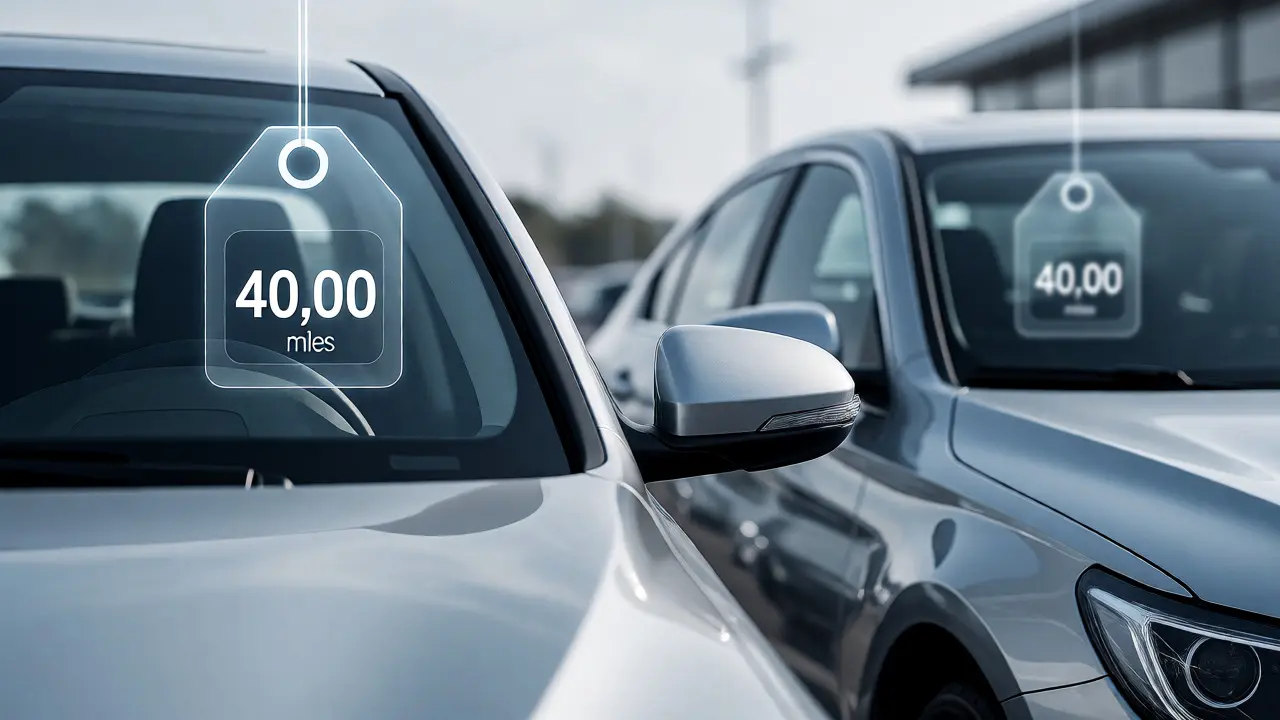
You pull up to a dealership or open an online listing, and two identical cars sit side by side. Same make, same model, same year, same colour. The only difference? One has done 40,000 miles, the other has clocked 120,000. The price tag tells you everything: one is worth thousands more than the other. But why does that specific number on the odometer hold so much power over what you pay or receive? It isn't just about wear and tear; it's about how buyers perceive risk, how insurers calculate premiums, and how the market prices uncertainty.
If you are selling, you want to know exactly where your vehicle valuation stands before you list it. If you are buying, you need to understand when a high-mileage bargain is actually a smart move versus a money pit waiting to happen. This guide breaks down the mechanics of mileage impact, moving beyond simple averages to give you the practical tools to negotiate better deals in the UK market.
The Non-Linear Reality of Depreciation
Most people assume mileage affects value in a straight line. They think if a car loses £500 for every 10,000 miles, then 50,000 miles costs £2,500. That is rarely true. Mileage impacts the resale value of a vehicle through a non-linear depreciation curve, meaning the steepest drops often happen at specific thresholds rather than evenly across the board. Think of it like a cliff edge. A car with 98,000 miles might be priced similarly to one with 99,000. But once you cross the 100,000 mark, the psychological barrier kicks in. Buyers suddenly see "six figures" instead of "five figures," and their willingness to pay drops disproportionately.
This psychological threshold is real data. In the UK used car market, listings under 100,000 miles consistently attract more enquiries than those just above it, even if the mechanical condition is identical. Sellers who ignore this cliff often lose out. If you are at 102,000 miles, you might get more money by accepting a slightly lower offer on a similar car at 98,000 miles than holding out for a premium that doesn't exist for your specific odometer reading.
Service History Trumps Odometer Readings
Here is the secret weapon that changes the equation: documentation. A Full Service History (FSH) can significantly mitigate the negative impact of high odometer readings. When a buyer sees 150,000 miles, they panic because they don't know how those miles were accrued. Were they motorway runs at steady speeds, which are gentle on engines? Or were they stop-start city commutes, which hammer clutches, brakes, and suspension?
A complete service history answers that question. It proves maintenance was regular and likely performed by qualified technicians. Without FSH, high mileage looks like neglect. With FSH, high mileage looks like reliability. For example, a well-maintained Toyota Corolla with 140,000 miles and full dealer stamps will often sell for more than a neglected Ford Focus with 80,000 miles but no paperwork. The market pays for certainty. If you are selling, dig out every receipt. If you are buying, treat missing history as a major red flag, regardless of how low the mileage appears.
Brand-Specific Mileage Tolerances
Not all cars age the same way. A 100,000-mile Honda Civic is viewed differently than a 100,000-mile Jaguar XJ. Why? Because brands have different reputations for longevity. Japanese manufacturers like Toyota, Honda, and Mazda build cars designed to run for hundreds of thousands of miles with basic maintenance. Their vehicles suffer less from the stigma of higher mileage.
European luxury brands, particularly German ones like BMW, Audi, and Mercedes-Benz, command higher initial prices but depreciate faster once mileage climbs past 60,000-80,000 miles. Complex electronics and air suspensions become liability concerns as parts age. British classics or niche sports cars operate on entirely different rules, where provenance matters more than distance travelled. Understanding your specific brand's tolerance helps you set realistic expectations.
| Brand Category | Ideal Resale Mileage | High Risk Threshold | Buyer Perception |
|---|---|---|---|
| Japanese Economy (Toyota, Honda) | < 100,000 miles | > 150,000 miles | Reliable workhorse |
| German Luxury (BMW, Audi) | < 60,000 miles | > 80,000 miles | Potential repair bills |
| British Family (Ford, Vauxhall) | < 70,000 miles | > 100,000 miles | Wear and tear visible |
| Luxury Sports (Porsche, Aston Martin) | < 30,000 miles | > 50,000 miles | Collector vs. Driver |

The Motorway vs. City Miles Myth
Sellers often claim, "It's mostly motorway miles," hoping to justify a higher price. Does it matter? Technically, yes. Mechanically, maybe not as much as you think. Modern engines are efficient at constant speeds, reducing carbon buildup and thermal stress. However, most buyers cannot verify this claim unless you provide telematics data or detailed service logs showing long-distance intervals.
In practice, savvy buyers discount the "motorway miles" argument unless backed by evidence. They know that tyres degrade with time, rubber hoses crack with age, and electrical components fail due to humidity and temperature cycles, not just rotation. A 10-year-old car with 50,000 motorway miles still has 10-year-old seals and belts. Don't bank on this phrase alone. Use it as a supporting point alongside good condition reports, not as your primary sales pitch.
How Insurers View High Mileage
Your insurance premium is tied to your annual mileage declaration. Higher declared mileage usually means higher premiums because statistically, you spend more time on the road, increasing accident probability. But here is the twist: when valuing a used car for insurance purposes, insurers use market comparables. If the market penalizes high mileage heavily, your insured value drops. If you declare 20,000 miles per year but the car shows 120,000 total, insurers may suspect misdeclaration or excessive usage, potentially affecting claims payouts.
Always ensure your declared annual mileage matches reality. Under-declaring saves pennies now but risks invalidating cover later. Over-declaring raises premiums unnecessarily. Check your policy terms carefully. Some providers offer "black box" or telematics policies that reward safe driving habits, potentially offsetting some cost associated with higher mileage usage.

Negotiating Tips for Buyers and Sellers
If you are selling, prepare your narrative. Gather receipts, note any recent repairs (new clutch, timing belt), and highlight features that counterbalance mileage, such as heated seats or premium audio. Be ready to explain gaps in history. Price slightly above your target to leave room for negotiation based on mileage objections.
If you are buying, use mileage as leverage. Point out comparable listings with lower mileage and ask for a price adjustment. Ask specifically about the last major service interval. Request a pre-purchase inspection from a trusted mechanic who can assess wear relative to mileage. If the interior looks worn at 60,000 miles, the engine likely has too. Never buy solely on low mileage without verifying overall condition.
Frequently Asked Questions
Does low mileage always mean a better car?
No. Very low mileage on an older car can indicate infrequent use, which may lead to issues like flat-spotted tyres, dried-out seals, or battery problems. Cars benefit from regular operation. Always check the service history and overall condition rather than relying solely on the odometer.
How much value does 10,000 miles remove?
There is no fixed amount. On average, you might expect a 5-10% reduction in value for every additional 10,000 miles compared to similar vehicles, but this varies wildly by brand, age, and demand. Luxury cars lose more value per mile than economy cars.
Is 100,000 miles too many for a used car?
Not necessarily. Many modern cars, especially Japanese models, run reliably past 150,000 miles with proper maintenance. The key factors are service history, type of driving (motorway vs. city), and specific model reliability records. Always prioritize maintenance records over raw mileage numbers.
Can I roll back the odometer?
Yes, digital odometers can be tampered with, though it is illegal to sell a car with a rolled-back meter without disclosure. Digital traces often remain in the ECU or instrument cluster. Professional inspections can sometimes detect discrepancies between reported mileage and actual wear patterns.
Do electric vehicles depreciate differently with mileage?
EVs face unique depreciation challenges related to battery health rather than mechanical wear. While motors are durable, battery degradation impacts range and value. Buyers scrutinize State of Health (SoH) reports more closely than traditional mileage figures for EVs.