
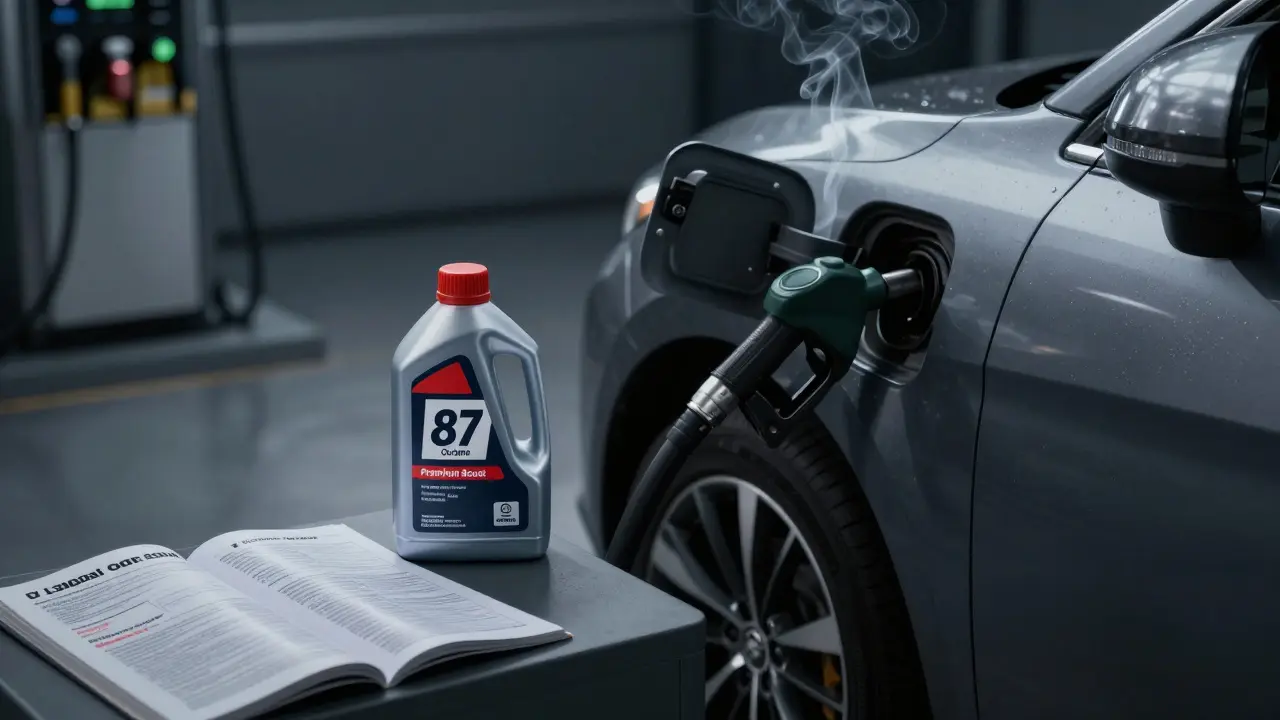
You see the ads everywhere: octane boosters that promise better gas mileage, smoother rides, and even more power. For a few bucks a bottle, they claim to turn your regular gas into premium fuel - or better. But do they actually work? Or are they just another way to spend money on something that won’t change how far your car goes on a tank?
If you’re trying to stretch every gallon, especially with gas prices still high in 2025, it’s natural to wonder. But the truth isn’t what the commercials say. Most octane boosters don’t improve fuel economy. In fact, many do nothing at all - unless your car specifically needs higher octane fuel.
What Octane Boosters Actually Do
Octane boosters increase the octane rating of gasoline. That’s it. Octane measures a fuel’s resistance to knocking - that pinging or rattling sound you hear when the air-fuel mixture ignites too early in the cylinder. High-performance engines, especially those with turbochargers or high compression ratios, need higher octane fuel to prevent this.
But most cars on the road today don’t need premium gas. The owner’s manual for 90% of vehicles sold in the U.S. says regular 87 octane is fine. If your car doesn’t require premium, adding an octane booster won’t make it run better, faster, or more efficiently. It just makes the fuel more expensive.
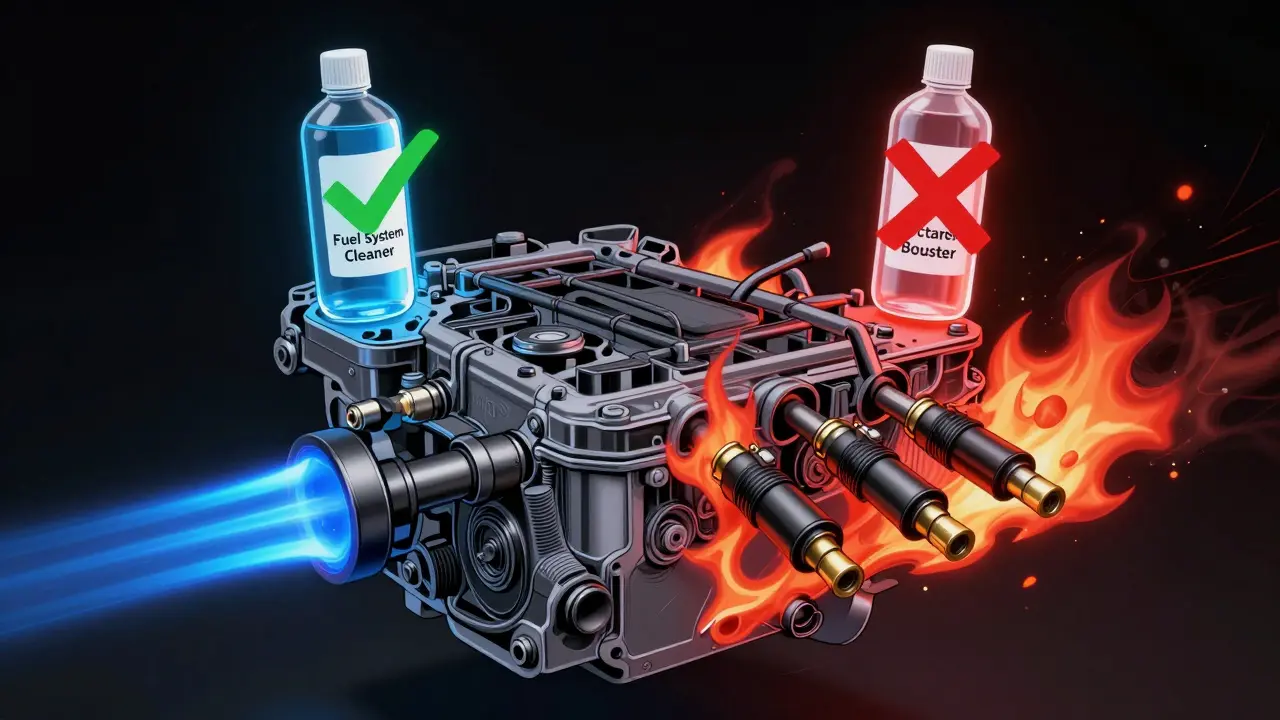
Some additives claim to clean fuel injectors or remove carbon buildup. That’s a different story. Fuel system cleaners like Techron or Gumout are designed to remove deposits that accumulate over time. If your engine has heavy carbon buildup - which usually happens after 75,000 miles without proper maintenance - a quality fuel additive might help restore lost power and slightly improve fuel economy. But that’s not the same as an octane booster.
The MPG Myth
There’s a big difference between cleaning a dirty engine and magically turning 20 mpg into 25 mpg. Independent testing by the EPA and Consumer Reports has repeatedly shown that octane boosters don’t improve fuel economy in engines designed for regular gas.
In one 2023 study by the American Automobile Association (AAA), 12 popular fuel additives were tested across 15 different vehicles. None of the octane boosters improved MPG. Only two fuel system cleaners showed a minor gain - around 1.5% - but only in cars with known, severe carbon buildup. The rest? Zero change.
Think of it like this: if your car is running fine, adding an octane booster is like putting expensive synthetic oil in a car that only needs conventional. It won’t hurt - but it won’t help either.
When Additives Might Actually Help
There are a few real cases where fuel additives make sense:
- Your car knocks or pings on regular gas - this means it needs higher octane. A booster might temporarily fix it, but you’re better off just using premium.
- Your vehicle has over 100,000 miles and you’ve never cleaned the fuel system. A single dose of a detergent additive (like Chevron Techron) could restore efficiency by 2-4%.
- You’re storing a vehicle for months - like a classic car or seasonal ATV. Fuel stabilizers prevent ethanol-based gas from breaking down and gumming up the system.
For everyday drivers with modern cars, none of these apply. Modern fuel already contains detergents. The EPA requires a minimum level of cleaning agents in all gasoline sold in the U.S. So unless you’re using cheap, off-brand gas from a station with questionable turnover, your injectors are probably fine.
What About Performance Claims?
Some brands say their additives increase horsepower or throttle response. That’s misleading. If your engine is tuned for 87 octane, it won’t suddenly produce more power just because you added a chemical that raises the octane rating. The engine’s computer adjusts timing to match the fuel it gets. Higher octane doesn’t mean more energy - it just means it burns slower and more evenly under pressure.
Real performance gains come from tuning the engine, upgrading the intake or exhaust, or adding forced induction. Not from a $10 bottle you pour into your tank.
The Real Cost of Octane Boosters
Let’s do the math. A typical bottle of octane booster costs $15 and treats 15-20 gallons of gas. That’s about $1 per gallon extra. If you drive 12,000 miles a year and get 25 mpg, you use 480 gallons. If you add booster every fill-up, you’re spending an extra $720 a year.
And for what? If your MPG doesn’t change, you’re just paying more per mile. Even if you somehow got a 1% improvement in fuel economy - which is extremely unlikely - you’d save about $12 a year on gas. That’s not worth $720.
Some people swear by them. They say their car feels smoother or sounds quieter. That’s placebo. Your brain expects improvement, so you perceive it. It’s the same reason people think expensive wine tastes better - even when it’s the same as cheap wine in a blind test.
What You Should Do Instead
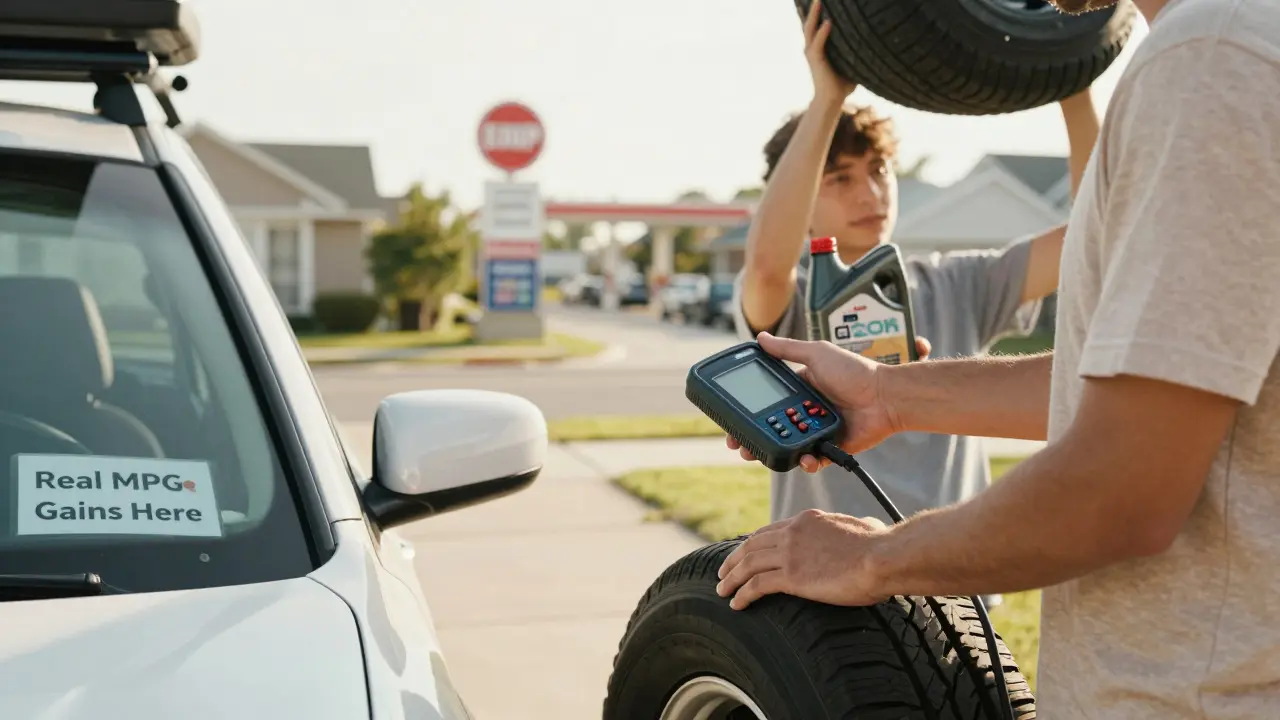
If you want to actually improve your MPG, here’s what works:
- Keep tires properly inflated - underinflated tires can drop MPG by 3-5%
- Replace a clogged air filter - only matters if it’s dirty enough to restrict airflow (rare in modern cars)
- Use the right motor oil - synthetic 5W-30 or 0W-20 as recommended reduces friction
- Drive smoothly - avoid rapid acceleration and hard braking
- Reduce weight - take out that unused roof rack or heavy cargo
- Use cruise control on highways
- Get regular tune-ups - spark plugs, oxygen sensors, and fuel injectors all affect efficiency
These things cost less, are backed by data, and actually change how far you go on a gallon.
Bottom Line
Octane boosters don’t improve fuel economy in cars that don’t need premium gas. They’re not magic. They’re not a secret hack. They’re a marketing product designed to make you feel like you’re doing something smart - when you’re really just paying more for the same gas.
Save your money. If your car runs fine on regular, stick with it. If you’re worried about carbon buildup, use a quality fuel system cleaner once a year - not every tank. And if you really want better MPG, focus on driving habits and maintenance. Those are the only things that matter.
Do octane boosters really increase gas mileage?
No, octane boosters do not increase gas mileage in vehicles designed to run on regular fuel. They raise the octane rating to prevent knocking, but they don’t make fuel more energy-dense or improve combustion efficiency. Independent tests by AAA and the EPA show no measurable MPG gain in standard engines.
Can I use octane boosters in my everyday car?
You can, but it’s unnecessary. Most modern cars are designed for 87 octane. Using a booster won’t harm your engine, but it won’t help either. If your owner’s manual says regular is fine, stick with it. Only use higher octane if your car knocks or the manual requires it.
Are fuel additives worth it for older cars?
For cars over 100,000 miles with poor maintenance history, a one-time use of a detergent-based fuel system cleaner (like Techron or Gumout) can help remove carbon deposits and restore lost efficiency. But octane boosters won’t clean injectors. Only specific additives with PEA (polyether amine) do that.
What’s the difference between octane boosters and fuel system cleaners?
Octane boosters increase the fuel’s resistance to knocking - they’re about combustion timing. Fuel system cleaners contain detergents that remove carbon buildup from injectors and valves. They solve different problems. One doesn’t replace the other.
Can I use octane boosters with ethanol-blended gas?
Yes, but it’s usually pointless. Ethanol already has a high octane rating (around 113). Most ethanol blends (like E10) are already at or above 87 octane. Adding an octane booster won’t improve performance or efficiency - and may even cause compatibility issues with older fuel lines or seals.
Will octane boosters hurt my engine?
Most are safe if used as directed. But some cheap brands contain MMT (methylcyclopentadienyl manganese tricarbonyl), which can foul spark plugs and oxygen sensors over time. The EPA restricts MMT in the U.S. because of this. Always check the label - avoid products with MMT if you have a modern car with emissions sensors.
Comments
Bharat Patel
It's funny how we chase quick fixes when the real answers are so simple. Like holding a magnifying glass up to the sun thinking it'll make the day brighter, when all you really need is to step outside and let the light hit you as it is. Octane boosters? They're the spiritual equivalent of buying a new pair of shoes because your feet hurt - maybe you just need to walk differently.
December 24, 2025 at 13:03
Bhagyashri Zokarkar
i just put that stuff in my car cause it makes me feel like im doin somethin smart like im a mechanic or sumthin but honestly i dont even know what octane is like is it a type of coffee or a brand of jeans i just see the bottle and think wow this might make my car stop sounding like a dying robot and honestly if it makes me feel better who cares i spend more on coffee than this so why not
December 24, 2025 at 17:58
Rakesh Dorwal
They don't want you to know the truth - this whole octane booster scam is part of the global oil cartel's plan to keep us hooked on unnecessary spending. Why do you think the EPA only allows certain additives? Because they're in bed with the big automakers and the fuel companies. They want you thinking you need premium when you don't. Even the word 'octane' sounds like a government code name. Look at the labels - MMT? That's not chemistry, that's surveillance tech disguised as fuel.
December 25, 2025 at 14:31
Vishal Gaur
man i used to buy these things every other fill up till i realized my car was never gonna turn into a ferrari no matter how many bottles i poured in it. i mean come on i got a 2015 corolla not a tesla model s. the only thing that got better was my bank account getting sadder. and now i just drive nice and easy and check my tire pressure once a month and guess what? my mpg is better and i dont even remember what octane booster tastes like
December 27, 2025 at 09:24
Nikhil Gavhane
It’s refreshing to see someone lay this out so clearly. So many people feel guilty for not doing enough to save money, so they buy something that sounds smart - even if it doesn’t work. But the truth is, caring for your car doesn’t require magic potions. It just requires showing up. Checking tires. Driving steady. Using the oil the manual says. That’s not boring - that’s wisdom.
December 27, 2025 at 12:04
Rajat Patil
I appreciate the clarity of this post. Many individuals are misled by marketing language that implies scientific advancement where none exists. The human tendency to seek external solutions for internal conditions is well documented. In this case, the condition is economic anxiety, and the solution offered is illusory. Simplicity and consistency remain the most reliable paths.
December 28, 2025 at 14:49
deepak srinivasa
Wait, so if ethanol already has 113 octane, why do we even need to add anything? Isn't that like putting sugar in honey? And if the EPA already requires detergents in gas, why do we keep buying more? Is it because we don't trust the system? Or because we think more is better? Just curious - I'm trying to understand the psychology behind this.
December 30, 2025 at 12:13
pk Pk
Look, if you're driving a modern car and you're not hearing knock, you're wasting money. But if you're a parent with a 12-year-old SUV that's been running on whatever gas they could find at the corner station for years? Then yeah, one clean-up dose might be worth it. Don't overthink it. Don't underthink it. Just be smart about what your car actually needs, not what the ad says it wants.
December 30, 2025 at 16:30
Shivani Vaidya
Thank you for this thoughtful and well-researched explanation. It is rare to encounter such a balanced perspective on a topic often clouded by misinformation. The distinction between octane boosters and fuel system cleaners is particularly important, as the two are frequently conflated by consumers. I believe greater public education on this matter would reduce unnecessary expenditures and promote more informed decision-making.
December 31, 2025 at 21:02
Rubina Jadhav
I never used these. My car runs fine. I just do what the manual says.
January 1, 2026 at 12:42
sumraa hussain
Okay but imagine if this whole octane booster thing was just a giant placebo experiment run by Big Gas to see how much we'd pay to feel in control... like, what if the real product isn't the bottle - it's the feeling of doing something? Like when you buy a $20 candle because your life feels messy and you need to believe you're fixing it... we're doing the same thing with our cars. We just want to believe we're not powerless. And honestly? That's kinda beautiful. And also kinda tragic.
January 2, 2026 at 13:05