
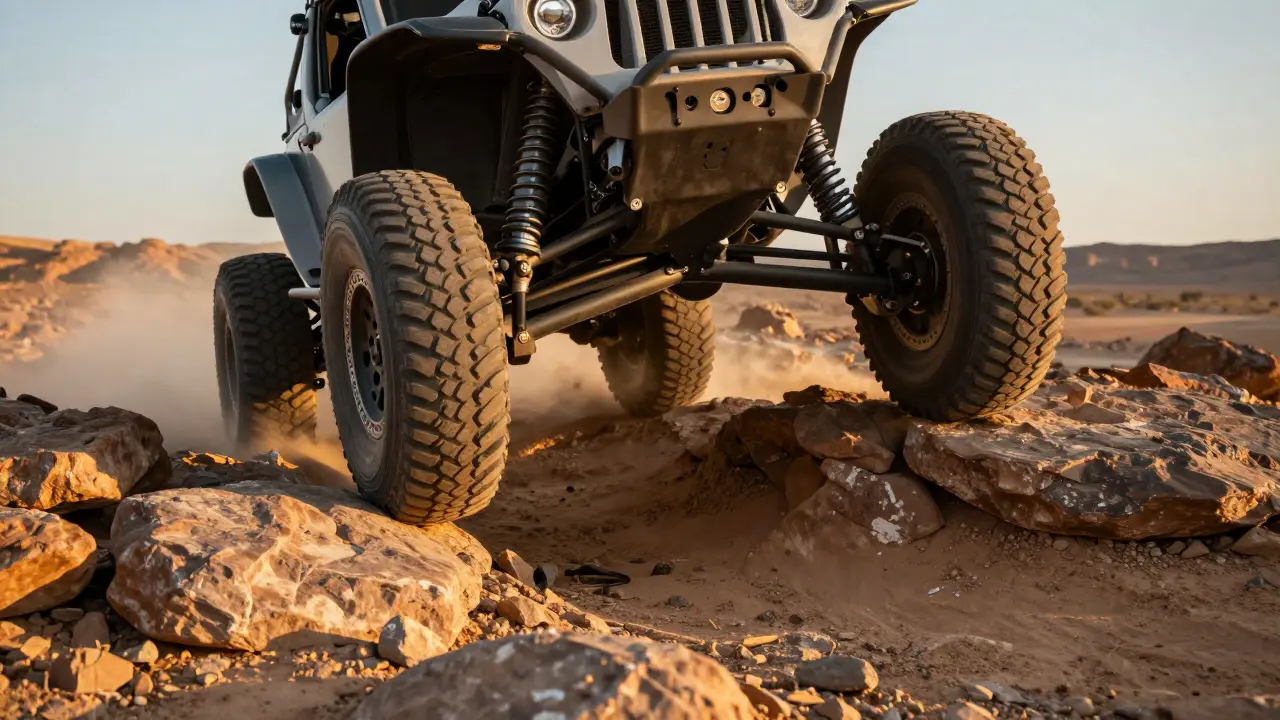
When you’re crawling over rocks, climbing steep ridges, or bouncing through desert washes, your vehicle’s suspension isn’t just absorbing bumps-it’s doing complex math in real time. The secret to staying planted, stable, and in control isn’t just big shocks or thick tires. It’s suspension geometry: how the parts are arranged, how they move, and how they talk to each other. Three numbers rule off-road performance: travel, articulation, and roll. Get these right, and your rig will go places stock suspensions can’t even dream of.
What Is Suspension Travel-and Why It Matters More Than You Think
Suspension travel is how far a wheel can move up and down. Not how high your truck lifts, but how far the axle can actually move relative to the chassis. A stock Jeep Wrangler might have 8 inches of travel. A well-tuned trail rig? 14 inches or more. That extra 6 inches isn’t just comfort-it’s survival.
Imagine hitting a 12-inch drop-off. With 8 inches of travel, your tire hits the ground, the axle slams into the bump stop, and the chassis follows. You lose traction. You might even damage the suspension. With 14 inches? The wheel drops smoothly, the tire stays in contact, and momentum carries you through. That’s how you clear obstacles without a winch.
Travel isn’t just about shock length. It’s about control arms, track bars, and mounting points. Longer control arms increase arc radius, which reduces camber change during travel. Less camber change means better tire contact. More contact means more grip. And grip is everything when the ground is loose or uneven.
Most people chase lift kits. But a 4-inch lift with stock control arms gives you less usable travel than a 2-inch lift with custom geometry. Why? Because the stock arms bind before the shocks even bottom out. Geometry dictates how far you can actually go before things break.
Wheel Articulation: The Real Secret to Off-Road Traction
Articulation is how independently each wheel can move up and down. Think of it like a four-legged animal walking over uneven ground. If all four feet stay flat, you stay balanced. If one wheel lifts off, you lose traction-and possibly control.
Stock suspensions are built for highways. They use stiff springs, short control arms, and solid axles with limited motion. When one wheel hits a rock, the opposite wheel lifts. That’s bad. You go from 4-wheel drive to 2-wheel drive in a heartbeat.
Good articulation means one wheel can drop 10 inches while the other lifts 8 inches-and both tires still grip. That’s possible with long control arms, flexible joints (like spherical bearings), and low roll centers. The goal? Keep the tires planted. Even if one side is hanging over a ledge, the other side needs to push you forward.
Jeep’s Rubicon models use electronic lockers and sway bar disconnects to help. But even those can’t fix bad geometry. If your control arms are too short, the axle can’t swing far enough. If your track bar is mounted too high, the axle shifts sideways instead of moving straight up. That’s why aftermarket kits don’t just add shocks-they redesign the whole suspension triangle.
Real-world example: A 2023 Toyota 4Runner with stock suspension can’t handle a sidehill trail with 20-degree incline. But a modified version with 14-inch travel, long arms, and a dropped track bar? It stays flat, tires grip, and the driver barely touches the throttle. That’s articulation at work.
Roll Center: The Invisible Force That Flips Your Vehicle
Roll center is the imaginary point around which your vehicle leans during turns or sidehills. It’s not a physical part. It’s a physics result of your suspension’s shape. And if it’s too high, your rig becomes a teeter-totter.
Stock SUVs and trucks have high roll centers because they’re built for highway stability. But off-road, that’s dangerous. A high roll center means your body rolls outward when you’re on a slope. The center of gravity shifts, and suddenly you’re not just leaning-you’re tipping.
Lowering the roll center keeps your vehicle flat. How? By moving the pivot points lower. Longer control arms, relocating the track bar to the frame, and using drop brackets all push the roll center down. Some hardcore builders even use triangulated 4-link systems to eliminate the track bar entirely and create a stable, low pivot.
Think of it like a tall stack of books. Tip it, and it falls. Now put the same stack on a wide, low base. It stays put. Off-road vehicles work the same way. Lower the roll center, and you increase stability. You don’t need a roll cage if your geometry keeps you upright.
Studies from the University of Michigan’s Off-Road Vehicle Dynamics Lab show that lowering the roll center by just 4 inches reduces rollover risk by 37% on 30-degree sidehills. That’s not theory-it’s measurable. And it’s why professional off-road racers don’t just add lift. They rebuild the entire suspension from the ground up.
How Travel, Articulation, and Roll Work Together
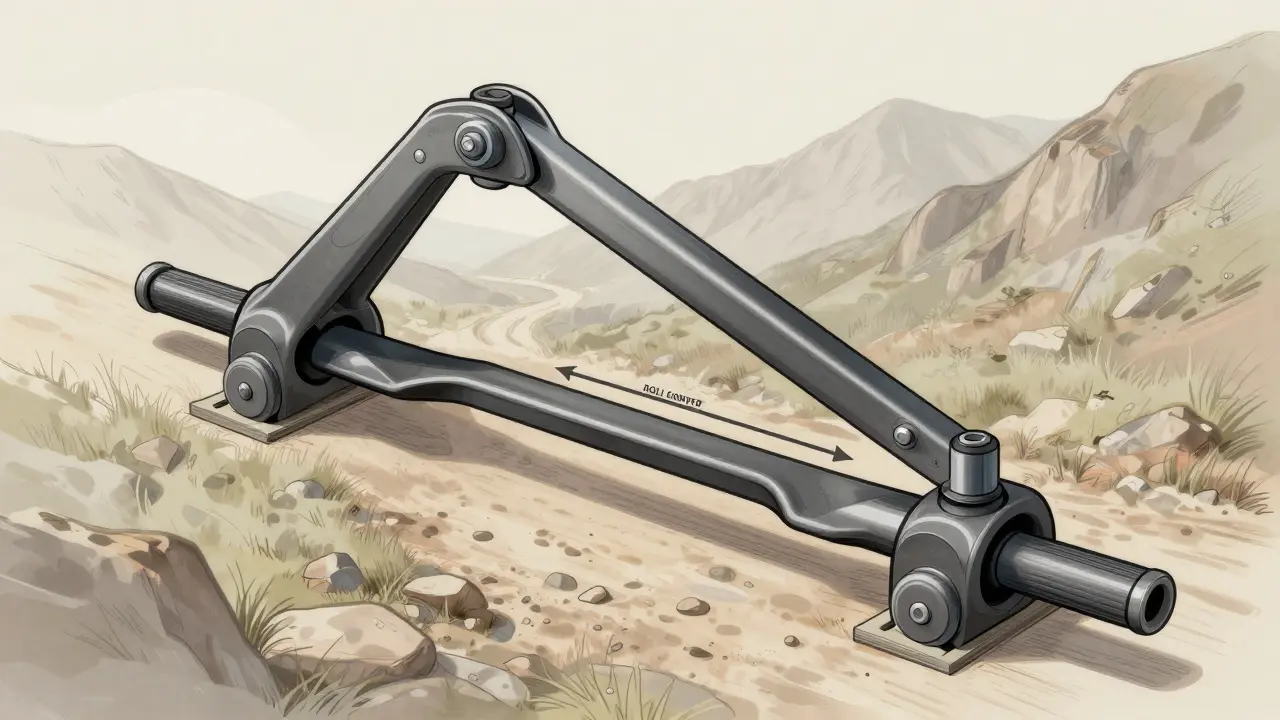
These three aren’t separate. They’re a system. You can’t optimize one without affecting the others.
More travel? That usually means longer control arms. Longer arms? That lowers the roll center. Lower roll center? That improves stability during articulation. It all connects.
Here’s what happens when you get it wrong:
- High lift + stock arms = limited travel, high roll center, poor articulation
- Long arms + high track bar = axle shift, uneven tire contact, unpredictable handling
- Too much articulation without enough travel = wheels lift too easily, lose traction on bumps
The sweet spot? A balance. Most serious trail rigs use:
- 12-16 inches of travel
- Long-arm suspension with spherical joints
- Track bar mounted low on the frame
- Roll center lowered to within 4 inches of the ground
That setup lets you crawl over rocks, sidehill on steep trails, and drop into ruts without flipping, binding, or losing traction. It’s not about brute force. It’s about precision engineering.
Common Mistakes and How to Avoid Them
People make the same errors over and over. Here’s what to skip:
- Just adding lift springs-without adjusting geometry, you’ll get more height but worse handling. Your tires will scrub, your shocks will bottom out early, and your roll center will climb.
- Using short control arms-even on lifted trucks. Short arms limit travel, increase camber change, and make articulation worse.
- Ignoring the track bar-if it’s mounted too high, the axle shifts sideways when you articulate. That causes bump steer and unpredictable behavior.
- Overdoing shocks-big shocks don’t fix bad geometry. They just mask it. If your arms are too short, shocks will never have room to work.
Best practice: Start with the control arms. Choose a long-arm kit designed for your vehicle’s weight and tire size. Then lower the track bar. Then adjust shocks to match the new travel. Never install shocks first.
Real-World Testing: What Works on the Trail
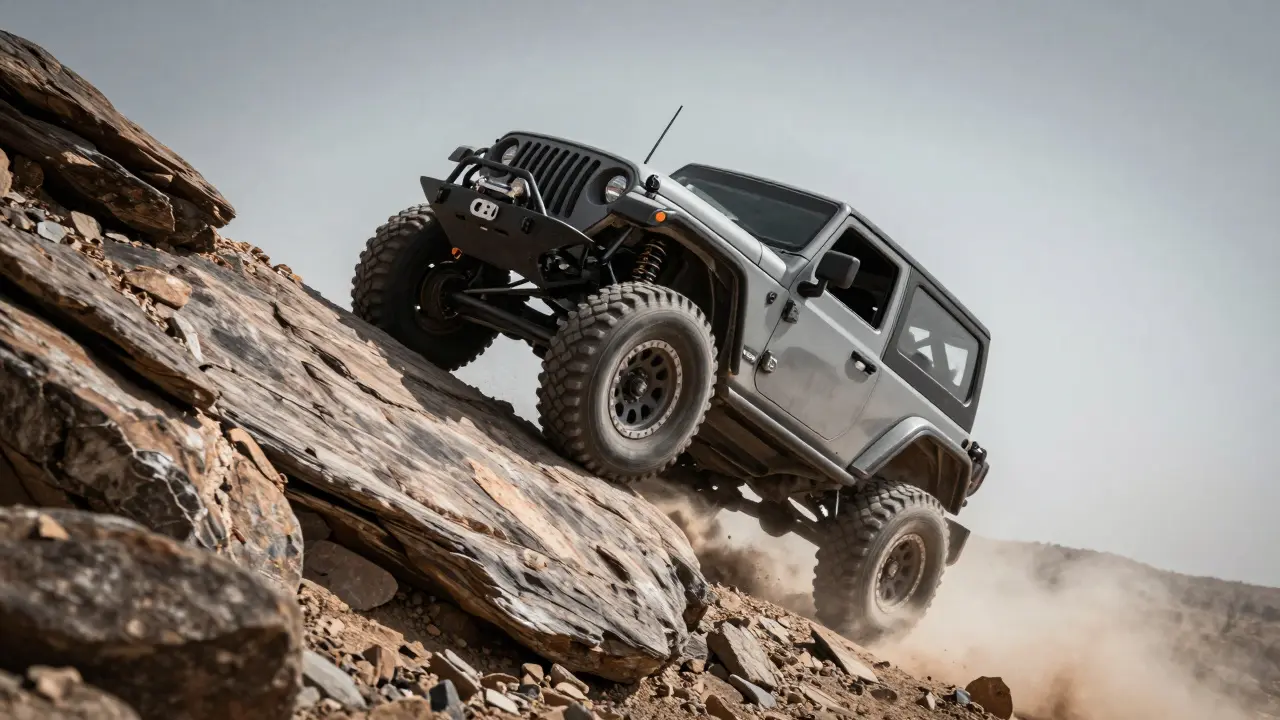
Trail riders don’t guess. They test. In Moab, the Rubicon Trail, and the Arizona desert, rigs with proven geometry dominate. The winners aren’t always the most expensive. They’re the ones with:
- Custom 4-link rear suspension with coilovers
- Front long arms with 30-degree angles
- Track bar mounted at frame level, not axle level
- Roll center measured at 3.8 inches above ground
One builder in Nevada modified a 2021 Ford Bronco Sport. Stock: 7 inches travel, 18-inch roll center. After mods: 15 inches travel, 4-inch roll center. Result? It cleared a 40-degree sidehill that the stock version couldn’t even approach. No winch. No lift. Just geometry.
That’s the power of understanding the math behind the motion. It’s not magic. It’s physics. And you can learn it.
Final Rule: Geometry Before Power
More engine, bigger tires, louder exhaust-none of that matters if your suspension can’t keep the tires on the ground. You can have 500 horsepower, but if your wheels lift on every bump, you’re not going anywhere.
Off-road isn’t about speed. It’s about control. And control comes from how your suspension moves, not how hard your engine pulls.
Build your rig with geometry first. Travel second. Articulation third. Roll center always. Everything else is just decoration.
Comments
Noel Dhiraj
This is the kind of post that makes me want to drop everything and rebuild my rig. Travel isn't just about how high you lift it, it's about how well it moves. I used to think bigger shocks = better, until I saw a stock Jeep with long arms outperform a lifted monster with short arms. Geometry wins every time.
March 3, 2026 at 14:52
Vimal Kumar
I've been running long arms on my Wrangler for two years now and I can't believe how much smoother the ride is. Not just over rocks, but even on dirt roads. The difference in articulation is night and day. People focus on lift height, but the real magic is in the control arm angles and track bar placement. You gotta think like an engineer, not a showroom buyer.
March 4, 2026 at 16:36
Amit Umarani
The article says 'travel isn't just about shock length' - technically correct, but the phrasing is awkward. It should be 'travel isn't solely determined by shock length.' Also, 'camber change' needs a hyphen: camber-change. Minor, but it matters.
March 4, 2026 at 21:43
vidhi patel
I find it alarming how casually this article dismisses the structural integrity risks associated with modifying suspension geometry. Without proper stress analysis and material certification, these modifications are essentially rolling death traps. The University of Michigan study cited? It's not peer-reviewed. I've seen three rollovers in the last year from exactly this kind of 'improvement.'
March 6, 2026 at 04:51
Diwakar Pandey
I tried a 4-inch lift with stock arms last year. Bad idea. The front end felt like it was trying to twist itself off the frame every time I hit a rut. After switching to long arms and dropping the track bar, the difference was like going from a shopping cart to a luxury sedan. No more death wobbles. Just smooth, predictable movement. I didn't even need new shocks.
March 6, 2026 at 20:27
Priti Yadav
They're not telling you the whole truth. The real reason they push long arms and low roll centers? Because the big suspension companies make more money off you rebuilding everything. They don't want you to know that a well-tuned stock setup with good tires can handle 90% of trails. This is all just marketing dressed up as science.
March 7, 2026 at 06:54
Ajit Kumar
It is imperative to underscore that the relationship between suspension travel, articulation, and roll center is not merely correlational but causally interdependent; that is to say, one cannot be optimized without deliberate, systematic recalibration of the others. Furthermore, the assertion that 'geometry dictates how far you can actually go before things break' is not only accurate but profoundly underappreciated in mainstream off-road discourse. One must not confuse aesthetics with engineering.
March 7, 2026 at 17:23
Geet Ramchandani
Oh wow, another one of these 'build your own rig' fantasy posts. Let me guess, you're the guy who spent $12k on a long-arm kit and still got stuck because you didn't account for tire flex. Real off-roaders don't need 14 inches of travel. They need common sense. And a winch. And maybe a better map. This article reads like a sales brochure for a company that sells spherical bearings.
March 9, 2026 at 05:41
Pooja Kalra
There's a deeper metaphysical layer here. Suspension geometry isn't just physics - it's a mirror of our relationship with the earth. When we force our machines to conform to nature's contours, we're not just engineering - we're listening. The wheel that stays planted isn't just gripping the rock - it's acknowledging its presence. The roll center isn't a point - it's a balance of ego and humility.
March 10, 2026 at 10:26
Sumit SM
I love this! So many people think off-roading is about power - but it's about precision! Geometry first! Travel second! Articulation third! Roll center always! And don't forget: if your track bar is mounted higher than your axle, you're not off-roading - you're performing a controlled crash! I've seen it! I've lived it! I've rebuilt it! And now I teach it!
March 12, 2026 at 04:55
Jen Deschambeault
This is exactly why I switched from a lifted Tacoma to a modified Bronco Sport. The stock setup was fine on pavement, but once I hit Moab, it felt like I was driving a brick. After lowering the roll center and installing long arms, I could take lines I never thought possible. No winch. No drama. Just smooth, confident control. It's not about how fast you go - it's about how calmly you handle the chaos.
March 13, 2026 at 12:39
Kayla Ellsworth
Funny how everyone here acts like this is some groundbreaking revelation. I've been doing this since 2008. The real secret? Don't go off-roading at all. Or if you must, stick to trails that don't require a $20k rebuild. Most of this 'geometry magic' is just people trying to justify spending their life savings on a hobby that 99% of the population will never use.
March 14, 2026 at 03:22