
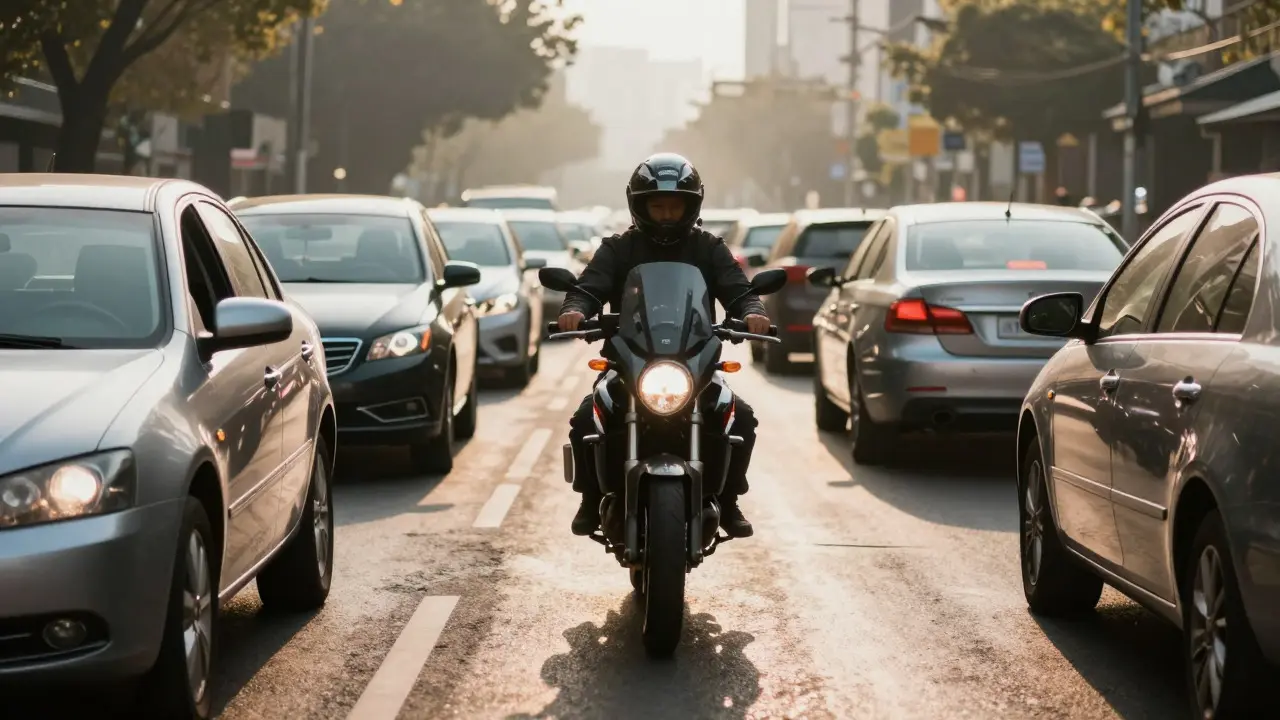
Stuck in bumper-to-bumper gridlock, your motorcycle is both your greatest asset and your biggest liability. While cars sit trapped in lanes, you have the option to move-but only if you know where to go and how much space you actually need. Defensive riding in dense urban environments isn't just about avoiding crashes; it's about maintaining constant mobility through precise spacing and pre-planned exits. The difference between a stressful crawl and a smooth flow often comes down to recognizing the invisible geometry of the road around you.
Key Takeaways
- Spacing is dynamic: Your following distance should adjust based on surface conditions and traffic speed, not just a fixed rule of thumb.
- Escape routes are proactive: Identify exit paths before you need them, focusing on gaps that allow you to merge without sudden braking.
- Visibility beats invisibility: In heavy traffic, being seen is safer than hiding in blind spots, even if it means occupying a full lane temporarily.
- Speed differential matters: Matching the flow of traffic reduces the risk of rear-end collisions more than maintaining high speed.
Understanding the Geometry of Traffic Flow
Traffic isn't static; it moves in pulses. When you ride in a city like Bristol, you notice that vehicles don't stop all at once. They create waves of compression and expansion. Understanding these waves helps you predict where gaps will open up. A common mistake riders make is assuming a gap behind a car means they can safely accelerate into it. Often, that gap is closing as the car ahead brakes. Instead, look two or three cars ahead. If the brake lights are illuminating further up the line, the wave is moving toward you. This early warning system gives you the crucial seconds needed to adjust your speed rather than reacting to an immediate stop.
The concept of lane discipline is critical here. Even when traffic is slow, staying centered in your lane provides the most predictable position for other drivers. Sudden lateral movements confuse car drivers who expect motorcycles to behave similarly to bicycles or pedestrians. By holding a consistent line, you become part of the expected pattern, reducing the cognitive load on surrounding drivers. This doesn't mean you can't change lanes; it means every lane change should be deliberate, signaled, and executed with a clear view of the destination gap.
Mastering Dynamic Spacing Techniques
The classic "two-second rule" is a starting point, but it fails in heavy traffic because reaction times shrink as speeds drop. At low speeds, you need less time to stop, but you need more awareness of nearby hazards. Consider this: at 10 mph, you need very little distance to stop. However, at 30 mph in congested areas, the margin for error shrinks dramatically due to the presence of cyclists and pedestrians who may enter the roadway unexpectedly.
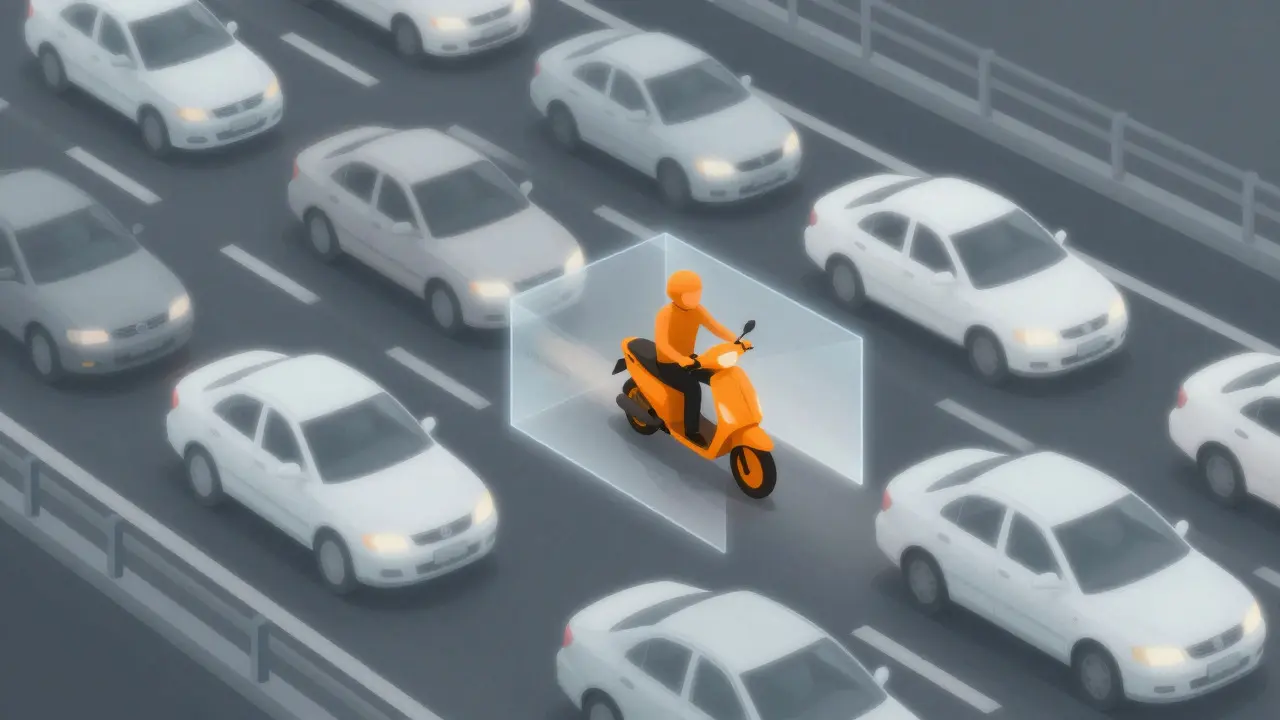
A more effective approach is the variable buffer zone. Imagine an invisible box around your motorcycle. In dry conditions with moderate traffic, keep a buffer of at least one second behind the vehicle ahead. In wet conditions, double that to two seconds. But the real key is the *lateral* buffer. Ensure there is enough space on both sides so that if the car next to you drifts over the line, you aren't immediately squeezed. This creates a safe corridor that allows you to maneuver if necessary without panic. Remember, your tires are your only connection to the road. If the surface is uneven or covered in oil, your stopping distance increases significantly. Always factor in the condition of the asphalt when setting your spacing.
| Condition | Dry Road | Wet Road | Gravel/Debris |
|---|---|---|---|
| Low Speed (Under 20 mph) | 1 second | 2 seconds | 3 seconds |
| Moderate Speed (20-40 mph) | 2 seconds | 4 seconds | 5+ seconds |
| High Speed (Over 40 mph) | 3 seconds | 6 seconds | 8+ seconds |
Identifying and Executing Escape Routes
An escape route isn't necessarily about leaving the road; it's about finding a path that keeps you moving when the main flow stalls. In multi-lane roads, the center lane often offers the best visibility and the fewest immediate threats from turning vehicles. However, in single-lane situations, you must look for alternative surfaces. Is there a bike lane? A wide shoulder? A parking bay that allows you to pull over briefly to let the queue pass?
When identifying these routes, scan the environment continuously. Look for:
- Turn-off gaps: Side streets or driveways where you can turn right (or left, depending on local rules) to bypass a jam.
- Lane changes: Gaps in adjacent lanes that allow you to shift position to avoid a specific hazard, like a pothole or a stopped bus.
- Pull-over zones: Safe areas to stop and wait for traffic to clear, rather than idling in the middle of the flow where you're vulnerable to side-swipes.
Managing Blind Spots and Driver Awareness
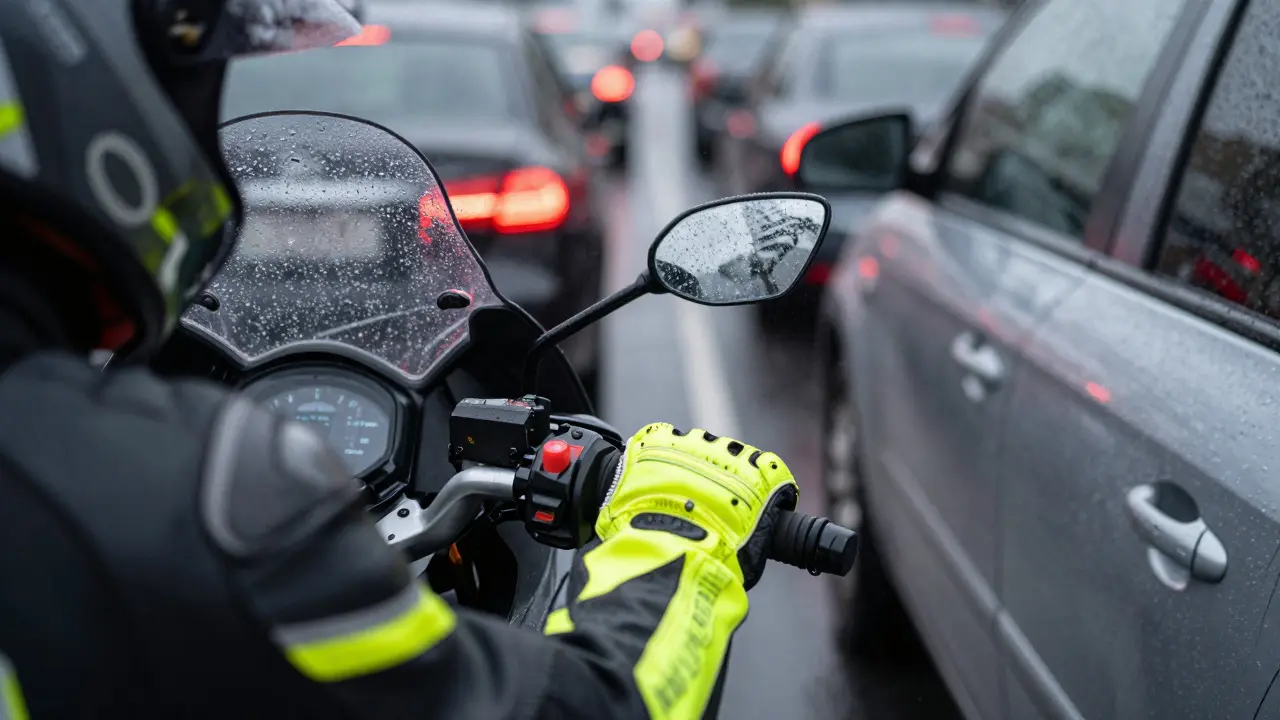
Heavy traffic amplifies the danger of blind spots. Car drivers often check their mirrors quickly and miss smaller objects like motorcycles. To counter this, position yourself where you are visible in the driver's direct line of sight, not just in the mirror. This usually means slightly ahead of the front wheel of the car next to you, or directly behind the center of the vehicle ahead.
Use your headlight and horn strategically. A quick tap of the horn can alert a driver who hasn't noticed you, especially during turns. Flashing your headlights can signal your intention to move forward or change lanes. These non-verbal cues bridge the communication gap between two different types of road users. Additionally, wear high-visibility gear. In the gray haze of rush hour traffic, bright colors cut through the visual noise and make you easier to spot from a distance. This simple measure significantly reduces the likelihood of being overlooked in tight spaces.
Practical Tips for Urban Riders
Riding in heavy traffic is a skill that improves with practice. Here are some actionable steps to enhance your safety:
- Practice scanning: Dedicate 10 minutes a day to observing traffic patterns in your area without riding. Note where bottlenecks form and how vehicles move through them.
- Simulate scenarios: In light traffic, practice changing lanes and adjusting speed to match the flow. Build muscle memory for smooth transitions.
- Check your equipment: Ensure your tires are properly inflated and your brakes are responsive. In heavy traffic, you rely on these systems far more than on open roads.
- Stay calm: Aggression leads to mistakes. Keep your hands relaxed on the bars and your breathing steady. Panic causes over-correction, which is dangerous in tight spaces.
Is lane splitting legal in the UK?
Yes, lane splitting is generally permitted in the UK, provided it is done safely and at a speed no greater than 30 mph. It is considered good practice if it allows you to filter through stationary or slow-moving traffic. However, always yield to larger vehicles and ensure you have sufficient space to maneuver safely.
How much following distance do I need in rain?
In rainy conditions, you should double your standard following distance. If you normally keep a two-second gap, increase it to four seconds. Wet roads reduce tire grip, increasing stopping distances significantly. Be extra cautious on painted lines, manhole covers, and metal plates, which become extremely slippery when wet.
What is the safest position in a lane?
The safest position is usually the center of the lane, slightly offset toward the side you intend to travel. This maximizes your visibility to drivers in adjacent lanes and provides space to maneuver around obstacles. Avoid riding directly behind the wheels of large vehicles, as this hides you from their view and exposes you to spray and debris.
How do I handle aggressive drivers in traffic?
Give them space and avoid eye contact. Aggressive drivers are often unpredictable. By maintaining a generous following distance and positioning yourself where they can see you clearly, you reduce the chance of conflict. Do not try to outmaneuver them; instead, use your escape routes to remove yourself from their path entirely.
Should I use my horn frequently in heavy traffic?
Use your horn sparingly and purposefully. A short, sharp blast can alert a driver who hasn't noticed you, especially during turns or lane changes. However, continuous honking can annoy other drivers and mask important auditory cues. Use it as a tool for communication, not frustration.
Comments
Brenna Gonedrman
Okay so listen up because this is actually really important and most people get it wrong! You think you are safe in the middle lane but that is a huge mistake if you do not check your mirrors constantly. The car to your left might just drift over without even looking at you. It happens all the time on the highway when traffic gets slow. You need to be ready to move fast or you will get clipped. Do not trust the drivers they are distracted by their phones. Keep your eyes on the road ahead and behind. If you see brake lights far away then start slowing down now. Do not wait until the last second to react. Your bike is light so it can stop faster than a truck. Use that advantage to stay out of trouble. Stay calm and keep your hands relaxed on the bars. Panic makes you jerk the handlebars which is bad. Just ride smooth and watch the waves of traffic. It is like surfing but with more danger. Trust me you will thank yourself later for paying attention.
August 28, 2026 at 22:29
Courtney Wagstaff
I love how you described the traffic waves, it’s like watching ink drop into water but slower. I’ve been riding for five years and still feel that little jolt of adrenaline when a big truck pulls up next to me. The sound of the engine alone changes the whole vibe of the street. Sometimes I just try to match the rhythm of the cars around me, like a dance step. It feels less aggressive that way. Also, the tip about high-vis gear is so true, I switched to a bright yellow jacket last winter and felt way safer. It’s amazing how much difference color makes in the gray morning fog. I used to hide in blind spots thinking I was being sneaky, but now I know visibility is king. Thanks for sharing these insights, they really resonate with my own experiences on the road.
August 30, 2026 at 00:15
Elisabeth Ballet
You guys need to stop being so passive about this! Get out there and practice your lane splitting skills right now! Don’t just read about it, go do it! Find a quiet street and drill those turns until they are muscle memory. Confidence comes from repetition, not just theory. If you are scared of a door opening, then you are not riding correctly. Speed is your friend if you control it properly. Stop letting fear dictate your route. Take charge of your space on the road. You have earned the right to move efficiently through traffic. Be bold but be smart. Check your blind spots twice before you commit to a move. Assertive riding saves lives. Don’t be an apologetic rider, be a confident one. Let’s go!
August 30, 2026 at 10:51
Joanna Mucha
One must consider the existential dread of the asphalt void. Is the gap truly open, or is it merely a mirage created by the collective delusion of other drivers? We are all just ghosts haunting the concrete rivers of our urban sprawl. The motorcycle is not a vehicle; it is a philosophical statement against stagnation. Yet, we cling to these arbitrary seconds of spacing as if they hold the key to salvation. Perhaps the true escape route is mental detachment from the chaos. But then again, gravity does not care for your metaphysical musings. It only cares for friction coefficients and tire tread depth. A tragic irony for the modern commuter seeking freedom in a cage of steel. One wonders if the driver in the SUV even sees us, or if we are merely part of his peripheral nightmare. The road is a canvas, and we are the smudges of paint that refuse to dry. Beautiful, isn't it? Terrifyingly so.
August 30, 2026 at 11:44
Bonnie Watt
Ugh another article telling us to be defensive riders. Honestly half the accidents happen because drivers are idiots who don't look. So what if you have perfect spacing? They won't check their mirror anyway. I've seen too many 'expert' advice columns that ignore the reality of human error. People drive like maniacs and expect you to save them with your two-second rule. It's not your job to fix their lack of attention. Just keep your head on a swivel and hope for the best. That's the real truth nobody wants to admit. Safety gear is the only thing that actually matters when things go south. Everything else is just wishful thinking dressed up in fancy language. Don't get too attached to these rules because the world is chaotic and unpredictable. Ride your own ride and let the chips fall where they may. That's how I survive.
September 1, 2026 at 03:00
Meagan Mueller
They are watching you. The cars aren't just stuck in traffic they are hunting you. Have you noticed how the trucks always seem to drift over when you are passing? It is not an accident. It is a coordinated effort to squeeze you off the road. The government wants you to buy a car so they can tax you more. Lane splitting is illegal in some states because they want to control your movement. Wear a helmet but also wear a body cam to catch them red handed. They will deny it but the evidence will speak for itself. Keep your eyes open for the hidden cameras on the light poles. They are tracking your speed and your position. This is why you need to be paranoid. Trust no one. Not the police not the other drivers. Only your own instincts. The conspiracy is deep but the truth is simple: they hate bikes. Fight back by staying visible and loud. Never let them make you invisible.
September 1, 2026 at 11:16
Dave Gibbeson
Good points. Focus on the lateral buffer. Most riders ignore side clearance. Keep a full car width if possible. Brakes matter more than throttle here. Check pads monthly. Tires need proper pressure. Cold tires grip less. Watch for oil spills near intersections. They are invisible until you hit them. Stay low center of gravity. Lean slightly into curves. Avoid sudden stops. Signal early. Give drivers time to react. Aggression kills. Patience wins. Keep your head moving. Scan ten seconds ahead. Predict the wave. Adjust speed early. Smooth inputs save your neck. Ride safe.
September 1, 2026 at 21:31
Sabrina Newland
i think its cool how you can feel the pulse of the city through the handlebars 🏍️✨ sometimes i wonder if the cars are alive too or just following a script 😅 the idea of an invisible box around your bike is kinda poetic isn't it? like a bubble of safety in a chaotic world 💫 i try to imagine each car as a character in a story and i am the narrator guiding them through the plot twists 📖🚗 it helps me stay calm when things get crazy. also typos happen when you are excited to share thoughts right? lol 😂 keep riding and keep dreaming out loud everyone! 🌟
September 3, 2026 at 14:37
Amara Akbar
It is worth noting that the psychological aspect of riding cannot be overstated. One must maintain a state of hyper-awareness without succumbing to anxiety. This balance is delicate but essential for long-term safety. The environment dictates the response, not the other way around. By observing the patterns of others, one gains insight into the flow. This knowledge empowers the rider to make informed decisions. Furthermore, the equipment must be inspected regularly. Negligence in maintenance leads to catastrophic failure. Therefore, discipline is the cornerstone of survival. Let us all strive for excellence in our craft. Respect the machine and the road. Together, we form a community of mindful travelers. May your journeys be smooth and your paths clear.
September 4, 2026 at 17:33
Mark Harvey
you got this bro. just keep your eyes up and your elbows in. dont stress about the small stuff. the big picture is what matters. stay loose and you will be fine. ride happy out there.
September 6, 2026 at 02:38
Art HND
Most of this is fluff. The real skill is knowing when to bail. Spacing is for amateurs. Pros read the room. Drivers are stupid. Accept it. Move on. Don't waste time analyzing waves. Just go. Or don't. Whatever. The road doesn't care about your feelings. It only cares about momentum. Stop overthinking it. You'll crash either way. Might as well enjoy the ride while it lasts. No point in pretending everything is under control. It never is. Just keep the throttle twisted and hope for the best. That's the honest truth. Nothing else matters.
September 7, 2026 at 16:50
Brandon Olvera
In America we respect personal freedom. That includes the freedom to choose your mode of transport. But we also respect the law. Lane splitting should be regulated properly. Too many reckless riders cause accidents. We need stricter enforcement. Our roads are built for cars. Bikes are a secondary option. Make sure you follow the rules. Don't put others at risk. Patriotism means doing your part. Keep the streets safe for everyone. That is the American way. Ride responsibly. Show pride in your country. Do not be a burden to society. Contribute to the greater good. That is what true citizens do. Stay focused and stay legal. That is the only way forward.
September 9, 2026 at 09:58
Elizabeth Brooks
hey did anyone else notice the table with the following distances? i thought it was super helpful to have those numbers laid out so clearly. i usually just guess based on how wet the road looks but having specific times for gravel vs dry is a game changer. also i totally agree with the bit about checking your tires. i almost blew out last week because i ignored the pressure warning light. glad i stopped before it got worse. thanks for putting this together it really helped me plan my next commute better. i feel more prepared now. keep up the good work sharing tips like these!
September 10, 2026 at 16:47