
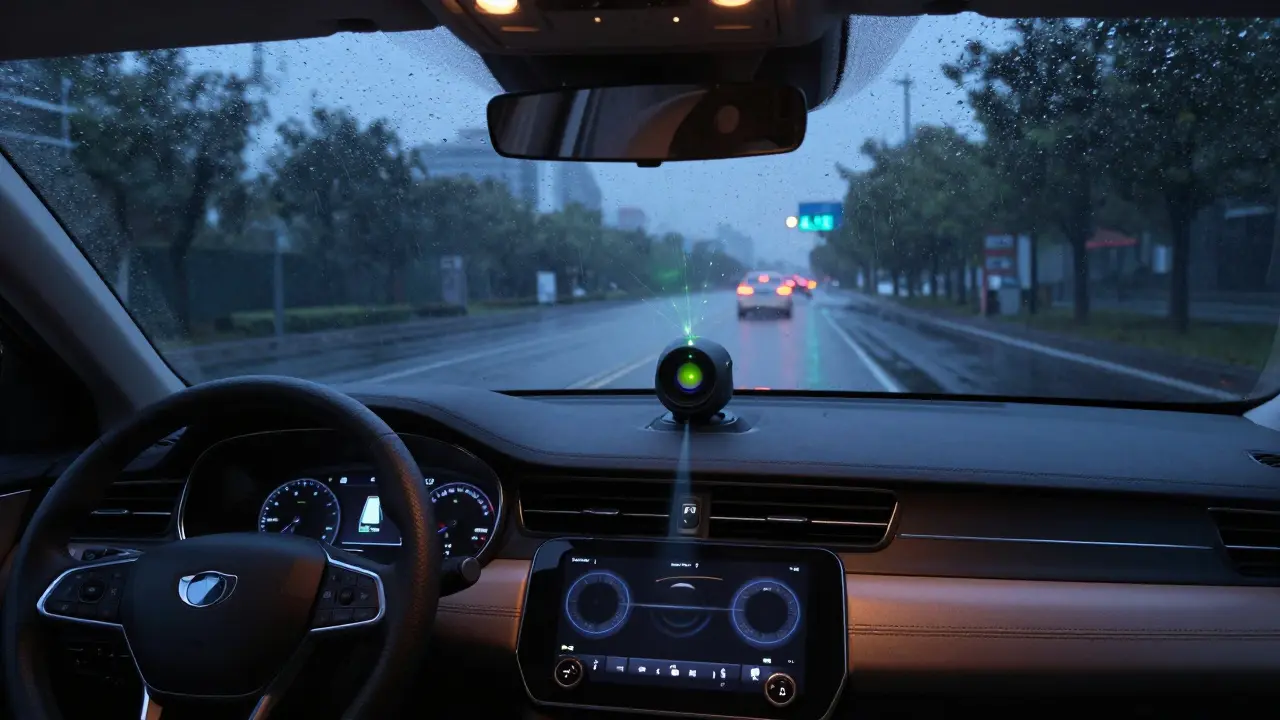
Modern cars don’t just drive-they see. Under the hood of today’s advanced vehicles, a quiet team of sensors works together to make driving safer, smoother, and sometimes even driverless. This team is called sensor fusion, and it’s the secret sauce behind features like automatic emergency braking, lane keeping, and adaptive cruise control. But how do cameras, radar, and LiDAR actually work together? And why can’t one sensor do it all?
Why One Sensor Isn’t Enough
Imagine trying to judge the distance to a car ahead of you in heavy rain. Your eyes blur. Your brain struggles. Now imagine that car is a robot, and its "eyes" are sensors. Each one has strengths and blind spots. A camera sees color and texture but goes blind in fog. Radar sees through rain but can’t tell if it’s a pedestrian or a plastic bag. LiDAR gives pinpoint accuracy but gets confused by snowflakes. That’s why automakers don’t pick one-they use all three.
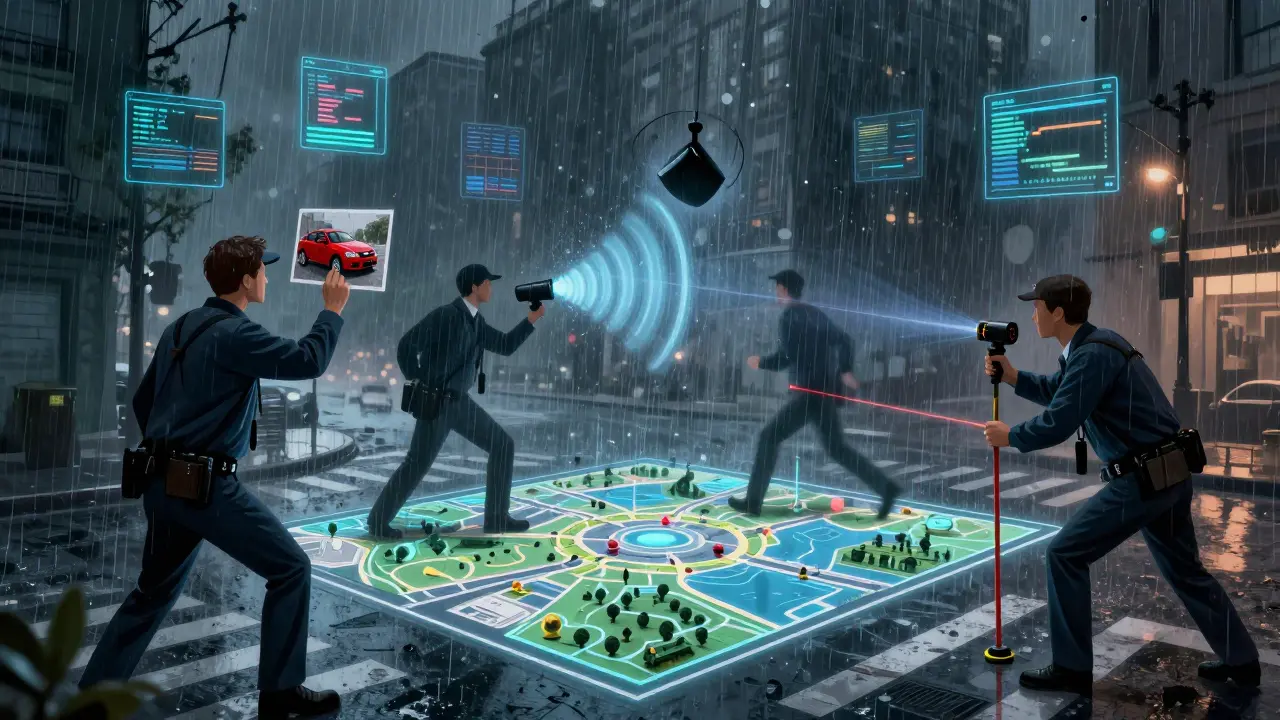
Think of sensor fusion like a team of detectives. One finds footprints (LiDAR), another hears a shout (radar), and a third spots a face in a security feed (camera). Alone, each clue is shaky. Together, they build a full picture. In cars, that picture is updated 20 times every second. Failures are rare because if one sensor glitches, the others compensate.
How Cameras Work in ADAS
Cameras are the most common sensors in new cars. They look like small lenses near the rearview mirror or grille. Most cars use multiple cameras-front, rear, and side-to create a 360-degree view. They capture color, texture, and detail: stop signs, lane markings, traffic lights, even a child’s red jacket.
But cameras have limits. Bright sunlight can blind them. Darkness? They need infrared lighting. Rain, snow, or dirt on the lens? Performance drops fast. That’s why camera-only systems often fail in bad weather. Still, they’re cheap, lightweight, and packed with data. A single camera can identify over 100 different objects-from a cyclist to a deer-using machine learning trained on millions of real-world images.
Companies like Tesla rely heavily on cameras. Their Autopilot system uses eight cameras and no LiDAR, betting that software can compensate for hardware limits. It works-mostly. But in tricky conditions, like tunnels or sudden glare, even Tesla’s system hesitates.
Radar: The All-Weather Workhorse
Radar has been around longer than most people realize. It’s not new tech-it’s been in airplanes and ships since WWII. In cars, radar sends out radio waves and listens for echoes. The time it takes to bounce back tells the system how far away something is. The change in frequency tells it how fast it’s moving.
That’s why radar is perfect for adaptive cruise control. It doesn’t care if it’s raining, foggy, or pitch black. It sees a car ahead, slows you down, and keeps a safe gap. Modern automotive radar operates at 77 GHz, which lets it detect small objects like motorcycles and even pedestrians. Some systems can spot a person walking into the road 150 meters away.
But radar has a downside: low resolution. It can’t tell if that blob ahead is a car, a truck, or a cardboard box. It sees shape and speed, not detail. That’s why radar never works alone. It teams up with cameras to answer: "Is that a person or just a shadow?"
LiDAR: The Laser Ruler of Cars
LiDAR stands for Light Detection and Ranging. It fires thousands of invisible laser pulses every second and maps the world in 3D. Think of it like a super-precise tape measure that scans everything around the car in real time.
LiDAR builds a point cloud-a digital model of the environment with millimeter accuracy. It can tell the difference between a curb and a pothole. It sees the exact shape of a parked truck. It maps trees, guardrails, and even the texture of road surfaces. That’s why many self-driving startups, like Waymo and Cruise, rely on LiDAR as their primary sensor.
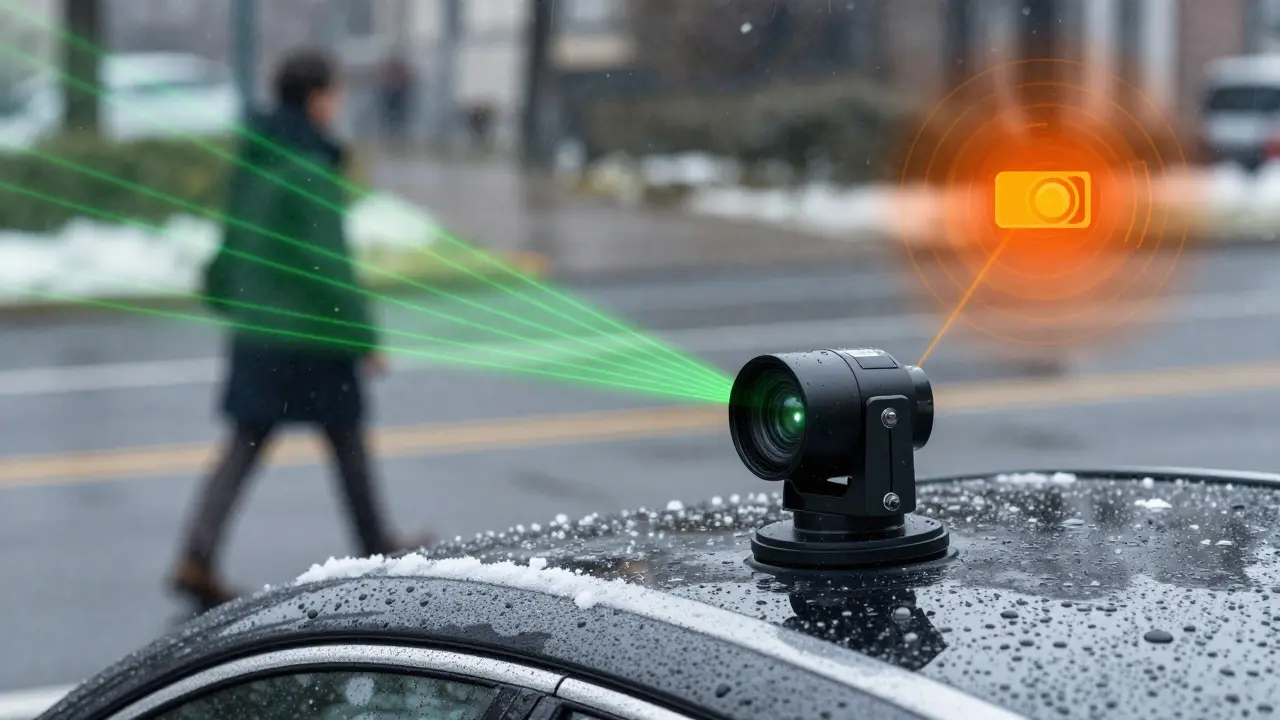
But LiDAR isn’t perfect. Heavy snow can scatter the laser beams. Dust or mud on the sensor? Performance drops. And until recently, LiDAR units were bulky and expensive. A single unit cost over $75,000. Today, solid-state LiDAR-no moving parts-has cut prices below $1,000. That’s why it’s now showing up in high-end SUVs like the BMW i7 and Mercedes S-Class.
How They Work Together
Here’s the real magic: sensor fusion doesn’t just use all three sensors-it combines their data into one unified view. The system doesn’t say, "Camera says there’s a car. Radar says there’s a car. LiDAR says there’s a car." It says, "There’s a white sedan, 42 meters ahead, moving at 58 km/h, with a height of 1.45 meters and a reflective surface consistent with metal and glass."
This fusion happens in real time using algorithms trained on millions of real-world driving scenarios. The system weighs each sensor’s confidence. If the camera sees a person but the radar doesn’t pick up a heat signature, it might ignore the visual cue. If radar says something is moving fast but the camera can’t see it, the system assumes it’s a false positive.
For example, when a car pulls out suddenly in front of you at an intersection:
- The camera spots the vehicle’s shape and color.
- The radar confirms its speed and distance.
- LiDAR maps its exact dimensions and position relative to the curb.
Together, they trigger automatic braking before you even react. No single sensor could do that reliably.
Real-World Performance: What Works and What Doesn’t
Not all systems are created equal. A $30,000 sedan with basic camera and radar might only handle highway cruise control. A $70,000 luxury SUV with triple-sensor fusion can navigate city streets, recognize traffic signs, and even park itself.
According to data from the Insurance Institute for Highway Safety (IIHS), vehicles with full sensor fusion systems have 50% fewer rear-end collisions than those with basic braking systems. That’s not a guess-it’s a 2024 study based on 1.2 million real crashes.
But even the best systems have blind spots. A parked truck with a reflective surface can confuse LiDAR. A child in a dark coat walking into the road at dusk might not show up clearly on radar. That’s why drivers still need to pay attention. Sensor fusion helps-it doesn’t replace you.
What’s Next? The Rise of AI and Redundancy
The next leap in sensor fusion isn’t just adding more sensors-it’s smarter software. New AI models can now predict where objects are going, not just where they are. If a cyclist swerves left, the system doesn’t just react-it anticipates.
Also, redundancy is becoming standard. High-end cars now include ultrasonic sensors, thermal cameras, and even GPS-aided inertial navigation. Some prototypes use radar and LiDAR from two different manufacturers to avoid single-point failures.
By 2027, most new cars sold in Europe and North America will have full sensor fusion. The goal isn’t just safety-it’s reliability. If one sensor fails, the system doesn’t shut down. It adapts. And that’s what makes modern ADAS more than a gimmick. It’s a lifeline.
Why This Matters for You
If you’re buying a new car, don’t just ask if it has "autonomous features." Ask: "Does it use camera, radar, and LiDAR together?"
Systems with all three sensors are more likely to work in rain, fog, and darkness. They’re less likely to miss a child crossing the street. They’re more trustworthy when you’re tired or distracted.
And if you’re already driving one? Don’t assume it’s flawless. Keep your hands on the wheel. Watch the road. Sensor fusion is there to help-not to replace your judgment.
Comments
Rubina Jadhav
This is so cool. I never thought about how sensors work together like this.
March 6, 2026 at 02:38
Raji viji
Tesla's camera-only system? Bro, that's just a gamble with lives. I've seen it freeze in tunnels like a glitchy PlayStation game. No LiDAR? No thanks.
March 6, 2026 at 03:02
Shivani Vaidya
The analogy of sensor fusion as a team of detectives is profoundly insightful. Each modality contributes a distinct epistemological layer-visual, spatial, and kinetic-allowing for a multidimensional understanding of the environment. This is not merely technological integration; it is epistemic symbiosis.
March 7, 2026 at 03:50
sumraa hussain
Radar in cars since WWII?? 😱 I thought it was some newfangled AI thing. Turns out our cars are basically flying bombers with cruise control. Also, LiDAR used to cost more than my entire apartment. Now it's cheaper than a good pair of noise-cancelling headphones. Wild.
March 8, 2026 at 11:39
Rajashree Iyer
We are not just building machines that see. We are building mirrors-reflecting humanity’s deepest fear: that we are not in control. And yet, we hand over our lives to algorithms trained on millions of images of children crossing roads. Who decides what a child looks like? Who coded the fear? The sensor doesn’t know. But we do.
March 9, 2026 at 02:40
Parth Haz
It's truly encouraging to see how sensor fusion is making roads safer for everyone. The data from IIHS speaks volumes. This isn’t science fiction anymore-it’s practical, life-saving engineering.
March 11, 2026 at 00:40
Vishal Bharadwaj
50% fewer crashes? Yeah right. You know how many times my cousin’s Prius hit a pole because it thought a plastic bag was a car? Sensor fusion my ass. It’s just a fancy way to make people lazy. And now they’re charging extra for it. Classic.
March 11, 2026 at 14:06
anoushka singh
Wait, so if I’m driving and my car sees a kid in a dark coat at dusk, it might not react? Like… why even have this then? I feel like I’m paying for a car that’s just… kinda trying?
March 13, 2026 at 05:19
Aryan Jain
They’re not trying to save lives. They’re trying to collect your data. Every laser pulse, every radar echo, every camera frame-it’s all being sent to a server somewhere. Soon, your car will know when you’re sad, when you’re speeding, when you’re texting. Welcome to the Panopticon, folks.
March 14, 2026 at 17:44
Nalini Venugopal
There’s a missing period after 'glass.' Also, 'km/h' should be spaced as 'km / h' in formal writing. Just saying. 🤓
March 15, 2026 at 17:52
Pramod Usdadiya
I live in Delhi. Our roads are chaos. Sensors? My tuk-tuk driver dodges cows, goats, and falling roof tiles better than any ADAS. But still… if this tech helps even one person, it’s worth it. 🙏
March 16, 2026 at 05:37
Aditya Singh Bisht
This is the future, and it’s already here. Don’t fear the tech-embrace it. Every time a sensor saves a life, it’s a win for humanity. Keep pushing forward. We’re building a safer world, one algorithm at a time. 💪
March 17, 2026 at 10:20
Agni Saucedo Medel
I love this! 🌟 Cameras + radar + LiDAR = like having 3 superpowered friends watching your back. So comforting. ❤️
March 18, 2026 at 16:51