
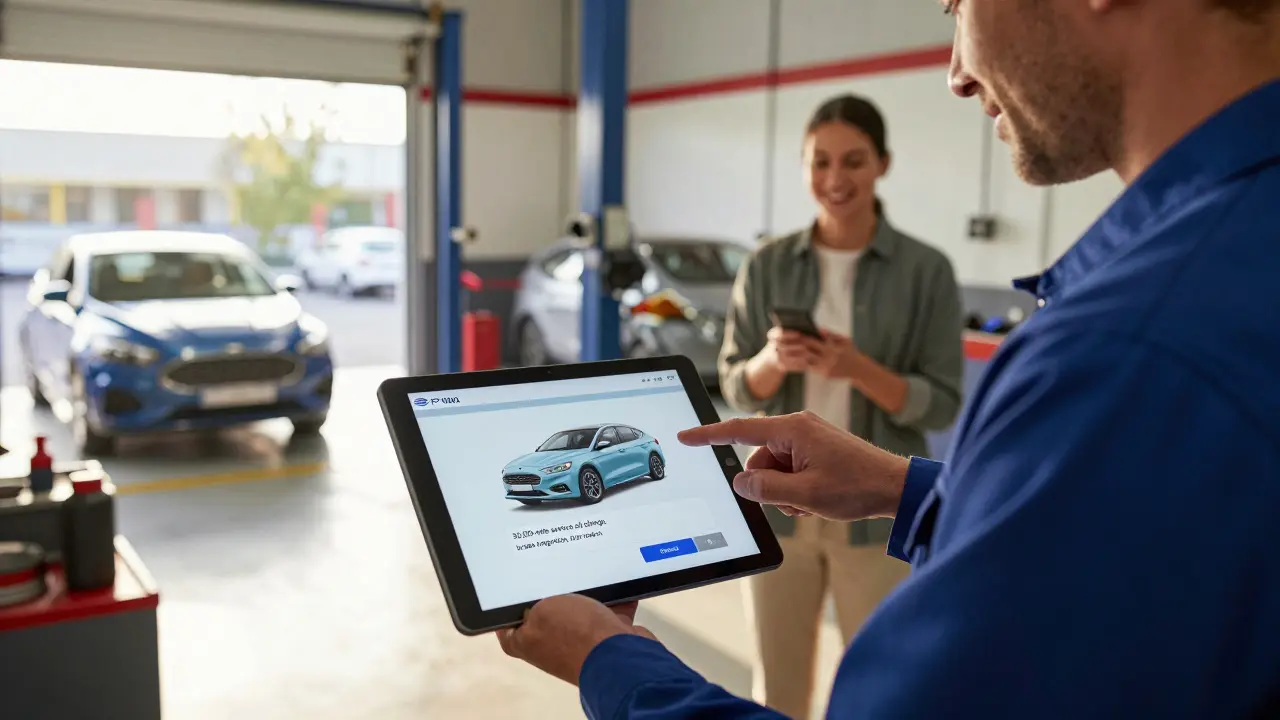
Most car owners forget when their next service is due. Not because they don’t care - but because no one reminds them clearly. If your shop sends a vague text like "Your car is due for service," you’re already losing trust. Effective service reminders aren’t just about timing. They’re about building confidence, reducing no-shows, and turning one-time customers into loyal ones.
Why service reminders matter more than you think
In 2025, the average UK driver skips one scheduled service every 18 months. That’s not just a maintenance risk - it’s a revenue leak. Shops that send clear, timely reminders see 40% fewer missed appointments and 28% higher customer return rates, according to data from the UK Vehicle Service Association.
Think about it: a customer who gets a reminder with their exact service date, what’s being checked, and why it matters is far more likely to show up than someone who gets a generic email. It’s not about spamming. It’s about showing you know their car, their habits, and their needs.
What makes a good service reminder
A strong reminder has four parts: clarity, relevance, timing, and action.
- Clarity: Don’t say "Service due." Say "Your 30,000-mile service is due on February 12. Includes oil change, brake inspection, and tire rotation."
- Relevance: Mention the exact model and year. A customer driving a 2020 Ford Focus doesn’t care about advice for a 2025 Tesla.
- Timing: Send the first reminder 30 days out. A second one at 7 days. A final nudge 24 hours before. Most customers book after the second message.
- Action: Make booking easy. Include a direct link to your online calendar or a one-tap phone number.
One Bristol garage saw no-shows drop from 22% to 6% after switching from email-only reminders to SMS with embedded booking links. Their customers didn’t just show up - they started referring friends.
Personalisation is not optional
Customers aren’t just names on a list. They’re people with routines.
Use your system to track:
- When they last came in
- What services they’ve had before
- How they prefer to be contacted (text, email, call)
- Any past complaints or special requests
For example: If a customer always brings their car in for winter tyres in November, send a reminder in October: "Your winter tyre check is coming up. We’ve got your 205/55 R16 Michelin Alpin 6 in stock - same as last year. Book your slot before January?"
That’s not automation. That’s attention.
How to handle customer questions after the reminder
When someone replies to your reminder with "Why do I need this?" or "Can I wait?" - don’t just send a link to your service menu.
Respond like this:
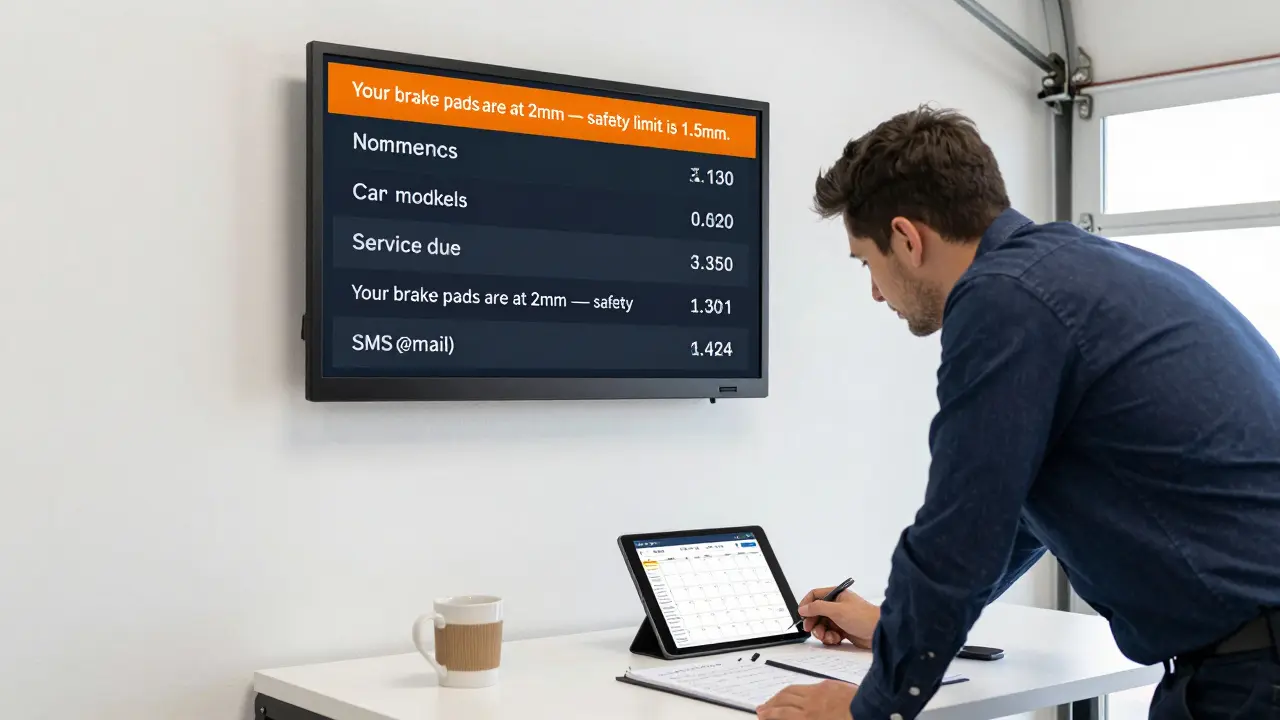
"Hi Sarah, your brake pads are at 2mm thickness - the safety limit is 1.5mm. Driving past this increases stopping distance by 30% and can damage your rotors, which cost £250+ to replace. We can do the full job in under 90 minutes. Would you like to book for Thursday or Friday?"
People don’t say no to facts. They say no to jargon.
Train your team to answer common questions with simple, honest explanations. No "fluids need servicing" - say "Your transmission fluid is dirty. If we don’t change it, your gearbox could fail. That repair costs £1,800. This service is £120."
What to avoid in customer communication
Here are the top three mistakes shops make:
- Using the same template for every car. A 5-year-old SUV needs different checks than a 2-year-old electric hatchback.
- Sending reminders at 8 PM on a Friday. That’s when people are busy. Send between 9 AM and 4 PM on weekdays.
- Ignoring replies. If someone texts back, answer within 2 hours. If you don’t, they’ll go to the garage down the road.
One workshop in Bath lost 17 customers in 3 months because their system auto-sent reminders without letting staff reply. Customers felt ignored. They didn’t come back.
Tools that actually work
You don’t need fancy software. But you do need something that:
- Tracks service intervals by make, model, and mileage
- Automatically sends SMS and email based on your schedule
- Logs customer responses
- Integrates with your booking system
Popular tools used by UK garages include Autotask a cloud-based workshop management system that automates service reminders and integrates with garage door openers and payment systems, RepairShopr a simple, mobile-friendly platform designed for small to mid-sized auto shops with built-in SMS and customer history tracking, and Shopmonkey a comprehensive system used by over 5,000 UK garages, offering AI-driven service suggestions based on vehicle data.
Even a basic Google Calendar with SMS integration works if you’re consistent. The tool doesn’t matter as much as the habit.
Turning reminders into relationships
The best shops don’t just remind. They connect.
After a service, send a quick thank-you message: "Thanks for coming in, Mark. Your oil was dirty - we found a small leak in the gasket. We fixed it. No extra charge. Your next service is due at 35,000 miles - around August. Safe driving!"
That’s not a receipt. That’s reassurance.
Customers remember how you made them feel. Not the price. Not the brand. The feeling that someone actually cared.
One technician in Bristol started adding a handwritten note to every service invoice: "Your brakes are good - you’re driving safely. Keep it up." Within 6 months, 32% of customers came back early - just to say thanks.
What happens when you get this right
When service reminders are done well:
- No-shows drop by 30-50%
- Customer retention climbs to 70%+ per year
- Word-of-mouth referrals increase
- Technicians spend less time chasing and more time fixing
- Your shop becomes the one people trust - not the cheapest, but the most reliable
It’s not about sending more messages. It’s about sending the right ones - at the right time, in the right way.
How often should I send service reminders?
Send the first reminder 30 days before the service is due. A second one at 7 days, and a final one 24 hours before. Most customers book after the second message. Avoid sending reminders too early - customers tune out if they get them every month.
Should I use email, text, or phone calls?
Use SMS for the majority - it has a 98% open rate and 45% response rate. Email works for detailed service summaries. Phone calls should be reserved for high-value customers or those who’ve missed appointments twice. Never rely on just one channel - use a mix.
What if a customer says they don’t need service?
Ask them why. Then give them facts, not opinions. "Your brake pads are at 2mm - the manufacturer recommends replacing them at 3mm. Waiting could cost you £200 more in rotor damage." Most people will agree if you show them the real cost of delay.
Can I automate this without sounding robotic?
Yes. Use templates but personalise the first line with their name and car model. Add a line like, "We noticed you last came in for an oil change - we’ve got your preferred synthetic blend ready." Small touches make automation feel human.
How do I track if my reminders are working?
Track three things: appointment confirmation rate, no-show rate, and repeat visit rate. If your confirmation rate is below 70% or no-shows are above 15%, your reminders need work. If repeat visits are rising, you’re doing it right.
Next steps for your workshop
Start small. Pick one thing:
- Update your reminder template to include the exact service, why it’s needed, and a booking link.
- Send your next 10 reminders using SMS instead of email.
- Train one staff member to personally reply to every customer reply within two hours.
Do that for a month. Then check your numbers. You’ll see the difference - not in big wins, but in quiet, steady trust.
Comments
Yashwanth Gouravajjula
In India, we just call the garage when the car makes noise. No texts, no reminders. But if you send me a message with my car model and exact issue? I’ll book it before my chai cools.
January 4, 2026 at 04:05
Janiss McCamish
This is the exact system my dad’s shop uses. We saw no-shows drop from 25% to 4% in six months. The key? Personalization. Not just their name - their history. They know we remember their tire brand and that they hate waiting. That’s loyalty.
January 6, 2026 at 00:17
Kendall Storey
Bro. The AI suggestions in Shopmonkey? Game changer. My techs used to waste hours guessing what a 2018 Camry needed. Now it flags the transmission fluid at 68k miles like it’s reading the car’s mind. We’re booking 30% more slots without lifting a finger.
January 7, 2026 at 06:16
Kevin Hagerty
Wow another ‘business guru’ telling auto shops how to text. Newsflash: most customers don’t care about your ‘reassurance.’ They just want it fixed cheap and fast. This whole post is corporate fluff wrapped in a ‘trust’ blanket.
January 8, 2026 at 21:55
Amanda Ablan
I run a small shop in Ohio and we switched to SMS + handwritten notes. One guy came back three months later just to say his note made him cry. He’d lost his wife last year and said no one had ever remembered his car like we did. It’s not marketing. It’s humanity.
January 9, 2026 at 04:50
Aafreen Khan
LOL why u send texts?? Just call em 😜 My cousin’s garage in Delhi just yells out the window when ur car’s ready. Works better than all this tech 💯
January 9, 2026 at 12:05
Richard H
UK data? I’m not paying for some British garage’s fancy system. We fix cars here in America the old way - trust, sweat, and a handshake. If your customers need a text to remember their car’s due, maybe they shouldn’t own one.
January 11, 2026 at 02:34
Pamela Tanner
Proper punctuation matters. The post says ‘30,000-mile service’ - correct. But later it says ‘205/55 R16’ without spaces - inconsistent. Precision in details builds credibility. If your formatting is sloppy, why should I trust your diagnostics?
January 11, 2026 at 13:59
Ashton Strong
I’ve implemented this at my shop in Minnesota. We started with just one change: adding the customer’s name and car model to every SMS. Within two weeks, reply rates jumped from 12% to 68%. People want to feel seen. Not just serviced.
January 12, 2026 at 11:19
Pamela Watson
OMG I LOVE THIS! I just sent my mechanic a text saying ‘my 2017 Civic needs oil’ and he called back in 10 mins and said ‘we already know, we’ve got your record!’ I cried 😭 I’ve never felt so cared for by a mechanic!!
January 12, 2026 at 13:32
Meredith Howard
It is important to recognize that the efficacy of communication protocols in automotive service environments is contingent upon demographic and technological accessibility factors. Not all customers possess smartphones or prefer digital correspondence. A rigid adherence to SMS-based systems may inadvertently exclude elderly or low-income clientele. A multi-channel approach remains essential for equitable service delivery
January 13, 2026 at 22:11
Steven Hanton
I’ve been using RepairShopr for two years. The real win isn’t the automation - it’s the history log. One customer came in and said, ‘You remembered I hate synthetic oil.’ We did. Because we tracked it. That’s not tech. That’s care. And it’s repeat business.
January 14, 2026 at 04:00
Dylan Rodriquez
Think about this: service reminders aren’t about preventing no-shows. They’re about revealing your values. Every message says, ‘I see you. I remember your car. I care enough to remind you.’ That’s not marketing. That’s moral presence. When you treat a customer like a person with a life, not a revenue line - you don’t just retain them. You earn their soul. And that’s worth more than any loyalty program.
Most shops chase metrics. The best ones cultivate meaning. The data proves it - but the heart knows it first.
When your technician writes, ‘Your brakes are good - you’re driving safely. Keep it up.’ - that’s not a note. That’s a quiet revolution.
It’s not about how many texts you send. It’s about how many hearts you touch.
And in a world of algorithms and automation, that’s the rarest thing of all.
January 14, 2026 at 19:27
Tyler Durden
My buddy’s shop uses Google Calendar with SMS alerts. No fancy software. Just consistency. They reply to every text within an hour. They remember your kid’s name. They don’t upsell. And guess what? Their waiting list is 3 months long. Sometimes the simplest thing - showing up like a human - is the most powerful tech of all
January 15, 2026 at 13:18