
The Great Confusion: What Are We Actually Talking About?
Walking into a car dealership today is a bit like entering a hall of mirrors. You see a vehicle that looks like a big boxy truck, and the salesperson calls it a crossover. Then you see one that looks almost identical, and they call it an SUV. For most of us, these terms have become interchangeable, but under the metal, they are fundamentally different machines. If you're picking a car for a daily commute, a weekend camping trip, or hauling a growing family, picking the wrong one could mean wasting thousands on towing capacity you'll never use or struggling to park in a standard city garage.
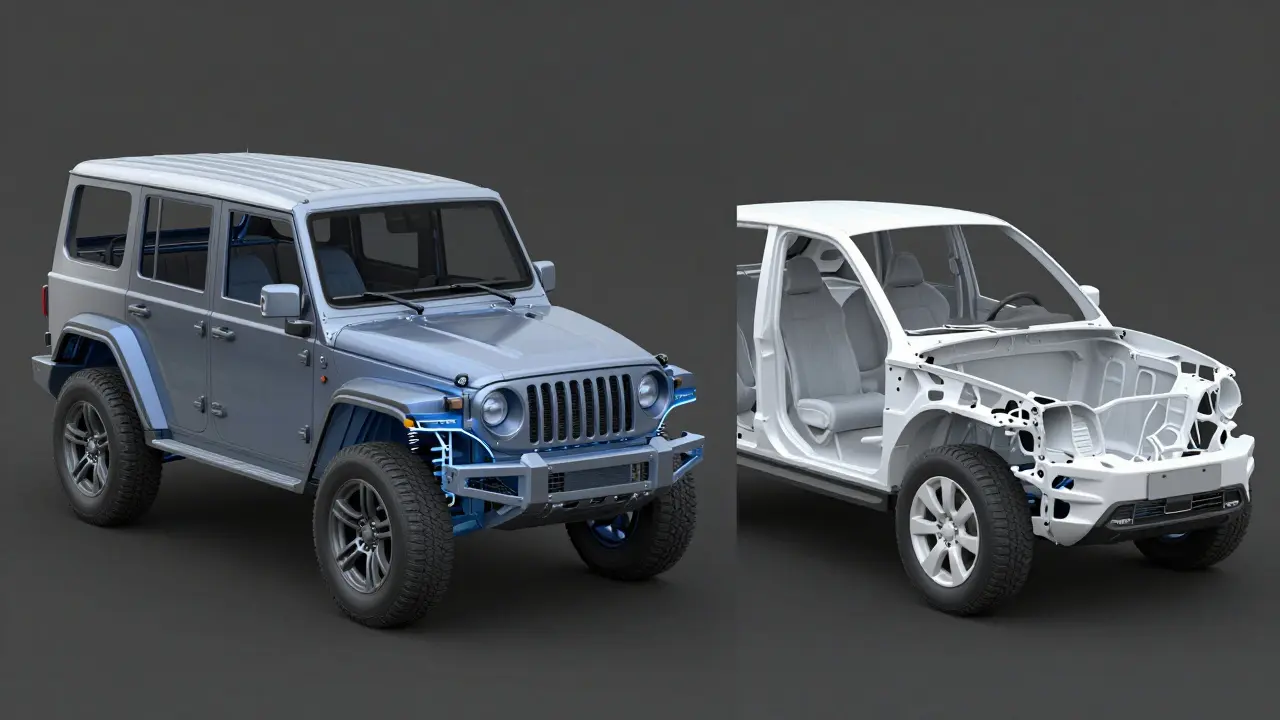
The core of the debate isn't about the shape of the car-it's about the chassis. A SUV is Sport Utility Vehicle, traditionally built using body-on-frame construction, which means the body is bolted onto a rigid steel frame. This is the same way we build heavy-duty pickup trucks. On the flip side, a Crossover (or CUV) is a vehicle built using unibody construction, where the chassis and the body are manufactured as a single, integrated piece. This is essentially a scaled-up version of a sedan or hatchback.
SUV vs Crossover differences aren't just technical jargon for engineers; they dictate how the car handles a corner, how much gas it gulps, and whether it can actually pull a boat out of the water without shaking apart.
The Quick Breakdown: What Matters Most
| Feature | Traditional SUV | Crossover (CUV) |
|---|---|---|
| Chassis Type | Body-on-Frame | Unibody |
| Drivetrain | Often 4WD (Low/High range) | Usually AWD or FWD |
| Towing Capacity | High (5,000 - 12,000+ lbs) | Low to Moderate (1,500 - 5,000 lbs) |
| Fuel Efficiency | Lower (Heavier weight) | Higher (Lighter weight) |
| Ride Quality | Truck-like, stiffer | Car-like, smoother |
The Heavy Lifter: Understanding the Traditional SUV
When people talk about "real" SUVs, they are usually referring to Body-on-Frame construction. Think of a Chevrolet Tahoe or a Ford Expedition. These vehicles start with a ladder-like steel frame, and the cabin is placed on top. This design is an evolutionary descendant of the Light Truck.
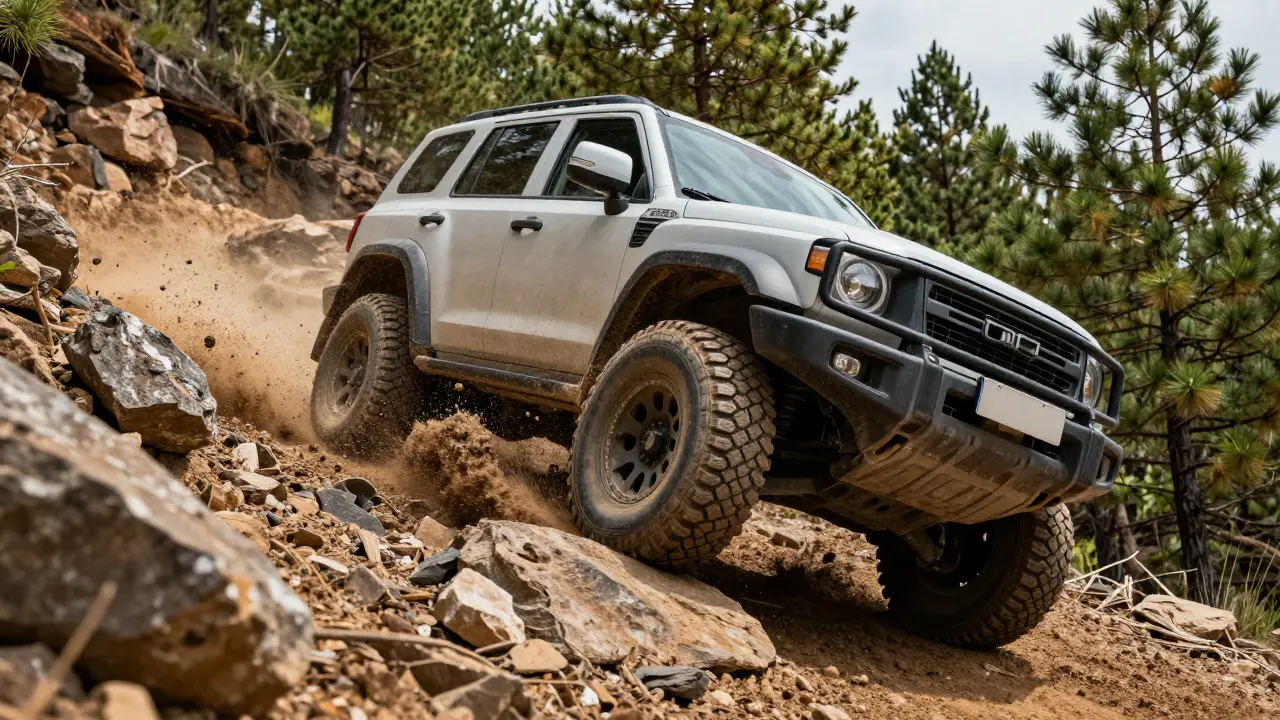
Why would you want this? Because it's nearly indestructible. If you're driving through a rocky trail or hauling a heavy horse trailer, the frame absorbs the stress, preventing the body of the car from twisting or warping. These vehicles typically feature Four-Wheel Drive (4WD) systems with a "low range" gear, which provides massive torque for crawling over obstacles or getting unstuck from deep mud.
However, there's a trade-off. The weight of that steel frame makes the car feel bulky. You'll notice a larger turning radius, meaning you might need a three-point turn to get out of a tight parking spot. The center of gravity is also higher, which makes them lean more in corners. If you've ever felt like you were piloting a boat rather than a car while taking a highway off-ramp, you were likely in a traditional SUV.
The Urban Chameleon: The Rise of the Crossover
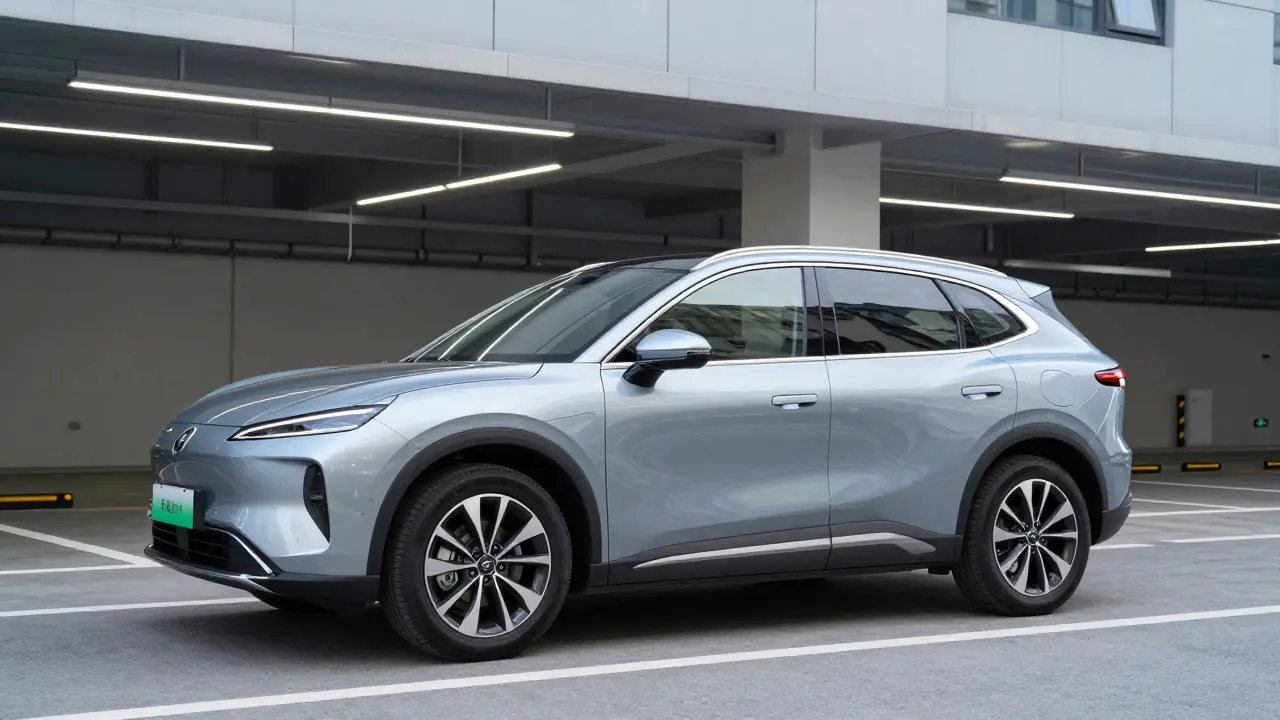
The crossover was born because most people want the *look* of an SUV without the *burden* of a truck. By using Unibody Construction, manufacturers can create a vehicle that is lighter, safer, and significantly more fuel-efficient. A great example is the Honda CR-V or the Toyota RAV4.
Because the frame and body are one, the vehicle is more rigid in a way that improves handling. The suspension is tuned for comfort, and the braking is more responsive. Most crossovers use All-Wheel Drive (AWD), which is a computer-controlled system that sends power to the wheels that have the most grip. It's perfect for a rainy highway or a snowy driveway, but it will struggle if you try to take it on a serious off-road trail.
The magic of the crossover is the space. You get the high seating position (the "command view") and plenty of legroom for kids, but you can park it in a standard garage without breaking a sweat. For the average driver who spends 95% of their time on pavement, the crossover is the logical choice. It's the bridge between a compact sedan and a full-sized truck.
Comparing the Drive: Handling and Performance
Imagine you're driving through a winding road in the mountains. In a crossover, the car feels planted. You can steer into a curve with confidence because the unibody design lowers the center of gravity. It behaves like a tall wagon. The steering is usually electric-assisted and light, making city driving effortless.
Now, put yourself in a traditional SUV. You'll feel the weight of the engine and the frame. The steering might feel a bit looser, and you'll feel the body "roll" as you turn. But once you hit the dirt road leading to that mountain cabin, the SUV wins. While the crossover might bottom out or struggle with a steep incline, the SUV's heavy-duty suspension and 4WD system just keep pushing forward. It's the difference between a sneaker and a hiking boot; both are shoes, but you wouldn't want to climb a mountain in the former.
Towing, Payload, and the Reality of Utility
This is where the divide becomes most apparent. If your "utility" means carrying groceries and a few suitcases, a crossover is plenty. Most crossovers can handle a small utility trailer or a couple of jet skis, but pushing them beyond 3,000 pounds often puts a strain on the transmission.
Traditional SUVs are designed for work. If you need to tow a 7,000-pound boat or a camper, you need a body-on-frame vehicle. The steel rails can handle the downward pressure of a heavy tongue weight without bending. Additionally, the payload-the total weight of passengers and cargo-is significantly higher. If you're regularly filling seven seats with adults and luggage, the structural integrity of a full-sized SUV ensures the vehicle doesn't sag or handle unpredictably under the load.
Fuel Economy and Long-Term Costs
Let's be honest: traditional SUVs are thirsty. The sheer mass of the frame and the friction of a permanent 4WD system mean you'll be visiting the gas station more often. Even with modern V8s or turbocharged engines, the aerodynamics of a "brick'" shape combined with heavy weight kills the MPG.
Crossovers, especially the newer Hybrid models, are vastly more efficient. Because they are lighter and more aerodynamic, they glide through the air better. Over five years of ownership, the difference in fuel costs between a mid-size crossover and a full-size SUV can easily run into the thousands of dollars.
Maintenance also differs. Traditional SUVs have more heavy-duty components to maintain-transfer cases, differentials, and heavier suspension parts. Crossovers generally follow a maintenance schedule similar to a standard car, making them cheaper to keep on the road over the long haul.
Which One Fits Your Life?
The decision usually comes down to a few specific questions. Do you actually tow things that weigh more than 3,000 pounds? Do you spend your weekends in the wilderness or in a suburban shopping mall? Do you have a garage that can actually fit a 200-inch vehicle?
If you're a weekend warrior who loves overlanding, hauling a boat, or needs to move a crew of eight people across the state, the traditional SUV is your tool. It's a piece of equipment designed for toughness. If you want a safe, roomy family car that's easy to park, doesn't bankrupt you at the pump, and handles like a normal car, the crossover is the way to go. The industry has shifted toward crossovers for a reason-they satisfy 90% of what the average person actually needs from a "sport utility" vehicle.
Can a crossover be 4WD?
Technically, most crossovers use All-Wheel Drive (AWD) rather than true Four-Wheel Drive (4WD). AWD is automatic and adjusts power between wheels on the fly. True 4WD, found in traditional SUVs, allows the driver to lock the axles together and often includes a low-range gear for extreme off-roading. While some crossovers market "rough road" modes, they lack the heavy-duty hardware of a 4WD system.
Are crossovers safer than SUVs in crashes?
In many cases, yes. Unibody construction allows engineers to build "crumple zones" more effectively. These zones are designed to collapse in a controlled way to absorb the energy of an impact, protecting the passengers. Traditional body-on-frame SUVs are very strong, but because the frame is so rigid, more of the impact energy can be transferred directly to the occupants.
Which one holds its value better?
It depends on the market. Full-size SUVs (like the Toyota Sequoia or Chevy Suburban) tend to hold their value incredibly well because there are fewer alternatives for people who truly need that towing capacity. However, compact crossovers are in such high demand that they also maintain high resale values. Generally, the more "specialized" the vehicle (like a heavy-duty SUV), the more it's coveted in the used market.
Will a crossover work for light off-roading?
Absolutely. If your idea of off-roading is a gravel road to a trailhead or a snowy driveway, a crossover with AWD is more than enough. Just avoid deep mud, large boulders, or steep river crossings. Crossovers have lower ground clearance and lack the skid plates and locking differentials needed for technical terrain.
Why are they both called SUVs in ads?
Marketing. "SUV" sounds adventurous, rugged, and capable. Calling a vehicle a "Tall Wagon" or a "Unibody Crossover" doesn't sell as many units. Car companies use the term SUV as a broad category to appeal to the image of utility and freedom, even if the vehicle is essentially a lifted hatchback.