
When you run a business in the UK, every pound you spend on a vehicle matters-not just for operations, but for your tax bill. Choosing between leasing and buying a car isn’t just about monthly payments or mileage limits. It’s about how much you can legally deduct from your taxable income. And the difference can be thousands of pounds a year.
Leasing: Deducting the Full Monthly Payment
If you lease a car for business use, you can usually claim the full monthly lease payment as a business expense. That’s it. No depreciation schedules, no capital allowances to calculate. Just subtract the lease cost from your profits, and your tax bill drops.
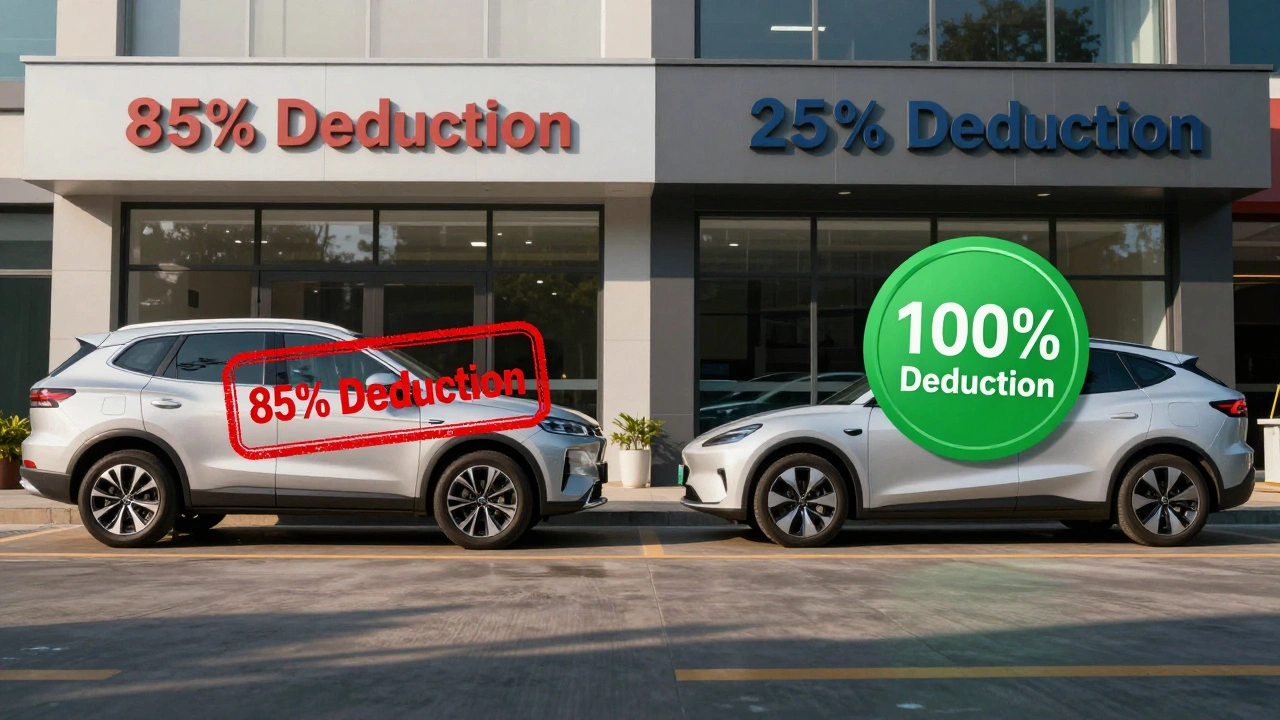
But there’s a catch: if the car emits more than 50g/km of CO₂, HMRC limits your deduction. For cars with emissions above that threshold, you can only claim 85% of the lease cost. The remaining 15% is disallowed. For example, if your monthly lease is £400, you can only deduct £340 per month if the car emits 120g/km. That’s £1,020 less in deductions per year.
On the flip side, if your leased car emits 50g/km or less-like a Tesla Model 3, Nissan Leaf, or Hyundai Ioniq 5-you can claim 100% of the lease cost. No limits. No reductions. That’s why many small businesses are switching to electric vehicles: not just for the environment, but for the tax break.
Also, remember that any personal use of the leased car must be tracked. If you use it for private trips, you’ll need to report a Benefit-in-Kind (BiK) on your personal tax return. But for the business, the deduction stays intact as long as the vehicle is primarily used for work.
Buying: Capital Allowances and Writing Down Allowances
When you buy a car outright, you don’t get to deduct the full price in one go. Instead, you claim capital allowances through the Annual Investment Allowance (AIA) or Writing Down Allowance (WDA).
Here’s how it works: if the car you buy emits 50g/km or less of CO₂, you qualify for a 100% First-Year Allowance. That means you can write off the entire cost in the year you purchase it. A £30,000 electric van? You deduct £30,000 from your profits. Your taxable profit drops by that amount. Simple.
But if the car emits more than 50g/km, you’re stuck with the Writing Down Allowance. That’s 6% per year on a reducing balance. So if you buy a £25,000 petrol SUV, you can only claim £1,500 in the first year, £1,410 in the second, £1,325 in the third, and so on. It takes over 15 years to fully write off the cost. Meanwhile, a leased car with the same emissions would let you deduct the full monthly payment every single month.
And here’s the kicker: if you buy a car and use it for both business and personal trips, you must apportion the capital allowance. If you drive it 70% for business, you can only claim 70% of the allowance. Leasing doesn’t require this split for the business expense-only for your personal BiK.
What About Fuel and Maintenance?
Both leasing and buying let you claim fuel and maintenance as business expenses-but only the business portion.
If you lease, your maintenance package is usually included. That’s a bonus. You don’t need to track oil changes or tyre replacements separately. The lease payment covers it, and you deduct the full amount (subject to emissions rules).
If you buy, you pay for repairs and fuel yourself. Keep every receipt. You can claim 100% of fuel used for business trips, but you must either:
- Track every business mile and claim the HMRC-approved rate (currently 45p per mile for the first 10,000 miles, then 25p after), or
- Claim actual fuel costs, but only for business use, and prove it with logs.
Most small business owners find the mileage rate easier. No receipts needed. Just a logbook. HMRC accepts it if you’ve recorded dates, destinations, and purposes for each trip.
Insurance, Tax, and Other Costs
Business insurance, road tax (VED), and breakdown cover? All deductible. Whether you lease or buy, you can claim these as business expenses.
But here’s where people get tripped up: if you lease, the insurance is often included in the monthly payment. That’s fine-you still deduct the full amount. If you buy, you pay insurance separately. As long as it’s a business vehicle, you deduct it.
Don’t forget vehicle excise duty. For cars registered after April 2017, the first-year rate depends on CO₂ emissions. After that, it’s a flat annual fee unless it’s zero-emission. Zero-emission cars pay £0 in VED. That’s another £150-£500 saved per year.
Which Option Saves More Tax?
Let’s compare two scenarios, both with a £30,000 vehicle used 80% for business.
| Option | Annual Deduction (50g/km or less) | Annual Deduction (120g/km) |
|---|---|---|
| Lease (monthly £500) | £6,000 (100%) | £5,100 (85%) |
| Buy (100% AIA) | £30,000 (first year) | £1,800 (6% WDA) |
| Buy (WDA over 5 years) | N/A | £1,800/year for 15+ years |
For a low-emission car, buying wins big in Year 1. You get £30,000 off your profits. That could knock your tax bill down by £6,000-£12,000, depending on your rate. But if you’re a sole trader or partner in a partnership, you might not have enough profit to use the full allowance in one year. In that case, leasing gives you steady, predictable deductions every month.
For a high-emission car, leasing is almost always better. The £5,100 annual deduction from a lease beats the £1,800 from WDA. And you get it every year, not just for 15 years. Plus, you can upgrade every 2-3 years. Buying locks you into a depreciating asset.
When to Choose Leasing
- You want predictable monthly costs
- You drive a lot and want maintenance included
- You prefer to upgrade cars every 2-3 years
- Your business doesn’t have enough profit to use a large capital allowance in one year
- You’re using a high-emission vehicle
When to Choose Buying
- You’re buying a zero or low-emission vehicle (electric or hybrid)
- You have enough profit to claim the full First-Year Allowance
- You plan to keep the car for 5+ years
- You want to own the asset and sell it later
- You need custom modifications (e.g., signage, tool racks)
Common Mistakes Business Owners Make
Many business owners think buying a car is always better because they "own" it. But ownership doesn’t equal tax savings.
Here are the top three errors:
- Claiming 100% of the purchase price for a high-emission car. You can’t. Only 6% per year.
- Forgetting to track personal use. If you use the car for family trips, you need to report BiK-even if you bought it.
- Not claiming mileage for business trips. If you buy, you can claim 45p per mile. Many don’t bother and end up paying more tax.
Another big one: mixing personal and business accounts. If you pay for a leased car from your personal bank account, HMRC might say it’s not a business expense. Always pay from your business account and keep the invoice in your business records.
What If You’re a Limited Company?
If you run a limited company, the rules shift slightly. You still get the same capital allowances for buying. But leasing payments are fully deductible as a business cost-no emissions cap applies to the company. The emissions limit only affects your personal BiK if you take the car home.
Here’s the twist: if your company owns a car, you can’t claim mileage. You can only claim fuel and maintenance. So if you’re a director using the company car for personal trips, you’ll pay BiK tax on the car’s value. That’s usually more expensive than claiming mileage as a sole trader.
For limited companies, leasing often makes sense because you avoid the BiK headache. The company pays the lease, claims the full deduction, and you don’t have to track personal miles. Just pay the BiK on your payslip. It’s cleaner.
Final Tip: Think Long-Term
Don’t just look at Year 1. Think about the next five years.
If you buy a car now and emissions rules tighten in 2027, you’re stuck with a vehicle that may no longer qualify for generous allowances. Leasing lets you swap it out. You get a newer, greener car every few years-and keep your tax deductions high.
Also, if you’re planning to sell your business, a company-owned car adds to the asset value. A leased car? It’s gone when the contract ends. That’s not always a bad thing-just something to weigh.
There’s no one-size-fits-all answer. But if you’re serious about cutting your tax bill, start with your vehicle’s emissions. Then match your choice-lease or buy-to how much profit you make and how long you plan to keep the car.
Can I claim VAT back on a leased car for business?
If you’re VAT-registered and the car is used exclusively for business, you can reclaim 100% of the VAT on the lease payment. But if it’s used for any personal trips-even occasional ones-you can only reclaim 50% of the VAT. That’s a common trap. Keep a logbook. If you’re unsure, treat it as 50% reclaimable to stay safe.
What’s the difference between capital allowances and expense deductions?
Capital allowances are for buying assets like cars, equipment, or machinery. You claim them over time. Expense deductions are for things you pay for regularly-like rent, utilities, or lease payments. You deduct those in full each year. Leasing = expense deduction. Buying = capital allowance.
Can I switch from buying to leasing later?
Yes. If you bought a car and later find leasing is better, you can sell the car and lease a new one. You’ll need to calculate any balancing allowance or charge on the sale. If you sold it for less than your remaining written-down value, you can claim the difference as a tax deduction. If you sold it for more, you’ll pay tax on the gain.
Is a van treated the same as a car for tax purposes?
No. Vans are treated as commercial vehicles, not cars. You can claim 100% of the purchase cost under the Annual Investment Allowance, regardless of emissions. Lease payments are fully deductible. And there’s no Benefit-in-Kind tax if you use a van privately-unless you use it for significant personal trips. For most business owners, vans are the smarter tax choice.
Do I need to register the car in my business name?
Yes. If you want to claim the expense, the vehicle must be registered to your business. If you’re a sole trader, you can register it in your personal name but must clearly show it’s used for business. For limited companies, it must be in the company’s name. HMRC will check the V5C logbook. Don’t skip this step.
Comments
Jane San Miguel
The distinction between capital allowances and expense deductions is fundamentally misunderstood by most small business owners. Leasing creates a true operating expense-cash flow neutral, tax-deductible in full, and rhythmically predictable. Buying, especially with high-emission vehicles, is a capital lock-in disguised as ownership. HMRC doesn’t reward ownership; it rewards efficiency. The 6% WDA on a £25k SUV is a slow bleed, not a deduction. Meanwhile, leasing lets you recycle capital annually while staying compliant. This isn’t finance-it’s fiscal hygiene.
December 1, 2025 at 23:10
Kasey Drymalla
They dont want you to know this but the government rigged the emissions system so you have to lease. They get more tax from BiK and the EV subsidies go to the car makers not you. The 50g/km limit is a scam. Even my Prius gets flagged. Its all about control. They dont want you owning anything. Lease. Pay. Stay in debt. Thats the plan.
December 2, 2025 at 12:00
Dave Sumner Smith
You think you're saving money by leasing? Think again. Every time you make a payment, the leasing company banks it and re-leases the same car to someone else. You're paying for depreciation twice-once to the dealer, once to the bank. Meanwhile, the government gives tax breaks to corporations that own fleets. You're the sucker paying for their loophole. And don't get me started on how they track your personal use with cameras and GPS. You think your logbook is safe? It's not. They're building a database.
December 4, 2025 at 04:17
Cait Sporleder
It is profoundly instructive to observe the structural asymmetry inherent in the tax treatment of leased versus purchased assets within the context of UK fiscal policy. The dichotomy between immediate expense recognition (leasing) and deferred capital allowance (purchasing) not only reflects a regulatory bias toward liquidity and operational flexibility, but also inadvertently incentivizes corporate behavioral patterns that prioritize short-term accounting over long-term asset stewardship. Moreover, the emissions-based tiering system-while ostensibly environmental in intent-functions as a regressive fiscal mechanism that disproportionately burdens small enterprises lacking the capital to acquire zero-emission vehicles outright, thereby transforming what should be a sustainability incentive into a wealth-based tax arbitrage opportunity. The result is a system where fiscal prudence is conflated with financial privilege.
December 4, 2025 at 22:47
Paul Timms
Just pay from your business account. Keep the invoice. Track personal use. It’s that simple. Don’t overcomplicate it.
December 6, 2025 at 19:16
Jeroen Post
Everything you're told about tax deductions is designed to keep you confused. The 50g/km threshold? It was chosen because it's just below what most hybrids can reliably hit. The government doesn't want you to own EVs-they want you to lease them so they can monitor you. And the BiK rules? That's how they tax your freedom. They don't care if you use the car for business. They care that you're moving. And movement is tracked. Always. You think you're saving on taxes? You're just paying in privacy.
December 8, 2025 at 10:33
Nathaniel Petrovick
I went with leasing last year after reading this and it was a game changer. No more stressing about repairs or depreciation. Just pay the monthly and forget it. My accountant was shocked at how clean the books looked. Also, the EV tax break is real-my Ioniq 5 let me write off the whole payment. Best decision ever.
December 8, 2025 at 11:16
Honey Jonson
omg this is so helpful!! i just bought a tesla and was worried i was doing it wrong but now i know i can write off the whole thing!! thank you!! also pls remember to drink water and take breaks when doing taxes lol
December 8, 2025 at 14:05
Sally McElroy
It's not just about tax deductions-it's about moral responsibility. Choosing a high-emission vehicle, even if it's 'tax-efficient,' is a betrayal of future generations. You're not being smart-you're being selfish. The planet doesn't care about your write-offs. If you're driving something that emits more than 50g/km, you're not a business owner-you're a climate criminal with a spreadsheet.
December 9, 2025 at 07:27
Destiny Brumbaugh
UK tax rules? Nah. We dont do that in America. Here we buy our cars and own em. Leasing is for weak people who cant handle responsibility. And why are we even talking about CO2? We got bigger problems than some car emissions. This is why America is better.
December 9, 2025 at 08:38
Sara Escanciano
Anyone who still buys a high-emission car for business deserves to be audited. You're not saving money-you're stealing from public funds meant for clean infrastructure. The 6% WDA is a mercy. You should be paying more. And if you're using a company car for personal trips? You're not just cheating the system-you're cheating your employees who can't afford a decent ride. Shame on you.
December 10, 2025 at 03:38