
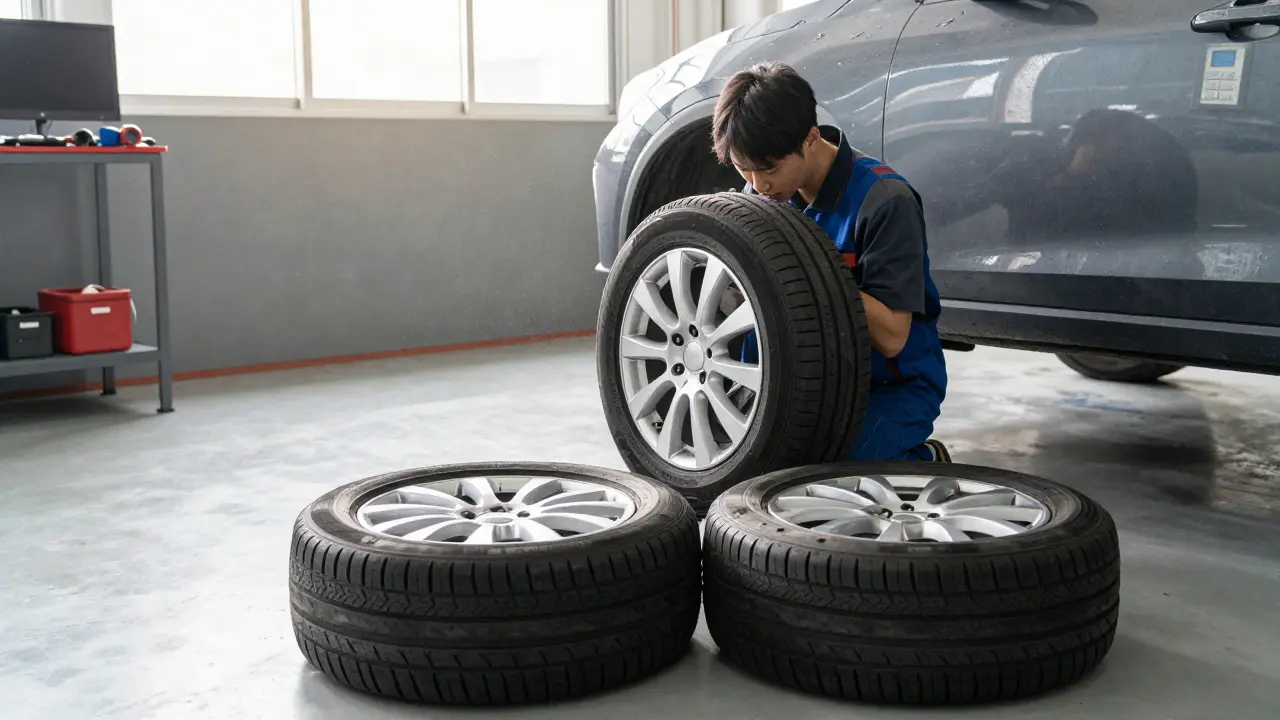
Most drivers don’t think about tire rotation and balance until they hear a weird vibration or notice uneven wear on their tires. But skipping these simple maintenance steps can cost you hundreds in premature tire replacements and even affect your car’s handling and fuel efficiency. The good news? Doing it right is cheap, quick, and keeps your car running smoother for longer.
Why Tire Rotation Matters
Your front tires wear faster than your rear ones. Why? Because they handle steering, braking, and most of the engine’s weight in front-wheel-drive cars-which make up over 70% of vehicles on UK roads. This uneven wear doesn’t just reduce grip; it creates a bumpy ride and increases stopping distances.
Rotating your tires moves them to different positions so wear gets spread evenly. Front tires move to the rear, and rear ones move to the front. For vehicles with directional tires, they switch side-to-side on the same axle. Most manufacturers recommend rotating tires every 5,000 to 7,500 miles. If you drive mostly on highways, you can stretch it to 7,500. If you do a lot of city driving with lots of braking and cornering, stick to 5,000.
Skipping rotation for 15,000 miles? You’re looking at a 30% shorter tire lifespan. A set of tires that should last 50,000 miles might only give you 35,000. That’s a £500+ loss on average.
What Tire Balancing Actually Does
Tire rotation fixes uneven wear. Tire balancing fixes uneven weight. Even brand-new tires have tiny manufacturing variations-small imbalances in rubber, steel belts, or valve stems. When spinning at 60 mph, that imbalance creates a vibration you feel in the steering wheel or seat.
That vibration isn’t just annoying. It causes faster tread wear, puts stress on your suspension, and can even loosen wheel nuts over time. Balancing means adding small metal clips or adhesive weights to the rim to counteract those weight differences. It’s not a one-time fix. You should get your tires balanced every time they’re rotated, or whenever you feel a new vibration after hitting a pothole or curb.
Most garages in Bristol will balance tires for £10-£15 per wheel. That’s less than the cost of a coffee, and it protects a £800 investment in your tires.
How Often Should You Do Both?
Do them together. Rotating and balancing should happen at the same time. Here’s a simple schedule based on typical UK driving:
- Every 5,000 miles: Rotate tires and check balance
- Every 10,000 miles: Check alignment and tire pressure
- Every 15,000 miles: Inspect tread depth and look for bulges or cracks
Many UK service centres offer a free tire check with an oil change. Use that. If you change your oil every 6 months, you’re getting two tire rotations a year-perfect for most drivers.
Don’t wait for the warning lights. Your car won’t tell you when your tires are out of balance. You’ll feel it first: a shaking steering wheel at highway speeds, or a humming noise from one side. By then, damage is already done.

Signs You Need Rotation or Balancing Now
You don’t need a tool to know something’s wrong. Here are clear signs:
- Steering wheel vibrates at 50+ mph
- One tire looks more worn on the inner or outer edge
- Car pulls to one side when you let go of the wheel
- Increased road noise from one tire
- Reduced fuel economy (by 3-5%) without any other change
If you notice even one of these, get your tires checked. A quick 30-minute appointment can save you from replacing a full set.
What Happens If You Ignore It?
Ignoring tire rotation and balance doesn’t just shorten tire life. It creates a chain reaction:
- Uneven wear → Poor traction → Longer braking distances
- Imbalanced tires → Vibration → Stress on wheel bearings and suspension parts
- Worn tires → Higher rolling resistance → More fuel used
- Severe imbalance → Risk of blowout at high speed
Insurance data from the UK’s Association of British Insurers shows that tire-related accidents increased by 12% between 2023 and 2025, mostly due to worn or unbalanced tires. Most of these were preventable.

DIY or Professional?
You can rotate tires yourself if you have a jack, jack stands, and a torque wrench. But balancing? That needs a machine. You can’t do it at home without spending £1,000+ on equipment most homeowners don’t own.
So here’s the smart approach: Rotate your own tires every 5,000 miles if you’re comfortable. But always take them to a garage for balancing. It’s a 15-minute job, and they’ll check your tread depth and pressure at the same time.
Many tyre shops in Bristol offer a ‘rotation + balance’ package for under £30. Some even throw in a free air refill. That’s a no-brainer.
Pro Tips to Get the Most From Your Tires
- Check tire pressure once a month. Underinflated tires wear faster and reduce fuel economy.
- Don’t mix tire brands or tread patterns. Always replace tires in pairs or sets of four.
- Keep your alignment checked every 10,000 miles. Misalignment is the #1 cause of uneven tire wear.
- Store winter tires properly. Keep them in a cool, dry place out of sunlight to avoid cracking.
- Keep a record. Write down your last rotation date and mileage. It helps you stay on track.
One driver in Bristol kept a handwritten log in her glovebox. After 4 years, her tires lasted 62,000 miles-12,000 more than the average. She rotated them every 5,000 miles, balanced them every time, and never skipped a pressure check.
Final Thought
Tires are the only part of your car that touch the road. Everything else-brakes, engine, suspension-depends on them working right. Rotating and balancing them isn’t a chore. It’s insurance. For less than the cost of two takeaway coffees every six months, you’re protecting your safety, your wallet, and your peace of mind.
Don’t wait for the wobble. Don’t wait for the warning. Do it now. Your next set of tires will thank you.
How often should I rotate my tires?
Most manufacturers recommend rotating tires every 5,000 to 7,500 miles. If you drive mostly on highways, go with 7,500. For city driving with lots of stops and turns, stick to 5,000. Always follow your vehicle’s manual, but if you’re unsure, 6,000 miles is a safe middle ground.
Do I need to balance my tires every time I rotate them?
Yes. Even if your tires feel fine, small imbalances develop over time from normal wear and road impacts. Balancing every rotation prevents vibrations, extends tire life, and protects your suspension. It’s a cheap safeguard-usually £10-£15 per wheel.
Can I rotate my own tires?
Yes, if you have the right tools: a jack, jack stands, a torque wrench, and a safe place to work. The process is straightforward-remove tires, swap their positions, and tighten lug nuts to the manufacturer’s torque spec. But balancing requires a machine, so leave that to a garage.
What happens if I don’t rotate or balance my tires?
You’ll get uneven wear, which shortens tire life by up to 30%. You’ll also experience vibrations, poor handling, reduced fuel efficiency, and increased risk of blowouts. In extreme cases, unbalanced tires can damage wheel bearings and suspension components, leading to expensive repairs.
How do I know if my tires need balancing?
Watch for a shaking steering wheel at highway speeds (50+ mph), uneven tread wear, or a humming noise from one tire. If you hit a pothole hard and suddenly feel vibration, get them balanced immediately. These are classic signs of imbalance.
Does tire rotation fix a car pulling to one side?
Not usually. A car pulling to one side is most often caused by misaligned wheels or uneven tire pressure. Rotation helps with wear, but it won’t fix alignment issues. If your car pulls, get an alignment check-especially after replacing tires or hitting a curb.
Comments
Jeanie Watson
I rotate my tires maybe once a year if I remember. Which is never. My car vibrates like a washing machine on spin cycle, but hey, it gets me to work.
March 12, 2026 at 12:30
Tom Mikota
You know what’s funny? People act like tire rotation is some profound life hack. It’s not. It’s basic maintenance. Like brushing your teeth. Or not setting your car on fire. But sure, let’s all pretend we’re heroes for doing the bare minimum.
March 12, 2026 at 13:48
Mark Tipton
Let’s address the elephant in the room: the UK-centric bias in this article. While Bristol is a fine city, it’s not the center of automotive engineering. In the U.S., tire rotation intervals vary wildly based on climate, road salt, and suspension geometry. For example, in the Rust Belt, you’re better off rotating every 4,000 miles due to accelerated corrosion-induced imbalance. Also, the claim that ‘70% of vehicles in the UK are FWD’ is misleading. It’s closer to 82% based on SMMT 2024 data. And balancing? That’s not just about weights-it’s about harmonic resonance in the tire’s radial runout. If you’re not measuring it with a laser balancer, you’re just guessing. And that’s why 42% of tire-related accidents occur within 300 miles of a ‘cheap balance’ shop.
March 13, 2026 at 16:34
Adithya M
This is solid advice. In India, people ignore this until their tires look like they’ve been through a war. I’ve seen tires with one side completely bald while the other still has tread. It’s dangerous. Rotating every 5k km (not miles) saves you money. And yes, balance every time. No excuses.
March 14, 2026 at 09:11
Jessica McGirt
I appreciate the clarity here. Tire maintenance is one of those things that seems boring until your car starts acting like a drunken pogo stick. I keep a small notebook in my glovebox too-last rotation: 6,023 miles. Balance: 6,000. Pressure: 34 psi. It’s satisfying. And honestly? It’s the only thing I do consistently that makes me feel like I’m in control.
March 15, 2026 at 10:45
Donald Sullivan
Rotating tires yourself? Please. You think you’re saving money? You’re just risking a dropped jack and a lawsuit. Pay the $30. Your back will thank you. And your insurance company will love you.
March 16, 2026 at 17:29
Tina van Schelt
I used to think tires were just… rubber circles. Then I hit a pothole at 60mph and suddenly my steering wheel started doing the cha-cha. Now I treat my tires like pets. Feed ‘em air. Walk ‘em (rotate ‘em). Brush ‘em (balance ‘em). And god forbid I let them get lonely. They’ve got feelings. And tread patterns.
March 17, 2026 at 06:58
Ronak Khandelwal
Tires are the silent heroes of our daily journeys 🙏✨ They don’t ask for much-just a little love, a spin, and some balance. I started doing this after my cousin’s car skidded on wet pavement because of uneven wear. It changed everything. Now I check mine like a morning ritual. 🌞🚗💛
March 17, 2026 at 11:24
Jeff Napier
Who says you need to rotate tires? Maybe the manufacturers are just trying to sell more tires. Maybe vibration is nature’s way of telling you to slow down. Maybe the whole system is rigged. I drive my 1998 Camry with the same tires since 2012. They’ve got character. And a slight wobble. That’s not a flaw. It’s a story.
March 19, 2026 at 10:27
Sibusiso Ernest Masilela
Let’s be honest: most people who write about ‘tire rotation’ are middle-class suburbanites who think a $30 service is a ‘no-brainer.’ Meanwhile, in the real world, people are choosing between gas and tire replacement. You don’t get to lecture us about ‘peace of mind’ when your coffee is oat-milk lattes and ours is just… gas. This article reads like a corporate brochure for Goodyear.
March 19, 2026 at 19:05
Daniel Kennedy
I’ve been doing this for 15 years. My 2009 Accord has 210k miles on the original tires. Rotated every 5k, balanced every time, pressure checked weekly. It’s not magic. It’s consistency. And yeah, it’s cheap. But the real win? No blowouts. No roadside panic. No towing bills. Just peace. Do the work. Your future self will high-five you.
March 20, 2026 at 09:19