
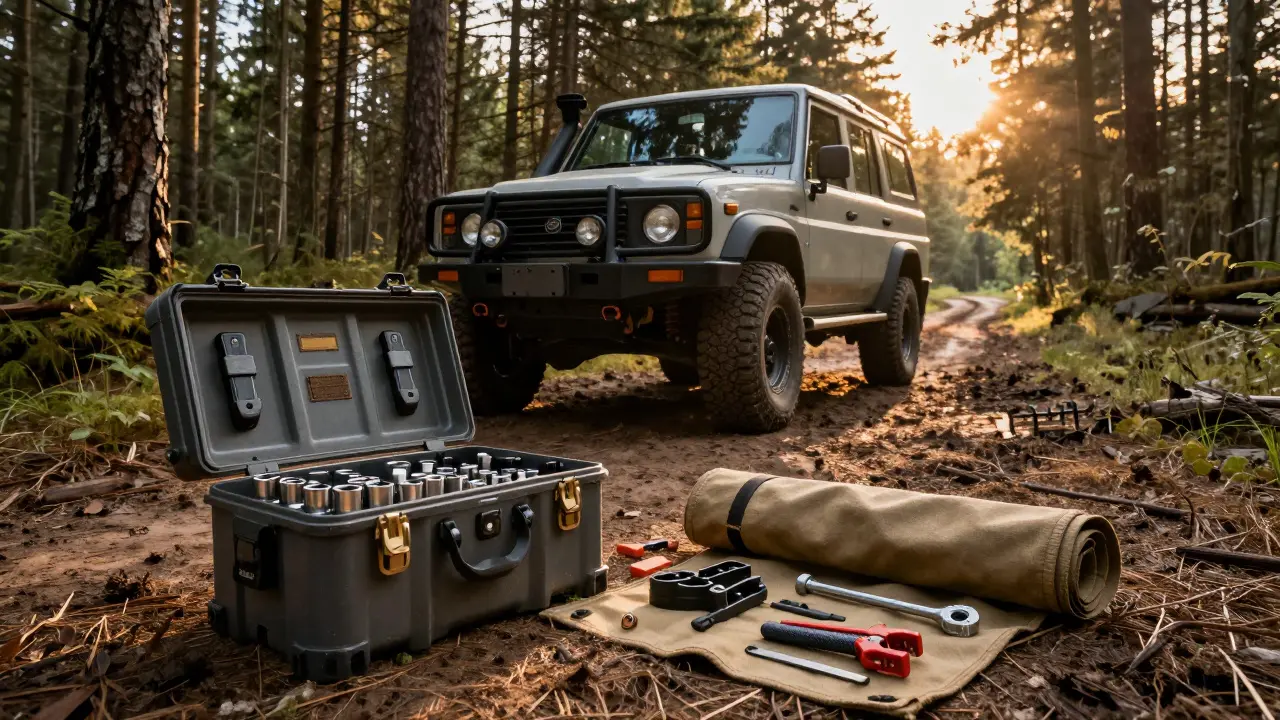
The Core Toolset for Remote Repairs
You don't need a full workshop, but you do need versatility. A heavy-duty socket set is your bread and butter, but go for a set with a 3/8-inch drive-it's the sweet spot between torque and portability. Many overlanders find that a Ratchet with an extension bar is the only way to reach a stubborn bolt on a suspension arm buried under a chassis.
Pliers are non-negotiable. You want a pair of needle-nose for those tiny clips that always fly off, and a set of locking pliers, often called Vise-Grips. When a bolt head rounds off because of rust and grit, locking pliers are often the only way to get a grip. Don't forget a multi-bit screwdriver with a magnetized tip; dropping a screw into a muddy engine bay is a mistake you only want to make once.
Then there's the heavy lifting. A Breaker Bar is essential for loosening lug nuts that have been torqued down by an impact wrench. If you're running larger tires, you'll need a high-lift jack, but remember that these are notoriously unstable. Always use a base plate to prevent the jack from sinking into soft soil, which could lead to a vehicle tip-over.
Essential Spares Every Rig Needs
Tools are useless if you don't have a part to replace. The most common failures in the wild usually involve rubber, electricity, or fluid. Start with a comprehensive fuse kit. A single blown 15-amp fuse can kill your fuel pump or headlights, leaving you stranded for a part that costs fifty cents.
For the engine, carry a selection of common belts and hoses. A Serpentine Belt is a prime candidate for failure when it rubs against a branch or wears thin. Having a spare belt and a way to tension it can save you from a total overheat. Speaking of heat, carry a gallon of pre-mixed coolant and a bottle of leak-stop sealant for those pinhole radiator leaks caused by flying debris.
| Spare Item | Primary Failure | Fix Difficulty | Priority |
|---|---|---|---|
| Zip Ties (Heavy Duty) | Loose wiring/hoses | Easy | Critical |
| Fuel Filter | Clogged lines from sediment | Medium | High |
| Tire Plugs/Glue | Punctures in tread | Easy | Critical |
| U-bolts | Leaf spring shift | Hard | Medium |
| Electrical Tape | Exposed wires | Easy | High |
Field Fixes for Tires and Traction
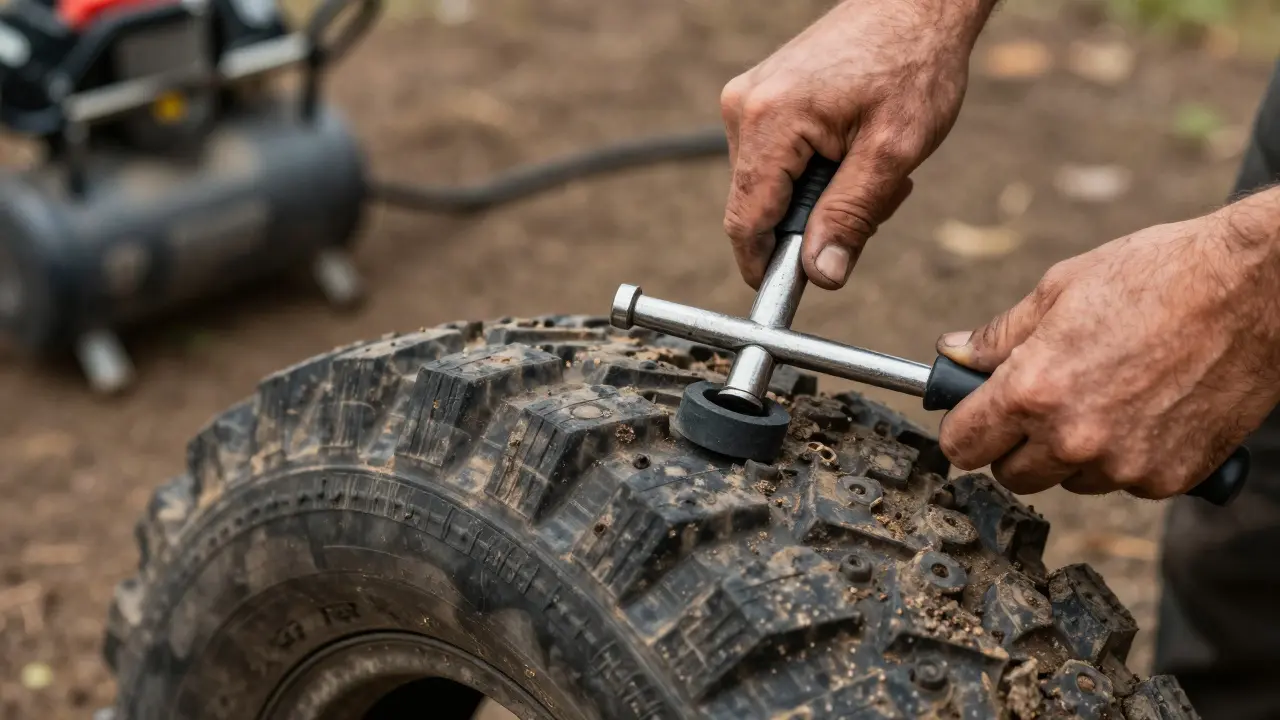
Tire failure is the most frequent "trail disaster." While a full-size spare is the gold standard, you can't always carry three spares if you're running a six-wheel setup. This is where a Tire Plug Kit becomes a lifesaver. A plug can fix a nail hole in minutes, but it won't help with a sidewall tear.
For sidewall damage, you need a patch kit with a vulcanizing agent. This is a more permanent fix that involves inserting a reinforced rubber patch inside the tire. However, if the tear is too large, you're looking at a Tire Boot. This is a heavy-duty rubber insert that plugs the hole from the inside, allowing you to limp back to civilization at low pressure.
If you're stuck in the mud, tools alone won't help. You need traction aids. Traction Boards-made of high-density polyethylene-provide a solid surface for tires to grab. Unlike digging with a shovel, which often just makes the hole deeper, boards create a bridge over the soft spot. Combine these with an Air Compressor to air down your tires to 15-20 PSI, increasing the footprint and grip of the rubber.
The Magic of Adhesives and Temporary Binds
When a part snaps or a seal fails, you aren't looking for a factory-spec repair; you're looking for "good enough to get home." This is where chemical adhesives come in. Duct Tape is the cliché for a reason, but for high-heat areas, you need aluminum foil tape. It can temporarily patch a leaking exhaust or a radiator hose where standard tape would melt.
For structural leaks, a two-part epoxy putty is incredible. It hardens like steel and can be used to plug a hole in a fluid reservoir or secure a loose bracket. Pair this with a large roll of heavy-duty zip ties. Zip ties are the duct tape of the mechanical world; they can hold a battery in place, secure a loose bumper, or keep a hose from sliding off a fitting.
Don't overlook the power of a WD-40 Specialist spray or a dedicated penetrating oil. When you're trying to turn a bolt that has been soaking in salt and mud for three years, a few minutes of soaking in penetrating oil is the difference between a successful repair and a snapped bolt head.
Planning Your Kit Based on Terrain
A kit for the sandy dunes of the Mojave is different from one for the rocky trails of the Rubicon. In sandy areas, focus on air management and traction. You'll want a high-volume compressor and multiple sets of boards. In rocky terrain, your risks are punctures and suspension damage. Carry extra steering linkage components or at least the hardware (nuts and bolts) to secure a bent tie rod.
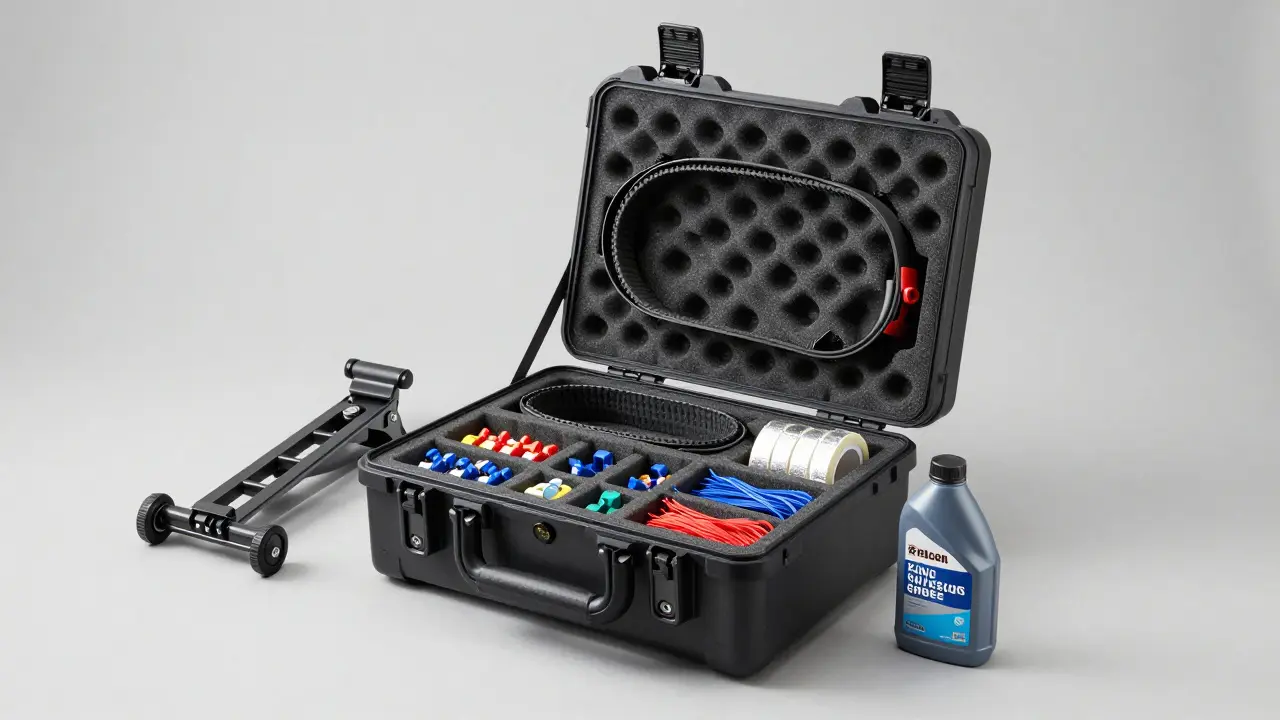
For deep forest or jungle treks, moisture is the enemy. Your tools will rust if they aren't stored in waterproof cases. Use a Pelican Case or a similar gasket-sealed box to keep your electronics and precision tools dry. Also, carry extra fuel filters; forest trails often have older fuel stations where sediment in the tank is a common problem, leading to clogged lines mid-journey.
Finally, consider the weight. Every pound of gear affects your fuel economy and your suspension's load capacity. Instead of carrying every tool known to man, focus on "multi-purpose" gear. A hatchet can be a hammer, a chopping tool, and a stake driver. A heavy-duty strap can be a tie-down or a makeshift hoist.
What is the most common tool used in trail repairs?
The most frequently used tools are typically a versatile socket set, locking pliers (Vise-Grips), and heavy-duty zip ties. These allow for a wide range of fixes, from tightening loose bolts to temporarily securing disconnected hoses and wiring.
Can I use a tire plug on a sidewall puncture?
No, you should never use a standard plug on a sidewall. The sidewall flexes too much, which will push the plug out and could cause the tire to fail catastrophically. Sidewall repairs require an internal patch or a tire boot, though these are often only temporary solutions to get you to a shop.
How do I know which fuses to carry in my kit?
Check your owner's manual or the fuse box cover inside your vehicle. Identify the fuses for critical systems like the fuel pump, ignition, and headlights. Carry at least two spares of each amperage (e.g., 10A, 15A, 20A) used in those critical circuits.
Is a high-lift jack safe for everyone to use?
High-lift jacks are powerful but can be dangerous if not used correctly because they have a high center of gravity. They are best used with a base plate on soft ground and should only be used to lift the vehicle vertically. Never go under a vehicle supported only by a high-lift jack without using jack stands.
What is the best way to organize a trail repair kit?
Use a modular system. Store tools in a dedicated tool roll or box, spares (belts, fuses) in a waterproof organizer, and adhesives in a small pouch. This prevents you from dumping your entire inventory on the ground just to find one 10mm socket.
Next Steps for Your Setup
If you're just starting, don't buy every professional kit on the market. Start with a basic set of hand tools and a tire plug kit. As you go on more trips, keep a "failure log." Every time you wish you had a specific tool or part, write it down. By the end of a season, you'll have a customized list of exactly what your specific rig needs for the terrain you actually drive.
For those moving into long-term overlanding, consider taking a basic field mechanics course. Knowing how to bleed brakes or replace a starter motor in the dirt is a skill that no amount of gear can replace. Gear is a multiplier, but your knowledge is the base value.
Comments
Henry Kelley
good list man, definitely helps the newbies get started without spendin a fortune
April 28, 2026 at 02:49
Nathan Pena
The inclusion of a high-lift jack in a general guide is predictably reckless. Only those who lack a fundamental understanding of vehicle centers of gravity would suggest such a tool without a more rigorous warning regarding its propensity for catastrophic failure. One does not simply "use a base plate" to mitigate the inherent instability of a tool that essentially acts as a catapult for two-ton vehicles when used on a moderate incline.
April 28, 2026 at 21:04
Krzysztof Lasocki
Oh yeah, because nothing says "I'm a pro" like almost flipping your rig with a high-lift jack! Just kidding, but for real, it's a beast of a tool if you actually know what you're doing. Keep the energy high and the tires aired down!
April 29, 2026 at 06:35
Sarah Meadows
Listen up, if you aren't running American-made steel on your rig, you're basically just playing house. Real patriots carry a full-sized spare and a heavy-duty impact driver because we don't do "temporary binds" in this country. Get some real gear or stay on the pavement where it's safe for the weak.
April 29, 2026 at 22:51
Mike Marciniak
Notice how the guide emphasizes electronics and fuses. It's funny how they want us to rely on "modular systems" and high-tech compressors. The moment a solar flare or a targeted EMP hits, all your fancy "curated collections" are just heavy scrap metal. I carry manual pumps and analog tools because I'm not trusting a circuit board to get me home when the grid goes dark.
May 1, 2026 at 03:17
Mbuyiselwa Cindi
I've spent years guiding in the bush and I totally agree with the modular approach! If you're new to this, I highly recommend adding a basic first aid kit specifically for burns and cuts, because you'll almost certainly scrape your knuckles while fighting with those Vise-Grips. Also, don't forget to keep your spare fuses in a small, labeled pill organizer-it makes finding the right amp way faster when you're stressed!
May 1, 2026 at 08:46
VIRENDER KAUL
The methodology presented herein is rudimentary at best and lacks the requisite technical rigor for true overlanding. One must observe that the priority levels assigned in the table are subjective and fail to account for the variance in vehicle makes. It is quite disappointing to see such a lack of empirical data regarding failure rates across different terrains. Truly an amateur synthesis of information
May 1, 2026 at 09:52
Tonya Trottman
Imagine thinking a "failure log" is some kind of revolutionary epiphany. It's called taking notes, sweetie. Also, the phrase "must have variable length" in the logic of these guides is just a fancy way of saying "I don't know how to pack." But sure, let's all pretend that using duct tape on a radiator hose is a sophisticated strategy rather than a desperate act of a man who forgot his actual tools. Truly a philosophical masterpiece of incompetence.
May 2, 2026 at 06:01
Rocky Wyatt
Most of you are just arguing about tools to hide the fact that you're terrified of actually getting lost. You buy the Pelican cases and the expensive socket sets to feel some semblance of control over a chaotic wilderness that doesn't care about your gear list. It's sad, really, how much gear you need just to feel like a real man in the woods.
May 3, 2026 at 10:29
Victoria Kingsbury
Totally love the focus on the air-down process! For those who aren't familiar, airing down is a game changer for your contact patch, especially when you're hitting those sandy sections. It's all about that flotation. Just a heads up, make sure your beadlocks are tight if you're going really low, or you'll be spending your afternoon popping beads instead of enjoying the view!
May 3, 2026 at 15:26
Santhosh Santhosh
I find myself reflecting on the sheer vulnerability of being alone in the vastness of nature and how these tools, while helpful, are merely thin shields against the overwhelming power of the elements. I remember a time when I sat by my vehicle for hours, not even using my tools, but simply listening to the wind and realizing that the fear of failure is often more paralyzing than the mechanical failure itself, though I do agree that having a spare serpentine belt provides a certain quiet peace of mind that allows one to breathe a bit deeper in the silence of the woods.
May 3, 2026 at 22:25