
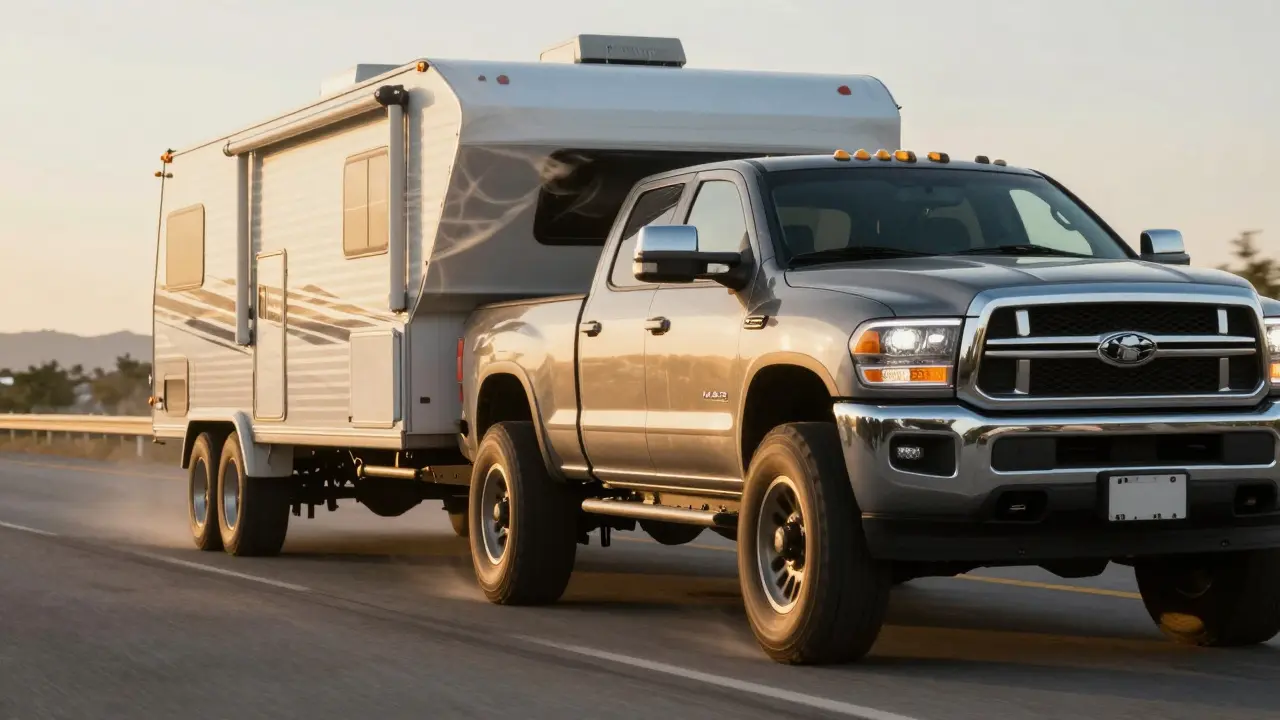
If you’ve ever loaded up a trailer only to have your pickup truck struggle on the highway, you know how important it is to get the right equipment. It’s not just about having a big engine - it’s about matching your truck to the trailer, the hitch, and the load. Too many people skip the basics and end up with unsafe towing, damaged vehicles, or even accidents. The good news? It’s simple once you know what to look for.
Know Your Pickup’s Tow Capacity
Every pickup truck has a maximum tow rating, and it’s not the same as its gross vehicle weight rating. This number - your tow capacity - tells you exactly how much weight your truck can safely pull. You’ll find it in your owner’s manual or on a sticker inside the driver’s door jamb. Don’t guess. Don’t rely on what someone else says their truck can handle. Your truck’s rating is specific to its engine, transmission, axle ratio, and suspension setup.For example, a base-model Ford F-150 with the 3.3L V6 might only tow 5,000 pounds. But the same model with the 3.5L EcoBoost and heavy-duty towing package? That’s 14,000 pounds. The difference isn’t just the engine - it’s the upgraded brakes, cooling system, and rear axle. If you’re planning to haul a 7,000-pound boat or a large utility trailer, you need to know if your truck can handle it - not just on flat ground, but on hills, in rain, or with headwinds.
Match the Trailer to Your Truck
A trailer isn’t just a box on wheels. It comes in types: utility, car hauler, gooseneck, fifth-wheel, horse trailer, and travel trailer. Each has different weight distributions and handling traits. You can’t just pick the biggest trailer you can afford and expect your truck to manage it.Here’s the rule: your trailer’s Gross Vehicle Weight Rating (GVWR) should be at least 15% under your truck’s maximum tow rating. That leaves room for fuel, passengers, and cargo inside the truck. If your truck can tow 10,000 pounds, aim for a trailer under 8,500 pounds. Why? Because that 15% buffer keeps your brakes from overheating, your transmission from overheating, and your tires from wearing out too fast.
Also, consider trailer length. A 30-foot travel trailer might look perfect, but if your truck is a mid-size model like a Toyota Tacoma, it’ll feel like you’re dragging a sailboat. Shorter trailers - under 22 feet - are easier to control and require less stopping distance. For most UK drivers hauling small equipment or camping gear, a 16- to 20-foot trailer is more than enough.
Choose the Right Hitch System
Not all hitches are created equal. There are four main types:- Class I - up to 2,000 lbs GTW (gross trailer weight), used for small utility trailers or bike racks.
- Class II - up to 3,500 lbs GTW, common on compact trucks and SUVs.
- Class III - up to 8,000 lbs GTW, the standard for full-size pickups.
- Class IV - up to 12,000 lbs GTW, for heavy-duty towing like large campers or horse trailers.
Most pickups sold in the UK come with a Class III hitch as standard. But if you’re upgrading your trailer, you might need to swap it out. Don’t just bolt on a heavier hitch - make sure your truck’s frame and mounting points can handle the stress. A Class IV hitch on a truck not rated for it can crack the frame over time.
Also, consider a weight distribution hitch if your trailer weighs more than 50% of your truck’s curb weight. It spreads the load across all four wheels, improves steering, and reduces sway. A simple ball hitch won’t cut it for trailers over 5,000 pounds. You’ll feel the difference the first time you hit a gust of wind on the M4.
Brakes Matter More Than You Think
Trailers over 3,000 pounds in the UK legally require electric or hydraulic surge brakes. But even if your trailer is lighter, adding brakes makes a huge difference. Imagine braking hard on a wet road with a 4,000-pound trailer behind you. Without trailer brakes, your truck’s brakes alone are doing all the work. That means longer stopping distances, overheated pads, and a higher chance of skidding.Electric brakes give you control - they activate in sync with your truck’s brakes. Surge brakes work mechanically, using the trailer’s forward motion to push fluid into the brake lines. Both are better than no brakes at all. If your trailer doesn’t have them, install them. It’s not expensive - under £300 for a full kit - and it’s one of the smartest upgrades you can make.
Don’t Forget About Tires and Wheels
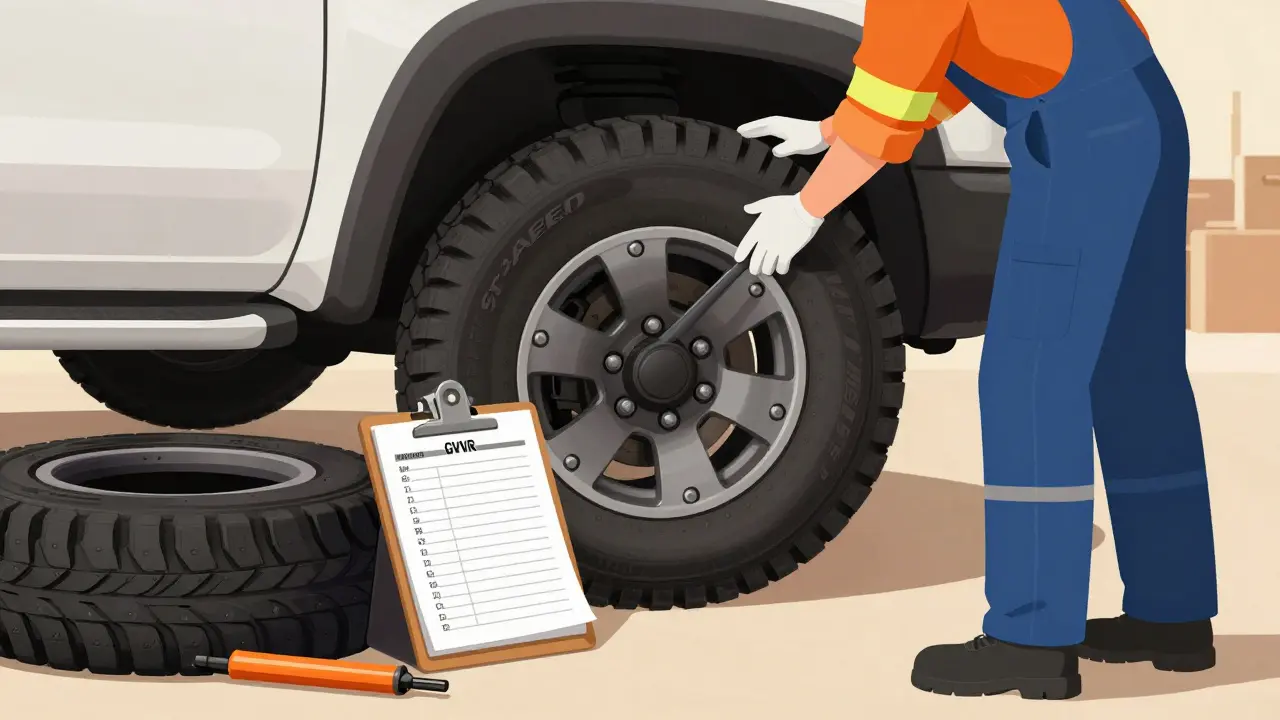
Your truck’s tires are designed for the weight it carries. But when you add a trailer, you’re adding extra stress - especially on the rear tires. Many people don’t realize that trailer tires wear out faster than truck tires because they’re often underinflated or not rated for heavy loads.Check your trailer’s tire sidewall. Look for the letter “ST” - that means “Special Trailer.” These tires have stiffer sidewalls and are built for the constant side loads of towing. Don’t use regular passenger tires on your trailer. They’re not designed for it. And always inflate them to the max pressure listed on the tire - even if the road feels bumpy. Underinflated trailer tires are the #1 cause of blowouts.
Also, rotate your trailer tires every 5,000 miles. Unlike truck tires, trailer tires don’t get much wear from steering, so they wear unevenly. Rotating them helps them last longer and stay safe.
Load Distribution Is Everything
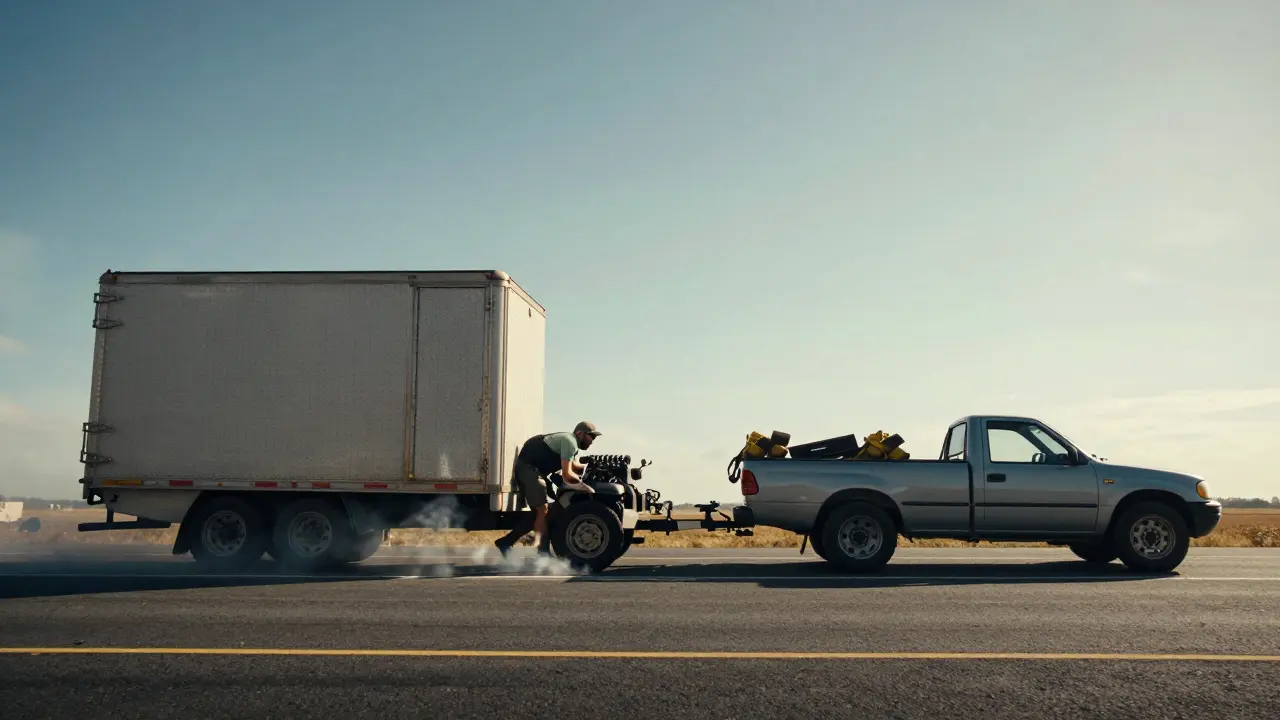
A trailer that’s loaded wrong can be more dangerous than a trailer that’s too heavy. The golden rule: 60% of the weight should be in front of the trailer’s axle. That keeps the tongue weight balanced. Too little tongue weight? The trailer will sway. Too much? It’ll overload your truck’s rear axle and make steering stiff.For most trailers, tongue weight should be 10-15% of the total trailer weight. So if your trailer weighs 6,000 pounds, aim for 600 to 900 pounds of tongue weight. Use a scale - there are portable tongue weight scales for under £80. Don’t guess. Place heavy items over the axle, not at the back. Keep low, heavy stuff (like tools or propane tanks) toward the front. Lighter stuff (coolers, bedding) goes in the back.
Also, secure everything. A loose cooler or a sliding lawnmower can turn into a projectile in a panic stop. Use ratchet straps, not bungee cords. Tie-downs aren’t optional - they’re safety gear.
Practice Before You Hit the Road
Towing isn’t like driving your truck alone. Turning radius changes. Braking distance doubles. Wind affects you more. You need to get used to it.Find an empty parking lot. Practice backing up. Learn how much you need to turn the wheel - it’s the opposite of what you expect. Practice stopping from 40 mph. Notice how your truck leans. Try driving in a straight line on a windy day. These aren’t exercises - they’re survival skills.
Also, check your mirrors. If you can’t see the trailer’s wheels, your mirrors are too narrow. Extendable trailer mirrors are cheap and worth every penny. You need to see both sides of the trailer at all times.
Final Checklist Before You Tow
- Trailer GVWR is under 85% of your truck’s tow rating
- Hitch class matches or exceeds trailer weight
- Trailer has functional brakes
- Tongue weight is 10-15% of trailer weight
- All cargo is secured with straps
- Trailer tires are ST-rated and properly inflated
- Truck’s transmission fluid and coolant are at proper levels
- Electrical connectors are clean and plugged in
- License plate and lights on trailer are visible
If you check all this, you’re not just towing safely - you’re towing smart. And that’s what separates the people who make it to their destination from the ones who end up on the side of the road.
Can I tow with a compact pickup like a Toyota Hilux or Ford Ranger?
Yes, but with limits. Compact pickups typically have tow ratings between 5,000 and 7,500 pounds. That’s enough for small utility trailers, jet skis, or lightweight camping trailers. Avoid large travel trailers or horse trailers unless your specific model is rated for it. Always check the owner’s manual - some compact trucks need a towing package to reach their max rating.
Do I need a special license to tow a trailer in the UK?
If you passed your driving test after January 1, 1997, you can tow a trailer up to 3,500 kg (7,716 lbs) combined weight - that includes your truck and trailer together. For heavier trailers, you need to pass a separate B+E test. Most people towing caravans or horse trailers need this. If you passed before 1997, you’re generally allowed to tow heavier loads without extra testing. Always check the DVLA website for your exact entitlements.
What happens if I exceed my truck’s tow rating?
Exceeding your tow rating puts extreme stress on your truck’s engine, transmission, brakes, and suspension. Over time, this leads to premature wear or sudden failure. In the short term, you might notice sluggish acceleration, overheating, or brake fade. In the worst case, your transmission can fail while you’re on a highway - and that’s not just expensive, it’s dangerous. Insurance may also refuse to cover damage if you were towing beyond your vehicle’s rating.
Should I use a weight distribution hitch for a 5,000-pound trailer?
Yes, if your trailer weighs more than half of your truck’s curb weight. For example, if your truck weighs 4,500 pounds and your trailer is 5,000 pounds, you’re well over the 50% threshold. A weight distribution hitch will transfer some of the load to the front axle, improving steering, braking, and reducing sway. Even if your truck can handle the weight without one, the hitch makes towing smoother and safer.
How often should I inspect my trailer and hitch?
Before every trip, check the hitch pin, safety chains, lights, and tire pressure. Every 3,000 miles or every six months, inspect the trailer frame for rust, the brake system for wear, and the wheel bearings for grease leaks. If you notice any play in the hitch or unusual noises while driving, get it checked by a professional. Trailer maintenance is cheaper than a roadside repair.
Comments
Kenny Stockman
Man, this post is gold. I used to think any truck could tow anything if it looked big enough. Then I tried pulling a 6,500-lb trailer with my base-model Tacoma-nearly lost control on a hill. Learned the hard way that tow rating isn't a suggestion. Now I always check the door jamb sticker before I even hook up. Saved my transmission and my sanity.
Also, trailer tires? ST-rated or bust. I used regular tires once. Blew out on I-80. Not fun at 70 mph with a trailer full of kayaks. Learned my lesson.
And yeah, practice backing up. You think you know how to turn until you're trying to parallel park a 28-foot camper in a Walmart lot.
March 1, 2026 at 22:39
Paritosh Bhagat
Finally someone who gets it! I can't believe how many people just buy a trailer because it 'looks cool' and then wonder why their truck 'suddenly stopped working.' It's not magic, folks. It's engineering. And if you don't respect the numbers, you're not just being careless-you're putting lives at risk. I've seen accidents. I've seen trailers flip. It's not a game.
Also, if your trailer doesn't have brakes and it's over 3,000 lbs, you're breaking the law in the UK and being dangerously stupid everywhere else. Get your act together.
March 2, 2026 at 09:39
Zach Beggs
Good breakdown. I’d just add that weight distribution hitches aren’t just for big trailers. Even a 4,000-lb trailer on a half-ton truck benefits from one if you’re hauling heavy gear up front. I didn’t use one for years. Then I noticed my rear tires wearing unevenly. Turned out the truck was squatting so bad the front end was light as a feather. Scary stuff.
March 2, 2026 at 13:19
Adrienne Temple
OMG YES to the tire pressure thing!! I used to underinflate my trailer tires 'cause they felt bumpy. Then one just exploded on the highway. I thought I hit a pothole. Nope. Underinflated ST tire. Now I check them before every trip with a digital gauge. Life saver. And yes, rotate them!! I didn’t know that until last year. Now they last 3x longer. 🙌
March 3, 2026 at 16:11
Nick Rios
Just wanted to say thank you for writing this. I’ve been nervous about towing since I got my first trailer last summer. This cleared up so many myths. I thought I needed a diesel or a 3/4-ton just to haul a small utility trailer. Turns out my F-150 with the right package handles it fine. Also, didn’t know about the 15% buffer rule. That’s gonna change how I shop for trailers.
March 4, 2026 at 07:52
Antonio Hunter
There’s an underlying assumption here that everyone has access to the owner’s manual or can read the door jamb sticker. But let’s not forget that a lot of people buy used trucks where the previous owner removed the sticker, or the manual is lost, or they inherited a trailer from a relative without knowing its specs. In those cases, the safest approach is to assume the lowest possible rating unless you can verify otherwise. And if you can’t verify? Don’t tow. Period. It’s better to rent a larger truck for a weekend than risk a catastrophic failure on a bridge or in heavy traffic. Safety isn’t about convenience-it’s about responsibility.
March 4, 2026 at 09:57
Sandy Dog
I JUST BOUGHT A 30-FOOT TRAVEL TRAILER AND MY HILUX ISN’T EVEN A FULL-SIZE TRUCK?? I’M SO SCARED. WHAT DO I DO?? I’M CRYING. I THINK I MADE A MISTAKE. I JUST SPENT ALL MY SAVINGS. MY HUSBAND IS MAD. I JUST WANTED TO GO CAMPING. NOW I’M AFRAID TO EVEN DRIVE IT. I’M SO STRESSED. CAN SOMEONE HELP ME?? 😭😭😭
March 5, 2026 at 18:38
Ben De Keersmaecker
One thing not emphasized enough: trailer tongue weight isn’t just about balance-it’s about physics. Too little, and you get oscillation (sway) because the trailer’s center of mass is behind the axle. Too much, and you overload the truck’s rear suspension, which reduces steering response and increases tire wear. The 10–15% rule works because it aligns with the trailer’s pivot point relative to the hitch. A scale isn’t optional-it’s a diagnostic tool. I use mine to fine-tune load placement. If you’re not measuring, you’re guessing. And guessing with trailers is how accidents happen.
March 6, 2026 at 20:23
Amanda Harkins
I used to think hitch class was just a marketing thing. Then I tried installing a Class IV hitch on my 2018 Ranger without checking the frame rating. Cracked the frame rail over six months. Took $2,200 to fix. Now I know: never upgrade the hitch without upgrading the whole system. And don’t trust YouTube tutorials. Half of them are wrong.
March 8, 2026 at 18:44
Fred Edwords
Correct me if I’m wrong, but the 15% buffer rule (trailer GVWR under 85% of tow rating) is not an official regulation-it’s a conservative best practice endorsed by the RV Industry Association and the National Highway Traffic Safety Administration. Many manufacturers design for 100% utilization, but real-world conditions (wind, elevation, heat, traffic) demand a safety margin. Also, note that tow ratings assume dry weight-add fuel, passengers, coolers, tools, and you’re often over before you even hook up. Always weigh your fully loaded rig. There are CAT scales at truck stops for $10.
March 9, 2026 at 22:39
Chris Heffron
Love this. 🙌 Just added electric brakes to my 4,500-lb trailer last month. Best $250 I ever spent. Braking feels smooth now. No more ‘brake pedal to the floor’ panic. Also, extended mirrors? Game changer. Can finally see the back wheels. 👍
March 11, 2026 at 13:30
Aaron Elliott
While the article provides a serviceable overview, it lacks a foundational critique of the commodification of recreational towing. The very notion that one can ‘choose the right equipment’ implies that safety is a matter of technical compliance rather than systemic design. Why are we, as a society, incentivizing the purchase of increasingly heavy trailers without addressing infrastructure limitations, driver education gaps, or the environmental cost of perpetuating this culture of overcapacity? The answer, of course, is profit. But let us not mistake technical advice for moral clarity.
March 12, 2026 at 12:11
Kenny Stockman
@55 - don’t panic. You’re not alone. I did the same thing. Bought a 30-footer with a Tacoma. Turned out, I just needed a weight distribution hitch, upgraded brakes, and to reduce the load by 800 lbs. Took it to a trailer shop-they weighed it for free. Now I go camping every weekend. It’s fine. Seriously. Breathe. You got this. 🤘
March 13, 2026 at 20:50