
You’re standing in your driveway, staring at two sets of tires for your F-150 or Silverado. One set is cheaper, looks smoother, and promises a quiet ride. The other costs more, feels stiffer, and has sidewalls that look like they could withstand a minor explosion. Which one do you buy? If you’ve ever confused these options, you’re not alone. Most drivers don’t realize that the difference isn’t just about brand loyalty-it’s about physics.
Choosing between E-Load and P-Metric tires determines whether your truck handles safely when fully loaded or wobbles dangerously on the highway. This guide breaks down exactly what those codes mean, how to read the sidewall, and why using the wrong tire can ruin your suspension-or worse, cause an accident.
Quick Summary / Key Takeaways
- P-Metric (Passenger Metric) tires are designed for cars, SUVs, and light trucks with lighter loads; they offer better comfort but lower maximum weight capacity.
- E-Load (Light Truck Metric) tires have stronger sidewalls and higher inflation pressures to support heavier payloads, towing, and off-road abuse.
- Inflation Pressure Matters: E-load tires require significantly higher PSI (often 80+) to reach their rated capacity, while P-metric tires typically operate at 35-45 PSI.
- Never Guess: Always check your vehicle’s door jamb sticker for the manufacturer’s recommended tire type and pressure.
- Ride Quality Trade-off: E-load tires provide durability and safety under load but result in a harsher, noisier ride compared to P-metric tires.
Decoding the Sidewall Codes
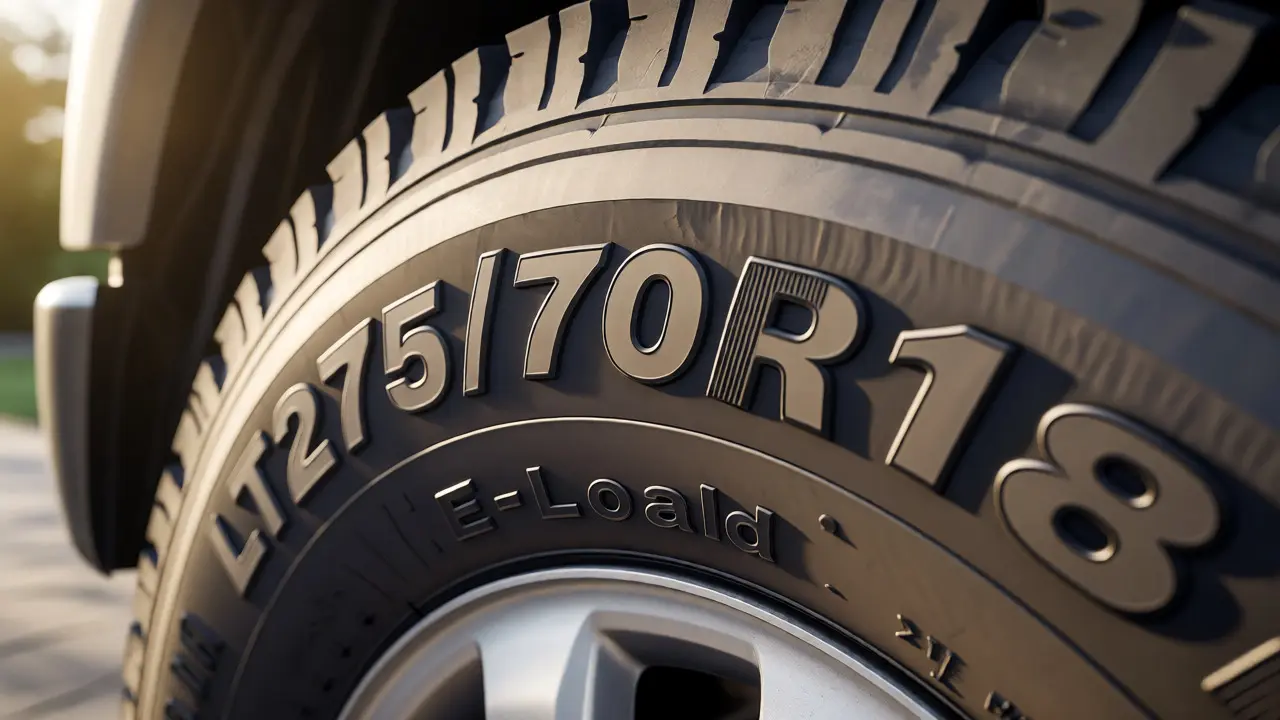
Every tire tells its own story if you know how to listen. Look at the side of any tire, and you’ll see a string of letters and numbers like P275/65R17 110T or LT275/70R18 129S. That first letter is the critical clue.
A P prefix stands for Passenger Metric. These are standard tires found on sedans, crossovers, and half-ton pickups used primarily for commuting. They prioritize fuel efficiency, low noise, and a smooth ride. If you see a tire without a prefix, it might be an older European standard or a specific commercial rating, but in the US market, 'P' is common for light vehicles.
Conversely, an LT prefix indicates Light Truck, which often correlates with E-Load capabilities. While "E-Load" refers specifically to the ply rating equivalent (10-ply strength), LT tires are engineered with reinforced sidewalls and deeper treads. They are built to handle the stress of carrying heavy tools, hauling trailers, or navigating rocky trails.
Why does this matter? Because a P-metric tire simply cannot hold the same amount of air pressure as an E-load tire without risking a blowout. The internal structure is different. Think of it like comparing a bicycle inner tube to a tractor tire. Both hold air, but one is designed to burst if you push it too hard.
Understanding Load Index and Inflation Pressure
The most dangerous misconception among truck owners is thinking that bigger tires equal more strength automatically. It doesn’t work that way. Strength comes from the combination of the Load Index and the maximum inflation pressure.
The Load Index is a numerical code that corresponds to a specific weight limit per tire. For example, a Load Index of 104 means the tire can carry 1,984 pounds. But here is the catch: that number is only valid if the tire is inflated to its maximum rated pressure. If you run an E-load tire at 40 PSI instead of its required 80 PSI, you are effectively halving its load-carrying capacity.
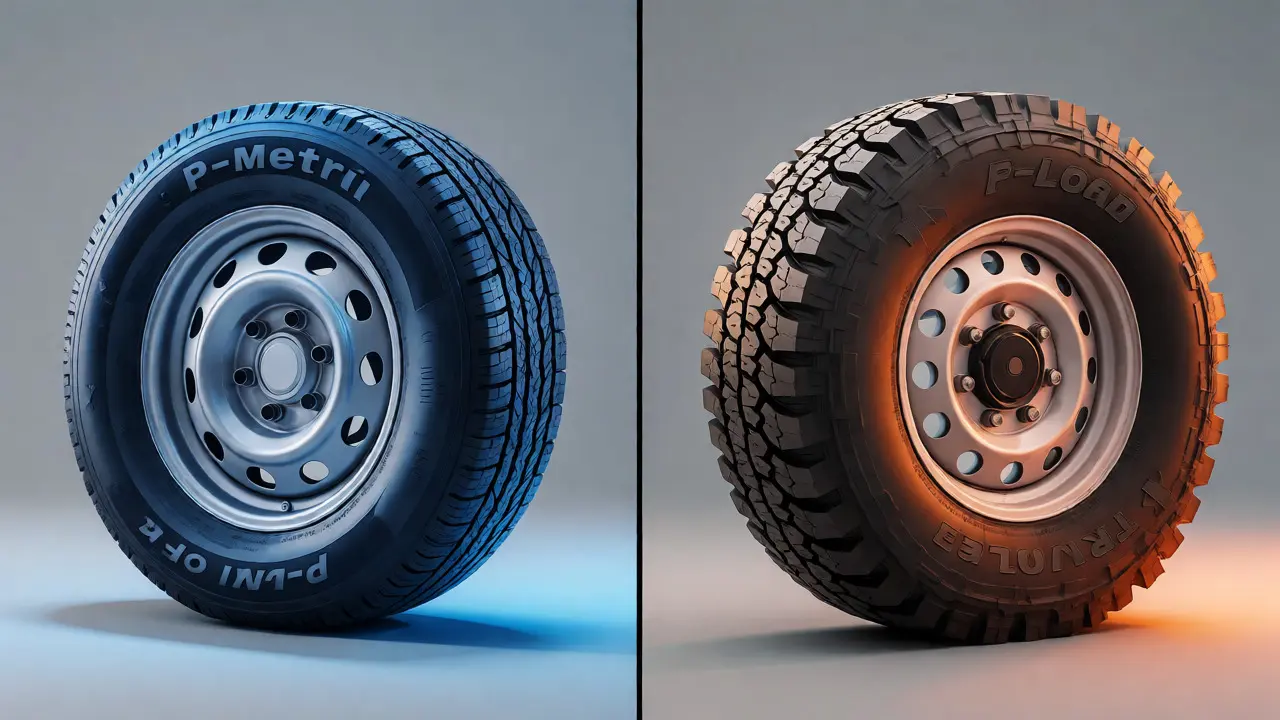
| Feature | P-Metric (Passenger) | E-Load (Light Truck) |
|---|---|---|
| Typical Max Pressure | 35 - 45 PSI | 60 - 80+ PSI |
| Sidewall Stiffness | Flexible, absorbs bumps | Rigid, resists deformation |
| Best Use Case | Daily commuting, empty bed | Towing, heavy payloads, off-road |
| Ride Comfort | High | Low (harsh) |
| Noise Level | Quiet | Loud/Humming |
This table highlights the core trade-off. You gain capacity with E-load tires, but you lose comfort. If you rarely tow more than 2,000 pounds and never carry construction materials, E-load tires might feel unnecessary and uncomfortable. However, if you regularly exceed your truck’s payload limit, P-metric tires will overheat and fail prematurely.
When to Choose E-Load Tires
So, who actually needs E-load tires? It’s not just for contractors. Consider your typical week. Do you haul a motorcycle trailer? Do you carry landscaping equipment in the bed? Do you live in an area with poor road conditions where potholes threaten your rims?
If you answered yes to any of these, E-load tires are likely your best bet. Their reinforced carcass protects against sidewall punctures, which are the leading cause of tire failure on rough terrain. A sharp rock that slices through a thin P-metric sidewall might just bounce off an E-load tire.
Moreover, stability changes dramatically under load. When you hook up a 5,000-pound boat trailer, your truck’s rear end sinks. With P-metric tires, the sidewalls bulge excessively, causing sway and unpredictable steering. E-load tires resist this squirm. They keep the contact patch flat against the pavement, giving you confidence during lane changes and braking.
Pro Tip: Check your owner’s manual for the Gross Vehicle Weight Rating (GVWR). Subtract your truck’s curb weight (what it weighs empty) from the GVWR. The remaining number is your payload capacity. If your gear plus passengers exceeds this number, you need E-load tires to stay within safe operating limits.
The Pitfalls of Mixing Tire Types
Can you mix P-metric and E-load tires on the same axle? Technically, yes, but it’s risky. Different tire constructions have different rolling radii and heat dissipation rates. If you put a stiff E-load tire next to a flexible P-metric tire, they won’t wear evenly. One might scrub faster than the other, leading to vibration issues that confuse your traction control system.
Worse yet, mismatched inflation pressures create uneven handling. Imagine turning a corner: the softer tire leans more, while the harder tire stays upright. Your truck pulls to one side, forcing you to constantly correct the steering wheel. Over time, this uneven wear damages your alignment components and reduces fuel economy.
If you must replace tires gradually, stick to the same category across all four wheels. If you’re upgrading from P-metric to E-load, change them all at once. This ensures uniform grip and predictable behavior in wet or icy conditions.
How to Read Your Door Jamb Sticker
Your truck tells you exactly what it wants. Open the driver’s side door and look at the sticker on the frame edge. It lists the original equipment tire size, the recommended cold inflation pressure, and sometimes the load index.
For many modern half-ton trucks, manufacturers specify a pressure around 35 PSI for front tires and 40 PSI for rear tires when using P-metric tires. If you switch to E-load tires, you generally need to increase this pressure to match the new tire’s rating-often up to 60 or 80 PSI. However, running E-load tires at full max pressure when the truck is empty makes the ride unbearable.
Here is a practical approach: Start by inflating your E-load tires to the pressure listed on the tire sidewall for the load you are carrying. Many manufacturers provide a chart showing pressure adjustments based on weight. For daily driving without cargo, you might drop E-load tires to 50 PSI for a compromise between comfort and safety. Never go below the minimum pressure required to support the vehicle's actual weight.
Maintenance Tips for Longevity
Tire life depends heavily on how you treat them. Here are three rules to extend the lifespan of either tire type:
- Rotate Regularly: Trucks tend to wear out rear tires faster due to payload distribution. Rotate every 5,000 to 7,500 miles. For E-load tires, pay attention to directional tread patterns if applicable.
- Check Pressure Monthly: Temperature drops reduce tire pressure. A 10-degree Fahrenheit drop lowers pressure by about 1 PSI. In winter, your tires might be underinflated without warning lights triggering. Underinflation causes excessive heat buildup, which kills tires.
- Inspect for Dry Rot: Even if you don’t drive much, rubber degrades over time. Check for cracks in the sidewalls, especially on E-load tires that sit at high pressure for long periods. UV exposure accelerates this process.
Remember, tires are consumables. No matter how expensive they are, they age. Most experts recommend replacing tires after six years, regardless of tread depth. The rubber compounds harden, losing grip and increasing stopping distances.
Can I use E-load tires on my car?
While physically possible if the size fits, it is generally not recommended for passenger cars. E-load tires require higher inflation pressures than most car suspensions are tuned for, resulting in a very harsh ride and potential damage to shock absorbers. Additionally, the heavier tire mass can negatively impact fuel economy and handling dynamics designed for lighter passenger tires.
Do E-load tires last longer than P-metric tires?
Not necessarily. E-load tires have tougher sidewalls and deeper treads, which helps them survive impacts and cuts. However, if you run them at incorrect pressures or use them for daily commuting without heavy loads, they may wear unevenly or develop center-strip wear due to over-inflation. P-metric tires optimized for light loads often provide similar mileage in appropriate applications.
What happens if I overload my truck with P-metric tires?
Overloading P-metric tires causes excessive sidewall flexing, which generates significant heat. This heat weakens the internal steel belts and rubber bonds, potentially leading to a sudden blowout. You might also notice poor braking performance, increased sway, and accelerated tread wear on the outer edges of the tire.
Is there a middle ground between P-metric and E-load?
Yes, some manufacturers offer tires with intermediate load ratings, such as D-load (8-ply equivalent) or specific hybrid designs. These provide more strength than standard P-metric tires but less stiffness than full E-load tires. Check the load index on the sidewall to find a rating that matches your typical payload without compromising too much on ride quality.
Does tire width affect load rating?
Yes, wider tires generally have a higher load index because they have a larger contact patch and more material to distribute weight. However, width alone is not enough; you must always verify the specific load index number assigned to that tire model. A wide tire with a low load index still cannot carry as much weight as a narrower tire with a high load index.