
Imagine pushing a bicycle up a steep hill. You’re working hard, but the air feels thin, and your legs burn because you aren’t getting enough oxygen to keep going. Now imagine someone giving you a fan that blows fresh air directly into your face with every pedal stroke. Suddenly, that climb feels easier, and you can maintain speed without exhausting yourself. That is essentially what turbocharging is a method of forced induction that uses exhaust gases to compress intake air, allowing an engine to burn more fuel and produce significantly more power than its displacement would normally allow. It transforms a standard engine into a high-performance machine by solving the fundamental problem of atmospheric pressure.
Most car engines rely on atmospheric pressure to push air into the cylinders. This is called "naturally aspirated." But atmospheric pressure limits how much air-and therefore how much fuel-can enter the engine. Turbocharging breaks that limit. By squeezing more air into the combustion chamber, you create a denser mixture that explodes with greater force. The result? More horsepower, better torque, and often improved efficiency compared to a larger naturally aspirated engine doing the same job.
How Does a Turbocharger Actually Work?
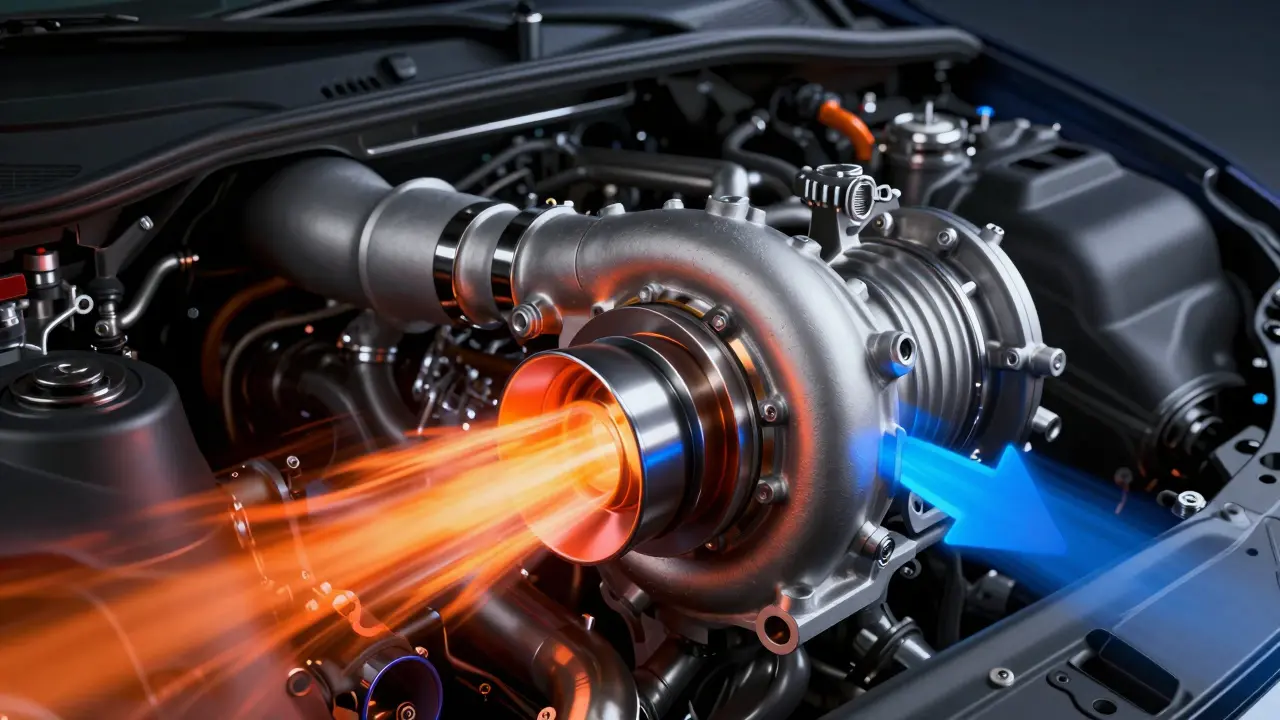
To understand why turbocharged cars feel so different, you have to look inside the engine bay. A turbocharger isn't just one part; it’s a system driven entirely by waste energy. Specifically, it uses the hot, expanding gases leaving your engine through the exhaust manifold.
The core component is a turbine wheel connected by a shaft to a compressor wheel. Here is the simple cycle:
- Exhaust Flow: When you step on the gas, the engine burns fuel, creating high-pressure exhaust gases.
- Turbine Spin: These gases rush out and hit the blades of the turbine wheel, causing it to spin at incredibly high speeds-often exceeding 100,000 RPM.
- Compression: Because the turbine is connected to the compressor via a central shaft, the compressor spins too. It sucks in ambient air and squeezes it tightly.
- Intake: This dense, compressed air is forced into the engine’s intake manifold, where it mixes with fuel for combustion.
Notice something important here: the turbo doesn’t draw power from the engine’s crankshaft like a supercharger does. It runs off free energy that would otherwise escape out the tailpipe. This makes it highly efficient. However, there is a catch. Since the turbo relies on exhaust flow, it needs time to spool up. This delay between pressing the accelerator and feeling the boost is known as turbo lag, which is the delay in throttle response caused by the time required for the turbine to reach sufficient rotational speed to generate boost pressure.
The Critical Role of Intercoolers
If compression were the only factor, turbocharging would be perfect. But physics throws a curveball. When you compress air, it heats up. Hot air is less dense than cold air. If you send scorching hot, compressed air into your engine, you lose some of the density gains you worked so hard to achieve. Worse, extreme heat can cause pre-ignition or detonation (knocking), which can destroy an engine in seconds.
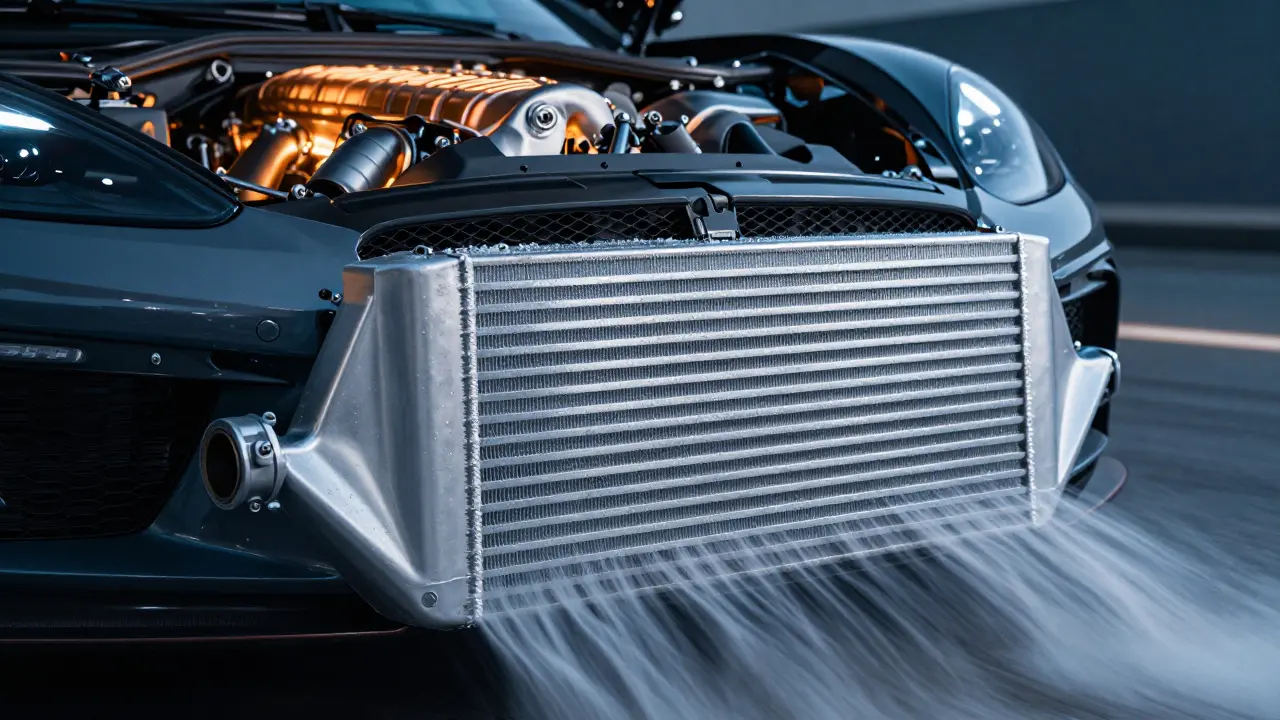
This is where the intercooler comes in. An intercooler is essentially a radiator for your intake air. After the turbo compresses the air, it passes through the intercooler before entering the engine. The intercooler sheds heat to the outside environment, cooling the air down. Cold air is denser, meaning more oxygen molecules per cubic inch. More oxygen means a more powerful explosion and a safer operating temperature for the engine.
There are two main types of intercoolers:
- Top-Mounted (Air-to-Air): Located above the engine. They are compact and common in factory setups but can suffer from heat soak since they sit right next to the hot engine block.
- Front-Mounted (FMIC): Located at the front of the car, behind the grille. They get a constant blast of fresh, cool air while driving, making them far more effective for sustained performance, though they require longer piping to connect back to the engine.
Turbo vs. Supercharger: Which Is Better?
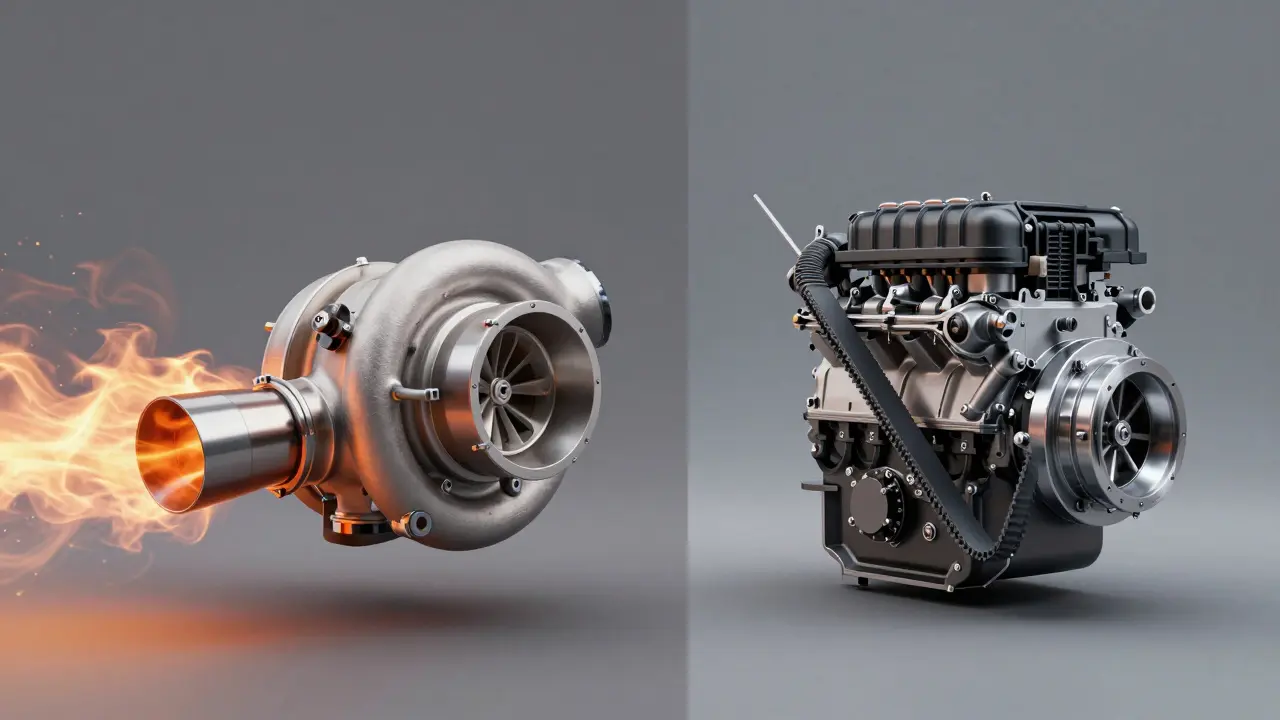
People often confuse turbos with superchargers because both are forms of forced induction. Both squeeze air into the engine. But their approach to delivering that air is fundamentally different, leading to distinct driving experiences.
| Feature | Turbocharger | Supercharger |
|---|---|---|
| Power Source | Exhaust gases (waste energy) | Engine crankshaft (belt-driven) |
| Response Time | Slower (exhibits turbo lag) | Instant (linear power delivery) |
| Efficiency | High (uses wasted energy) | Lower (parasitic drag on engine) |
| Complexity | Higher (requires oil lines, exhaust routing) | Lower (mechanically simpler) |
| Peak Power | Higher potential at high RPM | Consistent across RPM range |
Think of a supercharger like a bicycle gear that is always engaged. As soon as you pedal, you get resistance and power immediately. A turbocharger is like having a tailwind. You have to ride fast enough to catch the wind before it helps you. For daily drivers and fuel economy, turbos generally win. For track days where instant throttle response is critical, many enthusiasts prefer the linear punch of a supercharger.
Common Problems and Maintenance Tips
Turbocharged engines are robust, but they operate under higher stress levels than naturally aspirated ones. Heat and friction are the enemies. If you own or plan to buy a turbocharged vehicle, keeping these points in mind will extend the life of the hardware.
Oil Quality Matters More. Turbos spin at temperatures that can exceed 800°F (425°C). The bearings inside the turbo rely on a thin film of oil for lubrication and cooling. Cheap or old oil can break down under this heat, leading to sludge buildup or bearing failure. Stick to synthetic oils and change them more frequently than the manufacturer’s minimum recommendation if you drive aggressively.
Avoid Immediate Shutdown. This is the golden rule of turbo maintenance. When you stop the car after a hard drive, the turbo is still spinning hot. If you kill the engine, the oil pump stops. The residual heat in the turbo can cook the oil sitting in the bearings, turning it into varnish over time. Modern cars often have "turbo timers" or electric water pumps that run after shutdown to prevent this, but older models need you to idle the engine for 30-60 seconds before turning it off.
Watch for Oil Leaks. The seals around the turbo shaft can degrade due to heat cycling. If you see blue smoke from the exhaust or notice oil leaks near the exhaust manifold, check the turbo seals. Early detection prevents catastrophic engine damage from ingesting oil.
Modern Innovations: Reducing Lag and Boosting Efficiency
Manufacturers haven’t stood still regarding turbo technology. The biggest complaint about turbos has always been lag. Engineers have developed several clever solutions to make small turbos act like big ones.
Variable Geometry Turbochargers (VGT). Also known as variable nozzle turbos, these use adjustable vanes inside the turbine housing. At low RPMs, the vanes narrow the passage, forcing exhaust gases to hit the turbine blades faster, spooling the turbo quickly. At high RPMs, the vanes open up to allow maximum flow. This gives you both quick response and high-end power.
Twin-Scroll Turbos. Instead of mixing exhaust pulses from all cylinders into one chamber, twin-scroll designs separate them. This preserves the pulse energy of the exhaust gases, improving scavenging and reducing lag without moving parts.
Electric Assist Turbos. This is the cutting edge. Companies like Mercedes-Benz and Porsche now use small electric motors integrated into the turbo shaft. When you stomp on the gas, the electric motor instantly spins the compressor up to speed, eliminating lag entirely until the exhaust gases take over. It’s expensive, but it delivers the best of both worlds: turbo efficiency and supercharger-like immediacy.
Why Downsizing Engines Makes Sense
You might wonder why manufacturers are replacing large V6 and V8 engines with smaller 3-cylinder or 4-cylinder turbo engines. It’s not just about meeting emissions regulations. It’s about thermal efficiency.
A smaller engine running at partial load is more efficient than a large engine struggling to move the same weight. By adding a turbo, you can match the peak power of the larger engine while using less fuel during normal driving conditions. This concept, known as "downsizing," allows a 2.0-liter turbo four-cylinder to produce the same power as a 3.0-liter naturally aspirated six-cylinder, but with better city mileage and lower CO2 emissions.
However, this strategy requires precise engineering. The turbo must be perfectly matched to the engine’s displacement. Too small, and you get excessive lag and heat. Too big, and the engine feels flat and unresponsive. Getting this balance right is what separates great turbocharged cars from mediocre ones.
Is Turbocharging Right for Your Car?
If you are considering adding a turbo to a naturally aspirated engine, think twice. It’s not just bolting on a turbo kit. You’ll likely need stronger internal components (pistons, rods), upgraded fuel injectors, a larger intercooler, and significant tuning to manage air-fuel ratios and boost pressure. The cost often approaches that of buying a used performance car.
On the other hand, if you are buying a new car, turbocharged engines offer the best compromise between everyday usability and weekend thrills. Just remember to treat them with respect. Keep the oil fresh, let them cool down after hard drives, and listen to the engine. With proper care, a turbocharged engine can deliver decades of reliable, exciting performance.
What causes turbo lag and how can it be reduced?
Turbo lag is caused by the inertia of the turbine wheel. It takes time for exhaust gases to build enough momentum to spin the turbo fast enough to create boost. Lag can be reduced by using smaller turbos, variable geometry turbines (VGT), twin-scroll designs, or electric assist motors that spin the compressor instantly.
Do turbocharged engines last as long as naturally aspirated ones?
Yes, modern turbocharged engines are designed to last just as long as naturally aspirated ones. The key is maintenance. Because turbos run hotter and under higher pressure, using high-quality synthetic oil and following strict oil change intervals is crucial. Avoiding immediate shutdown after hard driving also extends turbo life.
Can I add a turbo to any car?
Technically, yes, but practically, it’s complex and expensive. Adding a turbo requires upgrading the exhaust, intake, intercooler, fuel system, and engine management computer. The engine internals may also need strengthening to handle increased cylinder pressures. It is usually more cost-effective to buy a turbocharged car than to convert one.
What is the difference between a turbo and a supercharger?
A turbocharger is driven by exhaust gases, making it more efficient but prone to lag. A supercharger is belt-driven by the engine crankshaft, providing instant power but creating parasitic drag that reduces fuel efficiency. Turbos are better for highway cruising and fuel economy; superchargers are preferred for instant throttle response.
Why do turbo engines need intercoolers?
Compressing air generates heat. Hot air is less dense, which reduces the amount of oxygen entering the engine. An intercooler cools the compressed air, increasing its density and preventing dangerous engine knocking. This results in more power and safer engine operation.