
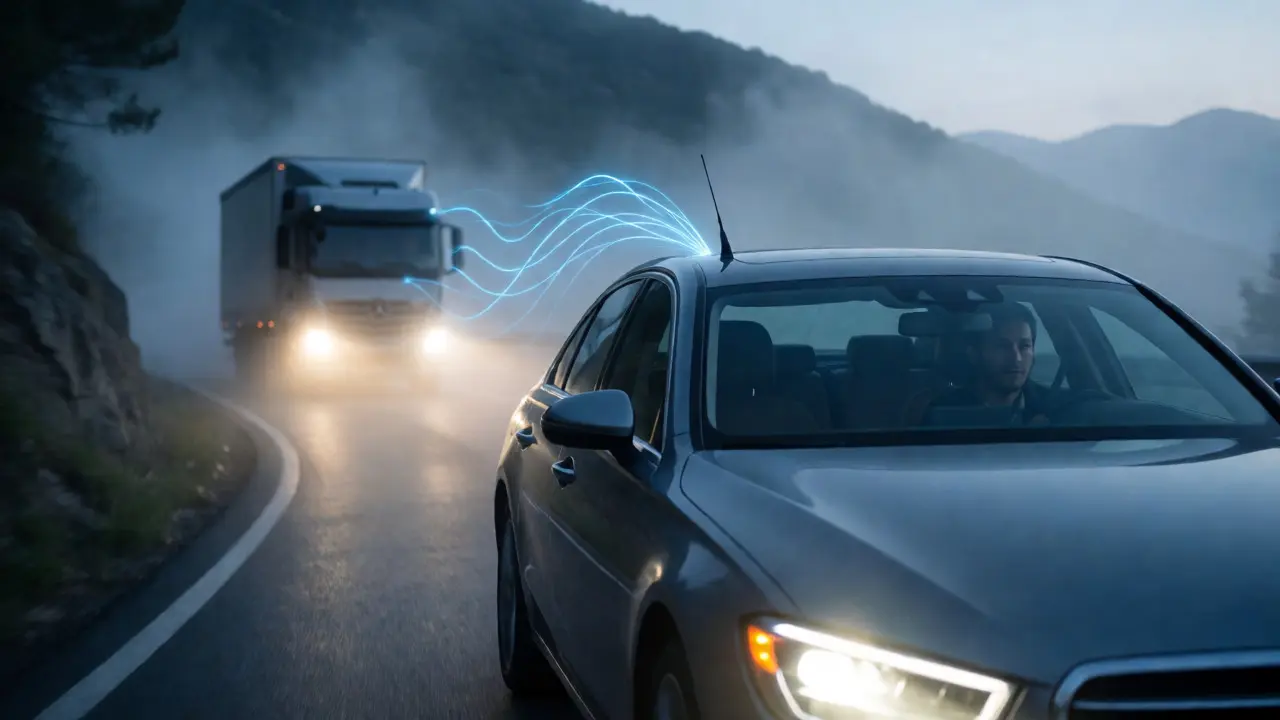
Imagine driving down a blind curve at 60 mph. You can’t see what’s coming around the bend, but your car does. It knows a truck is braking hard on the other side because that truck just broadcasted its speed and position to every vehicle within a quarter-mile radius. This isn't science fiction; it's Vehicle-to-Vehicle Communication, or V2V. It is a technology that allows cars to exchange data about their speed, direction, and location with nearby vehicles in real-time.
If you’ve ever wondered how autonomous cars will actually stay safe without relying solely on cameras and radar, V2V is the missing piece. Cameras have blind spots. Radar gets confused by rain. But radio waves? They cut through fog, darkness, and even physical barriers like buildings or hills. By September 2026, this tech has moved from experimental prototypes to standard equipment in many new models, fundamentally changing how we think about road safety.
How V2V Actually Works Under the Hood
At its core, V2V is a short-range wireless communication system. Think of it as a private Wi-Fi network for cars, but much faster and more reliable. Every equipped vehicle sends out a message called a Basic Safety Message (BSM) ten times per second. These messages contain critical data: latitude, longitude, elevation, heading, speed, and acceleration.
The magic happens when your car receives these messages from others. Your onboard computer calculates the trajectory of each surrounding vehicle. If two paths intersect dangerously, the system warns you. Unlike adaptive cruise control, which only looks ahead, V2V gives you a 360-degree awareness bubble. It works in all weather conditions because radio signals aren't blocked by snow or heavy rain the way optical sensors are.
There are two main standards competing for dominance here. The first is DSRC (Dedicated Short-Range Communications), which is based on Wi-Fi protocols. The second is C-V2X (Cellular Vehicle-to-Everything), which uses cellular networks. While DSRC was the early favorite, C-V2X has gained massive traction due to its ability to integrate with 5G networks and support longer-range communication.
The Real-World Benefits Beyond Just Avoiding Fender Benders
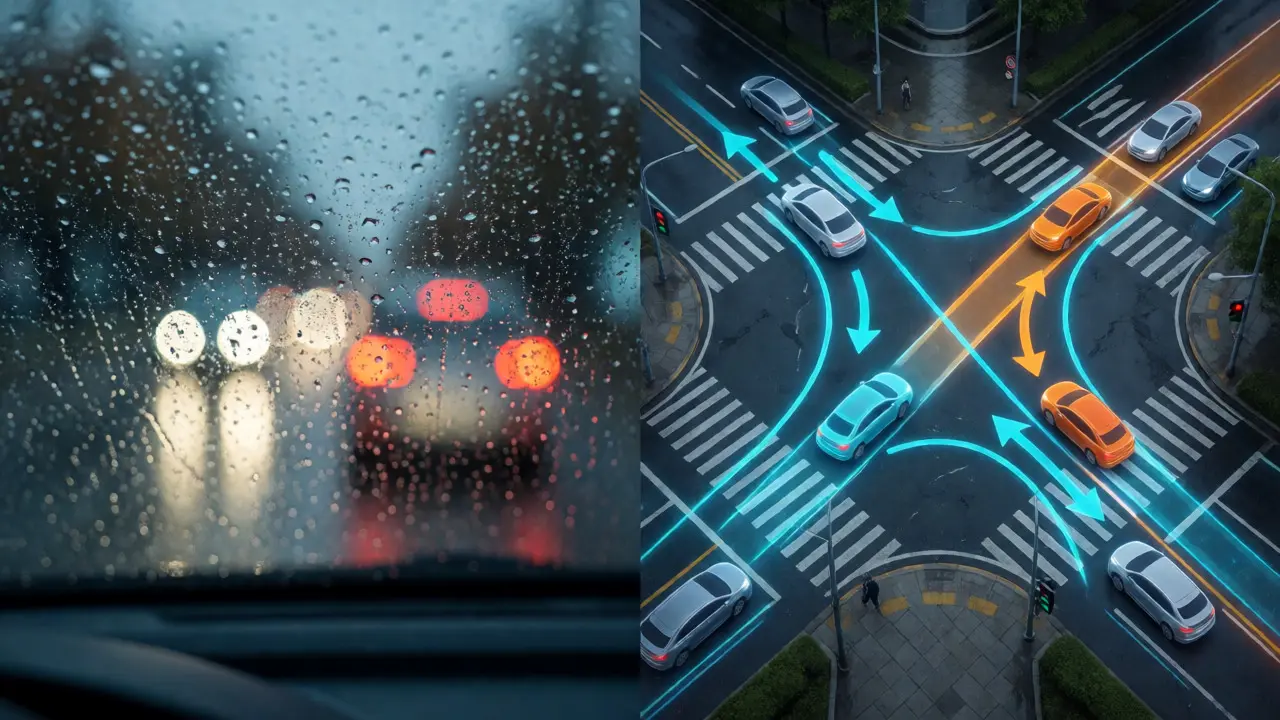
Sure, preventing a collision is great. But V2V offers benefits that go deeper than just saving your bumper. Consider traffic flow. When cars communicate, they can coordinate movements more smoothly. Imagine an intersection where no traffic lights are needed because every car knows exactly when the others will arrive. They weave through gaps seamlessly, reducing stop-and-go traffic and cutting fuel consumption.
- Blind Spot Elimination: Know if a car is hiding behind a large truck before you change lanes.
- Intersection Safety: Get alerts about vehicles running red lights from cross streets.
- Emergency Brake Warning: See brake lights three cars ahead, giving you time to react before the hazard reaches you.
- Cooperative Adaptive Cruise Control: Maintain tighter following distances safely because your car trusts the data from the car in front, not just its own sensors.
This technology also paves the way for true autonomy. Self-driving cars struggle with edge cases-unpredictable human behavior, obscured signs, or sudden obstacles. V2V removes the guesswork. If a pedestrian steps off a curb, their smartphone (if equipped with V2P, or Vehicle-to-Pedestrian) can alert nearby cars instantly. It creates a cooperative ecosystem rather than a competitive one.
V2V vs. ADAS Sensors: Why We Need Both
You might ask, "Why do I need V2V if my car already has cameras and LiDAR?" That’s a fair question. Advanced Driver Assistance Systems (ADAS) are powerful, but they have limits. Cameras rely on line-of-sight. If a delivery van blocks your view, you’re blind. LiDAR is expensive and struggles in heavy rain or snow. Radar is good for distance but poor at identifying object types.
| Feature | V2V Technology | Camera/LiDAR/Radar |
|---|---|---|
| Line of Sight | No (works through obstacles) | Yes (blocked by objects) |
| Weather Performance | High (radio waves penetrate rain/fog) | Variable (LiDAR/Cameras degrade in bad weather) |
| Range | Up to 1,000 meters | Typically under 200 meters |
| Data Type | Predictive (intent and trajectory) | Reactive (current state) |
| Cost to Implement | Low (chipset integration) | High (multiple sensor suites) |
V2V doesn't replace sensors; it complements them. Think of sensors as your eyes and ears, while V2V is like having a friend whispering warnings in your ear about things you can't see yet. The combination creates a redundant safety net. If your camera fails due to glare, V2V still knows the car next to you is drifting into your lane.
The Chicken-and-Egg Problem: Adoption Rates
Here is the catch: V2V only works if enough cars have it. If you’re the only person on the road with V2V, you’re talking to yourself. This is known as the network effect problem. For V2V to be truly effective, manufacturers argue that a critical mass of vehicles needs to be equipped. Estimates suggest that once penetration rates hit 20-30%, the safety benefits become statistically significant for everyone, even those without the tech, because accidents decrease overall.
As of late 2025, major automakers like Ford, General Motors, and Toyota have made V2V standard or optional packages on most new models. However, retrofitting older cars remains a challenge. Aftermarket devices exist, but they lack the deep integration with steering and braking systems that factory-installed units offer. You get a warning beep, but you don’t get automatic braking assistance.
Infrastructure plays a role too. This is where V2I (Vehicle-to-Infrastructure) comes in. Traffic lights, signs, and road sensors can also broadcast data. A smart traffic light can tell your car, "You're going to hit a red light in 4 seconds," allowing you to ease off the accelerator early. This saves fuel and reduces wear on brakes. Cities investing in smart infrastructure accelerate the utility of V2V, creating a feedback loop that encourages more drivers to buy connected cars.
Privacy and Security Concerns
Sharing your location ten times a second sounds like a privacy nightmare, right? Who wants their daily commute tracked by strangers? Fortunately, V2V is designed with anonymity in mind. The messages don't contain your name, license plate number, or VIN. They use rotating digital certificates that change frequently. This means other cars know a vehicle is approaching, but they don't know *who* owns it.
Security is another layer. Since these messages control safety-critical functions, hackers could theoretically spoof a signal. Imagine sending a fake message saying a car is braking when it isn't, causing a chain reaction of unnecessary stops. To prevent this, the industry uses public-key infrastructure (PKI) to sign every message. Your car verifies the signature before acting on the data. If the signature doesn't match, the message is ignored. It’s like checking the ID badge of anyone trying to enter a secure building.
What the Future Holds for Connected Vehicles
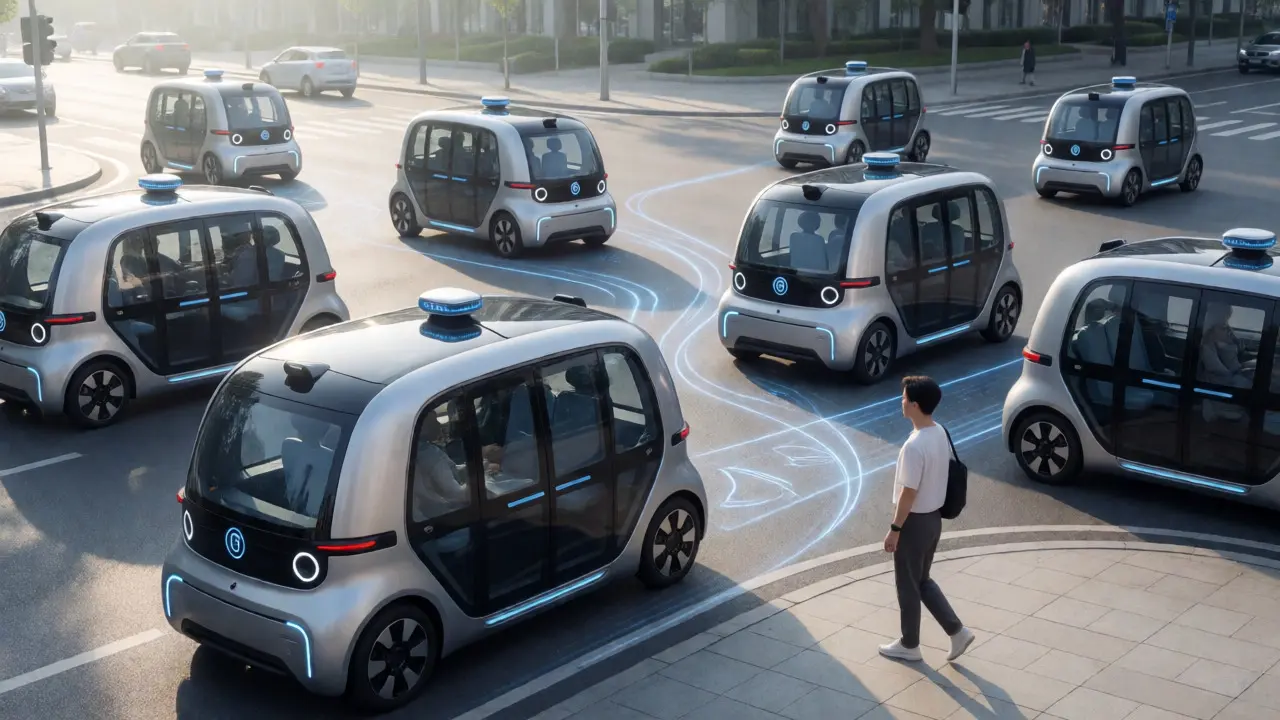
We are currently in the transition phase. The US Department of Transportation initially pushed for mandatory V2V via DSRC, but the shift toward C-V2X has complicated regulatory timelines. In Europe, the rollout is steady, with strict GDPR compliance ensuring user data stays protected. By 2027, we expect to see the first fully autonomous shuttles operating in dense urban areas using V2V as their primary navigation aid.
Long-term, V2V could eliminate the concept of traffic jams. If cars coordinate their speeds and spacing perfectly, phantom traffic jams caused by one driver tapping their brakes disappear. The goal isn't just safer roads; it's efficient ones. Less idling means lower emissions, contributing to cleaner air in cities like London, Bristol, and Manchester.
For now, if you're shopping for a new car, look for V2V capability as a key feature. It future-proofs your investment. As more cars join the network, the value of your specific vehicle increases. It’s a bit like buying a phone with 5G before 5G towers were everywhere-you’re ready for the upgrade when it arrives.
Does V2V work in tunnels or underground parking?
Generally, yes, but with limitations. Radio waves used by V2V (5.9 GHz band) can penetrate concrete and earth better than high-frequency cellular signals, but deep underground environments may attenuate the signal. Most modern systems include inertial measurement units (IMUs) to maintain location tracking when GPS signals are lost, ensuring V2V continues to function relative to other nearby vehicles.
Is V2V compatible with electric vehicles?
Absolutely. In fact, EVs benefit significantly from V2V. Cooperative Adaptive Cruise Control (CACC) enabled by V2V allows for smoother acceleration and deceleration patterns, which extends battery range by reducing energy wasted on abrupt stops and starts. Many EV manufacturers prioritize V2V integration for this efficiency gain.
Can I add V2V to my current car?
Retrofitting is possible but limited. You can purchase aftermarket OBD-II dongles or dash-mounted units that receive V2V messages and provide audible or visual alerts. However, these devices cannot interface directly with your car's braking or steering systems, so they won't trigger automatic emergency braking. Full integration usually requires a factory installation.
What is the difference between V2V and V2X?
V2V stands for Vehicle-to-Vehicle, meaning cars talk only to other cars. V2X stands for Vehicle-to-Everything, which is a broader umbrella term. V2X includes V2V, plus V2I (Vehicle-to-Infrastructure, talking to traffic lights/signs), V2P (Vehicle-to-Pedestrian, talking to smartphones/wearables), and V2N (Vehicle-to-Network, talking to cloud services). V2V is a subset of V2X.
Will V2V make my insurance premiums lower?
Potentially, yes. Insurance companies are increasingly offering telematics-based discounts. Because V2V helps prevent accidents, insurers view connected vehicles as lower risk. Some providers offer usage-based insurance programs where safe driving habits verified by V2V data can lead to significant premium reductions over time.
Comments
Mark Harvey
honestly this is the future of driving and i am so here for it 🚗💨
the part about blind spots being eliminated by radio waves is just mind blowing to me because we have been relying on mirrors for decades and that feels so outdated now
i think people underestimate how much stress comes from not knowing what is around you especially in heavy traffic or bad weather
when your car can basically see through a truck ahead of you it changes everything about how safe you feel behind the wheel
it is not just about avoiding crashes but also about reducing that low level anxiety that many drivers carry every single day
imagine never having to worry if someone is going to cut you off because their car already told yours they are turning
that kind of peace of mind is worth paying extra for imo
plus the idea of smoother traffic flow without stop and go patterns sounds like a dream come true for anyone who commutes long distances
less braking means less wear on our cars and probably better gas mileage too which helps our wallets
i hope more manufacturers push this standard quickly because waiting years for adoption feels painful when the tech is ready now
we need critical mass fast so everyone benefits not just early adopters with expensive new models
keep spreading the word everyone lets get connected roads happening soon 🙌
September 5, 2026 at 00:52
Art HND
Another overhyped tech solution looking for a problem.
DSRC is dead. C-V2X is just a way for cellular companies to sell more data plans.
Radar and LiDAR work fine without needing every other driver to buy a subscription service.
Privacy concerns are real despite the 'anonymity' marketing fluff.
September 6, 2026 at 19:15
alex kobri
Art makes a fair point about the corporate motives but dismissing the utility ignores the physics of line of sight limitations
Sensors cannot predict intent only position and speed
V2V provides context that sensors physically cannot capture in complex urban environments
It is not about replacing cameras it is about redundancy
If one system fails due to glare or fog the other catches the error
This layered approach to safety is engineering best practice not hype
We should be skeptical of marketing claims but not the underlying technology itself
September 7, 2026 at 05:31
Sabrina Newland
omg yes!! 🤯 the privacy thing always scares me but reading that they use rotating certificates actually made me feel way better 😅
like who wants some stranger knowing exactly where i live based on my commute patterns right?
but if its anonymous then its kinda like wearing a mask while still talking to people?
its weirdly philosophical how we trade some privacy for safety and convenience
i wonder if hackers could ever figure out a pattern in the rotation though? 👀
anyway i love that cars are becoming more social beings lol
its funny how we used to hate talking to neighbors but now our cars talk to each other constantly
maybe thats why humans are so isolated now lol
🚗💬👋
September 9, 2026 at 04:31
Amara Akbar
I completely agree with Alex regarding the necessity of redundant systems for optimal safety outcomes.
While skepticism toward corporate motives is healthy, we must recognize that V2V represents a significant leap forward in collision avoidance capabilities.
The ability to perceive threats beyond the horizon allows for proactive rather than reactive driving responses.
This shift in paradigm requires patience as infrastructure catches up to vehicle capabilities.
Let us remain open to the potential benefits while critically evaluating implementation challenges.
Together we can navigate this transition effectively.
Your perspective adds valuable nuance to the discussion.
September 9, 2026 at 08:35
Quintin Franzese
Oh great, now my car will gossip about my driving habits with the Honda Civic next door. Can't wait for my vehicle to judge my parallel parking skills in real-time. Truly, the pinnacle of human achievement: teaching metal boxes to snitch on each other.
September 10, 2026 at 03:56
Deb Kortyna, MBA
One must consider the sheer magnitude of the societal shift implied by this technology.
It is not merely an incremental improvement; it is a fundamental reimagining of vehicular interaction.
To dismiss it as mere gadgetry is to ignore the profound implications for public health and urban planning.
The reduction in accidents translates directly to reduced trauma and economic burden.
We stand at the precipice of a safer, more efficient era of transportation.
Resistance to such progress often stems from fear of the unknown rather than rational analysis.
Let us embrace this innovation with both caution and optimism.
September 10, 2026 at 21:30
Tamara Miller
Finally! Someone acknowledges the truth!!! 🎉
V2V is absolutely essential... it is NOT optional anymore!!!
People who refuse to adapt... are simply selfish!!!
They put everyone else at risk... by staying analog!!!
Insurance rates SHOULD reflect this... immediately!!!
Old cars... are dangerous relics... get rid of them!!!
We need mandatory upgrades... NOW!!!
Why are we still debating... basic safety features???
It is ridiculous... frankly speaking...
September 11, 2026 at 08:25
Zach Loescher
Interesting read. I'm curious how this interacts with existing ADAS calibration issues. Seems like software complexity might increase failure modes even if hardware redundancy improves.
September 12, 2026 at 14:12
Susan Cole
I appreciate the balanced view here. It’s good to hear that retrofitting options exist, even if limited. Makes me feel like I don’t have to rush to buy a new car yet.
September 13, 2026 at 00:33