
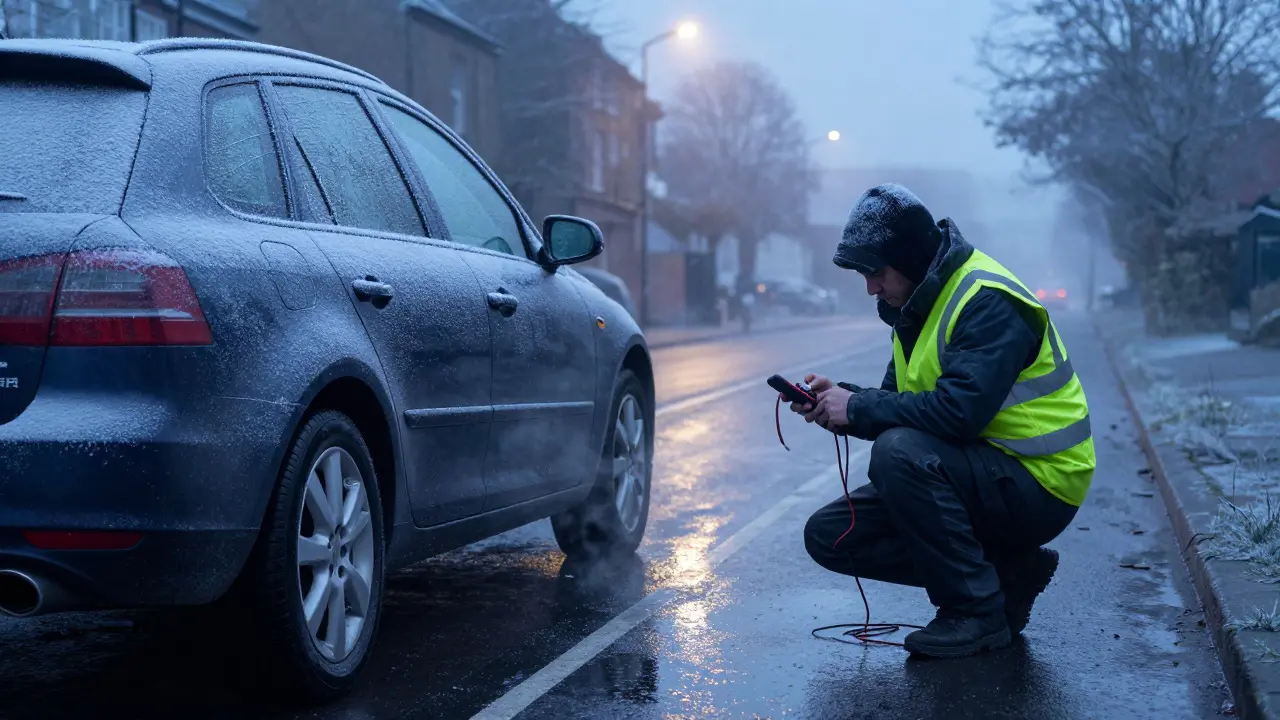
When the temperature drops below freezing, your car doesn’t just get cold-it starts to struggle. Windshield wipers freeze to the glass. Batteries lose half their power. Tires lose grip on icy roads. If you’re driving in the UK during winter, especially in places like Bristol where frost and rain turn streets slick, skipping winter car maintenance isn’t just inconvenient-it’s dangerous.
Check Your Battery Before the First Frost
Your car battery is the first thing to fail in cold weather. Cold slows down the chemical reactions inside it, cutting its capacity by up to 60% at -10°C. A battery that worked fine in October might not turn over your engine in December.Most car batteries last 3 to 5 years. If yours is older than that, get it tested. You can do this for free at most auto parts stores like Halfords or Kwik Fit. They’ll check voltage and cranking amps. A healthy battery should read 12.6 volts or higher when the engine is off. Anything below 12.4 volts means it’s weak and could leave you stranded.
Also clean the terminals. Corrosion-those white, powdery deposits-blocks electrical flow. Use a mixture of baking soda and water with an old toothbrush to scrub them. Rinse with clean water and dry thoroughly. Apply a thin layer of petroleum jelly to prevent future buildup.
Switch to Winter Tires or All-Seasons
Summer tires harden in cold weather. At 7°C and below, their rubber loses flexibility, meaning less grip on wet, icy, or snowy roads. Winter tires are made with special rubber compounds and deeper tread patterns designed to stay soft and bite into snow and ice.In the UK, you don’t legally need winter tires, but if you drive regularly on country roads or hills around the Cotswolds, they’re a smart investment. Look for the three-peak mountain snowflake symbol (3PMSF) on the sidewall-that’s the official mark for winter-rated tires.
If you don’t want to buy a second set of tires, go for all-season tires with the 3PMSF symbol. They’re not as good as dedicated winter tires in deep snow, but they’re far better than summer tires in freezing rain. Replace tires when tread depth drops below 3mm. The legal minimum is 1.6mm, but that’s not safe in winter conditions.
Top Up and Use the Right Antifreeze
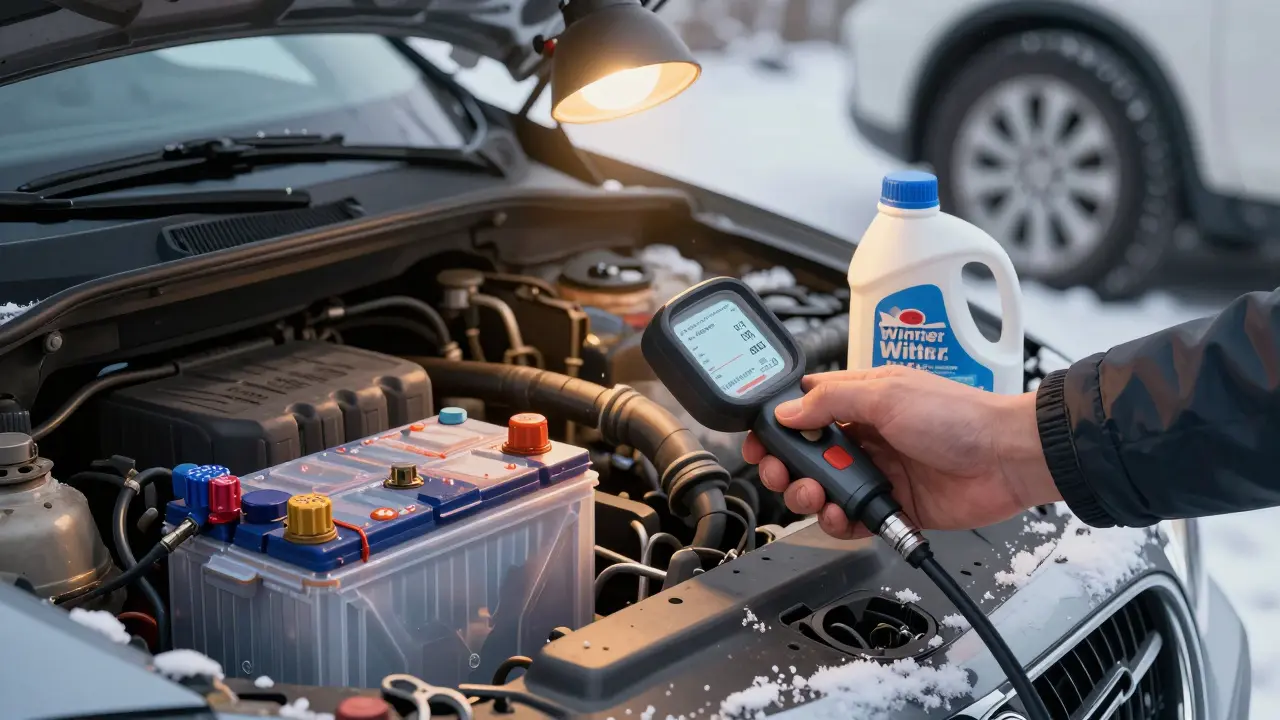
Coolant, or antifreeze, doesn’t just stop your engine from overheating. It also prevents freezing. A 50/50 mix of antifreeze and water protects down to -37°C. But if you’ve just topped up with plain water-common after a leak or evaporation-you’ve created a ticking time bomb.Check your coolant level in the overflow tank, not the radiator. The tank has minimum and maximum marks. If it’s low, top it up with the correct type of antifreeze for your car. Mixing different types can cause sludge and blockages. Most modern cars use organic acid technology (OAT) coolant-check your manual.
Use a coolant tester, available for under £10 at Halfords, to check freeze protection. Squeeze the bulb, draw in fluid, and read the color. If it shows protection only down to -5°C, you’re at risk. Flush and refill if needed. Don’t wait until the first snowfall.
Inspect Wipers and Replace Fluid
Winter rain, sleet, and road grime make windshield visibility critical. Wiper blades crack and harden over time. If they streak, chatter, or leave smears, replace them. Rubber blades last about 6 to 12 months, and winter conditions wear them out faster.Use winter-grade washer fluid. Regular fluid freezes at 0°C. Winter fluid contains methanol or ethanol and won’t freeze until -20°C or lower. Keep a spare bottle in the boot. And don’t forget to test your rear wiper and headlight washers-many drivers forget them until they’re covered in mud and can’t see.
Ensure Your Heating and Defrosting Systems Work
A working heater isn’t just for comfort-it’s for safety. Fogged-up windows kill visibility. If your defroster is slow or blows cold air, the problem could be low coolant, a faulty blower motor, or a clogged cabin air filter.Replace the cabin air filter every 12,000 to 15,000 miles. It’s usually behind the glovebox and takes 10 minutes to swap. A dirty filter reduces airflow, making defrosting take twice as long. Also check that all vents open and close properly. If the heater only works on high speed, the resistor pack might be failing.
Test the rear window defroster too. If any lines are broken, they’re easy to repair with a conductive paint kit from Amazon for under £15.
Check Lights and Keep Them Clean
Shorter days and frequent fog mean you’re driving in low light more often. One burnt-out bulb can make you invisible to other drivers. Check all lights monthly: headlights (high and low beam), brake lights, indicators, fog lights, and reverse lights.Use a flashlight at dusk to walk around your car. Ask someone to help you check brake lights. Replace halogen bulbs with LED equivalents if your car allows it-LEDs are brighter, last longer, and use less power. Clean lenses with toothpaste and a soft cloth. Cloudy lenses scatter light and reduce output by up to 40%.
Keep an Emergency Kit in the Boot
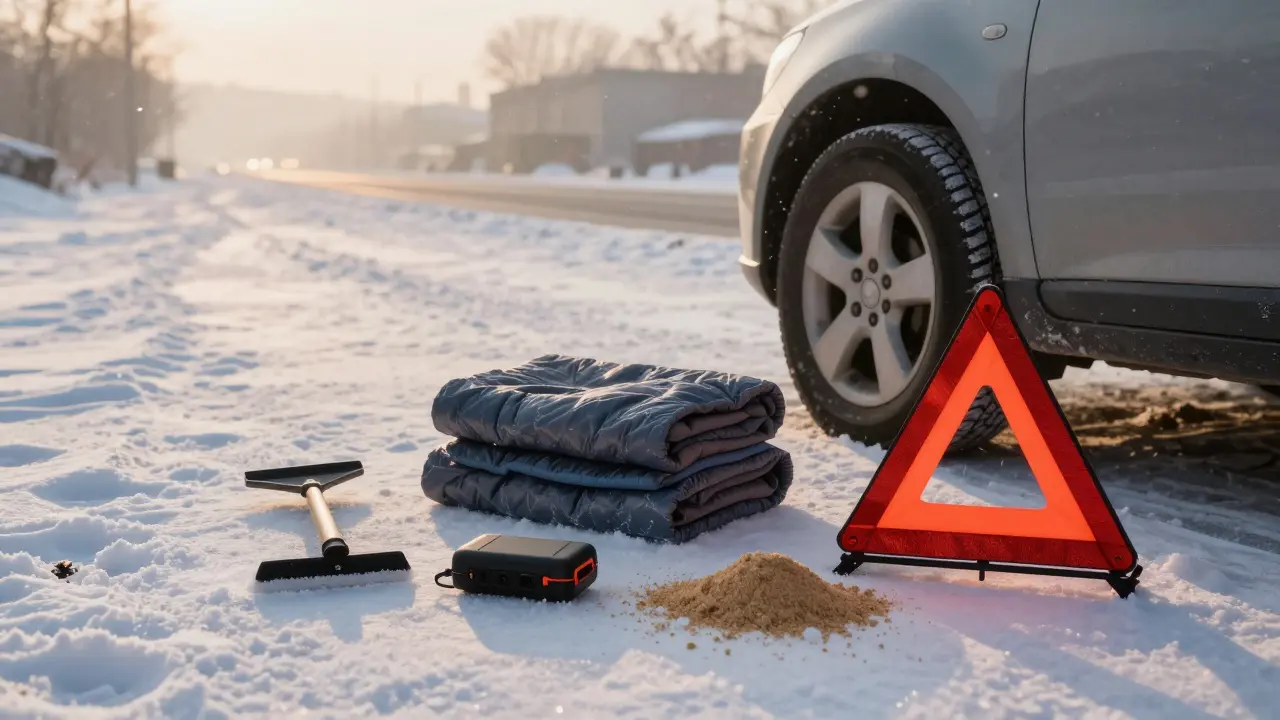
Even the best-maintained car can break down in winter. Always carry these essentials:- Ice scraper and snow brush
- Blanket or thermal wrap
- Non-perishable snacks and bottled water
- Portable phone charger (power bank)
- Jump leads or a portable battery starter
- Sand or cat litter for traction if stuck
- High-visibility vest and warning triangle
Store these in a waterproof bag. Keep the blanket and snacks in the cabin, not the boot, in case you’re trapped. If you’re stranded on the M4 or A38 in freezing rain, warmth and hydration can be lifesaving.
Don’t Ignore the Fuel System
Water in your fuel tank can freeze and block fuel lines. Condensation builds up when the tank is half-empty or less. Always keep your tank at least half full during winter. It reduces air space and limits moisture buildup.Use a fuel additive designed for winter. Products like STA-BIL or Red Line Fuel System Cleaner prevent water from freezing and clean injectors. Add them every time you fill up from November through March. Avoid cheap, no-name brands-they often don’t contain enough alcohol to be effective.
Drive Smarter, Not Harder
Maintenance isn’t just about parts-it’s about habits. In winter:- Warm up your car for 30 seconds, not 10 minutes. Modern engines don’t need long idling.
- Accelerate slowly. Sudden power can spin wheels on ice.
- Leave double the stopping distance. Wet, icy roads can double braking time.
- Clear all snow from the roof before driving. It can slide forward and block your view.
- Don’t use cruise control on slippery roads.
These habits won’t fix a bad battery or worn tires-but they’ll keep you alive while you fix them.
How often should I check my car for winter readiness?
Do a full winter check at least once in late October or early November, before temperatures consistently drop below 5°C. Then do a quick visual check every two weeks-especially before long trips. Focus on tires, lights, fluid levels, and wipers.
Can I use summer tires in winter if I drive slowly?
No. Even at low speeds, summer tires lose grip on ice and wet roads below 7°C. They take 40% longer to stop than winter tires in freezing rain. Slowing down helps, but it doesn’t replace proper tires. The risk of skidding or losing control is too high.
Is it worth getting winter tires if I only drive to work?
Yes, if you drive on any road that’s not fully salted or cleared. Even a 10-minute commute on a hill in Bristol can become dangerous with black ice. Winter tires improve control, reduce accidents, and give you more confidence. Many drivers keep a second set of wheels with winter tires mounted, switching them seasonally to save wear.
Why does my car struggle to start in the morning?
Cold thickens engine oil and drains battery power. If your car cranks slowly or clicks, your battery is likely weak. Also check the oil viscosity-switch to 5W-30 or 0W-20 in winter. Thinner oil flows better in cold. If the problem started suddenly, get the battery and alternator tested immediately.
Should I wash my car more often in winter?
Yes. Road salt and grime eat away at brake lines, wheel wells, and undercarriage. Wash your car every two weeks, especially after snow or rain. Focus on the underside with a pressure washer if possible. Rinse wheel arches and door sills. Waxing in autumn helps, but washing is the real defense against rust.
Comments
Tarun nahata
Yo, winter’s not the enemy - it’s just testing your ride’s grit. I swapped to winter tires last year and my 2018 Civic went from a scaredy-cat to a snow ninja. No more white-knuckle drives on the A38. If you’re still using summer rubber, you’re basically driving a brick with a steering wheel. Do yourself a favor - get those 3PMSF tires. Your future self will high-five you while sipping hot chai in a warm garage.
January 11, 2026 at 11:23
Aryan Jain
They don’t want you to know this but the government secretly pushes winter tire fear so they can sell more batteries. The real issue? Cold weather is just nature’s way of exposing weak systems. Your battery’s fine. Your car’s fine. It’s the system - the oil companies, the tire corporations, the auto shops - they’re all in cahoots. Just drive slower. That’s it. No fancy fluids. No $200 tire swaps. Trust the universe. And maybe don’t trust anything you read online.
January 12, 2026 at 11:55
Nalini Venugopal
Just a quick note - you wrote ‘antifreeze’ as one word in the title but then used ‘anti-freeze’ later. Minor thing, but it’s a consistency thing. Also, ‘wiper blades’ should be plural in ‘replace wiper blades’ - you had it right once but slipped in another spot. And PLEASE don’t forget the rear wiper! I once drove for 40 minutes in sleet with zero rear visibility and nearly hit a hedgehog. Sad story, but true. 😅
January 14, 2026 at 09:04
Pramod Usdadiya
Hey thanks for this guide really helpful i never knew about the coolant tester thing before now i got one from halfords and it saved me last week when it dropped to -4c. Also i found out my battery was at 12.1v so i replaced it and now my car starts like a dream. One thing though - i think you meant ‘petroleum jelly’ not ‘petroleum jelly’ - wait no you got it right lol. My typo not yours. Keep it up!
January 16, 2026 at 00:25
Aditya Singh Bisht
If you’re reading this and thinking ‘I’ll just wait till it snows’ - stop. Right now. Go outside. Look at your tires. Are they balding? Are they hard like old chewing gum? If yes, you’re not being smart - you’re being lucky. Luck runs out in Bristol when you hit black ice on a hill at 30mph. Don’t wait for the car to fail. Do the 1-hour check this weekend. Your family doesn’t want to hear ‘I didn’t think it’d be that bad.’ It will be. And you’ll wish you’d listened.
January 17, 2026 at 08:34
Amit Umarani
‘Top up with the correct type of antifreeze’ - vague. Which type? OAT? HOAT? IAT? You didn’t specify. Also, ‘use toothpaste to clean lenses’ - that’s abrasive. It scratches polycarbonate. Use a proper lens restoration kit. And ‘don’t use cruise control’ - true, but you didn’t mention why. It disengages traction control. Also, ‘cat litter’ for traction? That’s a myth. Sand works. Cat litter just makes a mess. This guide is 80% good. The rest is amateur hour.
January 17, 2026 at 20:52
Noel Dhiraj
Just wanted to say thanks for laying this out so clearly. I’m new to driving in the UK and I’ve been nervous about winter. This helped me feel like I’m not totally lost. I did the battery test yesterday at Kwik Fit - they said I’ve got another year. Also picked up a cheap ice scraper and a power bank. I’m gonna keep the blanket in the back seat now. Honestly, I didn’t realize how much I didn’t know. You made it feel doable. Keep sharing stuff like this.
January 19, 2026 at 19:51
vidhi patel
It is imperative to underscore the egregious negligence exhibited by individuals who disregard the manufacturer's specified coolant specifications. The use of non-OAT coolant in modern vehicles constitutes a direct violation of engineering protocols and may result in catastrophic engine failure. Furthermore, the recommendation to employ toothpaste for headlight restoration is not only scientifically unsound but also constitutes a breach of automotive maintenance ethics. I urge all readers to consult their owner’s manual and refrain from adopting unverified, anecdotal advice. This post, while well-intentioned, is dangerously misleading in several critical respects.
January 21, 2026 at 00:47