

Zero percent financing sounds like a dream. No interest. No extra cost. Just drive off the lot with a brand-new car and pay exactly what the sticker says. But here’s the truth: if you’re reading this, you’re probably wondering if it’s too good to be true - and you’re right to ask. Most people who get 0% financing don’t realize how narrow the window is, or how much they’re giving up to get it. This isn’t about tricks or hidden fees. It’s about understanding the trade-offs so you don’t end up stuck with a car you can’t afford or a loan that looks great on paper but hurts your wallet in the long run.
Who Actually Qualifies for Zero Percent Financing?
Zero percent financing isn’t offered to everyone. It’s not a discount. It’s a marketing tool used by manufacturers to move specific models - usually slow-sellers, end-of-year inventory, or new releases that need buzz. The catch? You need to be a near-perfect credit risk. Most lenders require a credit score of 720 or higher. Some brands, like Toyota or Honda, might accept 700, but that’s the lower limit. If your score is below that, you won’t even see the offer on the website.
It’s not just about your score. Lenders also look at your debt-to-income ratio. If you’re already paying $1,200 a month on student loans and rent, and you’re asking for a $40,000 car, they’ll say no. They want to see stable income - two years of consistent employment, a low amount of existing debt, and a clean credit history with no late payments in the last 12 months. Even one missed payment can knock you out of running.
There’s another hidden rule: the loan term. Zero percent deals usually cap at 48 or 60 months. If you stretch it to 72 months, the rate jumps to 3% or more. That’s because the manufacturer is subsidizing the interest for a shorter period. Longer terms mean more risk for them, so they don’t offer 0% on them. If you’re told you can get 0% on a 72-month loan, double-check the fine print. It’s probably a bait-and-switch.
What You’re Giving Up to Get 0% APR
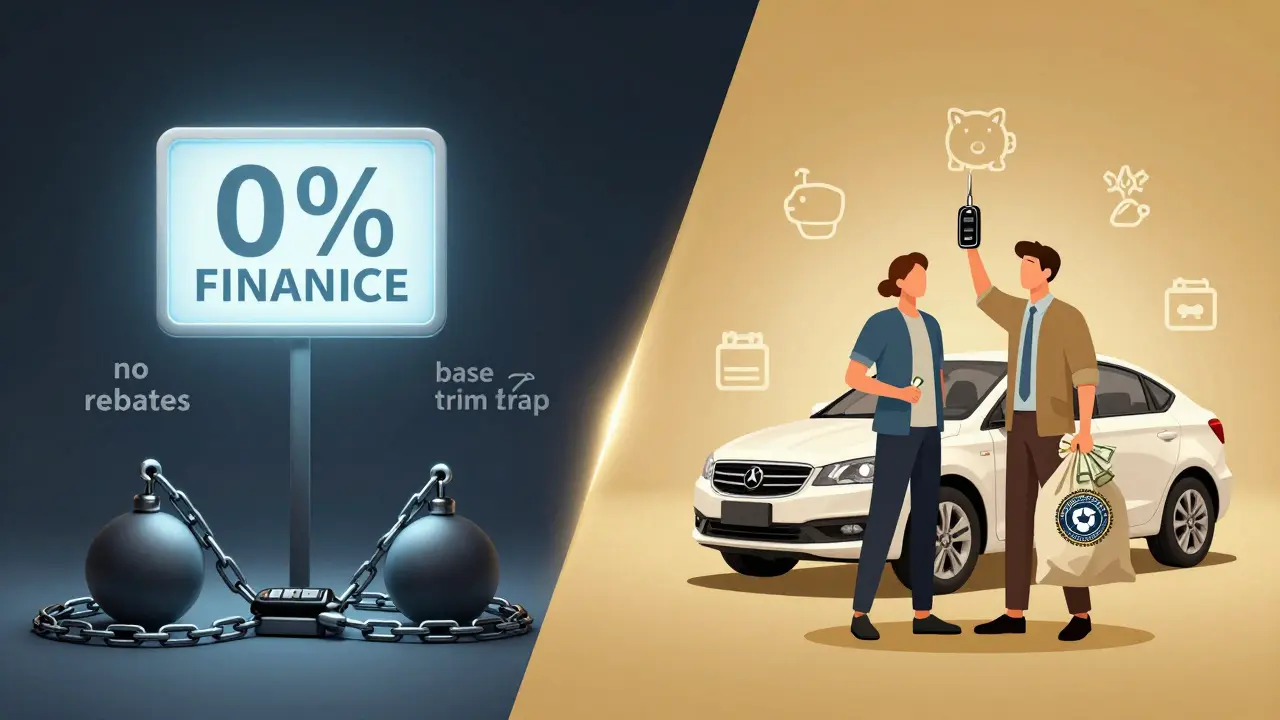
Here’s the part no salesperson will tell you: 0% financing often comes with strings attached. The biggest one? No rebates. If you take the 0% deal, you lose the chance to get $3,000 or $5,000 in cash back. That’s not a small amount. On a $30,000 car, $5,000 cash back is a 16.7% discount. Even if you pay interest at 4%, you’re still better off taking the cash and financing separately.
Let’s say you buy a $32,000 car. Option A: 0% for 60 months. You pay $533 a month. Option B: $5,000 cash back, so you finance $27,000 at 4.5% over 60 months. Your monthly payment is $505. You save $28 a month - that’s $1,680 over five years. Plus, you still have $5,000 in your pocket. You can use it for repairs, insurance, or even put it toward a down payment on your next car.
Another hidden cost? Limited inventory. The cars with 0% financing are usually base models with no options. Want leather seats? A sunroof? A better sound system? You’ll pay full price for those. The 0% deal only applies to the base trim. So you’re not getting a loaded car for free. You’re getting a stripped-down version, and then paying extra for everything you actually want.
Alternatives That Actually Save You Money
If you don’t qualify for 0% financing - or if you do but the deal isn’t as good as it looks - here are three better paths.
- Get a loan from your credit union - Credit unions often offer lower rates than dealerships, even if you don’t have perfect credit. Members of Navy Federal or PenFed, for example, regularly get rates between 2.5% and 4% on new cars. They also let you bundle in extended warranties or service plans without jacking up the rate. And unlike dealerships, they don’t push you into longer terms just to make the payment look affordable.
- Buy a certified pre-owned (CPO) car - A 2-year-old car with a manufacturer-backed warranty can save you 20% to 30% off the new price. Many CPO programs include free maintenance, roadside assistance, and even 0% financing - but with more flexible credit requirements. A 2023 Honda Civic CPO with 15,000 miles might cost $22,000. You can finance that at 3.5% for 72 months and still pay less per month than a new car with 0% APR.
- Save up and pay cash - This sounds old-school, but it’s the smartest move if you can do it. No debt. No interest. No monthly stress. If you’re planning to buy a car in the next year, set aside $500 a month. In 12 months, you’ll have $6,000. That’s enough to cover a decent used car outright. You’ll avoid the entire financing game.
Why Dealerships Push Zero Percent Financing
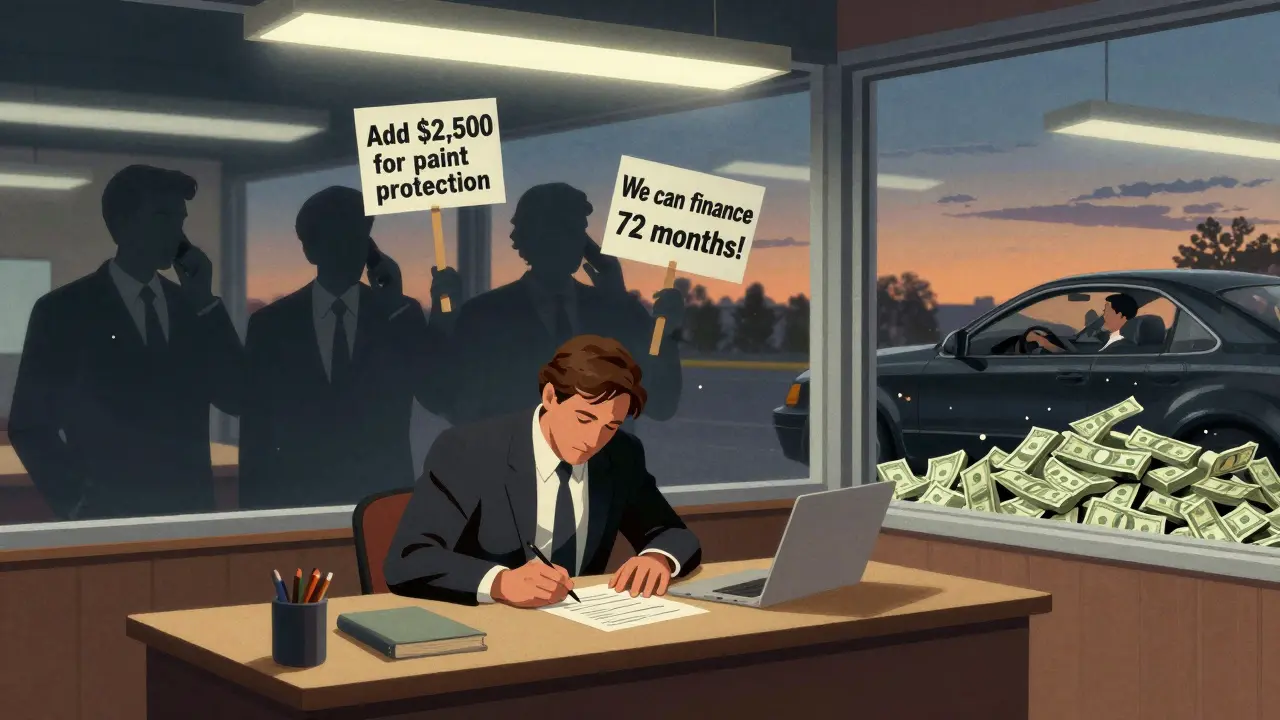
Dealers don’t offer 0% financing because they’re generous. They do it because they make money in other ways. When you take the 0% deal, they get paid a bonus by the manufacturer for moving that specific model. They also know you’re more likely to buy extras - extended warranties, paint protection, gap insurance, rustproofing. These add-ons cost the dealer $200 to $500 but sell for $1,500 to $3,000. They make their profit on the extras, not the car.
They also know that if you’re excited about 0% financing, you’ll be less likely to shop around. You’ll walk in thinking you’ve won the lottery. They’ll keep you there for hours, showing you every add-on, every upgrade, every “limited-time offer.” By the time you leave, you’ve spent $8,000 more than you planned.
The best defense? Go in with a clear plan. Know exactly what car you want. Know the market price (use Kelley Blue Book or Autotrader). Know your credit score. And never let them start talking about financing until you’ve locked in the car price.
When Zero Percent Financing Makes Sense
There are times when 0% is the right move - but only if you meet all these conditions:
- Your credit score is 740 or higher
- You’re buying a model that has no cash-back rebate
- You’re getting a trim level with the features you actually need
- You’re comfortable with a 48- or 60-month term
- You won’t be tempted to add $5,000 in extras
If all five are true, go for it. But if even one is false, walk away. The savings from 0% APR are real - but they’re only real if you don’t give them back through hidden costs.
What to Do If You’re Denied
If you’re turned down for 0% financing, don’t panic. It’s not the end of the road. Start by checking your credit report for errors. A single late payment from two years ago might still be listed - and it’s fixable. You can dispute it with Experian, Equifax, or TransUnion. It takes 30 days, but it can raise your score by 50 points.
Next, talk to your bank or credit union. Many offer pre-approval for auto loans. That gives you leverage. When you walk into the dealership, you’re not begging for a loan - you’re showing them you have better options. That changes the whole negotiation.
And if you’re still not approved? Consider a used car. A 2022 or 2023 model with low mileage often has better value than a new one. You’ll get more features for less money. And you’ll avoid the steep depreciation that hits new cars in the first year.
Final Tip: Don’t Let Emotion Drive the Deal
Zero percent financing triggers a psychological response. It feels like a win. But smart buyers know: the best deal isn’t the one that sounds the best. It’s the one that fits your budget, your needs, and your life.
Before you sign anything, ask yourself: Would I still buy this car if the interest rate was 6%? If the answer is no, then the 0% offer is just a distraction. Walk away. Come back next week. You’ll find a better option.
Can I get zero percent financing with a 650 credit score?
It’s very unlikely. Most 0% financing offers require a credit score of 720 or higher. A 650 score might qualify you for a standard auto loan with an interest rate between 6% and 10%, depending on the lender. Focus on improving your credit first - pay down debt, make on-time payments, and check for errors on your credit report. Even a 50-point boost can open up better rates.
Is zero percent financing really free money?
No. It’s not free. The manufacturer covers the interest cost to make you buy their car. But they make up for it by offering the deal only on slow-selling models, limiting it to base trims, and removing cash-back rebates. You’re trading upfront savings for fewer options and less flexibility. Always compare the total cost - including rebates and fees - before deciding.
Should I finance a car for 72 months to get a lower payment?
Only if you can’t afford a shorter term. Longer loans mean you’ll pay more in interest over time, even with 0% financing. More importantly, you’ll be upside-down on the loan - owing more than the car is worth - for years. That makes trading in or selling the car difficult. Stick to 48 or 60 months if possible. Lower payments aren’t worth the long-term risk.
Can I combine zero percent financing with a trade-in?
Yes, but be careful. Dealers often roll your trade-in value into the new loan, which increases your total amount financed. That can push you into a higher monthly payment than expected. Make sure the trade-in value is fair (check Kelley Blue Book), and ask them to show you the breakdown: car price, trade-in value, fees, and final loan amount. Never let them hide the numbers.
What’s better: 0% financing or a cash rebate?
In most cases, the cash rebate is better. For example, on a $30,000 car, a $5,000 rebate reduces your loan amount to $25,000. Even at 4% interest, your monthly payment will be lower than if you took 0% on the full $30,000. Plus, you keep the $5,000 in cash for repairs, insurance, or emergencies. Always calculate both options side by side using a loan calculator.
If you’re shopping for a car right now, don’t fall for the hype. Zero percent financing is a tool - not a gift. Use it wisely, or walk away and find a deal that actually works for you.
Comments
Chris Heffron
Zero percent financing? Sounds like a fairy tale told by someone who’s never read the fine print. 😅
December 17, 2025 at 04:38
Adrienne Temple
I love how this breaks it all down. So many people think 0% is free money, but it’s really just a bait-and-switch with extra steps. 💡
My cousin took the 0% deal on a Camry, lost the $4K rebate, and ended up paying $3K more for leather and a sunroof he never used. Classic.
December 17, 2025 at 13:03
Sandy Dog
OH MY GOD. I JUST GOT DENIED FOR 0% FINANCING AFTER SPENDING 3 HOURS AT THE DEALERSHIP AND THEY WERE SO NICE AND I TRUSTED THEM AND THEN THEY SAID MY SCORE WAS 708 BUT STILL NOT GOOD ENOUGH?? 😭
Now I’m sitting in my 2015 Corolla crying while listening to ‘Never Gonna Give You Up’ on repeat. I feel so used. Like, I thought I was winning the lottery and instead I got scammed by a guy in a polo shirt who called me ‘sweetheart.’
Also, why do they always say ‘we’re just trying to help you’ when they’re trying to sell you $2K in rustproofing??
I’m never buying a car again. I’m moving to a city with bikes. Or a goat. A goat would be easier.
December 19, 2025 at 10:24
Nick Rios
Really appreciate this breakdown. A lot of people get caught up in the excitement of 0% and don’t realize how much they’re sacrificing.
My advice? Always run the numbers yourself. Use a loan calculator. Compare the cash-back option vs. 0% with the same term. You’ll be surprised how often the rebate wins.
And if you’re unsure? Walk away. Come back tomorrow. The car won’t disappear.
December 19, 2025 at 19:07
Amanda Harkins
the part about dealers making bank on add-ons? yeah. they’ll literally sell you a $1500 ‘protection package’ that includes a car wash and a sticker. i once paid $2k extra because i felt bad saying no. don’t be me.
December 21, 2025 at 08:37
Jeanie Watson
So… if you have a 680 score, you’re just out of luck? No middle ground? Feels like the system’s rigged.
December 23, 2025 at 05:00
Tom Mikota
0% financing? More like 0% common sense. Dealers don’t give out free money-they give out traps wrapped in shiny rims and a smile. And don’t even get me started on the ‘72-month 0%’ lie-unless you’re planning to keep the car until it’s a museum piece, don’t touch it.
Also, ‘base model’? That’s code for ‘you’re getting the car with no air conditioning and a radio that only plays AM.’
December 24, 2025 at 08:55
Mark Tipton
Let me break this down with actual data. According to J.D. Power’s 2023 Auto Finance Report, 87% of 0% offers are restricted to models with inventory over 90 days. The average rebate forgone is $4,120. Meanwhile, the average add-on purchase at dealership financing is $2,380. The manufacturer pays the dealer a $1,500 bonus for moving the vehicle under the 0% program. So yes-this is a coordinated, algorithm-driven sales funnel designed to exploit cognitive biases. You’re not getting a deal. You’re being algorithmically nudged into a profit center. And if you think you’re ‘smart’ for getting 0%, you’re the exact demographic they target. Your credit score is just a metric in their CRM. You’re not a customer-you’re a data point with wheels.
December 25, 2025 at 22:50
Adithya M
This is spot on. In India, we don’t even have 0% offers-just 12-month EMI with hidden processing fees. Same game, different country. Always compare total cost, not monthly payment. Always.
December 26, 2025 at 11:24
Jessica McGirt
Thank you for writing this so clearly. I shared it with my sister who’s in the market for a car. She’s 28, making good money, but has student loans. She was about to take the 0% offer on a Highlander. Now she’s looking at CPO models. This could save her thousands.
Real talk: the best car deal is the one you don’t feel pressured into.
December 27, 2025 at 20:24
Aaron Elliott
One must observe that the psychological architecture of consumer finance is predicated upon the illusion of scarcity and the seduction of zero-cost paradigms. The 0% financing paradigm, while ostensibly beneficial, functions as a neo-liberal apparatus of commodified desire, wherein the individual is coerced into the dialectic of consumption under the guise of fiscal liberation. The rebate-versus-zero-interest dichotomy is not merely an economic calculation-it is an ontological confrontation with the capitalist sublime. To accept the 0% offer is to surrender one’s autonomy to the corporate logic of deferred gratification. The true freedom lies not in the absence of interest, but in the absence of debt altogether.
December 28, 2025 at 16:23
Donald Sullivan
Aaron, you’re overthinking this. It’s a car, not a PhD thesis. If you can afford the monthly payment and you don’t get screwed on add-ons, 0% is fine. But yeah, cash back usually wins. I took $5K off my 2023 Accord and financed the rest at 3.9%. Paid less per month than the 0% deal on the same car. And I still had $5K for tires and a roof rack. Simple math.
December 30, 2025 at 11:53